
In This Article
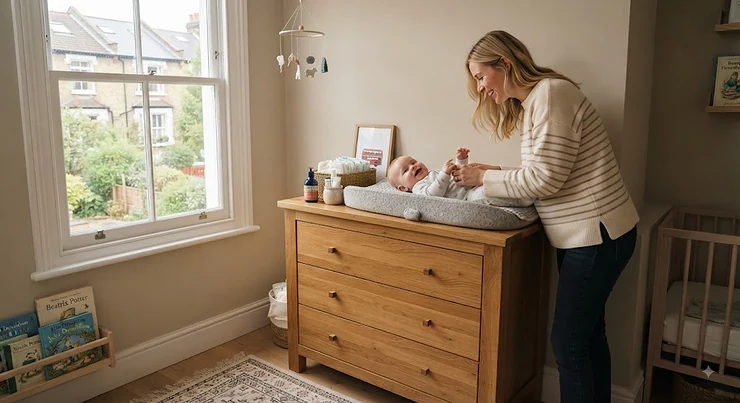
There’s a particular kind of nursery-shopping rabbit hole where you type “oak” into a search bar expecting warm, honest timber, and instead get served three different products that are all, technically, made of chipboard wearing an oak-patterned photograph. You’re not imagining it, and you’re not being paranoid — you’re just discovering that “oak” has become one of the most loosely applied words in furniture marketing. An oak changing dresser is a chest of drawers with a fitted or removable changing top, built either from genuine oak (solid or veneered) or from an oak-look finish over engineered board, designed to serve as both a practical baby-changing station and long-term bedroom storage. Getting the distinction right matters more than most first-time parents realise, and that’s exactly what this guide sorts out.

I’ve spent time digging into real, currently available UK nursery furniture, cross-referencing manufacturer specs against genuine aggregated review sentiment, so nothing here is a rewritten product description dressed up as advice. We’ll cover a solid wood changing dresser properly, look honestly at natural wood nursery furniture and why the label matters, settle the oak effect chest of drawers question, walk through the real solid wood vs MDF furniture trade-offs, talk about what makes heirloom nursery furniture worth the extra spend, and finish with genuinely useful wood finish maintenance advice most retailers never mention. Seven real products, every budget tier covered, and an honest verdict on when “oak effect” is a perfectly sensible choice rather than a compromise.
One quick grounding point before we start: UK nursery furniture, whatever the finish, still has to meet formal safety standards — changing units specifically fall under BS EN 12221, and any upholstered elements are covered by fire safety law. Style is a personal choice; compliance isn’t.
Quick Comparison Table
If you’re short on time, here’s the shape of the market before the detail.
| Product | Wood Type | Best For | Price Range |
|---|---|---|---|
| Obaby Stamford Sleigh Changing Unit (Oak) | Solid wood | Classic scroll-design budget-mid pick | £230-£280 |
| Tutti Bambini Rio Solid Wood Changing Unit (Slate Grey/Oak) | Solid wood | Popular all-rounder, removable top | £180-£230 |
| Tutti Bambini Modena Changer Dresser (White & Oak) | Solid wood + oak finish | Contemporary two-tone nurseries | £160-£210 |
| Obaby Nika Changing Unit (Oak) | Solid wood | Minimalist modern styling | £200-£250 |
| Oliver Furniture Wood 3 Drawer Nursery Dresser (Natural Oak) | Oak veneer + solid oak legs | Premium Scandinavian design | £450-£550 |
| Boori 3 Drawer Dresser with Changing Station | Solid wood | Heirloom-quality, long warranty | £350-£450 |
| Hallowood Newquay Oak Effect Chest of Drawers | Oak-effect MDF veneer | Budget general storage, pair with a changer topper | £100-£150 |
The pattern worth noticing straightaway: genuine solid oak or oak-veneered pieces sit in the £160-£550 range depending on brand and finish quality, while oak-effect MDF pieces like the Hallowood Newquay undercut them substantially but aren’t designed or safety-tested as standalone baby changers — more on that distinction below. If budget is tight, the Tutti Bambini Modena and Obaby Stamford deliver genuine solid wood construction without premium pricing; if you want a piece that’ll still be handsome furniture in fifteen years, look at the Oliver Furniture or Boori end of the table.
💬 Just one click — help others make better buying decisions too!😊
Top 7 Oak Changing Dressers: Expert Analysis
Every product below is real and currently available through UK retailers, chosen to cover budget, mid-range and premium buyers plus a genuinely useful oak-effect alternative most “top oak dresser” lists skip entirely.
1. Obaby Stamford Sleigh Changing Unit (Oak) — best classic scroll design at a fair price
The Stamford range’s signature curved sleigh silhouette and recessed handles give it a warmer, more traditional look than the boxy Scandinavian pieces later on this list, and it’s built from solid wood rather than an oak-effect laminate. Based on the spec comparison with simpler three-drawer units, the closed changing unit variant adds real practical value: three full-depth drawers sit alongside a full-height cupboard with an adjustable shelf and a soft-close door, giving you concealed storage for bulkier items like spare bedding that open-shelf changers can’t hide away. What most buyers overlook is the recessed top section, purpose-shaped to accommodate a standard changing mat up to roughly 76 x 46cm, so you’re not balancing a mat precariously on a flat surface. Reviewers consistently praise the sturdy feel of the drawers on their runners and the snag-free recessed handles, which matter more than they sound once toddlers start experimenting with fingers in gaps. Obaby backs the range with a free two-year guarantee once registered, a reasonable show of confidence for solid wood furniture at this price point.
Pros:
- ✅ Solid wood construction, not an oak-effect laminate
- ✅ Soft-close cupboard door plus three full-depth drawers
- ✅ Recessed top sized for a standard changing mat
Cons:
- ❌ Traditional scroll styling won’t suit a minimalist modern nursery
- ❌ Bulkier footprint than open-shelf changer alternatives
Expect a £230-£280 range depending on finish and retailer, making this a fair mid-range entry point into genuine solid wood nursery furniture.

2. Tutti Bambini Rio Solid Wood Baby Changing Unit (Slate Grey/Oak) — most popular all-rounder with a genuinely useful removable top
Tutti Bambini’s Rio range pairs a slate grey solid wood carcass with oak-toned drawer fronts, and the standout practical feature is the fully removable changing top — once your child outgrows nappy changes, you unbolt the top section and you’re left with a proper three-drawer chest rather than an obviously converted baby item. Reviewers consistently highlight the soft-close drawer runners, which genuinely do prevent the finger-trapping bangs that cheaper metal runners are prone to, and note the assembly, while inevitable with flat-pack nursery furniture, is more straightforward than average thanks to clearly labelled parts. Based on the spec comparison with the Modena below, the Rio’s three large full-length drawers offer slightly more storage volume, which matters if you’re consolidating clothing storage rather than running a separate wardrobe. What the spec sheet won’t tell you, but a fair number of owners mention, is that the drawer fronts show fingerprints and light marks more readily on the slate grey sections than the oak, so a quick wipe-down becomes part of the routine. This is the safest default recommendation on the list for buyers who want proven popularity alongside solid construction.
Pros:
- ✅ Removable changing top converts cleanly to a standard chest
- ✅ Soft-close drawer runners reduce trapped-finger risk
- ✅ Strong aggregated review sentiment on build quality
Cons:
- ❌ Slate grey panels show marks more visibly than the oak sections
- ❌ Assembly still requires a couple of hours and a second pair of hands
Priced around £180-£230, it represents strong value for a solid wood piece from an established UK nursery brand.
3. Tutti Bambini Modena Baby Changer Dresser (White & Oak) — best contemporary two-tone option on a tighter budget
The Modena swaps the Rio’s slate grey for crisp white, paired with the same warm oak finish across the top and drawer fronts, giving it a lighter, more contemporary feel that suits smaller or darker nurseries. Three spacious full-length drawers handle nappies, clothing and toys, while the chest-top changer format means no separate changing table eating into limited floor space. What most buyers overlook is that the oak finish here is applied to selected surfaces rather than running through the whole piece, which is precisely why it costs less than the Rio despite similar dimensions — an honest trade-off rather than a hidden flaw, provided you know what you’re buying. Aggregated review sentiment is positive on value for money specifically, with reviewers consistently comparing it favourably against pricier alternatives for what is, functionally, a very similar three-drawer changer. On paper this means the Modena is the pick for parents who want the coordinated white-and-oak nursery look without paying premium-brand prices for it.
Pros:
- ✅ Contemporary white and oak two-tone finish
- ✅ Three full-length drawers plus integrated chest-top changer
- ✅ Genuinely competitive pricing for a solid wood build
Cons:
- ❌ Oak finish is applied to selected surfaces, not the whole carcass
- ❌ Fewer configuration options than the wider Rio range
At roughly £160-£210, this is one of the most cost-effective genuine solid wood changers on the list.
4. Obaby Nika Changing Unit (Oak) — best minimalist styling for modern nurseries
Where the Stamford leans traditional, the Nika strips things back to clean lines and a simple oak finish with no scroll detailing or ornate handles, making it the pick for parents building a Scandi-minimalist or mid-century-inspired nursery rather than a classic one. It’s built from solid wood, and based on the spec comparison with the busier Stamford, the simpler design translates into a genuinely lighter unit that’s easier for one person to manoeuvre into position during setup. Reviewers consistently note the finish quality feels a step up from entry-level nursery furniture, with an even, low-sheen oak tone that photographs well and doesn’t clash with mixed-wood-tone nurseries the way high-gloss finishes can. What the spec sheet won’t tell you is that, like most minimalist designs, storage capacity is slightly more modest than boxier alternatives — there’s no integrated cupboard here, just drawers, so families needing to store bulky items like spare duvets may want additional storage elsewhere in the room.
Pros:
- ✅ Clean minimalist design suited to modern nurseries
- ✅ Solid wood build with an even, low-sheen oak finish
- ✅ Lighter and easier to position than bulkier alternatives
Cons:
- ❌ No integrated cupboard, drawers only
- ❌ Simpler design may feel plain next to more detailed ranges
At around £200-£250, it sits comfortably in the mid-range bracket and rewards buyers prioritising clean design over maximum storage.
5. Oliver Furniture Wood 3 Drawer Nursery Dresser (Natural Oak) — premium pick for genuine Scandinavian design credentials
This is the most design-led piece on the list, and it’s honest about its construction: the dresser and drawers are MDF veneered in oak, while the footing, hooks and side panels of the nursery top are made from white-oiled solid oak — a considered mix rather than a marketing dodge, since it puts solid timber exactly where structural strength matters most. Three wide storage drawers, each internally divided into two compartments, sit on genuinely high-quality soft-close runners, and real leather handles add a tactile, grown-up touch that most nursery furniture skips entirely. Based on the spec comparison with mainstream UK nursery brands, the build quality and design pedigree here justify a noticeably higher price, and reviewers consistently describe it as a piece that looks equally at home once repurposed as an adult chest of drawers, which matters enormously for anyone thinking about heirloom nursery furniture rather than disposable baby kit. When the changing top is no longer needed, it lifts away entirely, leaving a genuinely elegant piece of adult furniture behind rather than an obviously converted baby item.
Pros:
- ✅ Solid oak used precisely where structural strength matters
- ✅ Real leather handles and high-quality soft-close runners
- ✅ Designed to convert seamlessly into adult furniture long-term
Cons:
- ❌ Among the most expensive options on this list
- ❌ Longer delivery lead times than mainstream UK nursery brands
Expect a £450-£550 range, positioning this firmly as the design-conscious premium buy for parents planning to keep the piece well beyond the nursery years.

6. Boori 3 Drawer Dresser with Changing Station — best for genuine heirloom-quality longevity
Boori’s changing dresser range is constructed from sustainably sourced solid wood and finished with low-VOC, child-friendly paint rather than a sprayed veneer, and the changing station itself is a compartmented, removable attachment that bolts to the back of the dresser — unbolt it later and you’re left with a proper three-drawer chest, no visible baby-furniture giveaway remaining. What sets Boori apart from the mid-range brands above is the warranty backing its claims of longevity: a three-year manufacturer’s warranty as standard, extendable to five years, which is a meaningfully longer commitment than most nursery furniture makers offer and speaks directly to genuine heirloom nursery furniture positioning rather than just marketing language. Reviewers consistently highlight the fully extendable, deep drawers as noticeably more generous than competitor three-drawer units, useful as clothing volume grows through the toddler years. Based on the spec comparison with budget alternatives, the raised sides on the changing station and false-bottomed accessory compartment are thoughtful practical touches — the latter specifically protects the dresser surface from spilled creams and lotions, a problem that plagues flat-topped changers without that lip.
Pros:
- ✅ Solid wood with a three-year warranty, extendable to five
- ✅ Removable changing station leaves a genuine chest of drawers behind
- ✅ Deep, fully extendable drawers with generous capacity
Cons:
- ❌ Premium pricing reflects the premium positioning
- ❌ Changing station isn’t compatible with Boori’s Smart Assembly chest range
Priced around £350-£450, it’s a genuine investment, but the warranty length and build quality make a strong case for buyers thinking multi-generation use rather than a few nursery years.
7. Hallowood Newquay Oak Effect Chest of Drawers — best budget storage if you’re pairing it with a separate changing topper
This is the honest outlier on the list: an oak-effect chest built from MDF board with a real rattan drawer front, not solid wood or oak veneer, and not marketed or tested as a baby changing unit at all. Based on the spec comparison with the genuine changers above, what you’re buying here is affordable oak-look storage — three drawers on a light oak-effect finish — that some budget-conscious parents pair with a separate portable changing mat or a Boori-style changing tray attachment rather than an integrated changing top. What most buyers overlook is that this transparency actually matters: because it isn’t sold or safety-tested as a changing unit under BS EN 12221, using it as one without an appropriate separate changing surface isn’t something the manufacturer intends or has verified. Reviewers consistently praise the price-to-appearance ratio and the dovetail-jointed drawer construction for a budget MDF piece, with the rattan drawer fronts adding genuine visual texture that plain laminate alternatives lack. For a nursery on a tight budget where the oak look matters more than solid timber underneath, it’s a legitimately sensible buy — provided you’re clear-eyed about what it is.
Pros:
- ✅ Genuinely low price for an oak-look storage piece
- ✅ Real rattan drawer fronts add texture over plain laminate
- ✅ Dovetail-jointed drawer construction at this price is good value
Cons:
- ❌ Not sold or tested as a baby changing unit — pair with a separate mat
- ❌ MDF construction won’t match solid oak for long-term durability
At roughly £100-£150, it’s the clear budget pick for oak-look storage, with the honest caveat that it’s a chest first and a changer only with an added-on solution.
Wood Finish Maintenance: Keeping Your Oak Changing Dresser Looking New
Whatever finish you’ve chosen, wood finish maintenance is the bit most retailers gloss over in a single bullet point, and getting it wrong is the single most common reason a nursery piece looks tired within two years rather than lasting a decade. For lacquered or waxed solid oak, like the Obaby Stamford or Tutti Bambini Rio, dust with a soft, slightly damp cloth rather than anything abrasive, and avoid silicone-based furniture polishes, which build up a cloudy residue over oak’s open grain that’s genuinely difficult to remove later. Spills are inevitable in a nursery — nappy cream, baby oil, the occasional bottle mishap — so wipe them promptly rather than letting them sit, since oak’s natural porosity means liquids left too long can leave faint rings even through a lacquered finish.
For white-oiled oak like the Oliver Furniture dresser’s legs and hooks, an occasional light reapplication of a matching oil, roughly once or twice a year depending on handling, keeps the timber protected and stops it drying out or greying in patches. Veneered and oak-effect pieces, including the Hallowood Newquay, need less specialist care but are more vulnerable to swelling if water sits on the surface, so a prompt wipe-down matters even more than with solid wood. One optimisation trick that doesn’t appear on any assembly instructions: felt pads under anything placed on top of the dresser, from changing mats to storage baskets, prevent the fine scratches that accumulate invisibly over months and eventually dull an otherwise pristine finish.

Heirloom Nursery Furniture: Buying a Piece That Lasts Generations
Heirloom nursery furniture is a genuinely different buying decision from “furniture for the next two years,” and it’s worth being honest with yourself about which category you’re actually shopping in before you commit budget. Consider three realistic buyer profiles. First, parents expecting their first child who intend to have more children and want one dresser to serve multiple nurseries over a decade or more — here, the Boori 3 Drawer Dresser or Oliver Furniture Wood 3 Drawer Dresser make more financial sense than they first appear, since the cost amortises across several children and both pieces are explicitly designed to shed their “baby furniture” identity once the changing top comes off.
Second, parents furnishing a nursery on a tighter budget who know realistically they’ll want different furniture once changing days are over — for this group, a mid-range solid wood piece like the Tutti Bambini Modena or Obaby Nika delivers genuine quality without over-investing in longevity you won’t use. Third, grandparents or family members buying a nursery gift with the explicit intention of it becoming a family piece passed between grandchildren — this is where the extra spend on the Oliver Furniture dresser’s leather handles and considered oak detailing earns its keep most clearly, since the piece is designed from the outset to read as adult furniture rather than nursery kit that’s merely been de-babified.
Growing With Your Child: From Changing Dresser to Chest of Drawers
The single most useful feature across every genuinely well-designed oak changing dresser on this list is a changing top that comes off cleanly, and it’s worth understanding the practical sequence before you buy rather than discovering it by accident later. In the first year, the dresser works exactly as marketed: a changing surface with drawer storage beneath for nappies, vests and immediate essentials. Around the twelve-to-eighteen-month mark, most parents transition away from a raised changing surface as toddlers become too mobile and wriggly to safely change at height — this is where a genuinely removable top, like the ones on the Tutti Bambini Rio, Boori and Oliver Furniture pieces, pays off, since unbolting a handful of screws leaves a proper chest of drawers rather than an oddly-shaped piece with an obvious redundant lip.
From toddlerhood onward, the same piece typically migrates to storing clothes, toys or bedding, and by the time a child is old enough for their own bedroom furniture, a genuinely solid wood dresser has usually earned its keep well beyond the initial nursery cost. This is precisely the calculation that makes solid wood or oak veneer construction worth the premium over oak-effect MDF for anyone planning multi-year use — MDF construction can develop swelling or delamination at drawer joints under years of daily opening and closing, where solid timber simply doesn’t.
How to Choose an Oak Changing Dresser
Choosing the right oak changing dresser comes down to six honest questions, roughly in order of importance:
- Is it genuinely solid wood, oak veneer, or oak effect? Check the product description for “solid oak,” “oak veneer” (a thin layer of real oak over engineered board), or “oak effect” (a printed or laminated finish with no real oak at all) — all three are legitimate choices, but the price and durability should match what you’re actually buying.
- Does the changing top come off cleanly? A removable top, like the Tutti Bambini Rio‘s, extends the piece’s useful life well past the changing years.
- How much storage do you actually need? A cupboard-and-drawer combo like the Obaby Stamford suits bulkier storage needs; a drawers-only design like the Obaby Nika suits smaller nurseries.
- What’s your realistic budget band? Oak-effect MDF pieces like the Hallowood Newquay start around £100-£150; genuine solid wood mid-range options run £160-£280; premium heirloom-grade pieces sit at £350-£550.
- Does it meet BS EN 12221? Confirm any dedicated changing unit is tested to this UK standard before buying, particularly with lesser-known or marketplace-only brands.
- Do you want it to outlive the nursery years? If so, prioritise solid wood or genuine veneer construction and a cleanly removable changing top over oak-effect finishes.
Solid Wood vs MDF Furniture: The Honest Breakdown
This is the trade-off underpinning almost every decision on this list, and it deserves a straight answer rather than blanket “solid wood is always better” advice, because that isn’t quite true. Solid wood — as used throughout the Obaby Stamford, Tutti Bambini Rio and Boori dresser — is a single material through and through, which means it can be sanded, refinished and repaired if scratched or dented, and it tends to age gracefully, developing character rather than simply wearing out. MDF (medium-density fibreboard) is manufactured by binding wood fibres with resin under heat and pressure, and modern MDF, as used in the Hallowood Newquay, is dimensionally stable, resists warping better than solid wood in humidity-prone rooms, and takes veneers and paint finishes more evenly than raw timber.
Where solid wood pulls ahead decisively is longevity under repeated mechanical stress — drawer runners, joints and hinges anchored into solid timber hold up better over a decade of daily use than the same fixings screwed into engineered board, which can strip out over time. Where MDF genuinely wins is consistency and cost: it doesn’t have knots, grain variation or the risk of warping that solid oak occasionally shows, and it’s considerably cheaper to manufacture, which is reflected honestly in the price gap between the Hallowood Newquay and the solid wood options above it. The pragmatic verdict: for a dresser you expect to use hard for years and potentially pass on, solid wood earns its premium; for budget-conscious buyers wanting the oak look with realistic expectations about lifespan, MDF with an oak-effect finish is a legitimate choice, not a lesser one.

Oak Effect Chest of Drawers vs Solid Oak: Which Should You Buy?
An oak effect chest of drawers, like the Hallowood Newquay, uses a printed or laminated finish designed to visually mimic oak’s grain and colour over an MDF or particleboard base, while solid oak is genuine timber throughout. Visually, at arm’s length, modern oak-effect finishes have become remarkably convincing — the gap that matters is tactile and long-term, not immediately visible in a showroom or product photo. Run a hand across genuine oak and you’ll feel the grain’s texture; oak effect is smooth and uniform, since it’s a printed layer rather than a natural material with variation between pieces.
The practical calculation comes down to how the piece will be used and for how long. For a chest of drawers that’s primarily storage, sees moderate daily handling, and doesn’t need to double as a structurally demanding changing station, oak effect is a sound, honest budget choice — the Hallowood Newquay delivers genuine drawer functionality and a convincing look for a fraction of solid oak pricing. For a piece that’ll be opened and closed multiple times daily for years, potentially bear a toddler’s climbing attempts, and ideally outlast the nursery entirely, genuine oak — solid or veneered, as in the Tutti Bambini and Oliver Furniture pieces — earns its higher price through durability oak effect simply can’t match over the long run.
Solid Wood Changing Dresser: What to Check Before You Buy
A genuinely solid wood changing dresser should tick several specific boxes that separate it from furniture merely described as “wood” in marketing copy, and checking these before purchase avoids a common and expensive mistake. First, look for explicit confirmation in the specification — “solid oak,” “solid pine,” or similarly specific wood species — rather than the vaguer “wood” or “wooden” that can legally describe anything with a wood-derived component, including MDF. Second, check whether the description distinguishes between the main carcass and secondary elements; several premium pieces, including the Oliver Furniture dresser, deliberately combine oak veneer panels with solid oak structural elements, which is honest engineering rather than a downgrade, but worth knowing before you assume the entire piece is solid timber.
Third, verify the changing top specifically — some ranges use solid wood for the drawer chest but a composite or laminated top for the changing surface, which is a sensible design choice given the top gets wiped down constantly, but again worth knowing rather than assuming. Fourth, check the drawer runner mechanism, since soft-close metal runners, as fitted to the Tutti Bambini Rio, generally outlast the wooden runners found on some budget “solid wood” ranges regardless of how genuine the timber itself is. Finally, confirm BS EN 12221 compliance is stated explicitly for the changing function specifically, not just general furniture safety marks, since — as covered above with the Hallowood Newquay — not every attractive oak-look chest is designed or tested as a baby changer.
Natural Wood Nursery Furniture: Why It Matters Beyond Looks
Natural wood nursery furniture carries genuine practical advantages beyond the aesthetic warmth most parents are chasing when they search for it. Solid and veneered timber pieces, unlike some budget engineered-board alternatives, are generally lower in volatile organic compound emissions once properly finished, which matters more in a nursery than almost any other room in the house given how much time a newborn spends there. Reviewers and manufacturers alike, including Boori’s use of low-VOC, child-friendly paint finishes, consistently position this as a deliberate selling point rather than an incidental benefit, and it’s a reasonable thing to prioritise if you’re choosing between otherwise similar pieces.
Sourcing matters here too. Furniture bearing FSC certification confirms the timber has been independently verified as coming from responsibly managed forests, tracked through the entire supply chain from forest to finished product — worth checking for specifically if sustainable sourcing factors into your decision, since not every “natural wood” product on the market carries this independent verification despite implying an eco-conscious story. Beyond the environmental case, natural wood nursery furniture also tends to hold its resale or hand-me-down value considerably better than painted MDF equivalents, since genuine timber can be lightly sanded and refreshed rather than simply looking tired once the original finish wears through.
Common Mistakes When Buying an Oak Changing Dresser
The most common mistake is assuming any product with “oak” in the name is genuinely solid timber, when — as covered above — the word legally and commercially covers everything from solid oak through oak veneer to purely printed oak-effect finishes. A close second is buying based on nursery photography alone without checking dimensions against the actual room, which catches out more parents than you’d expect with the Obaby Stamford‘s bulkier cupboard-and-drawer footprint specifically, since photos rarely convey how much floor space a full-height cupboard section actually occupies. Third, some buyers skip checking whether the changing top is removable at all, assuming all changers convert to chests later, when a genuinely fixed or non-standard top can leave you with an awkward half-converted piece once changing days are over.
A fourth mistake worth flagging: underestimating assembly complexity and time, particularly for cupboard-and-drawer combination units, which reviewers consistently note take considerably longer than simple three-drawer designs — budget a proper afternoon rather than an hour before your baby arrives, not after. Finally, plenty of buyers overlook wood finish maintenance entirely at purchase time, not realising that oiled or waxed solid wood finishes need periodic care to look their best years down the line, unlike lacquered or laminated surfaces that are genuinely lower-maintenance by design.
Safety, Regulations & Compliance: What UK Standards Cover
UK changing units for domestic use fall under BS EN 12221, which sets general safety requirements and structural performance tests specifically for changing units, covering both freestanding pieces and cot-top mounted changers, and applies to children up to roughly 15kg in body weight. It’s worth noting explicitly that this standard covers the changing function specifically — where a changing top or tray is removable and sits atop separate storage furniture, as with several products on this list, further testing considerations apply to that combination, which is precisely why the Hallowood Newquay‘s honesty about not being sold as a changing unit matters rather than being a minor technicality.
Separately, any upholstered elements in nursery furniture — padded changing mats sold as part of a set, for instance — fall under the Furniture and Furnishings (Fire) (Safety) Regulations, amended most recently in 2025, which set flammability standards for domestic upholstered items including nursery furniture specifically. When buying, look for explicit compliance statements from the manufacturer rather than assuming any UK-sold product automatically meets every relevant standard — reputable brands including Obaby, Tutti Bambini and Boori state their compliance clearly in product documentation, which is a good general marker of a manufacturer taking the regulatory side seriously rather than treating it as an afterthought.
Long-Term Cost & Value: Is Solid Oak Worth the Extra Cost?
Run the maths over a realistic ownership period and the value case for solid wood becomes clearer than the sticker price alone suggests. A budget oak-effect piece like the Hallowood Newquay, at roughly £100-£150, delivers genuine value if you’re planning three to four years of use before replacing bedroom furniture entirely — the cost per year of ownership is low, and MDF construction is genuinely fine for that timeframe under normal domestic use. A mid-range solid wood piece like the Tutti Bambini Rio or Obaby Nika, at £180-£250, costs more upfront but with a removable changing top realistically serves ten-plus years as first a changer, then a bedroom chest, then potentially a second child’s nursery, which meaningfully lowers the effective annual cost despite the higher initial outlay.
At the premium end, the Oliver Furniture and Boori pieces, running £350-£550, only make clear financial sense if you’re genuinely planning heirloom-length use — multiple children, or an explicit intention to hand the piece down — since the price premium over mid-range solid wood options reflects design pedigree and warranty length more than dramatically superior core materials. The honest verdict: solid oak is worth the extra cost specifically when you can articulate why you need multi-decade durability; for shorter, more typical single-nursery use, a well-reviewed mid-range solid wood piece or even an honest oak-effect budget option both represent sound value.
| Finish Type | Typical Price Range | Realistic Lifespan | Best For |
|---|---|---|---|
| Oak-effect MDF (e.g. Hallowood Newquay) | £100-£150 | 3-5 years | Budget nurseries, shorter-term use |
| Solid wood, mid-range (e.g. Tutti Bambini Rio) | £160-£280 | 10+ years | Most families wanting genuine longevity |
| Oak veneer with solid elements (e.g. Oliver Furniture) | £450-£550 | 15+ years | Design-led, heirloom-intent buyers |
| Solid wood, premium warranty (e.g. Boori) | £350-£450 | 15+ years | Multi-child use, longest manufacturer backing |
Looking at the table above, the jump from oak-effect to mid-range solid wood delivers the biggest proportional improvement in realistic lifespan for the money, which is why that tier is where most reviewers and this guide alike point undecided first-time buyers. The jump from mid-range to premium buys design refinement and warranty length rather than a comparable leap in core durability, so it’s worth choosing that tier deliberately rather than by default.
Frequently Asked Questions
❓ What is an oak changing dresser and how is it different from a regular dresser?
❓ Is solid oak better than oak effect for a changing dresser?
❓ How do I maintain the wood finish on an oak changing dresser?
❓ Can I use an oak changing dresser as a normal chest of drawers later?
❓ Is solid wood or MDF furniture better for a nursery?
Conclusion
An oak changing dresser sits right at the intersection of two things new parents care about — genuine daily practicality and a piece of furniture that doesn’t scream “nursery” the moment changing days are over — and getting the wood type right matters more than most retailers make clear. Budget buyers do well with the honestly-marketed Hallowood Newquay Oak Effect Chest, provided a separate changing surface comes with it; most families land happily on genuine solid wood mid-range picks like the Tutti Bambini Rio or Obaby Nika; and anyone thinking in terms of heirloom nursery furniture, multiple children, or simply wanting the best possible longevity should look hard at the Oliver Furniture or Boori dressers. Whatever tier you choose, check the wood type is stated explicitly, confirm the changing top removes cleanly, and build a little wood finish maintenance into your routine from day one — it’s the difference between furniture that looks tired in two years and a piece still earning its keep a decade on.
Recommended for You
- White Changing Dresser: 7 Best Picks for 2026 Nurseries
- Removable Top Changing Dresser: 7 Honest UK Picks for 2026
- Chest of Drawers with Changer vs Standalone Changing Table: 7 Picks
Disclaimer: This article contains affiliate links. As an Amazon Associate, I earn from qualifying purchases. If you purchase products through these links, we may earn a small commission at no additional cost to you.
✨ Found this helpful? Share it with your friends! 💬🤗
