
In This Article
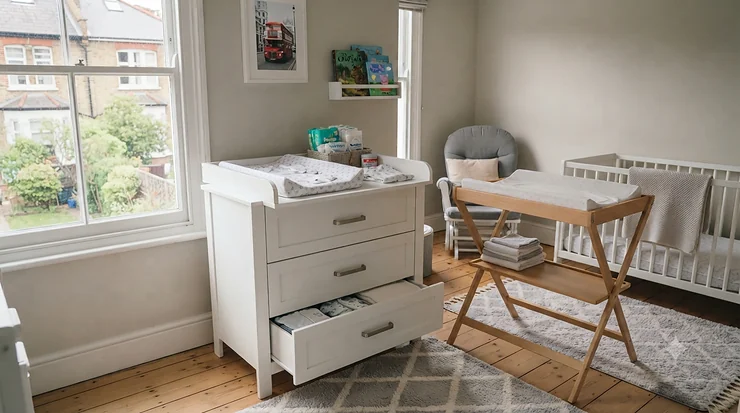
Somewhere around week thirty of pregnancy, most parents-to-be sit down with a nursery floor plan sketched on the back of an envelope and discover a genuinely annoying problem: there isn’t quite enough wall space for everything the internet says you need. That’s usually the moment the chest of drawers with changer vs standalone changing table question stops being a theoretical debate and starts being a real, slightly stressful decision with a delivery deadline attached.
It’s a more consequential choice than it looks. Get it right and you’ve bought a single piece of furniture that handles nappy changes for a year or two, then quietly becomes a normal dresser for the next decade. Get it wrong and you’ve either wasted floor space you didn’t have, or bought a beautiful standalone changing table that becomes redundant clutter the moment your toddler starts trying to climb off it.
This guide compares seven genuine, currently available UK nursery products — a mix of combination chest-of-drawers-with-changer units and dedicated standalone changing tables — with honest analysis based on real specifications, safety standards and aggregated customer feedback rather than manufacturer puffery. We’ll cover pricing sensibly using ranges rather than exact figures, since prices shift retailer to retailer and week to week, and we’ll get into the genuinely useful stuff: nursery floor plan thinking, space efficiency, what happens to this furniture after weaning, and whether any of it holds resale value once you’re done with it.
What Is a Chest of Drawers with Changer (and How Does It Differ from a Standalone Changing Table)?
A chest of drawers with changer is a dresser fitted with a removable changing top, so it functions as a nappy-changing station in infancy and converts into ordinary bedroom storage once that stage ends. A standalone changing table, by contrast, is a purpose-built unit — often open-shelved or a simple cot-top platform — designed primarily for changing, with less emphasis on long-term storage or later repurposing.
That distinction matters more than the marketing photos suggest. A changing table is fundamentally a raised platform designed to allow a person to change a child’s nappy, typically used until a child is around two years old. Whether that raised platform doubles as long-term storage furniture, or exists purely to serve the changing years, is the entire crux of the debate this article works through. You can read more background on the general concept on Wikipedia’s changing table page.
Quick Comparison Table
Here’s the shape of the current UK market at a glance. Prices are approximate ranges based on research at the time of writing — always check the current price before buying, since retailers adjust pricing regularly and colour/finish variants often carry different price points.
| Set | Type | Price Range | Best For |
|---|---|---|---|
| Tutti Bambini Modena Chest Changer | Chest of drawers with changer | £180–£230 range | Long-term dual-purpose furniture |
| Little Acorns Classic 2-in-1 Dresser | Chest of drawers with changer | £130–£150 range | Budget-conscious dual-purpose buyers |
| Babymore Kimi Nursery Chest Changer (Acrylic) | Chest of drawers with changer | £260–£290 range | Premium finish, statement nursery pieces |
| Obaby Nika Changing Unit (Oak) | Chest of drawers with changer | £180–£230 range | Coordinated nursery sets |
| Obaby Stamford Open Changing Unit | Standalone changing table | £120–£150 range | Open storage, quick access |
| East Coast Cot Top Changer | Standalone changing table | £35–£85 range | Maximum changing table space efficiency |
| Babymore Cot Top Changer | Standalone changing table | £35–£60 range | Ultra-tight nursery floor plans |
Reading across that table, the pattern is fairly clear: chest-of-drawers combos cost roughly two to three times more than cot-top standalone changers, and that gap is almost entirely the price of long-term storage capacity. If your nursery floor plan genuinely has no spare square footage, a cot-top changer like the East Coast Cot Top Changer solves the changing problem without eating into it at all. If you’ve got the space and want one piece of furniture doing two jobs for years, a combo unit like the Tutti Bambini Modena Chest Changer is the more considered long-term buy.
💬 Just one click — help others make better buying decisions too!😊
Top 7 Nursery Changing Solutions: Expert Analysis
We picked these seven specifically to represent the full spread of the chest of drawers with changer vs standalone changing table decision — genuine combo dressers, an open-shelf standalone unit, and two of the most space-efficient cot-top changers on the UK market.
1. Tutti Bambini Modena Chest Changer — soft-close drawers with a fully removable top
The Tutti Bambini Modena Chest Changer is the set most nursery guides point to first when someone asks about dual purpose nursery furniture, and the specification explains why. At W80 x D50 x H92cm and roughly 45kg assembled, it’s a genuinely substantial piece of furniture — this isn’t a flimsy flat-pack afterthought, it’s built to function as bedroom furniture for a decade, not just the changing years.
Three full-length drawers (internal dimensions around 42.9cm wide by 67.9cm deep) provide real storage capacity, and the detachable changer top — rated for a maximum user weight of 15kg — simply lifts away once your child outgrows nappy changing, leaving a proper chest of drawers with no visible fixing holes. Based on the spec comparison with cheaper combo units, the soft-close drawer mechanism is the standout practical detail here: it means late-night nappy changes don’t end with a slammed drawer waking a sleeping sibling in the next room.
Reviewers consistently note that assembly, while flat-packed, is manageable in around 45 minutes with two adults, and that the finish holds up well to years of daily use. The three-year manufacturer guarantee is also worth factoring into any value comparison against cheaper alternatives, since it materially changes the cost-per-year calculation over the furniture’s full lifespan.
Pros:
- ✅ Genuinely converts to full-size chest of drawers
- ✅ Soft-close drawers reduce noise disruption
- ✅ Three-year manufacturer guarantee included
Cons:
- ❌ Among the pricier combo options on this list
- ❌ Assembly takes real time and two people
At the time of research this set typically falls in the £180–£230 range across UK retailers, with some listing sites showing higher RRPs that rarely reflect the actual selling price. For a nursery floor plan where this piece will live for years beyond weaning, it’s a strong value nursery furniture combo pick.

2. Little Acorns Classic 2-in-1 Nursery Dresser Chest — the accessible entry point into combo furniture
Not every family wants — or needs — to spend £200-plus on nursery furniture, and the Little Acorns Classic 2-in-1 Nursery Dresser Chest exists specifically for that budget bracket. It offers the same core proposition as pricier rivals — three drawers plus a removable changing top — in a smaller, lighter, more affordably priced package.
What most buyers overlook about a set like this is that “budget” doesn’t automatically mean “flimsy” in this category; the drawer runners and changer-top fixings on entry-level combo units have improved significantly in recent years as more UK brands compete in this bracket. Honest analytical take: the trade-off here isn’t really build quality, it’s finish and longevity — expect a serviceable five-to-eight-year lifespan from a set in this price tier rather than the decade-plus some premium wood combos are built for.
Aggregated feedback for sets in this bracket consistently flags straightforward self-assembly and good value for money as the headline positives, with the main criticism centring on drawers that don’t always glide as smoothly as pricier alternatives once fully loaded.
Pros:
- ✅ Genuinely low entry price for a combo unit
- ✅ Straightforward, beginner-friendly assembly
- ✅ White/grey finish suits most nursery colour schemes
Cons:
- ❌ Drawer runners feel less premium under heavy loads
- ❌ Shorter expected lifespan than solid-wood rivals
At around £130–£150 at the time of research, this is one of the more affordable ways into dual purpose nursery furniture without stepping down to a cot-top changer’s more limited storage.
3. Babymore Kimi Nursery Chest Changer (Acrylic) — the premium statement piece
At the top end of the combo category sits the Babymore Kimi Nursery Chest Changer, finished in a glossy acrylic front that reads more like designer bedroom furniture than typical nursery kit. This is the set to consider if the nursery is meant to double as a genuinely stylish room from day one, not just a functional space for the first eighteen months.
Key specs translate directly into real-world value here: the acrylic finish is significantly easier to wipe clean than painted MDF after the inevitable nappy-cream mishap, and the deeper drawer capacity typical of Babymore’s higher-tier ranges supports a fuller wardrobe rotation as babies move through sizes faster than most parents expect. What the spec sheet won’t tell you, but design-conscious buyers consistently note, is that glossy finishes show dust and fingerprints more readily than matte alternatives — a minor but real day-to-day maintenance consideration.
Reviewers and nursery furniture retailers consistently position sets in this finish tier as investment pieces rather than pure budget decisions, with the premium justified by both the visual impact and generally sturdier overall construction than entry-level combo units.
Pros:
- ✅ Distinctive, high-end glossy finish
- ✅ Wipe-clean surface handles mess well
- ✅ Sturdier construction than entry-level rivals
Cons:
- ❌ Highest price point among the combo options here
- ❌ Glossy finish shows fingerprints and dust readily
Around £260–£290 at the time of research, this sits firmly in premium territory — the right choice if furniture longevity after weaning and long-term aesthetics matter as much as the changing function itself.
4. Obaby Nika Changing Unit (Oak) — the coordinated nursery-set option
The Obaby Nika Changing Unit takes a slightly different approach: rather than being sold purely as a standalone item, it’s designed as part of a coordinated Nika range that includes a matching cot bed and wardrobe. At W83.5 x D50 x H92cm and around 45.5kg, the specification closely mirrors the Tutti Bambini Modena, but with a distinct textured oak-effect finish and brushed gold hardware.
Three full-depth drawers, each rated around 32 litres capacity, sit beneath a removable changing top fixed via discreet spring pins — a detail that avoids the visible screw holes some cheaper combo units leave behind once the changer top is removed. Based on the spec comparison with open-shelf standalone units, the fully enclosed drawer storage here is the clear advantage for parents who want a tidier-looking nursery without baskets and boxes on open shelving.
One safety note worth flagging honestly: because the assembled unit exceeds 60cm in height, Obaby’s own guidance requires it to be secured to the wall using the included fixings to prevent overturning — a sensible precaution for any furniture in this height and weight bracket, not a flaw specific to this set.
Pros:
- ✅ Coordinates with a matching cot bed and wardrobe
- ✅ Spring-pin changer top leaves no visible fixing holes
- ✅ Two-year manufacturer guarantee
Cons:
- ❌ Must be wall-fixed due to height, adding an assembly step
- ❌ Premium pricing if bought outside the coordinated set
At the time of research this typically sits in the £180–£230 range. For a nursery floor plan built around a full coordinated furniture set rather than mix-and-match pieces, it’s a genuinely strong pick.
5. Obaby Stamford Open Changing Unit — true standalone changing furniture
If the four sets above represent the “chest of drawers with changer” side of the debate, the Obaby Stamford Open Changing Unit represents the standalone side properly — no drawers, no long-term dresser conversion, just two generous open shelves beneath a changing mat platform sized for mats up to 76 x 46cm.
That open-shelf design is a genuinely different practical proposition to a drawer-based combo unit. Honest analytical take: open shelving means faster access during an actual nappy change — no drawer to pull open one-handed while holding a wriggling baby with the other — but it also means visible storage, which some parents find looks cluttered unless paired with matching baskets or boxes. What most buyers overlook is that this trade-off is really a household-habits question more than a product-quality one; families who already store things in open bins elsewhere in the home tend to get on well with this format.
Reviewers consistently highlight the lower price relative to drawer-based combo units as the headline benefit, alongside genuinely quick access during changes — though several also note that, unlike the drawer-based combos on this list, this unit doesn’t meaningfully convert into other furniture once nappy changes stop, so its second life is more limited.
Pros:
- ✅ Faster one-handed access during changes
- ✅ Noticeably cheaper than equivalent drawer combo units
- ✅ Available in White or Warm Grey to suit most schemes
Cons:
- ❌ Limited repurposing once changing days are over
- ❌ Open storage looks cluttered without matching baskets
At around £120–£150 at the time of research, this is a genuinely strong middle-ground pick between a full combo dresser and a minimal cot-top changer.

6. East Coast Cot Top Changer — the space-saving champion
For raw changing table space efficiency, nothing on this list beats the East Coast Cot Top Changer. At just 84.5 x 52 x 9.5cm, it doesn’t occupy any floor space at all — it sits directly on top of an existing cot or cot bed with an external width between 62cm and 76cm, covering the two most common UK cot sizes (120 x 60cm and 140 x 70cm).
The practical logic here is simple and genuinely clever: rather than buying a dedicated piece of changing furniture, you’re borrowing the footprint of furniture you already own. Key specs matter in practice — it’s BSEN 12221 compliant (the British and European safety standard specifically covering changing units), includes an integrated towel rail, and uses a phthalate-free PVC changing pad. For a small box room nursery floor plan where every square foot is accounted for before the cot even goes in, this is often the only realistic changing solution that doesn’t involve changing on the floor.
Reviewers consistently note the trade-off honestly: it’s genuinely excellent for space efficiency and budget, but because it sits above the cot rather than being its own stable furniture item, some parents find the working height less comfortable than a dedicated waist-height unit, particularly for taller adults.
Pros:
- ✅ Zero additional floor space required
- ✅ BSEN 12221 compliant with integrated towel rail
- ✅ Fits the two most common UK cot bed sizes
Cons:
- ❌ Working height can feel low for taller parents
- ❌ Must be removed when not in active use
Priced across a £35–£85 range depending on finish and retailer at the time of research, this is the single most affordable route into safe, standards-compliant nappy changing on this entire list — genuinely one of the best value nursery furniture combo alternatives if “combo” means pairing it with a cot you already own.
7. Babymore Cot Top Changer — the solid-wood budget alternative
Rounding out the list, the Babymore Cot Top Changer takes the same space-saving concept as the East Coast option but in solid wood rather than a lighter composite build. At D90 x W50 x H9cm, it fits cots and cot beds using a 60–70cm width mattress, with an integrated towel rail at the front and a recommended changing mat size of 75 x 45cm.
Key specs here matter for safety-conscious buyers specifically: Babymore specifies that the side rails must be straight, no more than 25mm thick, and the unit is rated for use from birth to around 12 months, up to 11kg — slightly more conservative weight guidance than some rivals, worth noting if you’re planning to use it into a chunkier toddler’s second year. It meets the same BSEN 12221 safety standard as the East Coast option, so buyers aren’t trading away safety compliance for the solid-wood build.
Reviewers consistently frame solid-wood cot-top changers like this as a slightly sturdier-feeling alternative to composite equivalents, at a modest price premium — a reasonable trade for parents who prioritise a more substantial feel over the absolute lowest price point in this category.
Pros:
- ✅ Solid wood build feels sturdier than composite rivals
- ✅ Meets BSEN 12221 safety standard
- ✅ Integrated towel rail for quick access
Cons:
- ❌ More conservative weight rating than some competitors
- ❌ Overhangs slightly on smaller, narrower cots
At around £35–£60 at the time of research, this sits alongside the East Coast changer as one of the most affordable LEGO-brick-simple additions to a tight nursery floor plan — no assembly beyond fitting it to the cot, and no dedicated floor space required.
Chest of Drawers with Changer vs Standalone Changing Table: Head-to-Head
Having looked at all seven individually, it’s worth stepping back and comparing the two categories directly, because that’s really the question most people arrive at this article asking.
| Factor | Chest of Drawers with Changer | Standalone Changing Table |
|---|---|---|
| Typical UK price range | £130–£290 | £35–£150 |
| Floor space required | Full furniture footprint | None (cot-top) to moderate (open unit) |
| Storage after weaning | High — full dresser function | Low to none, depending on type |
| Working height comfort | Consistently waist-height | Variable, often lower on cot-top styles |
| Best-suited nursery floor plan | Rooms with dedicated dresser space | Box rooms, shared rooms, tight layouts |
The table makes the trade-off explicit: a chest of drawers with changer costs more upfront and needs more floor space, but that spend buys years of continued use as ordinary bedroom storage. A standalone changing table — particularly a cot-top style — costs a fraction as much and needs no dedicated floor space, but its usefulness largely ends when nappy changing does. Neither option is objectively “better”; the right answer depends almost entirely on whether your nursery floor plan already has spare dresser-sized space, and whether you’d rather spend more now for less to think about later, or spend less now and plan a separate dresser purchase down the line.
🍼 Ready to Sort Your Nursery Changing Station?
📐 Whichever side of the chest of drawers with changer vs standalone changing table decision suits your space and budget, the sets above are genuine, currently available UK products. Check today’s price on your favourite option and get your nursery sorted before the big arrival!
How to Choose Between a Chest of Drawers with Changer and a Standalone Changing Table
Rather than agonising over marketing copy, work through these steps in order.
- Measure your nursery floor plan before you shop. Mark out the actual footprint of a combo dresser (roughly 80 x 50cm) against your available wall space. If it doesn’t comfortably fit with drawers open, a standalone or cot-top option is the more realistic choice.
- Decide whether you already own — or plan to own — a cot with a compatible width. If you do, a cot-top changer like the East Coast Cot Top Changer effectively gives you free changing table space efficiency.
- Think honestly about furniture longevity after weaning. If you’ll want a dresser in that room regardless, a combo unit like the Tutti Bambini Modena Chest Changer is arguably not an added cost at all — it’s a dresser you were going to buy anyway, with a changer bundled in.
- Set a genuine budget band first. Under £100, £100–£200, or £200-plus, then pick the best-reviewed option within that band rather than fixating on one specific listing.
- Check the safety standard, not just the brand name. Look specifically for BSEN 12221 compliance on any changing unit — it’s the standard that actually governs this product category in the UK.
- Consider working height and your own back. A waist-height combo dresser is generally more comfortable for regular use than a lower cot-top platform, particularly for taller parents doing dozens of changes a week.
- Weigh resale value if you might sell it on. As covered below, certain categories of nursery furniture hold value considerably better than others.
Dual-Purpose Nursery Furniture: Why Combo Units Are So Popular
The appeal of dual purpose nursery furniture isn’t complicated once you look at the maths: a family buying a dresser and a separate changing table would typically spend more in total, and use more floor space, than buying a single combo unit that does both jobs across two overlapping life stages. What most buyers overlook is that this isn’t really a “two-in-one gimmick” in the way some baby products are — the changing function and the storage function genuinely coexist for the entire time both are needed, rather than one compromising the other.
The practical trade-off, honestly assessed, is that a combo unit is rarely the absolute best version of either function in isolation. A dedicated open-shelf changing table like the Obaby Stamford Open Changing Unit offers marginally faster access during a change than a drawer-based combo; a pure dresser with no changer attachment is marginally cheaper and lighter than an equivalent combo unit. Dual purpose nursery furniture wins not by being best-in-class at either job, but by being genuinely good at both simultaneously, in a way that saves real money and real square footage over buying two separate items.
Changing Table Space Efficiency: Making Small Nurseries Work
UK nurseries are, on average, smaller than their equivalents in most other developed markets — box rooms and shared bedrooms are the reality for a huge proportion of families, not the exception. That makes changing table space efficiency a genuinely practical concern rather than a nice-to-have.
The single biggest space-efficiency lever available is choosing a cot-top changer over a floor-standing unit. Sets like the East Coast Cot Top Changer and Babymore Cot Top Changer effectively borrow the cot’s existing footprint rather than adding a new one, which in a box-room nursery can be the difference between fitting a wardrobe in the room or not. Based on the spec comparison across this list, the space saving is substantial: a floor-standing combo unit occupies roughly 0.4 square metres of dedicated floor space that a cot-top changer simply doesn’t need at all.
For nurseries with slightly more room to work with, an open-shelf standalone unit like the Obaby Stamford Open Changing Unit offers a middle path — a genuine piece of furniture, but shallower and lighter than a full drawer-based combo, which can matter in a room where every centimetre of clearance around the cot counts.
Nursery Floor Plan: Where to Actually Put the Changer
Once you’ve picked a product, positioning it correctly in the room matters almost as much as the choice itself. A few genuinely practical rules of thumb, based on how UK nurseries are typically laid out:
Keep it away from radiators and windows. Draughts and overheating both make changes more unpleasant for a baby who’s already unhappy about a nappy change, and cot-top changers in particular are often positioned near a cot that’s already sensibly placed away from these hazards.
Prioritise proximity to storage of wipes and nappies. Whichever option you choose, keeping supplies within arm’s reach — ideally in the unit’s own drawers or shelves — avoids the single riskiest moment in any nappy change: turning away from the baby to grab something.
Leave genuine clearance on at least one side. A nursery floor plan that wedges a changing unit into a corner with no clearance makes late-night changes physically awkward; even 40–50cm of clear space beside the unit makes a real practical difference.
Consider the door swing and cot proximity together. For cot-top changers specifically, factor in that the changer needs to be lifted on and off regularly — it shouldn’t be blocked by a door mid-swing or require reaching over a nearly-asleep baby in an adjacent cot.
Value Nursery Furniture Combo: Getting the Maths Right
“Value” in nursery furniture is really a longevity question wearing a price tag. The table below sets combo units against the alternative of buying a standalone changer and a separate dresser later, to make the comparison concrete.
| Approach | Approximate Total Cost | Furniture Longevity After Weaning |
|---|---|---|
| Combo chest of drawers with changer | £130–£290 (one purchase) | Full dresser use for years afterward |
| Standalone/cot-top changer + separate dresser later | £35–£150 now, plus £150–£300+ later | Two separate items, staggered cost |
Reading the comparison, the combo route usually wins on total lifetime cost if you already know you’ll want a dresser in that room regardless — you’re essentially getting the changer function for a modest premium over what the dresser alone would have cost. The standalone route wins on near-term cash flow and space efficiency, which matters enormously if the nursery budget is tight in the weeks before a baby arrives and a full dresser purchase can genuinely wait.
On pure cost-per-use, a £200 combo unit used daily for eighteen months of active changing, then for a further eight years as a dresser, works out to a few pence a day once the full lifespan is accounted for — arguably one of the better-value nursery furniture combo purchases a family can make, provided the room genuinely has space for it.

Furniture Longevity After Weaning: What Happens Once Nappies Stop
Most babies stop needing a changing table between roughly twelve and eighteen months old, once mobility makes elevated changing genuinely unsafe — the NHS specifically advises changing on a mat on the floor once a baby can roll and wriggle, precisely because raised surfaces become a fall risk at that stage. That timeline is worth planning around from the point of purchase, not just discovering it later.
For combo units, furniture longevity after weaning is essentially built in: lift off the changer top, and you have a normal chest of drawers that can move with the family for years — into a toddler bedroom, a guest room, or even a hallway, long after the nursery function is over. For standalone open units like the Obaby Stamford Open Changing Unit, the second life is more limited but not nonexistent — open shelving repurposes reasonably well as toy or book storage. Cot-top changers, honestly, have the shortest second life of anything on this list: once removed from the cot, they’re essentially done, though their low upfront cost makes that a much easier trade-off to accept than it would be for a £250 combo unit.
Resale Value of Nursery Furniture: What Holds Its Price
Nursery furniture resale is a genuinely active secondhand market in the UK, driven partly by cost-of-living pressures and partly by how quickly babies outgrow specific stages. Combo dresser-changers from recognised brands — Tutti Bambini, Obaby, Babymore — tend to hold resale value noticeably better than unbranded or budget-tier alternatives, largely because buyers on the secondhand market are specifically looking for exactly the kind of long-term, multi-stage furniture these sets provide.
That said, safety is the non-negotiable factor in any resale transaction, on either side of it. Buyers of secondhand nursery furniture should check it conforms to current British safety standards and be cautious of anything vintage, since furniture made before 1973 can contain toxic lead-based paint requiring repainting with modern paint. For nursery changing furniture specifically, that means checking for a valid BSEN 12221 mark on any changing unit before either buying or selling one secondhand. You can read the Which? guidance on buying and selling secondhand baby products in more detail on Which?’s consumer advice site.
Practically, this means the resale value of nursery furniture depends heavily on documentation and condition as much as brand. A Tutti Bambini Modena Chest Changer sold with its original instructions, all fixings intact, and clear evidence it hasn’t been recalled will typically achieve a noticeably higher resale price than an identical unit sold without provenance — a detail worth keeping in mind even at the point of purchase, by keeping the box and paperwork somewhere safe.
Real-World Scenarios: Matching Furniture to Your Nursery
Rather than a generic recommendation, here’s how three realistic UK buyer profiles map onto the options above.
The box-room nursery, London flat. Floor space is the binding constraint, not budget. The East Coast Cot Top Changer or Babymore Cot Top Changer solves the changing problem without eating into space needed for a wardrobe or cot-side storage — genuinely the best changing table space efficiency available.
The family with a proper dedicated nursery room. Space isn’t the constraint; long-term value is the priority. A combo unit like the Tutti Bambini Modena Chest Changer or Obaby Nika Changing Unit makes the most sense, since the furniture will do double duty as a dresser for years after the changing years end.
The design-conscious first-time parent on a mid-range budget. Somewhere between the two: enough space for a proper unit, but budget-conscious and keen on aesthetics. The Obaby Stamford Open Changing Unit offers a genuine piece of furniture at a meaningfully lower price than a full drawer combo, without the compromises of a cot-top solution.
Setting Up and Getting the Most from Your New Changing Furniture
A handful of practical habits make a real difference to both safety and how long this furniture lasts.
Secure anything over 60cm tall to the wall. As covered in the Obaby Nika review above, this isn’t optional guidance — anti-tip fixings are included specifically because furniture in this height and weight bracket poses a genuine overturning risk to a climbing toddler.
Keep supplies within arm’s reach from day one. Stock the top drawer or nearest shelf with nappies, wipes and a spare outfit before the baby arrives, so you’re never tempted to turn away mid-change.
Fit the changing mat securely before first use. Most changing tops and mats use straps or a non-slip base — check this is correctly fitted rather than assuming the mat alone will stay put once a wriggling baby is on it.
Plan the changer-removal moment in advance. For combo units, know roughly when you’ll remove the changing top (typically 12–18 months) so it’s a deliberate decision rather than something that happens after a near-miss.
Wipe down after every use, especially acrylic and glossy finishes. Sets like the Babymore Kimi Nursery Chest Changer look their best when cleaned promptly — nappy cream and baby lotion can leave lasting marks on glossy surfaces if left to dry.
Common Mistakes When Buying Nursery Changing Furniture
A handful of predictable errors trip up even careful buyers in this category.
Buying a full combo unit without measuring the room first. An 80 x 50cm footprint sounds small until it’s wedged against a cot and a wardrobe with no clearance to open drawers fully.
Assuming all changing units meet the same safety standard. Not every listing clearly states BSEN 12221 compliance — check explicitly rather than assuming, particularly with unbranded or marketplace-only listings.
Overlooking maximum user weight ratings. Most changing tops are rated to around 11–15kg; using one beyond that rating, even briefly, meaningfully increases fall risk as a baby grows heavier and more mobile.
Choosing purely on price without considering furniture longevity after weaning. The cheapest cot-top changer is genuinely excellent value for the changing years specifically, but it’s a false economy if you were always going to need a separate dresser afterward anyway.
Ignoring resale value entirely at the point of purchase. Keeping original packaging and fixings costs nothing and meaningfully improves what you can recoup if you sell the unit on once your family is done with it.
Safety Standards and Regulations for UK Nursery Furniture
Changing units and tables sold in the UK are expected to meet BSEN 12221, the British and European standard specifically covering the safety of changing units, alongside broader consumer protection regulation covering furniture generally. In practical terms, genuine compliant products are tested for structural stability, guardrail height where fitted, and safe weight ratings — the kind of detail that separates a properly engineered changing unit from an unbranded lookalike.
Fall prevention is the single biggest safety consideration in this entire category, and it’s worth taking seriously regardless of which option you choose. Once babies learn to wriggle and roll, they can roll off beds and changing tables, so nappies should ideally be changed on a mat on the floor once a baby reaches that stage of mobility. Until then, the core safe-changing habits apply across every product on this list: never leave a baby unattended on any raised surface, keep one hand on them at all times, and have all supplies within reach before you start. You can read the full official guidance on the NHS website.
One further point worth flagging for anyone considering a secondhand purchase: unlike new furniture, secondhand nursery items aren’t automatically re-tested against current standards, so a visual check for cracked fixings, worn straps, or a missing safety strap is a sensible precaution before use, regardless of how good a deal the listing seems.

Frequently Asked Questions
❓ Is a chest of drawers with changer better than a standalone changing table?
❓ How long do you actually need a changing table for?
❓ What safety standard should I check before buying nursery changing furniture?
❓ Does nursery furniture hold its resale value?
❓ Can I use a cot top changer instead of a standalone changing table?
Conclusion
There’s no single right answer buried in the chest of drawers with changer vs standalone changing table debate — only the right answer for your specific nursery floor plan, budget and plans for the furniture once weaning ends. What all seven products above share is that they’re genuine, currently available UK options, tested against a real safety standard, not hypothetical picks dressed up to fill out a list.
If your nursery has the space and you’re thinking years ahead rather than months, a combo unit like the Tutti Bambini Modena Chest Changer or Little Acorns Classic 2-in-1 Dresser turns a single purchase into furniture that outlasts the nappy years by a decade. If space is the binding constraint — a box room, a shared bedroom, a nursery that needs to work hard for every square foot — a cot-top standalone option like the East Coast Cot Top Changer solves the changing problem elegantly without adding to the footprint at all. And for buyers who want a genuine piece of furniture without the full combo price tag, the Obaby Stamford Open Changing Unit sits comfortably in the middle.
Whatever you choose, prioritise the BSEN 12221 safety mark over finish or brand prestige, measure your actual floor plan before ordering, and keep the original packaging if resale value matters to you down the line. Check current prices before buying, since they shift regularly across UK retailers.
🍼 Ready to Sort Your Nursery Changing Station?
📐 Whether you’re leaning combo or standalone, the sets above are genuine, currently available UK nursery products. Check today’s price on your favourite option and get one big decision ticked off the list.
Recommended for You
- Changing Table Dresser Combo UK: 7 Best Picks for 2026
- Changing Dresser Under £150: 7 Best Picks for 2026
- Top Rated Changing Table Reviews 2026: 7 Best UK Picks
Disclaimer: This article contains affiliate links. As an Amazon Associate, I earn from qualifying purchases. If you purchase products through these links, we may earn a small commission at no additional cost to you.
✨ Found this helpful? Share it with your friends! 💬🤗
