
In This Article
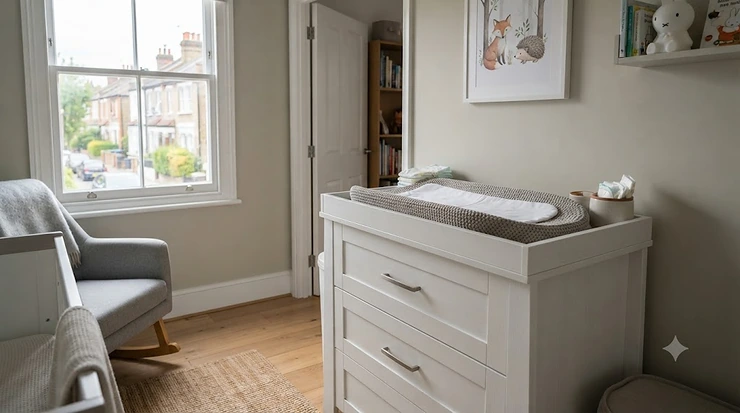
There’s a particular kind of nursery-shopping fatigue that sets in around week thirty of pregnancy, somewhere between the fortieth open browser tab and the realisation that “changing table” apparently means eleven different things depending on which website you’re on. If you’ve landed here, you’ve probably already worked out that a dedicated changing table is a short-lived luxury — babies outgrow the changing stage in around twelve to eighteen months, but a decent chest of drawers needs to last through toddlerhood, the school years, and possibly a house move or two. That’s the entire appeal of a removable top changing dresser.
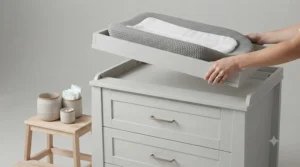
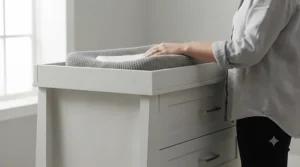
So, what is a removable top changing dresser? It’s a standard chest of drawers fitted with a detachable changing tray or raised-edge topper that clips, screws, or slots onto the carcass, giving you a padded, contained surface for nappy changes. Once your child outgrows changing, the top lifts off, leaving an ordinary piece of bedroom furniture behind.
The appeal is obvious on paper — one purchase, two life stages — but the execution varies wildly between brands, and that’s where this guide earns its keep. We’ve researched seven real, currently available UK models spanning budget MDF units to premium solid-oak pieces, checked what genuine owners say about them, and worked through the practical trade-offs (safety compliance, weight limits, resale value, IKEA-hack alternatives) that Amazon’s product bullet points conveniently skip. Every removable top changer sold in the UK sits within a wider framework of furniture safety testing, and it’s worth understanding that context before you commit your budget.
Quick Comparison Table
| Product | Type | Price Range | Best For |
|---|---|---|---|
| Silver Cross Westport | Solid oak dresser + changer | £550-£700 | Premium buyers wanting heirloom furniture |
| Tutti Bambini Rio | Solid wood 3-drawer changer | £250-£320 | Best all-rounder for most nurseries |
| CuddleCo Enzo | Truffle oak dresser + changer | £400-£480 | Small nurseries needing deep storage |
| WOLTU 4-Drawer | MDF budget changer | £120-£180 | Tight budgets and first-time parents |
| Shefa Kids 800 Topper | Universal changing topper | £90-£140 | Anyone with an existing IKEA dresser |
This snapshot only scratches the surface, and it deliberately leaves out two of our seven picks (the Tutti Bambini Modena and the Babymore Luno Veni) to keep the table scannable — you’ll find full analysis on all seven below. What jumps out immediately is the price spread: you’re looking at roughly a six-fold difference between the cheapest and priciest options, yet all five above technically do the same core job. The gap comes down to material (solid wood versus MDF/particleboard), drawer mechanisms (soft-close versus standard runners), and whether you’re buying a full dresser or just a topper for furniture you already own.
💬 Just one click — help others make better buying decisions too!😊
Top 7 Removable Top Changing Dressers: Expert Analysis
1. Silver Cross Westport Dresser & Changing Table — heirloom-grade oak build
The standout here is longevity: this is furniture built to outlast the nursery years by decades, not just survive them. It measures W85cm x D60cm x H93cm, with three deep, soft-close drawers and an exposed warm-oak finish that reads more “Scandi living room” than “baby gear.” Silver Cross backs it with a three-year warranty against manufacturing faults, which is longer than most rivals in this category offer.
Based on the spec comparison, the soft-close mechanism matters more than it sounds — with a newborn asleep down the hall, a drawer that doesn’t slam shut is worth the premium alone. This is the pick for parents who see nursery furniture as a long-term investment in the family home, not a disposable baby-stage purchase; it suits households furnishing a “forever nursery” that’ll later become a child’s bedroom. Reviewers consistently note that assembly is more involved than budget alternatives, generally recommending two adults and an afternoon. A common thread in aggregated feedback is genuine surprise at how solid the drawers feel compared with typical flat-pack nursery furniture — though a minority mention the oak veneer marking if wiped with anything abrasive.
Pros:
- ✅ Three-year manufacturer warranty, longer than most competitors
- ✅ Soft-close drawers reduce noise near a sleeping baby
- ✅ Solid, heirloom-quality build that suits a “forever” bedroom
Cons:
- ❌ Among the priciest options in this category
- ❌ Assembly is lengthy and best done with two people
Expect to pay in the £550-£700 range at the time of research; prices may vary, so always check current pricing before buying. For buyers who plan to keep this piece for ten-plus years, the value case is strong — for those changing nurseries every couple of years, it’s harder to justify.
2. Tutti Bambini Rio Chest Changer — best all-rounder for most nurseries
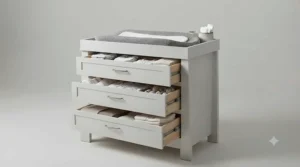
What stands out about the Tutti Bambini Rio is how unremarkable it looks once the topper’s removed — which is exactly the point. This solid wood, three-drawer chest ships in Dove Grey/Oak or White finishes, with soft-close drawers throughout and a changing top rated for use from birth up to around 15kg (roughly toddler weight).
The 15kg weight rating is worth dwelling on: many budget changing toppers are only tested to around 11kg, meaning you’ll be transferring your baby to the floor for changes months before Tutti Bambini owners do. Here’s what to weigh: this model suits parents who want one of the longest usable changing windows without stepping up to premium pricing. Tutti Bambini has been designing nursery furniture for over three decades and has built a reputation across hundreds of thousands of UK nurseries, which shows up in the consistency of aggregated review sentiment — reviewers frequently praise the soft-close drawers and describe assembly as more manageable than expected for solid wood furniture. A recurring, more minor complaint is that the changing top’s side barriers are on the shallow side compared with dedicated changing tables.
Pros:
- ✅ 15kg weight rating extends usable changing life
- ✅ Soft-close drawers on all three compartments
- ✅ Established UK brand with strong track record
Cons:
- ❌ Changing top side barriers are relatively shallow
- ❌ Only available in a limited colour range
Typically found in the £250-£320 range, this sits comfortably as the mid-market benchmark other convertible changing dresser options get measured against.
3. Tutti Bambini Modena Chest Changer — classic solid pine at a fair price
The Tutti Bambini Modena leans into a traditional aesthetic — solid pine construction with a painted white-and-oak finish — that coordinates with matching cot beds and wardrobes if you’re building out a full nursery set. Three full-length drawers provide genuine storage capacity, not the shallow top drawer many budget units include as an afterthought.
On paper, solid pine sits below oak veneer in perceived prestige, but what most buyers overlook is that solid pine is often more resistant to dents and scratches from day-to-day toddler abuse than a thin oak veneer over MDF. This is the sensible choice for parents who want genuine solid-wood construction without stretching to premium pricing, particularly those coordinating multiple pieces from one collection for a cohesive look. Aggregated customer sentiment highlights the coordinated collection as a major draw — buyers frequently mention purchasing the matching cot bed and wardrobe alongside it — while some reviewers note the white paint finish shows scuffs more readily than darker alternatives.
Pros:
- ✅ Solid pine construction resists dents better than veneer
- ✅ Coordinates with a full matching nursery collection
- ✅ Three full-length drawers, not just a shallow top one
Cons:
- ❌ White paint finish shows scuffs over time
- ❌ Classic styling won’t suit every modern nursery scheme
Pricing generally sits in the £280-£350 range. Worth noting: the removable changer top here converts the piece into “just like a chest,” in the brand’s own words, meaning zero cosmetic compromise once the baby stage ends.
4. CuddleCo Enzo Dresser & Changer — best for tight spaces needing deep storage
The CuddleCo Enzo targets a specific problem: nurseries where floor space is scarce but storage needs aren’t. Finished in a warm truffle oak and white combination, it packs generous drawer capacity into a footprint that doesn’t dominate a small room, and CuddleCo backs the whole range with an unusually long five-year warranty.
Based on the spec comparison against the rest of this list, that five-year warranty is the longest of any product here bar none, which speaks to CuddleCo’s confidence in the build quality. What the spec sheet won’t tell you, but reviewers note, is that the changing top’s raised barriers are noticeably deeper than most rivals, which matters enormously once your baby starts wriggling during changes around the four-to-six-month mark. This suits parents in flats or smaller Victorian terraces where every centimetre of nursery floor is contested territory. Reviewers consistently report that the drawers glide smoothly even when fully loaded with folded clothing, and the truffle oak finish is repeatedly described as looking more expensive than the price suggests.
Pros:
- ✅ Five-year warranty, longest of any product on this list
- ✅ Deep changing-top barriers suit wriggly older babies
- ✅ Compact footprint without sacrificing drawer capacity
Cons:
- ❌ Fewer colourway options than some competitors
- ❌ Sits toward the upper end of the mid-price bracket
Expect a price in the £400-£480 range. For buyers prioritising longevity of cover over raw upfront savings, that five-year warranty arguably pays for itself if anything goes wrong in year three or four.
5. Babymore Luno Veni Chest Changer — value-focused UK brand pick
The Babymore Luno Veni occupies useful middle ground: a White Oak finish that looks considerably pricier than its position in the market suggests, paired with straightforward three-drawer storage and a lift-off changing top. Babymore has built a following among UK parents specifically for offering mid-tier styling at closer-to-budget pricing.
Here’s what to weigh: this isn’t the most feature-rich option — there’s no soft-close mechanism, for instance — but the fundamentals are sound, and it undercuts the Tutti Bambini and CuddleCo pieces by a meaningful margin while still using genuine oak-effect finishes rather than plain white MDF. It’s a strong fit for parents furnishing a nursery on a defined budget who still want it to look considered rather than purely functional. Aggregated feedback across UK retailers consistently flags the value-for-money angle as the headline strength, with several reviewers specifically comparing it favourably against pricier alternatives they’d initially shortlisted; a recurring criticism is that the drawer runners feel less substantial than premium competitors after a year or two of heavy use.
Pros:
- ✅ Oak-effect finish at a genuinely mid-budget price point
- ✅ Straightforward three-drawer layout, easy to assemble
- ✅ Frequently rated strong value against pricier rivals
Cons:
- ❌ No soft-close drawer mechanism
- ❌ Runners can feel less robust after extended heavy use
Generally priced in the £200-£260 range, this is the pick when budget matters but you’re not quite ready to go full MDF-and-nothing-else.

6. WOLTU 4-Drawer Baby Changing Table — best for tight budgets
The WOLTU 4-Drawer unit is the entry point of this list, built from MDF and particleboard rather than solid or veneered wood, and finished in white or white-and-high-gloss combinations. Four drawers is actually one more than most of the pricier competitors here manage, which is a genuinely useful trade-off for parents prioritising storage volume over premium materials.
What most buyers overlook about budget MDF units is that the material itself isn’t inherently a problem — MDF is dense, stable, and resists warping better than solid wood in humid bathrooms-adjacent nurseries — the trade-off is really about drawer mechanism quality and long-term wear at the joints. This is squarely aimed at first-time parents outfitting a nursery on a tight budget, or anyone buying for a second child where the furniture only needs to survive one more changing-stage cycle rather than a decade. Reviewers frequently describe it as good value for the price bracket and straightforward to assemble solo, though a consistent thread in feedback flags that the changing top’s guard rail feels less secure than on solid-wood alternatives, and a minority of buyers report drawer alignment issues after assembly.
Pros:
- ✅ Four drawers — more storage than several pricier rivals
- ✅ MDF resists warping well in humid conditions
- ✅ Genuinely accessible entry price point
Cons:
- ❌ Changing top guard rail feels less secure than solid wood
- ❌ Some reports of drawer alignment issues post-assembly
Typically found in the £120-£180 range. For a first nursery on a strict budget, this remains one of the more sensible convertible changing dresser choices available, provided expectations about material quality are realistic going in.
7. Shefa Kids 800 Universal Changing Top — the topper-only clever alternative
The Shefa Kids 800 isn’t a dresser at all — it’s a changing topper designed to sit on top of furniture you already own, specifically engineered to fit IKEA’s Malm, Hemnes, and Nordli dresser ranges. If you’ve already bought (or inherited) an IKEA chest of drawers, this is the cheapest legitimate route into a proper changing station.
Based on the spec comparison, this is the single best value-per-pound entry on this entire list for anyone who already owns compatible furniture, because you’re paying only for the changing surface rather than duplicating a dresser you don’t need. The catch is compatibility: it’s engineered for specific IKEA carcass widths, so measuring before buying is non-negotiable — a mismatch means the topper won’t sit securely, which is a genuine safety issue rather than a cosmetic one. This suits budget-conscious parents, second-time buyers repurposing an existing dresser, or anyone renovating a nursery without wanting to replace furniture that still has years of life left. Reviewers consistently praise the compatibility engineering when the fit is correct, and a common thread in feedback is relief at not needing to buy an entirely new piece of furniture; the main recurring criticism is that instructions for confirming exact dresser compatibility could be clearer before purchase.
Pros:
- ✅ Dramatically cheaper than buying a whole new dresser
- ✅ Purpose-fit for popular IKEA Malm/Hemnes/Nordli ranges
- ✅ Ideal for second-time parents reusing existing furniture
Cons:
- ❌ Only compatible with specific IKEA dresser models
- ❌ Requires accurate measuring before purchase to fit securely
Price-wise, this sits in the £90-£140 range — by far the lowest entry cost on this list, assuming you already have compatible furniture at home.
Setting Up and Maintaining Your Changing Dresser
Getting a new changing dresser from flat-pack box to functioning nursery furniture involves more than following the instruction booklet. Start by positioning it away from radiators and windows — both temperature swings and direct sunlight accelerate finish wear on oak veneers over a few years. Before your first nappy change, test the changing top’s attachment by applying firm downward pressure at each corner; a properly seated topper shouldn’t shift more than a few millimetres.
A simple monthly maintenance routine pays off: wipe the changing surface with a mild detergent (never bleach, which degrades most finishes and foam padding), check that drawer runners are still gliding smoothly, and re-tighten any visible screws on the topper’s attachment points, since vibration from regular use gradually loosens fixings. The most common first-30-days mistake is skipping the anti-tip wall-anchoring kit that ships with almost every dresser — it takes ten minutes and it’s the single most important safety step, full stop, given that once your baby starts pulling up on furniture around eight to ten months, an unanchored dresser becomes a genuine tip-over risk.
Real Nurseries, Real Choices: Three Buyer Scenarios
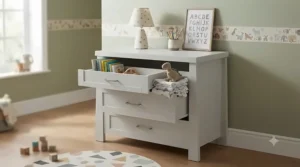
The first-time parent on a tight budget furnishing a single nursery room from scratch, with roughly £150 to spend and a preference for simplicity over styling, is generally best served by the WOLTU 4-Drawer — four drawers of storage and a functional changing top without the outlay of solid-wood alternatives.
The second-time parent with an existing IKEA dresser already has the storage half of the equation solved and just needs a safe changing surface without duplicating furniture. The Shefa Kids 800 slots directly onto compatible IKEA carcasses, turning existing furniture into a changing station for a fraction of the cost of starting over.
The family furnishing a forever nursery in a long-term family home, planning to keep the piece through multiple children and into the toddler years as ordinary bedroom furniture, gets the best long-run value from something like the Silver Cross Westport or CuddleCo Enzo — both built with warranty backing and materials designed to outlast the changing-table phase by years, not months.
✨ Don’t Miss These Exclusive Deals!
🔍 Take your nursery shopping to the next level with these carefully selected picks. Click through to check current pricing and availability, and give your family a changing station that’s actually built to last.
Problem → Solution: Fixing Common Changing Dresser Headaches
Problem: the changing top wobbles after a few months of use. Solution: most attachment points loosen from repeated vibration, not manufacturing defects — a monthly check-and-tighten routine (covered above) generally resolves this, and if wobble persists, contact the manufacturer, since a genuinely loose topper is a safety fault worth escalating rather than living with.
Problem: drawers stick or misalign after assembly. Solution: this is almost always a levelling issue rather than a faulty unit — check the dresser is standing on a completely flat floor, since even a 5mm lean can throw runners out of alignment on budget models like the WOLTU 4-Drawer.
Problem: the changing surface feels too small once baby starts moving more. Solution: this typically means you’ve reached the practical limit of that model’s weight or size rating — models like the Tutti Bambini Rio, rated to 15kg, buy considerably more runway here than 11kg-rated budget alternatives, so checking the rating before buying prevents this becoming an issue at all.
Problem: uncertainty about whether a topper will actually fit an existing dresser. Solution: for universal toppers such as the Shefa Kids 800, measure the exact width of your dresser’s top surface before ordering — manufacturer compatibility charts exist precisely because “should fit” and “does fit” aren’t the same thing with flat-pack furniture tolerances.
How to Choose a Removable Top Changing Dresser
- Check the weight rating first. This single number determines how many months of genuine use you’ll get before your baby outgrows the changing surface — anything under 11kg gives a notably shorter usable window than 15kg-rated options.
- Measure your nursery footprint before falling in love with a finish. A stunning oak dresser is no help if it doesn’t fit between the door and the cot.
- Decide whether you need a full dresser or just a topper. If you already own compatible storage furniture, a universal topper like the Shefa Kids 800 saves considerable money.
- Prioritise drawer mechanism quality over drawer count. Four flimsy drawers are less useful long-term than three that glide smoothly and won’t need replacing.
- Factor in the warranty length as a proxy for build confidence. Brands willing to back furniture for five years, such as CuddleCo, are signalling something about expected longevity.
- Confirm the topper genuinely detaches without tools damage. Some cheaper units require force or leave visible screw holes once removed — check reviews specifically for this detail.
- Think one step ahead to resale or reuse. A removable top only adds long-term value if the underlying dresser looks like proper furniture once it comes off.
Changing Topper for Dresser: The IKEA Hack Alternative
Not every parent wants — or needs — an entirely new piece of furniture. A dedicated changing topper for dresser use, rather than a full integrated unit, is a genuinely underrated route, particularly for anyone who already owns a decent chest of drawers or is happy to buy a plain one separately and pair it with a purpose-fit topper.
The Shefa Kids 800 is the clearest example on this list, engineered specifically around IKEA’s Malm, Hemnes, and Nordli ranges — dressers that are already common in UK bedrooms long before a baby arrives. What most buyers overlook about this approach is that it decouples two purchasing decisions that integrated changing dressers force together: you can buy furniture based purely on how it looks in your home, then add changing functionality separately, and remove it cleanly later without the dresser ever having been “baby furniture” in the first place. The trade-off is compatibility risk — a topper genuinely engineered for one dresser range won’t necessarily sit securely on another, so this only works if you’re buying (or already own) a matching carcass.

The Changing Unit That Lifts Off: How the Mechanism Actually Works
The phrase “changing unit that lifts off” undersells how much engineering sits behind a genuinely safe removable top. Most designs use one of three attachment methods: slot-and-peg systems where the topper’s underside pegs drop into corresponding holes on the dresser carcass; screw-fixed brackets that require a screwdriver to attach or remove; or friction-fit lipped edges that grip the dresser’s top surface without any hardware at all.
Screw-fixed systems, used on several of the solid-wood options here including the Tutti Bambini range, tend to be the most secure but the least convenient to remove — genuinely a two-minute job with a screwdriver, not a one-handed lift. Slot-and-peg and friction-fit systems, more common on budget units, are quicker to detach but rely more heavily on correct initial seating. According to FIRA’s guidance on childcare furniture standards, where a changing unit is removable — whether that’s a top surface, rails, or a drawer-mounted attachment — additional stability testing beyond the base furniture standard should be considered, precisely because a lift-off mechanism introduces a failure point that fixed furniture doesn’t have. In practice, this means: always test the fit firmly before first use, and never assume “it looks seated” is the same as “it is seated.”
Convertible Changing Dresser vs Standalone Changing Table
A convertible changing dresser and a standalone changing table solve the same immediate problem — somewhere safe and contained to change a nappy — but diverge sharply on everything that happens afterwards. A standalone changing table is furniture with exactly one job; once your child’s out of nappies, it typically becomes redundant, sold on or relegated to the loft. A convertible changing dresser, by contrast, is a chest of drawers first and a changing station second, meaning the underlying furniture keeps earning its keep for years after the topper’s gone.
The practical trade-off cuts the other way on footprint and dedicated safety features: purpose-built standalone changing tables often include deeper contoured surfaces and more generous safety barriers specifically because they’re not compromising on dresser proportions. For a nursery with genuinely limited floor space, or parents who know they’ll want the furniture to transition seamlessly into a toddler bedroom, the convertible changing dresser wins on space efficiency and long-term value. For anyone prioritising the single best possible changing experience regardless of what happens to the furniture afterwards, a dedicated changing table can still make sense — it’s simply solving a narrower problem, on purpose.
Transitioning Out of Nappies: When (and How) to Remove the Top
Timing the removal of a changing top isn’t governed by a fixed rule — it’s governed by your child’s weight, mobility, and, eventually, their progress transitioning out of nappies altogether. Most manufacturers cap changing-top use somewhere between 11kg and 15kg, which typically lines up with somewhere between twelve and twenty months of age, though every child’s growth curve differs. According to NCT’s guidance on toilet training, most children show genuine readiness signs for potty or toilet training somewhere between eighteen months and three years, meaning the changing dresser’s topper often gets retired well before nappies do — worth planning for rather than treating as a single cut-off moment.
Removing the top is usually a five-minute job: unscrew or unclip the attachment points, lift the topper away, and check the dresser’s exposed top surface for any leftover screw holes or bracket marks that might need filling or covering. This is also the ideal moment to reassess anti-tip wall anchoring, since a dresser without a changing topper is more likely to be climbed on by an increasingly mobile toddler than a baby who couldn’t yet pull themselves up.
Second-Hand Nursery Furniture Resale: What Removability Does for Value
Here’s a genuinely underappreciated angle: a removable top doesn’t just benefit you, it directly affects what the furniture is worth when you’re done with it. Standalone changing tables have a narrow resale audience — only other parents mid-changing-stage want them. A dresser that converts cleanly into ordinary bedroom furniture, by contrast, can be sold or handed down as either a nursery changer or a plain chest of drawers, which roughly doubles the pool of interested buyers on the second-hand nursery furniture resale market.
According to Which?’s guidance on second-hand and pre-loved baby products, nursery furniture that’s primarily supervised by adults during use — dressers being a good example — is generally considered safer to buy or sell second-hand than items with more complex safety-critical mechanisms, like car seats or cots with drop-side rails. Practically, this means solid-wood options such as the Silver Cross Westport or Tutti Bambini Rio tend to hold resale value particularly well, since buyers can inspect the wood condition directly and the removable topper means the eventual buyer isn’t limited to parents currently in the changing-table phase. If resale matters to your buying decision, prioritise genuine wood over MDF and keep the original fixing hardware — missing screws are one of the most common reasons second-hand nursery furniture gets rejected by cautious buyers.
Safety, Regulations and Compliance Guide
UK nursery furniture, including removable changing units, sits under the General Product Safety Regulations, which set a general legal duty that consumer products placed on the market must be safe under normal and reasonably foreseeable use. According to Wikipedia’s overview of the General Product Safety Regulations 2005, the regulations have applied across the UK since October 2005 and remain the baseline safety framework for product categories, including furniture, that aren’t covered by a more specific standard.
For changing units specifically, industry testing typically references British and European harmonised standards covering strength, stability, and entrapment hazards for both freestanding and cot-top mounted units — and, importantly, additional stability testing is generally recommended wherever the changing surface itself is removable, since a detachable component introduces risks a fixed unit doesn’t have. Practically, look for a permanent label referencing the relevant BS EN testing standard, always use the anti-tip wall-anchoring kit supplied with the furniture, never leave a baby unattended on any changing surface even briefly, and check the manufacturer’s stated weight limit rather than estimating by eye — babies’ weight gain in the first year is faster and less predictable than most new parents expect.
Common Mistakes When Buying a Removable Top Changing Dresser
The single most common mistake is buying on finish alone and only checking the weight rating after delivery — by which point returns can be costly for large furniture items. A close second is skipping measurements: nursery doorways, stair turns, and lift access all catch out parents who ordered based on room dimensions alone and forgot the delivery route. Buyers also frequently underestimate assembly time on solid-wood units, scheduling a “quick evening job” that turns into a weekend project, particularly on units like the Silver Cross Westport that trade convenience for build quality. Finally, many parents fail to check whether the changing top removal leaves visible fixing marks — a detail that matters enormously if resale value or a seamless conversion to ordinary furniture is part of the plan from day one.
Long-Term Cost & Maintenance
Total cost of ownership rarely stops at the purchase price. Budget MDF units like the WOLTU 4-Drawer carry a lower upfront cost but a shorter realistic lifespan — expect drawer runners to need replacing or the whole unit retiring somewhere in the five-to-eight-year range under regular household use. Solid-wood options such as the Tutti Bambini Modena or Silver Cross Westport cost considerably more initially but routinely last well over a decade, meaning the effective cost-per-year often narrows the gap between budget and premium considerably once you run the numbers over a realistic ownership period. Ongoing maintenance costs are modest across the board — mild detergent, occasional screw-tightening, and, for solid wood, an occasional application of appropriate wood care product — but factoring resale value back in (see the second-hand resale section above) tips the long-term economics further in favour of genuine wood construction for anyone planning to sell on afterwards.
Frequently Asked Questions
❓ Is a removable top changing dresser safe once the topper is fitted?
❓ Can I fit a changing topper for dresser use on any chest of drawers I already own?
❓ How long can you use a convertible changing dresser before baby outgrows it?
❓ Does removing the changing top damage the dresser underneath?
❓ Is it worth buying a used removable top changing dresser?
Conclusion
There’s no single “best” removable top changing dresser — there’s only the best one for your specific nursery, budget, and how long you’re realistically planning to keep the furniture around afterwards. If you want heirloom-grade furniture that’ll outlive the nursery entirely, the Silver Cross Westport or CuddleCo Enzo justify their higher price tags with warranty backing and material quality. For most parents, the Tutti Bambini Rio hits the sweet spot of weight rating, build quality, and price that makes it the sensible default recommendation. Tight-budget buyers shouldn’t feel short-changed by the WOLTU 4-Drawer, and anyone who already owns a compatible IKEA dresser should seriously consider the Shefa Kids 800 before buying anything new at all.
Whichever you choose, the core advice holds steady: check the weight rating before the finish, anchor it to the wall regardless of how sturdy it looks in the shop, and think one step ahead to what the furniture becomes once the changing years are behind you.
Recommended for You
- Chest of Drawers with Changer vs Standalone Changing Table: 7 Picks
- Changing Table Dresser Combo UK: 7 Best Picks for 2026
- Changing Dresser Under £150: 7 Best Picks for 2026
Disclaimer: This article contains affiliate links. As an Amazon Associate, I earn from qualifying purchases. If you purchase products through these links, we may earn a small commission at no additional cost to you.
✨ Found this helpful? Share it with your friends! 💬🤗
