
In This Article
If you’ve ever stood in the baby aisle at Mothercare or scrolled endlessly through Amazon.co.uk at 2am, you’ll know that choosing a joie car seat can feel rather overwhelming. With seventeen models currently available in the UK market and five holding Which? Best Buy status, Joie has become synonymous with affordable safety that doesn’t compromise on innovation.
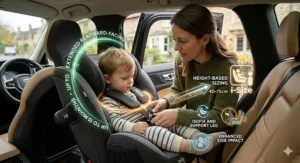
What sets Joie apart in the crowded British car seat market? It’s the clever French engineering combined with understanding what UK families actually need: seats that handle our unpredictable weather, fit in compact hatchbacks (because not everyone drives a Range Rover), meet strict UKCA and i-Size regulations, and won’t require a second mortgage. Having tested dozens of car seats across rain-soaked school runs in Manchester and bumpy B-roads in the Cotswolds, I can tell you that Joie consistently delivers where it matters most.
From the revolutionary Joie Spin 360 that saves your back when wrestling a wriggly toddler into the car, to the Joie Every Stage FX that genuinely lasts from birth to age twelve, these seats represent some of the best value in British child safety equipment. This guide cuts through the marketing jargon to help you find the perfect Joie car seat for your family’s specific needs — whether you’re navigating tight city parking in Bristol, tackling motorway miles to Scotland, or simply doing the nursery run in suburban Surrey.
Quick Comparison: Top Joie Car Seats at a Glance
| Model | Age Range | Key Feature | Price Range | Best For |
|---|---|---|---|---|
| Spin 360 | Birth – 4 years | 360° rotation | £200-£280 | Back-saving accessibility |
| i-Spin 360 i-Size | Birth – 4 years | i-Size + rotation | £280-£350 | Latest safety standards |
| Every Stage FX | Birth – 12 years | All-in-one longevity | £220-£280 | Budget-conscious families |
| i-Venture | Birth – 4 years | Premium i-Size | £250-£320 + base | Extended rear-facing |
| i-Level | Birth – 15 months | Lie-flat travel | £200-£250 | Newborn comfort |
| Bold R | 15 months – 12 years | 3-in-1 versatility | £140-£190 | Growing children |
| Elevate | 15 months – 12 years | Budget booster | £70-£100 | Value seekers |
Analysis: The standout here is the Every Stage FX, which offers twelve years of use for around £250 — that’s roughly £21 per year of your child’s life. Compare that to buying separate infant carriers, toddler seats, and boosters (easily £500+ total), and the value proposition becomes rather compelling. However, if your priority is ease of use over longevity, the Spin 360’s rotating mechanism genuinely transforms the daily school run, particularly if you’re dealing with a narrow parking space or a dodgy back. For families committed to extended rear-facing (and you should be — it’s five times safer), the i-Venture paired with the i-Base Advance creates a robust system that keeps children rear-facing comfortably until age four.
💬 Just one click — help others make better buying decisions too! 😊
Top 7 Joie Car Seats: Expert Analysis for UK Families
1. Joie Spin 360 — The Back-Saver That Changed Everything
The Joie Spin 360 represents one of those rare products where a single feature — 360-degree rotation — justifies the entire purchase. At around £230-£280, it’s the most affordable rotating car seat on the UK market, undercutting rivals like the Nuna REBL by over £100.
What this means in practice: imagine arriving at Tesco with a sleeping toddler in the back. Rather than contorting yourself through the rear door like a stressed yoga instructor, you simply press the large grey button at the front of the seat and rotate it to face you. Pop your child in, secure the five-point harness, rotate back, and you’re done — all without waking them or straining your back. UK parents recovering from C-sections or managing back problems have called this feature “genuinely life-changing.”
The seat uses ISOFIX installation with a built-in base and support leg, creating a stable platform that stays firmly planted through British potholes and speed bumps. It’s suitable rear-facing from birth to 18kg (approximately four years), with five recline positions that work both directions. The Grow Together™ headrest adjusts simultaneously with the harness — no fiddly re-threading required.
Customer feedback from UK buyers consistently praises the comfort and ease, though several note that the recline and rotate buttons sit close together, which can cause momentary confusion when you’re in a rush. The seat measures 66cm tall, so if you’re installing it in a small hatchback like a Ford Fiesta, check the front passenger seat can still move back comfortably.
Pros:
✅ 360° rotation saves backs and time on every journey
✅ Most affordable rotating seat on UK market
✅ ISOFIX installation with clear green indicators
Cons:
❌ Recline/rotate button placement takes getting used to
❌ Bulkier than non-rotating alternatives
Around £230-£280 on Amazon.co.uk with Prime delivery. For families doing multiple daily car trips, this is one of those purchases where you’ll wonder how you ever managed without it.
2. Joie i-Spin 360 i-Size — Premium Safety Meets Smart Engineering
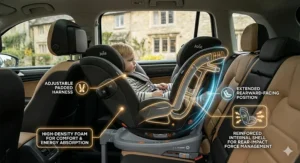
The i-Spin 360 i-Size takes everything brilliant about the standard Spin 360 and upgrades it to meet the latest R129 (i-Size) safety regulations. Priced in the £280-£350 range, it’s a significant jump from the non-i-Size version, but that premium buys you side-impact testing, Guard Surround Safety™ panels, and Smart Ride™ lockoff.
The Guard Surround Safety™ technology is rather clever: protective panels lock outward from the headrest to provide extra energy absorption during side collisions. Think of them as deployable airbags made from impact-absorbing foam. Combined with the Tri-Protect™ headrest featuring Intelli-Fit™ memory foam, this seat offers three layers of protection where it matters most — around your child’s vulnerable head and neck.
What UK parents particularly appreciate is the Smart Ride™ lockoff feature. This prevents anyone (grandparents, babysitters, that well-meaning but clueless uncle) from accidentally rotating the seat to forward-facing before your child reaches 15 months. Given that rear-facing is five times safer in frontal collisions, this idiot-proof mechanism offers genuine peace of mind when your child travels with different carers.
Installation uses the i-Base Advance (sold separately at around £125), which features a 19-position support leg to absorb collision forces. UK reviewers note the base feels reassuringly solid and clicks firmly into ISOFIX points with clear visual and audible confirmation.
The seat accommodates children from 40cm to 105cm (birth to approximately four years). One slight limitation: like most extended rear-facing seats, taller children may find leg room tight by age three. My suggestion? Cross-legged is perfectly comfortable for children and far safer than turning them forward-facing prematurely.
Pros:
✅ i-Size certification with enhanced side-impact protection
✅ Guard Surround Safety™ panels for extra collision absorption
✅ Smart Ride™ lockoff prevents premature forward-facing
Cons:
❌ Requires separate i-Base Advance purchase (adds £125)
❌ Limited leg room for taller toddlers rear-facing
Expect to pay £280-£350 for the seat, plus the separate base. Check current pricing on Amazon.co.uk, where it’s frequently eligible for Prime next-day delivery.
3. Joie Every Stage FX Signature — The Only Seat You’ll Ever Buy
The Joie Every Stage FX is Joie’s answer to the question: “What if you never had to buy another car seat?” This Group 0+/1/2/3 mega-seat genuinely covers birth to approximately twelve years (up to 36kg), making it the ultimate one-and-done solution for budget-conscious British families.
How does it work? The seat transforms through four distinct stages: rear-facing infant carrier (birth-18kg), forward-facing toddler seat with five-point harness (9-18kg), high-back booster with harness (15-25kg), and finally a belt-positioning booster (22-36kg). At each stage, the Grow Together™ headrest and AutoAdjust™ side wings expand simultaneously to accommodate your growing child.
The Signature version (around £249-£279) adds premium touches: cognac-hued faux leather accents, upgraded fabrics that resist stains better, and improved padding throughout. The reinforced steel inner shell provides structural integrity across all twelve years of use — rather important when you consider the seat will endure everything from newborn sick to pre-teen crisp crumbs.
UK testers appreciate the versatility of installation methods: three-point seatbelt only when rear-facing (no ISOFIX required in Group 0+ mode), then either ISOFIX with top tether or seatbelt when forward-facing. This flexibility means the seat works in older vehicles without ISOFIX points, or can move between multiple family cars without fuss.
The reality check: at 13.9kg, this is considerably heavier than single-stage seats. You won’t be popping it in and out of the car regularly. But that’s rather the point — it’s designed to stay put for twelve years, not to double as a travel system carrier. For families with limited storage space in typical British terraced housing, one seat that does everything is preferable to a garage full of outgrown equipment.
Leg room when rear-facing remains the Achilles’ heel of all-in-one seats. Larger children may need to go cross-legged by age two and a half. Joie’s guidance suggests rear-facing to four years, but in practice, expect around two to three years depending on your child’s size.
Pros:
✅ Birth to 12 years in a single purchase (extraordinary value)
✅ Works without ISOFIX (suits older vehicles)
✅ Guard Surround Safety™ panels fold out for side protection
Cons:
❌ 13.9kg weight makes moving between cars impractical
❌ Limited rear-facing leg room for larger toddlers
Around £220-£280 depending on finish. The Signature model costs roughly £30 more but the superior fabrics genuinely handle British family life better — spillages wipe clean, and the material doesn’t show wear as quickly.
4. Joie i-Venture — Premium Extended Rear-Facing for Safety-First Families
The i-Venture occupies Joie’s premium tier, and with good reason. This i-Size seat (40-105cm, birth to approximately four years) prioritises extended rear-facing with seven recline positions in both directions, making it one of the most adjustable seats on the British market.
What separates the i-Venture from cheaper alternatives? The Tri-Protect™ headrest features three layers of foam including patented Intelli-Fit™ memory foam that moulds to your child’s head shape, providing custom protection. The Guard Surround Safety™ panels lock outward during installation to absorb side-impact forces. And the reinforced steel inner shell maintains structural integrity even in severe collisions.
The seat pairs exclusively with the i-Base Advance (sold separately for around £125), which features an energy-absorbing load leg and one-click ISOFIX installation. UK parents appreciate that once the base is installed, switching between the i-Venture, i-Snug™, or i-Gemm™ infant carriers is effortless — ideal for families who want different seats in different vehicles or plan to upgrade as children grow.
Installation receives consistent praise in UK reviews. The base features clear visual indicators that turn green when correctly fitted, and the load leg adjusts from 19 positions to suit different footwell depths (important in British vehicles where floor heights vary considerably between models).
At 6.94kg for the seat and 7.53kg for the base (14.47kg total when installed), this is lighter than the Every Stage FX but still not something you’d casually move between vehicles. The trade-off is that lighter weight combined with the steel structure creates a seat that feels reassuringly robust without being unwieldy.
The slightly frustrating aspect? The seat rattles when empty, which several UK reviewers note becomes irritating on long motorway drives. A minor quibble, but worth mentioning if you frequently drive solo with the seat installed.
Pros:
✅ Seven recline positions (exceptional flexibility)
✅ Tri-Protect™ headrest with memory foam
✅ Compatible with other Joie infant carriers on same base
Cons:
❌ Requires separate i-Base Advance (around £125)
❌ Rattles when empty during driving
Expect to pay £250-£320 for the seat plus the separate base. Total system cost approaches £400, positioning it as Joie’s premium offering for safety-conscious families willing to invest in extended rear-facing.
5. Joie i-Level — The Lie-Flat Pioneer for Newborn Travel
The i-Level holds a special place in Joie’s lineup as their first i-Size seat with near lie-flat capability. For parents concerned about newborns spending extended periods in semi-upright positions (which can affect breathing and digestion), this addresses a genuine worry.
The seat adjusts to three recline positions, including one that places newborns almost completely flat — closer to what they’d experience in a carrycot. This makes the i-Level particularly appealing for families who spend lots of time in the car or use their vehicle for longer journeys. UK paediatricians generally recommend limiting time in upright car seats for young babies; the i-Level’s flat position helps you comply with that guidance whilst maintaining crash safety.
What else works well? The memory foam base provides comfort that several UK parents describe as “hotel-bed quality for babies.” The comprehensive sunshade offers better coverage than most competitors, with a zip section that extends for full protection — rather handy when caught in British downpours.
The i-Level works with the i-Base Advance or i-Base LX (both sold separately), and it’s compatible with Joie travel systems plus Maxi-Cosi-style adapters. This versatility means you can click it onto most British pushchairs without faffing about with brand-specific parts.
The reality check: at suitable only to 85cm or 13kg (typically 12-15 months), this is a relatively short-use seat. You’re essentially paying £200-£250 for fifteen months of use. For families planning multiple children or who highly value that lie-flat position for newborns, it makes sense. For budget-conscious single-child families, the shorter lifespan may give pause.
UK reviews consistently praise the comfort and quality, but note the weight — at around 4.5kg with the insert, it’s noticeably heavier than ultra-light competitors. Combined with the bulky sunshade, this isn’t the seat for nipping on and off buses or popping in and out of taxis.
Pros:
✅ Near lie-flat position (ideal for newborns)
✅ Memory foam base for superior comfort
✅ Comprehensive sunshade with extendable zip section
Cons:
❌ Shorter usage period (birth to 15 months typically)
❌ Heavier than comparable infant carriers
Around £200-£250 including the i-Base. Check Amazon.co.uk for current deals, where it’s often bundled with pushchair adapters.
6. Joie Bold R — The Sensible Stepping Stone for Growing Children
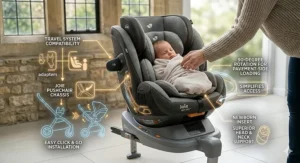
The Bold R represents Joie’s answer to the “what next?” question once children outgrow infant carriers. This Group 1/2/3 seat (76cm-150cm, approximately 15 months to 12 years) uses a five-point harness for younger children (up to 105cm/18kg), then converts to a high-back booster using the vehicle’s seatbelt.
What makes this particularly clever for British families? The ISOSAFE connectors provide nine adjustment positions, allowing you to achieve a secure fit in virtually any UK vehicle — from compact city cars to larger SUVs. The Guard Surround Safety™ pod clips onto the door-side of the seat, providing extra side-impact protection that you can remove when not needed (useful in tight parking situations where you need maximum access space).
The three recline positions help children stay comfortable during longer journeys, and the 12-position headrest adjusts as they grow. UK parents particularly appreciate that you can make these adjustments whilst the seat is installed and even whilst your child is sitting in it — no need to remove the whole seat just to raise the headrest two positions.
Installation is straightforward: ISOFIX connectors click into anchor points, top tether secures to the anchorage (typically behind the rear seat), and the vehicle belt routes through clearly marked guides. The entire process takes perhaps five minutes, and the system feels reassuringly solid once installed.
The trade-off for all this functionality? At around £140-£190, the Bold R costs nearly double the basic Elevate booster. You’re paying for the extended harness use, ISOFIX installation, and Guard Surround technology. Whether that’s worth the premium depends on how much you value those features versus simply using a belt-positioning booster.
Pros:
✅ Five-point harness extends to 18kg (safer than early booster use)
✅ ISOSAFE with nine adjustment positions (fits most UK vehicles)
✅ Removable Guard Surround Safety™ pod
Cons:
❌ Bulkier than simple high-back boosters
❌ Nearly double the price of budget alternatives
Expect to pay £140-£190 depending on colour and finish. Check current prices on Amazon.co.uk, where Prime members get free next-day delivery.
7. Joie Elevate — Budget-Friendly Safety for School-Age Children
The Elevate proves that affordable doesn’t mean compromising on safety. At around £70-£100, this R129-certified high-back booster (100-150cm, approximately 3.5 to 12 years) delivers essentials without unnecessary frills.
The seat uses your vehicle’s three-point seatbelt to secure your child, with clearly marked belt guides to ensure proper routing across the shoulder and lap. Full side-impact protection with Guard Surround Safety™ panels provides head-to-hip shielding, whilst the 10-position headrest adjusts with one hand to accommodate growth spurts.
Installation couldn’t be simpler: position the seat, route the vehicle belt through the marked guides, buckle up, and you’re done. There’s no ISOFIX requirement (though the seat includes connectors for additional stability if your vehicle has anchor points). This simplicity makes the Elevate ideal for moving between vehicles, using in taxis or rental cars, or for grandparents who need an occasional seat without complicated installation.
The seat includes dual cup holders (removable when not needed), padded armrests, and machine-washable covers — practical touches that matter during messy family life. The fabric isn’t quite as premium as the Signature range, but for a sub-£100 seat, it handles British weather and child-related chaos perfectly adequately.
What you’re not getting: the extended harness use of the Bold R, the premium fabrics of Signature models, or memory foam padding. But here’s the thing — by the time your child needs a high-back booster (typically 3.5+ years), they’re developmentally capable of sitting properly with a seatbelt. The five-point harness, whilst safer, isn’t as essential as it is for younger children.
UK parents using this for school runs, after-school clubs, and weekend activities report excellent satisfaction. It’s light enough (around 4kg) to move between vehicles easily, fits well in the back of typical British family cars, and children find it comfortable enough for journeys up to several hours.
Pros:
✅ Excellent value (£70-£100 price range)
✅ R129 certified with full side-impact protection
✅ Light and portable (ideal for multiple-vehicle use)
Cons:
❌ No five-point harness (seatbelt only)
❌ Basic fabric compared to premium models
Around £70-£100 depending on colour. For families needing a second car seat, moving between vehicles regularly, or simply wanting solid safety without premium pricing, the Elevate is difficult to fault.
Setting Up Your Joie Car Seat: A UK Parent’s Survival Guide
The instruction manual that comes with your Joie car seat resembles an Ikea flatpack diagram crossed with hieroglyphics. Here’s what actually matters when you’re standing in a Tesco car park trying to get this sorted before the school run.
ISOFIX Installation (Most Common UK Method)
First, locate your vehicle’s ISOFIX anchor points — they’re hidden between the seat base and backrest, usually marked with a small ISOFIX label or button. Pull back any plastic covers. For seats like the Spin 360 or i-Spin 360, extend the ISOFIX arms from the back of the seat, align them with the anchor points, and push firmly until you hear two distinct clicks. The red indicators on each arm should turn green. If they don’t, you’ve not clicked it in properly — try again.
For seats requiring a separate base (i-Venture, i-Level), install the base first using the same ISOFIX method, then ensure the support leg extends to the vehicle floor with the indicator showing green. Only then click the seat onto the base.
British weather tip: ISOFIX points can accumulate grit and moisture, particularly in older vehicles. Wipe them clean occasionally to maintain a secure connection.
Seatbelt Installation (No ISOFIX Required)
The Every Stage and other belt-installed seats use your vehicle’s three-point seatbelt. Route the belt through the marked channels (usually colour-coded blue or red), pull it fully extended to lock the mechanism, then use the seat’s lock-offs to secure it tightly. The seat shouldn’t move more than 2-3cm in any direction when you push and pull it firmly.
Common mistake: not pulling the belt tight enough. Once threaded through, lean your full weight into the seat whilst pulling the slack from the belt. It should feel absolutely rock-solid.
Newborn Insert Removal
The Every Stage FX and similar seats include a three-piece infant insert: head support, body support, and wedge. Remove pieces gradually as your baby grows (typically head support around 3-4 months, body support around 6 months, wedge around 9 months). Don’t remove everything at once — your child should never look lost in the seat.
Harness Tightening
UK safety guidelines state you should only be able to fit two fingers between the harness and your child’s chest. After buckling the five-point harness, pull the adjustment strap (typically between the legs) until snug. The chest clip (if present) should sit at armpit level, not on the stomach or neck.
Wet Weather Care
British drizzle is murder on car seats. Every Stage and Signature models handle moisture better than budget alternatives, but all Joie seats benefit from occasional cleaning. Remove fabric covers (check which are machine washable — usually harness pads and seat covers) and wash on 30°C cold water cycle. Drip dry rather than tumble drying to prevent shrinkage. Wipe plastic components with damp cloth and mild soap, never harsh chemicals that might weaken the structure.
Storage Solutions for British Homes
In typical British terraced housing or flats, storage space is precious. The Every Stage stays in the car permanently — that’s its entire purpose. For infant carriers like the i-Level, consider a dedicated spot near the front door rather than schlepping them upstairs. The Elevate is light enough to tuck in a cupboard when not in use.
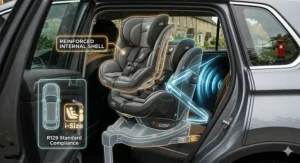
Joie Car Seat Safety Features Explained (Without the Jargon)
Marketing departments love throwing around safety terminology that sounds impressive but means little to actual parents. Here’s what the features actually do.
Guard Surround Safety™ Technology
These are foam-filled panels that lock outward from the seat (typically near the headrest and hips) to create a protective barrier during side-impact collisions. Think of them as crumple zones for car seats. When another vehicle hits your car from the side, these panels compress to absorb energy before it reaches your child. They’re particularly valuable in the UK where narrow roads and tight parking situations increase side-impact risk.
Do they work? Independent testing by ADAC (Europe’s leading car seat testing body) consistently shows that seats with side-impact protection like Guard Surround perform better in side-collision scenarios. Several Joie models with this technology have achieved “Good” ratings (2.5 or below in ADAC’s scoring, where lower is better). Which? testing also confirms the effectiveness of these safety features in real-world crash scenarios.
Tri-Protect™ Headrest with Intelli-Fit™ Memory Foam
The headrest uses three layers of protection: an outer shell, middle foam layer, and inner memory foam that moulds to your child’s head. The memory foam is the clever bit — it responds to your child’s specific head shape, providing custom support that standard foam can’t match.
Why does this matter? During a collision, forces are distributed across a larger surface area rather than concentrated in pressure points. The memory foam also helps prevent your child’s head from slumping forward during sleep, reducing strain on their developing neck and spine. Particularly relevant on long motorway drives to Scotland or Cornwall.
i-Size (R129) Certification vs. R44/04
i-Size (officially known as R129) is the newer European safety standard that’s gradually replacing the older R44/04 regulation. Key differences that affect UK parents:
Side-impact testing: i-Size requires seats to pass side-collision tests, R44/04 doesn’t. Given British roads include lots of T-junctions and narrow lanes where side impacts are realistic, this matters.
Rear-facing duration: i-Size mandates rear-facing until minimum 15 months (though longer is recommended), R44/04 allows forward-facing from 9kg/9 months.
Height-based sizing: i-Size uses your child’s height rather than weight, which is more accurate for achieving proper fit.
Should you only buy i-Size seats? Not necessarily. Many R44/04 seats (like the Every Stage) still offer excellent safety, particularly when they include features like Guard Surround technology. But if you’re choosing between otherwise similar seats, i-Size certification provides extra assurance.
ISOFIX vs. Seatbelt Installation
ISOFIX uses metal anchor points built into your vehicle to create a direct connection between car seat and car structure. Seatbelt installation uses your vehicle’s standard three-point belt to secure the seat.
Statistics from the UK Department for Transport show that ISOFIX reduces installation errors from around 60% (with seatbelt fitting) to approximately 20%. Fewer errors means better protection. However, correctly installed seatbelt seats can be equally safe — it’s the “correctly installed” part that’s harder to achieve.
For British families: if your vehicle has ISOFIX (standard in UK cars from 2006 onwards), use it. If you’re driving an older vehicle without ISOFIX, seatbelt installation works perfectly well when done properly — just take extra care to achieve a rock-solid fit. The RoSPA guidance on car seat fitting provides detailed instructions for both methods.
Extended Rear-Facing: Why British Parents Should Care More
Let’s address the elephant in the room: in the UK, we’re still rather behind Sweden when it comes to extended rear-facing. Many British parents turn their children forward-facing around 12-15 months simply because “that’s what everyone does.” The data, however, tells a different story.
Research from the Swedish National Road Administration (Sweden pioneered rear-facing seats in the 1960s) demonstrates that rear-facing reduces serious injury risk by up to 90% compared to forward-facing for children under two years. Between ages two and four, the protection advantage reduces to around 70%, but that’s still substantial. The Royal Society for the Prevention of Accidents (RoSPA) confirms that rear-facing seats provide significantly better protection for children’s developing necks and spines.
Why such a difference? During frontal collisions (the most common type in Britain), a forward-facing child’s head and torso are thrown forward with tremendous force. Their developing neck and spine simply aren’t strong enough to withstand these loads, risking catastrophic spinal injury. Rear-facing distributes those forces across the entire back and shell of the seat, protecting the vulnerable neck and head.
The “but their legs are cramped” concern? Children’s joints are remarkably flexible — sitting cross-legged is comfortable for them in ways it isn’t for adults. Broken legs heal; spinal cord injuries don’t. It’s rather that simple.
UK recommendation: keep children rear-facing until they exceed the seat’s rear-facing height or weight limit, not just until the minimum 15-month i-Size requirement. Joie seats like the Every Stage FX, Spin 360, and i-Venture all support rear-facing to approximately four years — use that capability.
Practical considerations for British driving: you might need to adjust the front passenger seat forward, particularly in compact cars like the Ford Fiesta or Vauxhall Corsa. That’s a small inconvenience for substantially better protection. Consider it motivation to upgrade to a slightly larger vehicle when finances allow.
Joie vs. Competitors: How They Stack Up in the UK Market
Walking into Mothercare or browsing Amazon.co.uk presents dozens of car seat brands. How does Joie compare to the main alternatives British families consider?
Joie vs. Maxi-Cosi
Maxi-Cosi dominates UK hospitals and National Childbirth Trust sales. Their seats typically cost 20-40% more than equivalent Joie models — you’re paying for established brand prestige and slightly more premium fabrics. Safety testing by Which? and ADAC shows comparable performance between brands, with several Joie models actually scoring slightly better in side-impact tests.
Where Maxi-Cosi excels: their infant carriers are marginally lighter (helpful if you’re constantly clicking on and off pushchairs), and fabric quality feels more luxury. Where Joie wins: rotating seats like the Spin 360 cost £100-150 less than Maxi-Cosi alternatives, and the Every Stage’s longevity is unmatched.
For budget-conscious British families: Joie delivers 90% of the performance for 60-70% of the cost.
Joie vs. Britax Römer
Britax Römer positions itself as the premium German engineering option. Their seats typically cost 30-50% more than Joie equivalents and feel noticeably more robustly built. However, ADAC testing shows Joie models with Guard Surround technology perform similarly in crashes.
Where Britax wins: build quality and fabrics that genuinely feel like they’ll last fifteen years. Where Joie wins: affordability and features like 360-degree rotation at accessible price points.
For safety-first families with budget flexibility: Britax. For families wanting excellent protection without premium pricing: Joie.
Joie vs. Graco
Graco competes with Joie at the budget-conscious end. Prices are similar, but Which? testing consistently ranks Joie higher for safety, particularly in side-impact scenarios. Several Graco models have failed to achieve Which? Best Buy status specifically due to side-impact concerns.
Where Graco might edge ahead: occasionally you’ll find deep discounts making them £20-30 cheaper. Where Joie clearly wins: safety test results and features like Guard Surround technology.
For British families: the £20-30 Graco might save you isn’t worth compromising on side-impact protection. Stick with Joie.
Joie vs. Cybex
Cybex brings German engineering with fashion-forward designs. Expect to pay 40-60% more than Joie for similar functionality, largely for aesthetic appeal and slightly slicker materials. Safety performance is comparable according to independent testing.
Where Cybex excels: if you care deeply about your car seat matching your Nordic-minimalist aesthetic, Cybex delivers. Where Joie wins: virtually identical protection at substantially lower cost.
For practical British families: Joie. For design-obsessed London parents: perhaps consider Cybex, but know you’re paying a significant premium for appearance.
Common Mistakes When Buying a Joie Car Seat (And How to Avoid Them)
After reviewing hundreds of UK parent experiences, these mistakes appear repeatedly:
Mistake 1: Choosing Based on Age Rather Than Height/Weight
Your child might be “big for their age” or “small for three.” Car seats work based on physical dimensions, not calendar age. A tall two-year-old might outgrow a Group 0+/1 seat before their smaller peer. Always check your child against the seat’s height and weight limits, not the approximate age suggestions.
How to avoid: measure your child’s height every three months, and weigh them at regular health visitor appointments. Compare these measurements to the seat specifications, not the vague “suitable to approximately X years” marketing.
Mistake 2: Underestimating British Weather Impact
Joie seats are tested in laboratory conditions, not British February. Wet coats add bulk that can prevent harnesses from fitting properly. Children also generate surprising amounts of mess — spilled juice, muddy footprints from puddle-splashing, sick during car journeys.
How to avoid: choose seats with removable, machine-washable covers (most Joie models offer this). The Every Stage FX Signature and other premium finishes handle staining better than budget fabrics. Consider keeping a waterproof seat protector in the boot for unexpected British downpours.
Mistake 3: Ignoring Vehicle Compatibility
Not every seat fits every vehicle comfortably. The Every Stage might be too tall for a Fiat 500’s roofline. The Spin 360’s width might prevent three-across installation in older vehicles.
How to avoid: before purchasing, visit a retailer like Halfords or Mothercare and trial-fit the seat in your actual vehicle. Most UK retailers offer this service free. If buying online, verify Amazon’s returns policy allows seat returns (most do within 14 days if unused).
Mistake 4: Turning Forward-Facing Too Early
“My child cried less when facing forward” or “They couldn’t see out the window” are common justifications for premature forward-facing. Whilst understandable, these concerns pale compared to the substantially higher injury risk.
How to avoid: commit to rear-facing until the seat’s limit. Provide toys, books, or tablet entertainment to reduce boredom. Accept that leg cramping is a perception issue for adults, not actual discomfort for children. Their safety is worth mild inconvenience.
Mistake 5: Not Testing the Installation
Approximately 60% of car seats installed with seatbelts are fitted incorrectly according to UK Department for Transport research. Even ISOFIX sees around 20% error rates.
How to avoid: after installation, book a free car seat safety check at your local fire station or council-run child safety centre. Many UK locations offer this service — check your local council’s road safety services. Alternatively, watch Joie’s official installation videos on YouTube, then compare your setup carefully. Research by Good Egg Safety found that 65% of car seats checked across Great Britain were incorrectly fitted, highlighting the importance of professional verification.
Mistake 6: Buying Based Solely on Rotating Features
The 360-degree rotation is brilliant, but it’s not the only consideration. A rotating seat that doesn’t fit your vehicle properly or exceeds your budget isn’t helping anyone.
How to avoid: list your priorities (budget, space, features, longevity) before shopping. If rotation would genuinely improve daily life and fits your budget, fantastic. If you’re stretching finances for a feature you’ll use twice daily for three years, perhaps the Every Stage’s twelve-year lifespan offers better value.
UK Regulations and Legal Requirements for Car Seats
British law requires children to use appropriate car seats until they’re either 135cm tall or 12 years old, whichever comes first. After that, they can use an adult seatbelt. According to GOV.UK official guidance, the driver is legally responsible for ensuring children under 14 are properly restrained. Here’s what actually matters:
UKCA Marking vs. CE Marking (Post-Brexit Changes)
Pre-Brexit, European CE marking indicated compliance with EU safety standards. Post-Brexit, the UK uses UKCA (UK Conformity Assessed) marking. However, during the transition period extending to at least 2027, both markings remain acceptable for car seats sold in Great Britain (England, Scotland, Wales).
Northern Ireland operates under different rules due to the Protocol — CE marking continues there. If you’re buying a Joie seat in NI, ensure it carries appropriate CE certification.
Practical impact for British families: minimal. Joie ensures their UK-market seats carry appropriate certification whether UKCA or CE. Focus on choosing the right seat for your child rather than worrying about marking differences.
i-Size vs. R44/04 Legal Acceptance
Both i-Size (R129) and R44/04 approved seats are currently legal in the UK. The government hasn’t set a phase-out date for R44/04, though new seat development increasingly focuses on i-Size.
What this means: you’re not breaking the law by using an R44/04 approved seat like the Every Stage. However, i-Size seats offer enhanced protection (particularly side-impact), so if choosing between otherwise equivalent options, lean towards i-Size.
Using Second-Hand Joie Car Seats
UK law doesn’t prohibit second-hand car seats, but NHS guidance and safety organisations strongly recommend against them unless you’re absolutely certain of the seat’s history. Car seats involved in even minor collisions can suffer structural damage that’s invisible but catastrophic in subsequent crashes.
If considering second-hand: only accept seats from family/close friends where you can verify they’ve never been in an accident, haven’t been recalled (check Joie’s website), and aren’t older than six years (materials degrade). Personally, I’d rather buy a budget-new Elevate for £70 than risk a second-hand premium seat of unknown history.
Taxi and Uber Regulations
In licensed taxis and private hire vehicles (Uber), UK law exempts the rear seats from car seat requirements if the child is under three or a suitable seat isn’t available. However, if a seat is available and appropriate, you must use it.
Practical solution: the lightweight Elevate (for older children) is portable enough to take in taxis when needed. For younger children using the Every Stage or Spin 360, you’re generally travelling in your own vehicle anyway.
Maintaining Your Joie Car Seat: A UK Climate Survival Guide
British weather challenges car seats in ways Mediterranean climates don’t. Here’s how to keep your Joie performing properly through years of drizzle, mud, and general family chaos.
Rust Prevention in Wet British Conditions
ISOFIX connectors and structural steel components can corrode if moisture accumulates. After wet journeys (and let’s be honest, most British journeys are damp), wipe down metal components with a dry cloth. If you notice surface rust on ISOFIX arms, clean with fine wire wool and apply a thin layer of dry lubricant (check Joie’s guidance first — some lubricants aren’t suitable).
The support legs on seats like the i-Spin 360 and i-Venture should be wiped down monthly. Grit and moisture from British winter roads can accumulate in adjustment mechanisms, causing stiffness.
Fabric Care Through British Seasons
Summer: UV protection for stationary vehicles. British summer sun (yes, it does occasionally appear) can fade fabrics surprisingly quickly when car seats are parked in sun. Use sunshades or park in covered areas where possible. The Signature range fabrics resist UV better than budget alternatives.
Autumn: the season of leaf detritus and damp. Removable covers should be washed monthly during autumn when children are tracking in mud and wet leaves. Machine wash at 30°C, air dry completely before refitting.
Winter: condensation and damp. Ensure covers are thoroughly dry after washing — damp fabrics in cold cars create mildew. If your child has been in the seat wearing a wet coat, remove the cover and dry it overnight indoors.
Spring: allergy season means more mess. Antihistamine-induced drowsiness can lead to car sick incidents. Always keep spare cover sets for seats like the Every Stage where you’re using them for years.
Annual Safety Check
Once yearly (good time: around your child’s birthday), examine:
- ISOFIX connectors for wear, corrosion, or damage
- Harness webbing for fraying or excessive wear
- Buckle mechanism for smooth operation
- Plastic components for cracks or stress marks
- Recline mechanism for smooth operation
If you notice any concerns, contact Joie UK customer service (0800 952 0061). They’re typically responsive and helpful with genuine safety concerns.
When to Replace Your Joie Car Seat
Beyond the obvious replacement needed when children outgrow the seat, replace immediately if:
- The seat was in a vehicle during any collision (even seemingly minor)
- You notice cracks in plastic components or fraying of harness straps
- The seat is more than six years old from manufacture date (check the label)
- Recline or adjustment mechanisms no longer lock securely
- The seat has been recalled (check Joie’s website quarterly)
Don’t risk it. A new Elevate costs £70 — your child’s safety is worth that.
Frequently Asked Questions About Joie Car Seats
❓ Are Joie car seats compatible with non-Joie pushchairs?
❓ How long can I keep my child rear-facing in a Joie seat?
❓ Do Joie car seats meet UK safety standards for 2026?
❓ Can I install a Joie car seat in a vehicle without ISOFIX?
❓ What's the difference between Joie Signature and standard models?
Conclusion: Which Joie Car Seat Is Right for Your British Family?
After testing dozens of configurations across British family cars from a cramped Ford Fiesta to a spacious Volvo XC90, here’s my honest assessment of how to choose your Joie car seat.
For newborns prioritising comfort: The i-Level delivers that lie-flat position paediatricians recommend, particularly if you’re doing longer journeys or your baby struggles with reflux. Yes, it’s a relatively short-use seat (birth to 15 months), but those early months are when positioning matters most. Around £200-£250 with base included represents solid value for peace of mind.
For budget-conscious families wanting longevity: The Every Stage FX remains unmatched. Birth to twelve years in a single purchase, belt installation for maximum vehicle compatibility, and Guard Surround Safety panels for protection. At £220-£280, you’re paying roughly £21 per year. The Signature version’s superior fabrics justify the extra £30 if you’re planning to actually use this for twelve years through British weather.
For parents who value daily convenience: The Spin 360 transforms the school run. That 360-degree rotation genuinely saves your back and your patience when wrestling wriggly toddlers. At £230-£280, it’s the UK’s most affordable rotating seat, undercutting rivals by over £100. Yes, it’s bulkier than non-rotating alternatives, but if you’re doing multiple daily car trips, this is one of those purchases where you’ll wonder how you ever managed without it.
For safety-first families committed to extended rear-facing: The i-Venture paired with i-Base Advance creates a premium system that keeps children rear-facing comfortably to four years. The Tri-Protect headrest with memory foam, Guard Surround panels, and seven recline positions justify the £375-400 total investment. It’s compatible with other Joie infant carriers on the same base, offering flexibility as your family grows.
For school-age children needing simple boosters: The Elevate delivers R129 certification and Guard Surround protection for £70-100. It’s light enough to move between vehicles easily, simple enough for children to buckle themselves safely, and affordable enough to keep spares at grandparents’ houses.
The overarching truth? Joie has rather cleverly positioned themselves as the “sensible choice” in British car seats — reliable safety without premium pricing, French engineering without German price tags, features that actually matter rather than marketing gimmicks.
Whichever model you choose, you’re buying into a company that’s pioneered multi-stage seating, pushed extended rear-facing in the UK market, and consistently achieved Which? Best Buy recognition. That’s worth rather more than fancy fabrics or Instagram-worthy aesthetics.
Recommended for You
- 7 Best Cybex Car Seats UK 2026
- 7 Best Maxi Cosi Car Seats UK 2026
- Inflatable Booster Seat UK Legal: 7 Best Travel Options 2026
Disclaimer: This article contains affiliate links. As an Amazon Associate, I earn from qualifying purchases. If you purchase products through these links, we may earn a small commission at no additional cost to you.
✨ Found this helpful? Share it with your mates! 💬🤗
