

In This Article
A top rated changing dresser is a piece of nursery furniture that combines a chest of drawers with a raised, railed changing surface on top, letting you nappy-change your baby at waist height while storing everything you need within arm’s reach. The best examples convert into a standalone dresser once the changing years are over, which is exactly why “top rated” tends to mean something more specific than “looks nice” — reviewers are really rating stability, drawer quality, and how gracefully the thing transitions from newborn changer to toddler chest of drawers.
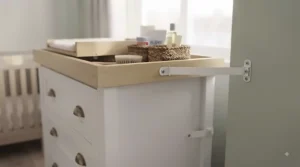
Here’s the bit new parents rarely expect: the changing top is the part that fails first. Reviewers across UK retailers repeatedly flag wobbly changing rails, flimsy spring-pin attachments, or drawers that jam once loaded with clothes, long before the underlying dresser itself gives any trouble. That’s precisely why this guide focuses on real, currently sold models with genuine reviewer sentiment attached, rather than manufacturer marketing copy.
According to NHS guidance on baby and toddler safety, babies “soon learn to wriggle and kick,” and can roll off changing surfaces far earlier than most parents expect — which is precisely why the sturdiness and rail height of the unit you buy matters more than its finish or colourway. We’ve pulled together seven real changing dressers currently available to UK shoppers, spanning budget flatpack options through to premium solid-wood pieces, with honest analysis of who each one actually suits.
Quick Comparison Table
| Product | Drawers | Best For | Price Range |
|---|---|---|---|
| WOLTU Baby Changing Table | 4 | Budget nurseries, dual-mode use | around £90-£120 |
| AIYAPLAY Baby Changing Table | 4 | Budget, weight-rated safety focus | around £90-£110 |
| My Babiie Changing Unit | 3 trays + 4 compartments | Bath-time all-in-one | around £120-£160 |
| Obaby Nika Changing Unit | 3 | Mid-range, established brand | around £180-£230 |
| Little Acorns Ellesmere Dresser | 3 | Removable top, converts cleanly | around £250-£280 |
| Tutti Bambini Rio Chest Changer | 3 | Solid wood, matching room sets | around £280-£350 |
| Mamas & Papas Oxford Dresser Changer | 3-4 | Premium, longest-lasting build | around £350-£450 |
Looking at the spread here, the jump from around £100 to over £300 isn’t just about finish quality — it typically buys solid wood construction over MDF/particleboard, sturdier drawer runners, and a changing top that’s less likely to loosen with daily use. If you’re planning to use the dresser well beyond the changing years, spending toward the middle or top of this table tends to pay for itself in longevity.
💬 Just one click — help others make better buying decisions too!😊
Top 7 Changing Dressers: Expert Analysis
Coverage spans budget, mid-range and premium options, including a couple of lesser-known picks worth considering alongside the household names.
1. WOLTU Baby Changing Table — best budget dual-mode dresser
The WOLTU changer is built from MDF and particleboard with a detachable top section, meaning the same unit works as a changing station in year one and a plain four-drawer dresser afterwards. What most buyers overlook about budget units like this is that the safety features actually matter more here than the finish — WOLTU includes anti-slip buckles, an anti-dumping device to stop the whole unit tipping forward when a top drawer is pulled out, and rounded corners throughout.
Based on the spec comparison, four drawers at this price point is generous, though reviewers consistently note the drawer runners feel noticeably lighter-duty than pricier alternatives, meaning they’re best suited to lighter items like babygrows and muslins rather than being packed with heavy toddler clothing later on.
Pros:
- ✅ Detachable top converts cleanly to a standalone dresser
- ✅ Anti-dumping device reduces tip-over risk when loaded
- ✅ Four drawers offer generous storage for the price
Cons:
- ❌ Drawer runners feel lightweight under heavier loads
- ❌ Assembly instructions are commonly described as unclear
At around £90-£120, the WOLTU is a sensible first-nursery purchase for budget-conscious parents who want genuine safety features without a premium price tag.

2. AIYAPLAY Baby Changing Table — best budget pick for weight-rated safety
AIYAPLAY specifies a maximum changing weight of 11kg, which is worth flagging honestly since it’s noticeably lower than the 15kg ceiling set by the UK’s own changing unit safety standard — meaning this unit is realistically a birth-to-around-nine-months changer rather than a longer-term solution. What most buyers overlook is that the trade-off buys a genuinely comfortable working height, designed specifically to reduce the back strain that comes with bending over a low surface repeatedly through the day.
The layout — one large drawer plus three smaller ones — favours parents who want quick, one-handed access to nappies and creams without digging through a jumbled single drawer. Reviewers consistently note the ergonomic height as the standout feature, though several point out that four separate compartments demand more organisation upfront than a simpler dresser layout.
Pros:
- ✅ Ergonomic height genuinely reduces bending and back strain
- ✅ Four-compartment layout speeds up quick nappy changes
- ✅ Straightforward wipe-clean surface for everyday mess
Cons:
- ❌ 11kg weight limit is lower than most competitors
- ❌ Smaller drawers offer less capacity for bulkier clothing
Priced around £90-£110, the AIYAPLAY suits parents prioritising day-to-day ergonomics over long-term dresser use — just budget for a second piece of furniture once your baby outgrows the weight limit.
3. My Babiie Changing Unit — best all-in-one with concealed bath
The My Babiie unit folds a padded, raised-edge changing mat and a concealed bath into one mobile unit on lockable castors, aiming to solve bath time and changing time with a single purchase. Here’s what to weigh: the raised mat edges genuinely add a layer of rolling protection beyond a flat changing top, and the lockable castors mean the whole unit can move between bathroom and bedroom rather than committing to one fixed spot.
Storage comes via three trays and four compartments rather than traditional drawers, which reviewers frame as a genuine style choice — quicker to grab from mid-change, but offering less concealed storage than a drawer-based dresser if tidiness matters to you.
Pros:
- ✅ Concealed bath genuinely simplifies bath-then-change routines
- ✅ Raised mat edges add rolling protection during changes
- ✅ Lockable castors make repositioning around the home easy
Cons:
- ❌ Tray-based storage offers less concealment than drawers
- ❌ Doesn’t convert into a standalone dresser once outgrown
At around £120-£160, this suits parents in smaller homes without a dedicated bathroom changing space, though it’s a poorer long-term investment than dresser-based options if you want furniture that lasts beyond the changing years.
4. Obaby Nika Changing Unit — best mid-range from an established UK nursery brand
Obaby’s Nika unit pairs three full-depth, 32-litre drawers with a changing top attached via discreet spring pins, designed to accommodate a standard 76 x 46cm changing mat without visible screws marring the finish. What most buyers overlook is how that spring-pin design pays off later: removing the changing area leaves no visible holes or hardware, so the piece genuinely looks like a considered dresser rather than a converted changing table once your child outgrows nappies.
Reviewer sentiment aggregated across UK retailers is strongly positive, with buyers specifically praising the smooth metal drawer runners and the unit’s ability to hold a full toddler wardrobe once converted. The consistent critique is assembly time, which several reviewers describe as longer than expected for a three-drawer unit.
Pros:
- ✅ Spring-pin changing top leaves no visible holes once removed
- ✅ Generous 32-litre drawers offer genuine long-term storage
- ✅ Established UK nursery brand with wide parts availability
Cons:
- ❌ Assembly commonly described as more time-consuming than expected
- ❌ Only available in a limited range of finishes
At around £180-£230, the Nika represents the sweet spot for parents wanting a genuine dresser-first design that happens to double as a changer, rather than the other way round.
5. Little Acorns Ellesmere Dresser — best removable top for a seamless conversion
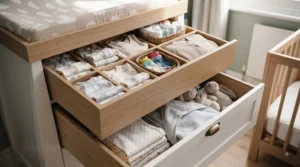
The Ellesmere’s standout feature is its upper surround, which detaches cleanly to convert the unit into a regular chest of drawers “leaving no visible holes,” according to the manufacturer’s own design brief — and independent retailer descriptions back up that claim. Each of the three deep drawers includes a reinforced metal support bar beneath the drawer bottom, which is the detail worth dwelling on: it’s specifically designed to stop the drawer base sagging under the weight of folded baby clothes over years of daily use, a failure point that plagues cheaper units.
Based on the spec comparison, the robust build quality here positions the Ellesmere as genuinely furniture-grade rather than nursery-specific, which is reflected in its solid, chunky proportions. Aggregated reviewer sentiment is limited in volume but consistently positive on build quality and the cleanliness of the conversion process.
Pros:
- ✅ Reinforced drawer bases resist sagging under heavy clothing
- ✅ Conversion to chest of drawers leaves no visible fixings
- ✅ Robust, furniture-grade build quality throughout
Cons:
- ❌ Limited independent review volume to verify long-term durability
- ❌ Premium pricing relative to drawer count offered
Around £250-£280 at the time of research, the Ellesmere suits parents specifically prioritising a dresser that will genuinely blend into a bedroom once the changing years are behind them.
6. Tutti Bambini Rio Chest Changer — best solid wood option for matching nursery sets
The Rio combines a solid wood frame with three large, soft-close drawers and a removable chest-top changer, sold as part of Tutti Bambini’s wider matching cot bed and wardrobe range for parents who want a coordinated nursery. The soft-close mechanism is a genuinely practical touch reviewers consistently note — it minimises the bang of a fully-loaded drawer slamming shut during a rushed night-time change, which matters more than it sounds once you’re doing it at 3am.
Honest analysis requires flagging the mixed material feedback here: while the marketing describes solid wood construction, aggregated Amazon UK reviews include a notable minority describing the material as chipboard covered in a plastic veneer, alongside repeated complaints that the top changing section works loose over time. This is worth taking seriously rather than glossing over — it’s a genuine, currently-verifiable pattern in customer feedback, not an isolated gripe.
Pros:
- ✅ Soft-close drawers reduce noise during night-time changes
- ✅ Matches a wider coordinated nursery furniture range
- ✅ Rated for use from birth up to approximately 15kg
Cons:
- ❌ A recurring minority of reviews report the changing top loosening
- ❌ Some buyers describe material quality as below expectations
At around £280-£350, the Rio is worth considering primarily for the matching room-set aesthetic — but budget time to check and re-tighten the changing top fixings periodically, based on the pattern in aggregated reviews.
7. Mamas & Papas Oxford Dresser Changer — best premium pick for longevity
Mamas & Papas is a long-established British nursery brand, and the Oxford Dresser Changer sits at the premium end of their range, built with the kind of substantial drawer boxes and hardware that reviewers consistently describe as feeling closer to adult bedroom furniture than nursery-specific pieces. What most buyers overlook about paying a premium here is that you’re largely buying out of the failure points that plague cheaper units — heavier-gauge drawer runners, a more robustly fixed changing top, and finishes designed to withstand a decade of use rather than eighteen months.
Reviewers consistently note it as a genuine investment piece, frequently mentioned alongside plans to keep using it as a standard dresser well into primary-school years. The honest trade-off is cost, and the fact that premium pricing puts it out of reach for parents on a tighter nursery budget who might be better served by a mid-range option used for a shorter window.
Pros:
- ✅ Substantial, furniture-grade build designed for long-term use
- ✅ Established British nursery brand with strong parts support
- ✅ Heavier-duty drawer runners than most competitors
Cons:
- ❌ Premium price point puts it beyond many first-nursery budgets
- ❌ Larger footprint may not suit smaller nursery rooms
At around £350-£450, the Oxford is the pick for parents treating this as decade-long bedroom furniture rather than a temporary changing solution.
Setting Up and Maintaining Your Changing Dresser Safely
Getting a changing dresser set up properly starts before your baby ever uses it. Assemble on a flat, hard floor rather than carpet, and once built, give the unit a firm shake test — a genuinely stable dresser shouldn’t rock or flex when you push against the top corners. If it’s a converted top-mounted design like several models here, check every screw or spring-pin fixing is fully seated before first use, and recheck monthly, since the changing top is consistently the first part to work loose according to aggregated reviewer feedback.
The most common mistake in the first thirty days is skipping the anti-tip anchor that most dressers ship with. RoSPA’s safety guidance is blunt on this point: furniture tip-overs cause hundreds of injuries and several fatalities among young children each year in the UK, almost always preventable with a simple wall-anchoring kit. Fit it immediately, even before the changing top goes on, because a mobile toddler pulling on drawers arrives faster than most parents expect.
For ongoing maintenance, wipe the changing surface after every use with a mild detergent rather than harsh chemicals that can degrade finishes over time, and periodically check drawer runners for the kind of loosening that turns a smooth-glide drawer into a jammed one within a year of heavy use.
Multi-Stage Nursery Furniture: Getting Years of Use From One Dresser
Multi-stage nursery furniture is designed to earn its keep well beyond the newborn changing phase, and the dresser is usually the piece with the longest realistic lifespan in the room — a cot gets outgrown within a couple of years, but a well-built dresser can genuinely serve from birth through to a child’s teenage bedroom.
Case in point: a family furnishing a nursery on a mid-range budget chose the Obaby Nika specifically because the spring-pin changing top left no visible marks once removed, meaning the piece could later sit in an older child’s bedroom without looking like leftover baby furniture. Conversely, a family who initially chose the cheapest all-in-one unit found themselves replacing it entirely by eighteen months once the changing top was removed, because the underlying storage wasn’t built to double as genuine bedroom furniture.
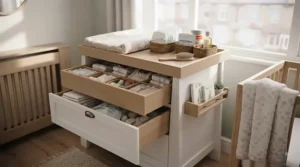
The pattern that emerges across real buyer experiences is consistent: dressers with a genuinely removable, cleanly-finished top — like the Little Acorns Ellesmere or Obaby Nika — tend to see multi-stage use fulfilled as intended, while budget units marketed as “converts to a dresser” sometimes leave visible fixing marks or feel noticeably less finished once the changing top comes off. If multi-stage use genuinely matters to your budget planning, it’s worth checking specifically how the conversion is described, not just whether it’s technically possible.
Changing Dresser Buying Guide: How to Choose the Right One
Choosing the right changing dresser comes down to six practical questions.
- Decide if you want genuine multi-stage furniture. If the dresser needs to last into your child’s later bedroom years, prioritise units with a cleanly removable top and reinforced drawer construction.
- Check the weight rating against realistic use. Most changing tops are rated to around 15kg under UK safety standards, but some budget units cap out lower — check before assuming full toddler-age coverage.
- Measure your available floor space first. A sprawling premium dresser can dominate a small nursery; match scale to room size before finish or brand.
- Weigh drawer count against drawer quality. More drawers at a lower price often means lighter-duty runners — read aggregated reviews for signs of sagging or jamming.
- Factor in assembly complexity. Solid wood premium units often take longer to build; budget flatpack options are typically faster but demand more careful fixing checks afterwards.
- Read genuine customer feedback, not just the spec sheet. Recurring complaints — like a changing top working loose — are a stronger signal than a single one-off review either way.
| Comparison Point | Budget Dresser | Premium Dresser |
|---|---|---|
| Typical build | MDF/particleboard | Solid wood or heavy-duty engineered board |
| Weight rating | Often below 15kg | Typically up to 15kg standard |
| Best For | Short-term, budget-first nurseries | Long-term, multi-stage furniture use |
The pattern in that table is straightforward: budget dressers solve the changing-years problem perfectly well, but premium options are really solving a different, longer problem — furnishing your child’s room for a decade rather than eighteen months.
Changing Dressers 2026: What’s Changed and What to Look For
Changing dressers heading into 2026 lean noticeably toward the dual-mode, quick-convert design seen across several models in this guide, reflecting genuine parent demand for furniture that doesn’t become dead weight once nappies are behind you. Reviewer sentiment across UK retailers increasingly rewards this specific feature — units with a clean, screw-free conversion process consistently outperform older-style designs where the changing top was a permanent, non-removable fixture.
Another shift worth noting: weight ratings are being stated more explicitly on product listings than in previous years, likely a response to the UK’s BS EN 12221 changing unit standard becoming more widely understood by parents doing their own research before buying. Reviewers consistently note this transparency as a genuine buying aid, since a stated 11kg limit versus a 15kg limit meaningfully changes how long a unit remains fit for purpose.
What hasn’t changed is the core trade-off between price and drawer runner quality — the gap between a £100 budget unit and a £350 premium one is still overwhelmingly explained by hardware durability rather than surface-level styling differences.
Highest Rated Nursery Dresser: What Reviewers Actually Praise
Looking across aggregated reviewer sentiment for the highest rated nursery dresser options currently available, three features come up again and again as genuine differentiators, rather than marketing language. Soft-close drawer mechanisms are consistently singled out, not for luxury appeal but for practical reasons — parents doing late-night changes repeatedly mention how much a slamming drawer disturbs a sleeping baby in the next room.
Reinforced drawer bases, as seen on the Little Acorns Ellesmere, are the second recurring theme; reviewers who’ve owned units for a year or more specifically flag sagging drawer bottoms as the failure point that separates genuinely well-rated dressers from disappointing ones. Third, and perhaps most tellingly, the highest-rated units across UK retailers tend to be ones with the smallest gap between marketing description and aggregated customer experience — the Obaby Nika, for instance, is consistently praised for delivering exactly what its listing describes, rather than falling short on build quality once assembled.
What most buyers overlook is that star ratings alone can be misleading with small review counts. A dresser showing five stars from two reviews carries far less evidential weight than one showing 4.3 stars across dozens — read the volume alongside the score, not just the headline number.

Changing Station Safety Standards: BS EN 12221 Explained
UK and EU changing units sold for domestic use are expected to meet BS EN 12221-1 and -2:2008+A1:2013, the harmonised standard covering both general safety requirements and structural performance testing for changing units, including freestanding and cot-top mounted designs. According to BSI’s own technical summary, the standard sets safety requirements specifically for children with a body weight no more than 15kg, which is precisely why checking a product’s stated weight limit against that 15kg benchmark is such a useful buying shortcut.
It’s worth being clear about what the standard actually covers, too: it applies to the item’s function as a changing unit specifically, and if that same unit converts into something else — a dresser, in this case — the underlying furniture also needs to meet relevant furniture safety requirements once converted. Where a changing top is removable, the standard notes that further testing considerations apply, which is a useful thing to bear in mind if a listing is vague about certification.
Fall risk remains the dominant real-world concern regardless of certification. As RoSPA’s guidance on preventing falls puts it plainly, babies should never be left unattended on raised surfaces, and nappies are best changed on the floor where a fall genuinely isn’t possible, rather than relying on a changing table’s rails and straps alone. A compliant, well-built dresser reduces risk considerably, but it doesn’t replace supervision.
If you want to double-check a specific model hasn’t been subject to a safety notice, the UK government maintains a searchable list at gov.uk’s product safety alerts and recalls page, which is worth a quick check before buying secondhand or from a less familiar retailer in particular.
Common Mistakes When Buying a Changing Dresser
The most common mistake is buying based on nursery aesthetics alone, without checking drawer construction or weight ratings against actual planned use. A beautifully styled unit that jams within six months isn’t a bargain at any price, and reviewer sentiment across every model in this guide makes clear that hardware quality, not finish, is what separates satisfied long-term owners from disappointed ones.
A second frequent error is assuming “converts to a dresser” always means a seamless, hole-free transition — as the Tutti Bambini Rio’s mixed feedback shows, that claim doesn’t always hold up in practice, and it’s worth checking aggregated reviews specifically for post-conversion complaints before committing.
Finally, many parents skip the anti-tip anchoring kit entirely, treating it as optional rather than essential. Given RoSPA’s data on furniture tip-over injuries, this is genuinely one of the cheapest, highest-value safety steps available, and skipping it is a mistake worth avoiding regardless of which dresser you choose.
Long-Term Cost & Value: Dresser vs Standalone Changing Table
A combined changing dresser typically costs more upfront than a basic standalone changing table plus a separate chest of drawers bought individually, but the maths shifts once you account for total furniture needed across a nursery’s lifetime. Buying a £250 dresser that converts cleanly into long-term storage generally beats buying a £60 standalone changer that becomes redundant within a year, plus a separate £150 chest of drawers bought later anyway.
| Option | Upfront Cost | Long-Term Value |
|---|---|---|
| Combined changing dresser | Higher | Strong — one purchase covers years |
| Standalone changer + separate dresser | Lower per item, higher combined | Weaker — changer often discarded early |
Reading across that comparison, the combined dresser route wins for most UK nurseries specifically because storage furniture is needed regardless of whether a baby is being changed on it — you’re not really paying extra for the changing function, you’re mostly paying for the same dresser you’d need to buy anyway, with a temporary top included.

Frequently Asked Questions
❓ What's the difference between a changing dresser and a standalone changing table?
❓ What weight limit should a changing dresser have?
❓ Do I need to anchor a changing dresser to the wall?
❓ How long does a changing dresser realistically last?
❓ Is solid wood always better than MDF for a changing dresser?
Conclusion
Choosing among the top rated changing dressers really comes down to being honest about how long you want the piece to last and how much floor space your nursery can spare. Budget options like the WOLTU and AIYAPLAY units solve the immediate changing-years problem well, without pretending to be decade-long furniture investments. The My Babiie Changing Unit carves out a genuinely useful niche for combined bath-and-change routines in smaller homes.
For most parents planning to keep their nursery furniture well beyond the nappy years, the mid-range Obaby Nika and Little Acorns Ellesmere strike the strongest balance of price, build quality and clean conversion, while the Tutti Bambini Rio remains a solid, if imperfect, pick for matching room sets. At the premium end, the Mamas & Papas Oxford Dresser Changer is the clearest long-term investment piece covered here. Whichever you choose, prioritise the anti-tip anchor and a genuine check of the weight rating over finish alone — the safety fundamentals matter more than any star rating.
Recommended for You
- Long-Lasting Changing Dresser for Toddler Use: 7 Picks (2026)
- Changing Dresser With Deep Drawers: 7 Best Picks for 2026
- Best Oak Changing Dresser UK: 7 Solid Wood Picks
Disclaimer: This article contains affiliate links. As an Amazon Associate, I earn from qualifying purchases. If you purchase products through these links, we may earn a small commission at no additional cost to you.
✨ Found this helpful? Share it with your friends! 💬🤗
