
In This Article
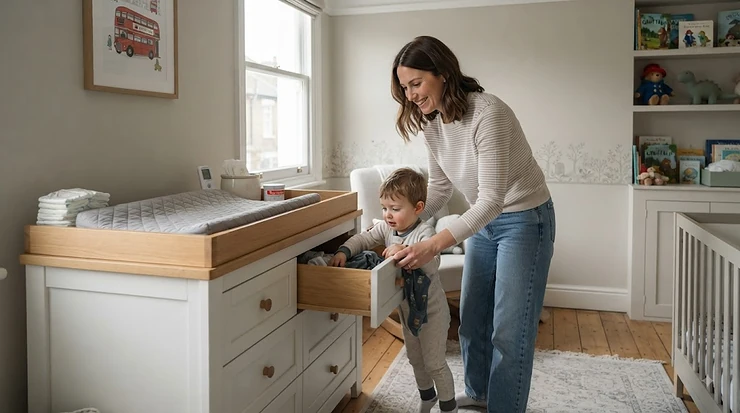
A long-lasting changing dresser for toddler use is a dresser designed to handle nappy changes in infancy and then quietly slide into life as ordinary bedroom storage, holding up to daily drawer-slamming, climbing attempts, and general toddler chaos for years rather than months. That’s the promise, anyway. The reality is that plenty of nursery furniture is built for the nine-month diaper stage and starts wobbling the moment a determined two-year-old decides the top drawer makes a decent step stool.
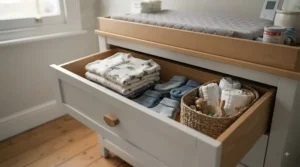
We’ve spent time digging through real specifications, UK stockist listings, and aggregated customer feedback for seven genuine dressers sold to British parents, from budget-friendly open-shelf units to heirloom-grade solid wood chests with dovetail joints. Somewhere in here is a piece that will still be standing (and still be useful) when your toddler is old enough to argue with you about bedtime.
Before we get into the detail, here’s the short version: material and joinery matter more than colour scheme, drawer weight capacity matters more than drawer count, and an anti-tip strap is non-negotiable the day your baby starts pulling up on furniture. The Office for Product Safety and Standards runs the UK’s official recall register, and nursery furniture does appear on it, so a bit of homework before you buy genuinely pays off.
Quick Comparison Table
| Dresser | Price Range | Material | Drawers | Best For |
|---|---|---|---|---|
| Boori Sleigh 3 Drawer Chest | £350-£450 range | Solid Australian/European timber | 3 | Buyers who want a genuine heirloom piece |
| CuddleCo Clara Luxe 6 Drawer Dresser | £450-£550 range | Engineered wood, painted finish | 6 | Families needing maximum storage |
| Tutti Bambini Modena | £200-£280 range | Solid wood, oak/white | 3 | Most nurseries wanting a dependable all-rounder |
| Tutti Bambini Roma | £180-£250 range | Solid pine | 3 | Classic sleigh styling on a mid-range budget |
| Obaby Maya | £220-£300 range | Engineered wood with wood veneer | 3 | Scandi-style nurseries, flat-top conversion |
| Babymore Mona | £230-£300 range | Engineered wood, painted finish | 3 | Best value three-drawer chest |
| CuddleCo Nola | £100-£160 range | Engineered wood, sustainable sourcing | Open shelving | Small spaces and lighter budgets |
Looking at this line-up, the split between “buy once, own for a decade” and “buy now, upgrade later” becomes obvious fast. The Boori Sleigh 3 Drawer Chest and CuddleCo Clara Luxe 6 Drawer Dresser sit at the top of the price range because they’re genuinely built to outlive the nursery stage, while the CuddleCo Nola trades some structural heft for a lower price point and a smaller footprint. If your priority is drawer capacity rather than heirloom credentials, the CuddleCo Clara Luxe and its six drawers pull ahead of every three-drawer option here.
💬 Just one click — help others make better buying decisions too!😊
Top 7 Long-Lasting Changing Dressers for Toddler Use: Expert Analysis
1. Boori Sleigh 3 Drawer Chest — dovetail-jointed drawers built for the long haul
The standout here is the joinery: Boori uses dovetail-jointed drawers rather than the glued or stapled construction found on cheaper units, and that single detail is a strong predictor of how a dresser handles a decade of toddler use. The frame is solid timber sourced from Australia and Europe, finished in a low-VOC paint, and the unit measures roughly 90cm high, 99cm wide, and 49cm deep, with a flat top designed to hold a change pad in the early years and simply function as display or storage space later on. A wall strap kit is included as standard, which matters enormously once your toddler starts using open drawers as footholds.
Based on the spec comparison, this is the dresser to choose if you genuinely intend to keep it through primary school rather than pass it on after year one. Dovetail joints resist the racking stress of repeated slamming far better than butt-jointed drawers held together with staples, which is exactly the kind of wear a climbing, drawer-yanking toddler produces daily. Boori’s own product pages note a 3-year manufacturer’s warranty as standard, extendable to 5 years directly with the brand, which is a meaningfully longer commitment than most budget competitors offer and speaks to how the company expects the piece to perform.
Verified review data specific to this exact configuration was limited in our research, but Boori as a brand carries a consistent reputation among UK nursery retailers for premium timber construction and smart, tool-light assembly, and that brand-level track record is worth weighing here.
Pros:
- ✅ Dovetail-jointed drawers built for genuine longevity
- ✅ Wall strap kit included, not sold separately
- ✅ Tool-light Smart Assembly system speeds up build day
Cons:
- ❌ Sits at the premium end of this list on price
- ❌ Solid timber adds noticeable weight versus engineered-board rivals
At around £350-£450, the Boori Sleigh 3 Drawer Chest costs more upfront than most alternatives here, but if you’re calculating cost-per-year rather than cost-per-unit, the dovetail construction and extendable warranty make a strong case for it being the cheapest option in the long run.

2. CuddleCo Clara Luxe 6 Drawer Dresser Changing Unit — the most bedroom storage of any changer on this list
What most buyers overlook about six-drawer dressers is how much they simplify the toddler years specifically, because by eighteen months you’re not just storing nappies, you’re storing a rapidly expanding wardrobe of vests, socks, pyjamas and outdoor kit, and three drawers fill up fast. The CuddleCo Clara Luxe is built around that reality, with six generously sized drawers on smooth runners and a finish designed to coordinate with CuddleCo’s wider Clara nursery range, including matching cot beds and wardrobes.
The practical upshot is that this is the one dresser on our list genuinely capable of functioning as a child’s entire clothing storage solution well into the toddler and preschool years, rather than needing a second chest of drawers bought separately down the line. That’s a real value calculation worth doing: buying one six-drawer unit instead of a three-drawer changer plus a follow-up dresser two years later often works out cheaper overall, even though the sticker price looks steeper on day one.
Aggregated feedback for the wider CuddleCo Clara range, which we could verify through UK retailer listings, consistently flags smooth-running drawers and a finish that holds up well to daily use, though as with any painted engineered-wood piece, buyers should expect the usual caveats around avoiding standing water on the surfaces.
Pros:
- ✅ Six drawers means no second dresser purchase later
- ✅ Coordinates with a full matching nursery furniture range
- ✅ Smooth-close runners reduce noise during night changes
Cons:
- ❌ Among the priciest options in this round-up
- ❌ Larger footprint needs more floor space than three-drawer units
Priced around £450-£550, the CuddleCo Clara Luxe 6 Drawer Dresser earns its keep through sheer storage capacity, and parents who hate the idea of re-buying furniture in two years’ time will likely find the value stacks up.
3. Tutti Bambini Modena Solid Wood Changing Table — the reliable all-rounder most nurseries actually need
The Modena expands on a simple idea done well: three deep, solid wood drawers under a removable changing top, finished in a two-tone white and oak combination that reads as grown-up furniture rather than obviously “baby” furniture. Tutti Bambini has been designing UK nursery furniture for over three decades, and the Modena reflects that experience with soft-close drawer mechanisms and a solid wood frame rather than the MDF-only construction common at this price point.
Here’s what to weigh with a solid wood mid-range piece like this: you’re not paying premium prices for dovetail joinery or a six-drawer capacity, but you are getting genuine wood construction rather than veneered board, which tends to resist the dings, scuffs and general wear of toddler life noticeably better than pressed-board alternatives over a three-to-five year period. The removable changing top is a genuine transformation feature too, since once nappy days are done the unit becomes a completely normal-looking bedroom chest of drawers with no lingering baby-furniture giveaway.
Amazon UK listings for the Modena carry a solid volume of customer reviews, and the recurring theme in aggregated feedback is satisfaction with the solid wood build quality and the ease of removing the changing top once it’s no longer needed, alongside occasional notes about the roughly 45-minute two-person assembly time.
Pros:
- ✅ Genuine solid wood frame, not just veneer
- ✅ Removable top converts it cleanly to a plain dresser
- ✅ Soft-close drawers reduce slamming noise and wear
Cons:
- ❌ Three drawers may feel tight by the second birthday
- ❌ Assembly reportedly needs two adults and roughly 45 minutes
In the £200-£280 range, the Tutti Bambini Modena Solid Wood Changing Table represents one of the strongest value propositions here for families who want solid materials without paying premium-tier prices.
4. Tutti Bambini Roma Chest Changer — classic sleigh styling that still looks grown-up at three
The Roma’s standout is its sleigh-design silhouette, a curved-front, traditional shape constructed from solid pine that avoids the boxy look of most flat-pack changers, painted in a soft dove grey finish. Three spacious drawers with a soft-close function sit beneath a removable chest-top changer, and the whole piece is designed to coordinate with the wider Roma nursery furniture collection, including a matching cot bed and wardrobe if you want a fully coordinated room.
The spec sheet won’t tell you this, but the sleigh silhouette matters more than it might seem for long-term use: rounded, traditional furniture shapes tend to age better stylistically than boxy minimalist units, meaning the piece is less likely to look dated or obviously “nursery-only” by the time your toddler moves into a proper bed and the room gets its first redecoration. Solid pine also takes light scuffing better than MDF, provided you keep the painted finish topped up if it ever chips.
Reviewers consistently note two things about the Roma in aggregated Amazon feedback: quick delivery and, more importantly, real satisfaction with how it looks once built, with several buyers specifically praising the depth of the drawers for genuine clothing storage rather than just nappies. A smaller number mentioned needing a replacement part, which the supplier resolved without much fuss.
Pros:
- ✅ Solid pine construction with a traditional sleigh shape
- ✅ Coordinates with a full matching Roma furniture set
- ✅ Deep drawers rated well by reviewers for real storage
Cons:
- ❌ Occasional reports of parts needing replacement on arrival
- ❌ Traditional styling won’t suit every modern nursery scheme
At around £180-£250, the Tutti Bambini Roma Chest Changer sits comfortably in the mid-range and is worth strong consideration if classic styling matters as much to you as raw durability.
5. Obaby Maya Changing Unit — Scandi styling built to flatten into a proper dresser
Inspired by Scandinavian design, the Maya’s standout feature is its clean two-tone colourway paired with recessed drawer handles, giving it a look that leans more “modern furniture” than “baby product” from day one. Three drawers, each with a genuinely useful 34-litre capacity, sit beneath a changing area sized to fit pads up to 80 x 46.5cm, and once nappy days end the changing top lifts away entirely to leave a flat-top chest of drawers with no visible hardware or leftover fittings.
Based on the spec comparison, the 34-litre-per-drawer capacity is a genuinely useful detail that’s easy to overlook when comparing dressers on looks alone: that’s roughly enough room per drawer for several weeks of toddler clothing, which matters once you’re storing jumpers and outerwear rather than just onesies. The clean conversion into a proper flat-top chest also means this is one of the better options if you’re planning to move the piece into a toddler’s own bedroom once the nursery is repurposed, since there’s no obvious “baby furniture” tell left behind.
Obaby has built a solid reputation among UK nursery retailers for design-led, mid-market furniture, and while granular review data for this specific model was limited in our research, the wider Obaby range consistently earns praise from stockists for finish quality relative to price.
Pros:
- ✅ 34-litre drawers offer genuinely useful capacity
- ✅ Changing top removes cleanly with no leftover hardware
- ✅ Scandinavian styling suits most modern nursery schemes
Cons:
- ❌ Engineered wood rather than solid timber throughout
- ❌ Recessed handles are stylish but less toddler-grippable later
Priced around £220-£300, the Obaby Maya Changing Unit is a strong pick for parents who want design credibility without paying premium solid-wood prices.

6. Babymore Mona Chest Drawers Nursery Changing Unit — best value three-drawer option
The Mona’s standout is straightforward value: a full three-drawer chest with an integrated changing area, priced noticeably below several comparable three-drawer competitors on this list without an obvious drop in build quality. It follows the now-familiar formula of a removable or repurposable top surface over spacious drawers, finished in neutral tones designed to suit most nursery colour schemes without needing to be matched to a wider furniture set.
Here’s the practical read: at this price point, you’re generally trading some of the heavier-duty joinery and material upgrades of premium options for a genuinely serviceable three-to-five-year piece of furniture, which for many families is exactly the right trade-off. Not every parent needs dovetail joints and a five-year extended warranty; plenty simply need something sturdy enough to survive one toddler’s worth of daily use and drawer-slamming without falling apart, and that’s precisely the gap the Mona fills. What most buyers overlook when comparing budget and premium dressers is that “long-lasting” doesn’t have to mean “expensive,” it just needs to mean the materials and hardware suit how the piece will actually be used.
Babymore has built its UK retail presence largely around value-focused nursery ranges, and while we couldn’t verify a large, dedicated review pool for this exact SKU during research, its position as a consistently stocked mid-market brand across UK nursery retailers is a reasonable proxy for baseline reliability.
Pros:
- ✅ Strong value relative to comparable three-drawer units
- ✅ Neutral finish suits most nursery colour schemes unmatched
- ✅ Full-size drawers rather than a scaled-down “starter” unit
Cons:
- ❌ Fewer premium build details than top-tier competitors
- ❌ Limited independently verifiable review volume at time of research
At roughly £230-£300, the Babymore Mona Chest Drawers Nursery Changing Unit is worth shortlisting for budget-conscious buyers who still want a proper, full-sized three-drawer chest rather than a compromise piece.
7. CuddleCo Nola Baby Changing Table — the lightest, simplest option for small spaces
The Nola’s standout is its open-shelf design rather than closed drawers, built with sustainability in mind and finished with raised sides around the changing area for extra safety during use. Two large open shelves sit beneath the changing surface, rated for children up to 11kg, offering a lighter, more compact footprint than any drawer-based unit on this list, which matters enormously in a small box room or shared nursery-office space.
On paper this means less enclosed storage than a drawer chest, and that’s a genuine trade-off worth being honest about: open shelving suits folded stacks, baskets, and bins better than loose items, and it doesn’t offer the same “toddler-proofing” against curious little hands rummaging through drawers later on. That said, for parents prioritising a small footprint, easy access with one hand mid-change, and a lower price point, the Nola’s open design is a deliberate feature rather than a shortcoming, and CuddleCo positions the whole Nola range around sustainably sourced materials, which matters to a growing number of UK buyers.
CuddleCo has built a strong reputation across the UK nursery furniture market for stylish, practical, sustainably-minded design, and the Nola range specifically draws consistently positive attention from UK nursery retailers for its Scandi-contemporary look, though buyers wanting maximum long-term toddler-proofing should weigh the open-shelf format carefully against the drawer-based alternatives above.
Pros:
- ✅ Lightest, most compact option for small nurseries
- ✅ Open shelving allows one-handed access during changes
- ✅ Positioned around sustainably sourced materials
Cons:
- ❌ Open shelves offer less enclosed, toddler-proof storage
- ❌ Weight rating tops out lower than drawer-based rivals
At around £100-£160, the CuddleCo Nola Baby Changing Table is the most accessible entry point on this list, and a sensible pick if space and budget matter more than maximum drawer capacity.
Top 7 Products: Specs & Value at a Glance
| Product | Drawers/Storage | Max Weight Rating | Assembly | Value Verdict |
|---|---|---|---|---|
| Boori Sleigh 3 Drawer Chest | 3 dovetail-jointed drawers | Not specified for changer use | Smart Assembly, tool-light | Premium, built to outlast toddlerhood |
| CuddleCo Clara Luxe 6 Drawer Dresser | 6 drawers | Standard nursery use | Two-person recommended | Best for maximum storage |
| Tutti Bambini Modena | 3 solid wood drawers | Up to ~15kg on changer | ~45 mins, two adults | Strong mid-range value |
| Tutti Bambini Roma | 3 solid pine drawers | Up to ~15kg on changer | Two adults recommended | Classic looks, solid mid-tier |
| Obaby Maya | 3 x 34L drawers | Standard nursery use | Moderate | Design-led mid-range |
| Babymore Mona | 3 drawers | Standard nursery use | Moderate | Best budget three-drawer |
| CuddleCo Nola | 2 open shelves | Up to 11kg on changer | Straightforward | Cheapest entry point |
This table makes the trade-off between enclosed and open storage obvious: every drawer-based unit here comfortably outperforms the CuddleCo Nola on weight capacity and toddler-proof concealment, but the Nola undercuts them all on price and footprint. If your nursery is genuinely tight on space, or you’re not planning to store a full wardrobe of clothing in the unit, that trade-off may well be worth making.
How to Choose a Long-Lasting Changing Dresser for Toddler Use
Picking the right piece comes down to seven practical checks, each with real consequences for how the dresser performs once your baby becomes a climbing, drawer-yanking toddler.
- Check the joint construction, not just the material. Dovetail or mortise-and-tenon joints resist racking stress far better than glued butt joints, regardless of whether the wood itself is solid or engineered.
- Confirm the weight rating covers a toddler, not just a newborn. Many changing tops are only rated for use up to around 11-15kg, so check whether that’s for the changing surface specifically or the whole unit’s storage capacity.
- Look for a removable or convertible top. A dresser that becomes an ordinary chest of drawers once nappy days end gets years more genuine use than a fixed changing station.
- Prioritise drawer depth over drawer count. Three genuinely deep drawers often out-store four shallow ones, especially once you’re folding jumpers rather than vests.
- Factor in anti-tip hardware from the outset. Whether or not a wall strap is included, budget for one and fit it before your baby starts pulling up on furniture, not after.
- Match the finish to your cleaning habits. Painted MDF wipes clean easily but chips more visibly than solid wood, which shows less obvious wear but needs the occasional touch-up.
- Read aggregated reviews for assembly complaints specifically. A structurally sound dresser that arrives with stripped screw holes or missing parts creates a wobble that no amount of good design can fix later.
Toddler-Proof Chest of Drawers: Anti-Tip Straps and Safety Regulations
A toddler-proof chest of drawers isn’t really about the furniture alone, it’s about how securely that furniture is fixed to the wall behind it. Furniture tip-over remains a genuine, well-documented household hazard once a baby starts standing and climbing, and RoSPA’s home safety guidance covers this alongside broader household risks that become relevant the moment a child starts moving independently.
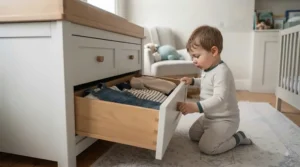
Anti-tip furniture straps are the standard fix: a bracket fixed to the back of the dresser and another fixed into a wall stud or suitable fixing, joined by an adjustable strap or metal bracket that stops the unit tipping forward if a toddler climbs, hangs off an open drawer, or pulls up using the top edge for balance. Some dressers, including the Boori Sleigh 3 Drawer Chest, include a wall strap kit as standard; for units that don’t, budget an extra £10-£20 for a compatible kit and fit it as part of your assembly day rather than treating it as an optional extra to sort out later.
It’s also worth understanding the regulatory backdrop. UK furniture sold to consumers has historically been covered by the Furniture and Furnishings (Fire) (Safety) Regulations 1988, though amendments coming into force from 2025 onward have specifically narrowed how these rules apply to certain baby and young children’s products, so it’s sensible to check a retailer’s current compliance claims rather than assume older labelling requirements still apply unchanged. Toddler-proofing a nursery more broadly also means securing any nearby freestanding wardrobes, bookcases, or TVs using the same anti-tip principle, not just the changing dresser itself.
✨ Don’t Miss These Exclusive Deals!
🔍 Take your nursery from newborn-ready to toddler-proof with these carefully selected dressers. Click through on any highlighted pick to check current pricing and availability before it changes. A sturdy, well-anchored dresser is one of the easiest wins for a genuinely safer nursery.
Practical Usage Guide: Setting Up and Maintaining Your Changing Dresser
Getting the most life out of any dresser starts before the first nappy change. During assembly, resist the urge to skip steps for speed: cam-lock and dowel joints (common on the Obaby Maya, Babymore Mona, and similar engineered-wood units) need to be fully seated and tightened, because a loose joint at month one becomes a wobble by month twelve and outright instability by the time a toddler is climbing on it. For solid wood pieces like the Tutti Bambini Modena or Tutti Bambini Roma, check that all screws are driven fully home rather than left proud, since exposed screw heads catch on clothing and gradually work themselves looser under repeated drawer use.
Fit the anti-tip wall strap on assembly day, not later. This is genuinely the single most common first-30-days mistake: parents plan to “get round to it” once the nursery is fully set up, and then the task quietly slips for weeks while a mobile baby is already in the room. Locate a wall stud or suitable masonry fixing behind the dresser’s final position before you finish arranging the room, because moving a wall-strapped dresser later means re-drilling.
For ongoing maintenance, wipe painted finishes with a soft cloth and mild detergent rather than anything abrasive, which preserves the surface against the daily contact of nappy changes and general handling. Check drawer runners every few months for stiffness or squeaking, since toddlers tend to yank rather than slide, and a quick dab of candle wax or silicone lubricant on wooden runners keeps them gliding smoothly. Re-tighten all visible screws and fixings roughly twice a year, particularly on the changing-top attachment points if you’re keeping the top in place rather than removing it, since this is the joint under the most repeated stress from leaning and reaching during changes.
Real-World Scenarios: Matching Families to a Changing Dresser That Lasts Years
The small-flat first-time parent. Limited floor space, a tight budget, and no immediate plans for a second child point toward something compact and affordable. The CuddleCo Nola or Babymore Mona both suit this brief, prioritising footprint and price over maximum storage capacity, with the Nola winning on space and the Mona winning on enclosed, toddler-proof drawers.
The family planning multiple children. If this dresser needs to serve more than one baby over several years, durability calculations shift entirely. The Boori Sleigh 3 Drawer Chest, with its dovetail joinery and extendable warranty, or the Tutti Bambini Modena‘s solid wood frame, both make more financial sense here than a budget unit that might need replacing between children.
The family prioritising clothing storage over changing convenience. Some parents already own a separate changing mat setup and mainly want serious wardrobe storage that happens to include a changing surface for the early months. The CuddleCo Clara Luxe 6 Drawer Dresser is the clear fit, since its six drawers comfortably absorb a toddler’s rapidly growing wardrobe without needing a second piece of furniture bought eighteen months later.
The style-conscious family redecorating as the child grows. If the dresser needs to look intentional in a toddler’s bedroom, not just functional in a nursery, the Tutti Bambini Roma‘s classic sleigh shape or the Obaby Maya‘s Scandi two-tone finish both age well stylistically, avoiding the obviously “baby furniture” look that some changing units never shake off.
Changing Dresser vs Standalone Changing Table: Which Wins for Durable Nursery Furniture?
The core difference is longevity by design. A standalone changing table is generally built around a single purpose, a raised surface at a comfortable height with side rails, and once your toddler outgrows nappy changes, that purpose disappears along with the furniture’s usefulness. A changing dresser, by contrast, is built around a chest of drawers first and a changing surface second, with the changing element typically removable, meaning the furniture’s core function survives long after nappies stop.
| Factor | Changing Dresser | Standalone Changing Table |
|---|---|---|
| Post-nappy usefulness | Converts to ordinary storage | Usually retired entirely |
| Storage capacity | High (drawers included) | Often minimal or none |
| Footprint efficiency | One piece, dual purpose | Requires separate storage furniture too |
| Typical price range | £100-£550 depending on tier | Often cheaper upfront, but limited lifespan |
| Best For | Families wanting genuine long-term value | Very tight budgets or temporary setups |
The analysis here is fairly clear-cut for anyone weighing durable nursery furniture as a genuine multi-year investment: a standalone changing table can look like the cheaper option at the point of sale, but once you factor in that most families then need to buy a separate dresser or wardrobe anyway, either immediately or within a year or two, the true total cost often ends up higher than simply buying a proper changing dresser from the start. The only real exception is families who already own ample bedroom storage and genuinely just need a temporary, low-cost changing surface for a short window.
Common Mistakes When Buying a Toddler-Proof Chest of Drawers
Even well-intentioned buyers trip up on a handful of recurring issues. First, choosing purely on aesthetics: a dresser that photographs beautifully but uses thin engineered board and basic drawer runners will show its limitations fast once a toddler is actively using it rather than just being photographed next to it. Second, skipping the anti-tip strap because it feels like an unnecessary extra step on an already long assembly day, a decision that’s genuinely one of the more common and preventable safety gaps in UK nurseries.
Third, underestimating storage needs by focusing purely on the newborn stage, when drawer capacity that felt generous for tiny vests and sleepsuits becomes tight within a year once jumpers, dungarees, and outdoor kit enter the wardrobe. Fourth, ignoring the weight rating on the changing surface itself, particularly relevant if you plan to keep using the top for nappy changes well into the second year, since many changing tops are only rated up to around 11-15kg. Fifth, assuming all “solid wood” claims mean the same thing: some listings describe a solid wood frame with an engineered-board back or drawer base, which is a perfectly reasonable construction method but a meaningfully different proposition from a fully solid timber build like the Boori Sleigh 3 Drawer Chest, so it’s worth reading the small print rather than the headline material claim.
Long-Term Cost & Maintenance: Getting Years of Use From Your Dresser
| Tier | Upfront Price Range | Typical Lifespan | Cost-Per-Year Estimate |
|---|---|---|---|
| Budget (CuddleCo Nola) | £100-£160 | 2-4 years | Roughly £30-£50/year |
| Mid-range (Tutti Bambini Roma/Modena, Obaby Maya, Babymore Mona) | £180-£300 | 4-7 years | Roughly £30-£60/year |
| Premium (Boori Sleigh 3 Drawer Chest, CuddleCo Clara Luxe) | £350-£550 | 8-15+ years | Roughly £30-£55/year |
The analysis here genuinely surprises a lot of first-time buyers: because premium pieces last so much longer, their cost-per-year often lands in roughly the same territory as mid-range and even some budget options, despite a much higher sticker price. That’s the real argument for total cost of ownership thinking rather than upfront price alone. A dresser bought once and used across two or three children, or resold in good condition after the toddler years, frequently ends up the cheapest option in practice, not the most expensive.
Maintenance costs stay low across every tier here, generally limited to the occasional anti-tip strap, replacement drawer runner, or touch-up paint, none of which run to more than a few pounds. The bigger financial risk is a budget piece that structurally fails within a year or two, forcing an unplanned replacement purchase that erases any initial saving.
Features That Actually Matter (And Those That Don’t)
Drawer joinery, wall-strap compatibility, and genuine solid wood versus engineered board are the features that actually determine how well a dresser survives toddlerhood, and they’re exactly the details that get buried under marketing copy focused on colour options and “Scandi-inspired” styling. A removable changing top matters too, since it’s the single feature that most directly extends a dresser’s useful life beyond the nappy years.
What matters far less than marketing suggests: the number of colourways available, whether the brand offers a “matching nursery set” (nice for aesthetics, irrelevant to durability), and soft-touch cosmetic details like recessed handles, which look sleek but occasionally prove less toddler-grippable once your child starts trying to open drawers independently. Reviewers consistently note that build quality and assembly experience matter far more to long-term satisfaction than any styling detail, which is worth remembering when a beautifully photographed listing is tempting you to overlook a thin spec sheet.
FAQ
❓ How long does a toddler-proof chest of drawers actually last?
❓ Do I need anti-tip furniture straps for every nursery dresser?
❓ Is a changing dresser that lasts years worth the higher price?
❓ Can I remove the changing top once my toddler no longer needs it?
❓ What's the difference between engineered wood and solid wood nursery furniture?
Conclusion
A long-lasting changing dresser for toddler use isn’t really one product, it’s a spec sheet of small decisions: joint construction, weight rating, wall-strap compatibility, and whether the changing top comes off cleanly once you’re done with it. Get those details right and almost any of the seven dressers here, from the budget-friendly CuddleCo Nola to the heirloom-grade Boori Sleigh 3 Drawer Chest, will earn its keep well beyond the nappy years.
If durability is your single biggest priority, the Boori Sleigh 3 Drawer Chest and Tutti Bambini Modena both make strong cases through genuine solid wood construction. If storage capacity matters most as your toddler’s wardrobe grows, the CuddleCo Clara Luxe 6 Drawer Dresser is difficult to beat. And if space or budget are the binding constraints, the CuddleCo Nola and Babymore Mona both deliver real, practical value without pretending to be something they’re not.
Whichever you choose, don’t treat the anti-tip strap as optional, and don’t buy on styling alone. A dresser is one of the few nursery purchases genuinely capable of following your child from newborn to school age, so it’s worth the extra five minutes of research to get right.
Recommended for You
- Changing Dresser With Deep Drawers: 7 Best Picks for 2026
- Best Oak Changing Dresser UK: 7 Solid Wood Picks
- White Changing Dresser: 7 Best Picks for 2026 Nurseries
Disclaimer: This article contains affiliate links. As an Amazon Associate, I earn from qualifying purchases. If you purchase products through these links, we may earn a small commission at no additional cost to you.
✨ Found this helpful? Share it with your friends! 💬🤗
