
In This Article
Picture this: you’ve just landed at Palma airport, the kids are buzzing with excitement, and then the car hire desk quotes you £70 for a week’s booster seat rental. For a bit of foam and plastic that’s seen better days and probably travelled more miles than your average minicab.
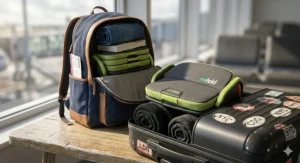
Here’s what most British parents don’t realise until it’s too late: a decent travel booster seat pays for itself after precisely one holiday. Whether you’re hopping into a taxi in central London, visiting the grandparents in Cornwall, or grabbing a hire car in Málaga, having your own portable booster seat transforms those awkward “we’ll just risk it for this short journey” moments into properly safe trips.
UK law requires children to use an appropriate car seat until they’re 12 years old or 135 cm tall, whichever comes first, as outlined by UK Government guidance. But the reality on British roads tells a different story: according to research from the Royal Society for the Prevention of Accidents (RoSPA), around 25% of child journeys happen without the correct restraint, often because the right seat simply wasn’t available when needed. Taxis, carpools, grandparents’ cars, airport transfers—these are the journeys where portable booster seats earn their keep.
The travel booster seat market has evolved considerably since the chunky backpack-seats of 2015. Today’s options range from inflatable cushions weighing less than a bag of sugar to telescopic designs that collapse smaller than a laptop. According to Which? consumer testing, not all portable boosters offer equivalent protection, making informed choice crucial. What hasn’t changed is the fundamental challenge: balancing genuine safety certification with portability light enough that you’ll actually take it with you. In this guide, I’ve tested and reviewed seven products available on Amazon.co.uk that manage that balance, drawing on real-world use across everything from Edinburgh taxis to Spanish hire cars. Every product listed meets UK safety standards (ECE R44/04 or the newer R129), because lightweight shouldn’t mean compromised.
Quick Comparison: Top 7 Travel Booster Seats at a Glance
| Product | Weight | Packed Size | Price Range | Best For | Safety Standard |
|---|---|---|---|---|---|
| BubbleBum Inflatable | 0.54 kg | 25 × 20 cm | £35-£45 | Ultimate portability | R44/04, FMVSS 213 |
| BubbleBum Teleport | 1.2 kg | 40 × 14 cm | £45-£55 | No inflation needed | R129 |
| Mifold Grab-and-Go | 0.75 kg | 26 × 13 cm | £40-£50 | Ultra-compact design | R44/04 |
| Mifold Hifold | 4.6 kg | 34 × 25 cm | £100-£130 | High-back protection | R44/04 |
| Trunki BoostApak | 2.0 kg | 40 × 36 cm | £50-£65 | Backpack + booster | R129 |
| Cozy N Safe Neo | 1.8 kg | 35 × 30 cm | £25-£35 | Budget-friendly | R129 |
| Graco TurboBooster | 2.4 kg | Standard size | £30-£45 | Everyday lightweight | R44/04 |
Looking at this table, the weight difference between the BubbleBum Inflatable and the Mifold Hifold is striking—that’s the gap between something you genuinely won’t notice in your cabin bag and something you’ll definitely feel after lugging through three airport terminals. The trade-off, naturally, is protection: lighter seats sacrifice the side-impact shielding and adjustable headrests you get with high-back boosters. For occasional taxi rides and holiday hire cars, most UK families find the compromise worthwhile. For daily school runs in your own vehicle, you’d want the full high-back protection. The BubbleBum Teleport sits in the sweet spot—light enough for travel at 1.2 kg, with R129 certification that exceeds the older R44/04 standard, yet substantial enough that it doesn’t feel like a temporary solution.
💬 Just one click — help others make better buying decisions too! 😊
Top 7 Travel Booster Seats: Expert Analysis
1. BubbleBum Inflatable Booster Seat — The Original Portable Pioneer
The BubbleBum Inflatable remains the gold standard for families who prioritise packability above everything else. Weighing just 540 grams—about the same as a bottle of water—this inflatable booster has carved out a devoted following among British parents who’ve cottoned on to its one killer advantage: it genuinely fits in a handbag.
Key Specifications & Real-World Performance
This is a backless booster seat that inflates to proper dimensions (approximately 35 cm wide, 40 cm deep) in under 30 seconds of steady blowing. The secret to its stability lies in the internal foam core, which prevents the collapsing sensation you might expect from an air-filled cushion. When deflated and rolled, it compresses to roughly the size of a paperback novel. It’s certified to both R44/04 European standards and FMVSS 213 (US), suitable for children aged 4–11 years weighing 18–36 kg (or 40–100 lbs in American specifications).
Expert Analysis: Who Benefits Most
Here’s what the spec sheet won’t tell you: the BubbleBum is genuinely transformative for families who do a lot of spontaneous taxi journeys or short-notice carpooling. That friend who offers to drive your daughter home from football practice? You can hand her the BubbleBum knowing it takes 20 seconds to set up. Airport transfers in Málaga or Alicante where the taxi rank doesn’t stock boosters? Sorted. The compact footprint also means it fits neatly between two full-sized car seats—invaluable if you’re trying to squeeze three kids across the back of a Ford Focus or similar compact saloon popular in Britain.
The limitation is comfort on longer journeys. Without the rigid shell of traditional boosters, some children find the inflatable base less supportive after 90 minutes, particularly on bumpy A-roads or motorway expansion joints. It’s also worth noting that whilst the material is durable (heavy-duty PVC), sharp objects and overzealous inflation can cause leaks. Most UK reviewers report 12–18 months of regular use before needing replacement, which at this price point feels reasonable. Independent testing by MadeForMums confirms the BubbleBum’s durability under normal family use.
UK Customer Feedback
British buyers consistently praise the BubbleBum’s airline cabin approval—it counts as hand luggage and stows easily in overhead bins. One recurring theme in Amazon.co.uk reviews: parents who initially bought it “just for holidays” find themselves using it far more often than expected for grandparents’ cars, car-sharing, and those awkward moments when you’ve forgotten to move the main seat between vehicles.
✅ Lightest option on the market (540g)
✅ Cabin baggage approved for flights
✅ Fits between two full-size seats
❌ Requires inflation (20–30 seconds)
❌ Less comfortable on journeys over 90 minutes
Price Range & Value Verdict
Around £35–£45 on Amazon.co.uk, often with Prime next-day delivery. That’s less than a single week’s booster hire on most European holidays, making the return on investment immediate for travelling families.
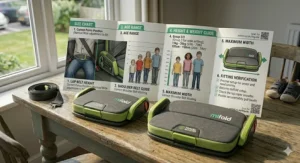
2. BubbleBum Teleport — The No-Inflation Evolution
The BubbleBum Teleport answers the one criticism levelled at the original: “What if I don’t fancy blowing up a seat at the taxi rank whilst juggling luggage?” This telescopic design collapses and extends mechanically, no lung power required.
Key Specifications & Real-World Performance
Weight: 1.2 kg. Extended dimensions: approximately 40 cm × 35 cm × 14 cm (height when seated). Collapsed: compresses to roughly one-third of its deployed size, about 40 cm × 14 cm × 10 cm. Certified to R129 (the newer i-Size regulation), which mandates more rigorous side-impact testing than the older R44/04 standard. Suitable for children 125–150 cm in height (roughly ages 6–12, though UK regulations base this on height rather than age).
The telescopic mechanism operates via a simple push-button system. Extend the seat base, lock the red belt guides into position, and attach the abdominal shield. The whole setup takes perhaps 15 seconds once you’ve done it twice. The base features a non-slip material that grips car seats effectively—something I appreciated in a leather-seated hire car in Portugal where cheaper boosters tend to slide forward under braking.
Expert Analysis: The Sweet Spot for UK Families
What sets the Teleport apart from its inflatable sibling is the improved all-day comfort. The padded seat base and slightly higher profile make it genuinely usable for longer journeys—I’ve had no complaints on three-hour drives to Devon, which is more than I can say for some full-sized boosters my kids have rejected. The R129 certification also means it meets more stringent crash testing than many competitors, which matters if you’re using this as your primary booster for a child who’s moved up from a harnessed seat.
The compromise, inevitably, is bulk. At 1.2 kg, it’s still remarkably portable by booster seat standards, but you’ll notice it in your hand luggage in a way the 540g BubbleBum never registers. The collapsed size fits comfortably in a medium rucksack or wheeled cabin bag, but it’s not pocket-sized. For families who split their time between proper high-back boosters at home and needing something portable for travel, the Teleport bridges both worlds more successfully than anything else I’ve tested.
UK Customer Feedback
British buyers particularly value the machine-washable cover—a godsend after the inevitable juice box incident or carsick episode. Several Amazon.co.uk reviews mention using the Teleport as a primary school-run seat rather than keeping it solely for travel, which speaks to its durability and comfort credentials.
✅ No inflation required—mechanical deployment
✅ R129 certified for enhanced safety
✅ Comfortable for longer UK journeys
❌ Heavier than inflatable options (1.2 kg)
❌ Pricier than basic alternatives
Price Range & Value Verdict
Around £45–£55 on Amazon.co.uk. If you’re planning to use this frequently rather than just tucking it away for the odd taxi ride, the extra £10–15 over the inflatable BubbleBum buys you noticeably better construction and R129 safety compliance.
3. Mifold Grab-and-Go — Smaller Than Your Laptop
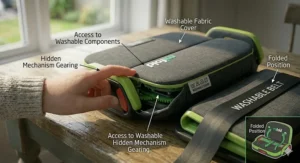
The Mifold Grab-and-Go takes a fundamentally different approach to portable boosting. Rather than lifting the child up to meet the seatbelt (traditional booster logic), it holds the seatbelt down to fit the child’s smaller frame. The result is a device roughly the size of a hardback book that weighs 750 grams.
Key Specifications & Real-World Performance
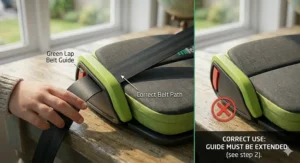
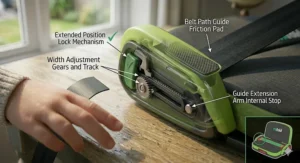
Dimensions when deployed: approximately 26 cm × 13 cm × 5 cm. Made from aircraft-grade aluminium, so it’s genuinely sturdy despite the minimal footprint. Three adjustable belt guide settings on the base accommodate different child sizes within the 15–36 kg weight range (Group 2/3). R44/04 certified. The belt routing system uses two hip guides and one shoulder clip to position the lap and diagonal belts correctly.
Installation genuinely takes under 60 seconds once you’re familiar with the mechanism. Position the mifold base under the child, adjust the red hip guides to sit snugly against their hips, thread the lap belt through, then attach the shoulder strap clip to pull the diagonal belt down to chest level (away from the neck). It feels counterintuitive at first—you’re used to boosters that lift—but the physics are sound and the certification proves it works.
Expert Analysis: Ultra-Portability With Trade-Offs
The mifold excels in scenarios where space is at an absolute premium. Glove box storage? Easily. Child’s school backpack? Fits with room for books. Three across the back seat of a narrow city car? The mifold’s compact width makes this genuinely achievable where traditional boosters would overlap.
The limitation—and it’s a significant one—is side-impact protection. As a backless booster with no surrounding structure, the mifold offers virtually nothing in the event of a T-bone collision. The Which? consumer testing organisation scored the mifold 0% for side-impact protection in their safety assessment, and whilst the seat remains legal and certified under R44/04, that’s a sobering statistic for safety-conscious parents. For occasional taxi rides or carpooling where the alternative is no booster at all, the mifold transforms child safety. For daily commuting on busy British roads where side impacts are a statistical reality, you’d want something more substantial.
UK Customer Feedback
British parents split into two camps on the mifold. One group loves it for exactly what it is—an emergency backup that lives permanently in the car for unexpected lift-sharing situations. The other group finds the lack of padding and minimal structure unsettling compared to traditional boosters. Several Amazon.co.uk reviews mention children who initially resisted using it because it “doesn’t feel like a proper car seat,” though most adapted after a few journeys.
✅ Smallest footprint (fits in glove box)
✅ Robust aluminium construction
✅ Three adjustable size settings
❌ Zero side-impact protection (Which? 0% rating)
❌ Minimal padding for long journeys
Price Range & Value Verdict
Around £40–£50 on Amazon.co.uk. If your priority is having something compact enough that you’ll actually keep it in the car at all times, the mifold delivers. Just understand what you’re trading off in terms of comprehensive protection.
4. Mifold Hifold — High-Back Protection That Still Packs Down
The Mifold Hifold is mifold’s answer to parents who wanted proper side-impact protection without sacrificing portability entirely. It’s a high-back booster with a clever folding system that reduces it to roughly the size of a small rucksack when not in use.
Key Specifications & Real-World Performance
Weight: 4.6 kg—substantially heavier than the products above, but still half the weight of many traditional high-back boosters. Extended dimensions: standard high-back booster size. Folded: approximately 34 cm × 25 cm × 25 cm. The party trick is the MultiFold system that allows the headrest, wings, and base to collapse in on themselves. Certified to R44/04, suitable for 15–36 kg (Group 2/3).
What makes the Hifold genuinely innovative is the MultiFit technology: nine headrest height positions, three head widths, three shoulder widths, and three hip adjustments. The manufacturer claims 243 different adjustment combinations, which sounds like marketing hyperbole until you realise it genuinely grows with your child from age 4 to 12 without gaps or compromises in belt positioning.
Expert Analysis: The Compromise Between Safety and Portability
This is the seat for families who need to fly with a booster for a two-week holiday but want proper protection once they’re driving around. The side-impact protection wings and adjustable headrest provide the comprehensive shielding you’d expect from a £150 premium booster, but the ability to fold it down means it stows in wheeled luggage rather than requiring a separate checked bag.
The weight is the sticking point. At 4.6 kg, a seven-year-old can carry it using the built-in strap, but they won’t enjoy doing so for more than a few minutes. For adults juggling multiple bags through airport security, it’s a noticeable burden. The Hifold works best for families with older children (8+) who can manage their own seat, or for those using it primarily for car-based travel rather than air journeys. It also shines in the grandparents’ scenario: compact enough to store in a cupboard rather than monopolising the spare room, but protective enough that you’re not compromising daily safety standards.
UK Customer Feedback
British reviewers consistently praise the build quality and adjustment range. Several mention using the Hifold as their primary booster rather than relegating it to travel-only duty, which is telling. The machine-washable fabric cover gets regular mentions—particularly appreciated after the inevitable biscuit crumbs and spilled juice incidents common on British school runs.
✅ Full high-back side-impact protection
✅ 243 adjustment combinations
✅ Folds to rucksack size for storage
❌ Heavy at 4.6 kg for regular carrying
❌ Premium pricing
Price Range & Value Verdict
Around £100–£130 on Amazon.co.uk. This is a significant investment, but if you’re looking for a single booster that handles both daily use and occasional travel, the Hifold’s versatility justifies the cost better than buying separate seats for each scenario.
5. Trunki BoostApak — The Backpack That Moonlights as Safety Equipment
The Trunki BoostApak represents peak British design ingenuity: a backpack with a hard-shell interior that transforms into a booster seat when needed. It’s exactly the sort of practical-meets-playful approach you’d expect from the people who brought you ride-on suitcases shaped like ladybirds.
Key Specifications & Real-World Performance
Weight: 2.0 kg. Dimensions when worn as backpack: 40 cm × 36 cm × 18 cm. Storage capacity: 8 litres—enough for a water bottle, iPad, colouring books, and snacks. R129 certified for children 125–150 cm tall. The transformation is straightforward: unzip the backpack, fold out the integrated seatbelt guides, and position the seat. The hard plastic interior provides the structure, whilst the ergonomic padding keeps your child’s back comfortable whether they’re wearing it or sitting on it.
The genius of the BoostApak lies in its dual-purpose nature. On the train from London to Edinburgh, your child carries their entertainment in it. When you arrive and hop in a taxi to the hotel, it becomes their booster seat. For families who resent single-use items cluttering their homes, this efficiency is genuinely appealing.
Expert Analysis: When Versatility Trumps Specialisation
The BoostApak works brilliantly for the specific use case it targets: journeys that combine public transport with taxis or short car rides. Train to airport, flight, hire car—it handles all three stages without requiring separate equipment. The backpack functionality also means children actually enjoy carrying it rather than viewing it as a chore, which any parent who’s struggled with reluctant luggage porters will appreciate.
The limitation becomes apparent on longer car journeys. Whilst the hard shell provides adequate support, it’s not as ergonomically refined as purpose-built boosters designed solely for in-car comfort. On a three-hour motorway drive, some children find the slightly higher, flatter profile less comfortable than traditional boosters with their contoured seats and deeper side wings. The BoostApak is also rather bulky as backpacks go—your child can definitely manage it, but it’s not subtle or streamlined.
UK Customer Feedback
British buyers particularly value the BoostApak for multi-modal journeys and visits to grandparents. The ability to pack toys and books inside means the booster doesn’t feel like dead weight during non-car portions of trips. Several Amazon.co.uk reviews mention it as excellent for coach journeys where children legally need boosters but traditional seats are impractical. The various colour options (including classic Trunki shades like pink, blue, and green) get regular mentions from parents whose children care about such things.
✅ 8-litre backpack + booster in one
✅ R129 certified safety
✅ Children willing to carry it themselves
❌ Bulkier than dedicated travel boosters
❌ Not optimised for all-day car comfort
Price Range & Value Verdict
Around £50–£65 on Amazon.co.uk. You’re paying a premium for the dual functionality, but if you’d otherwise be buying both a kids’ backpack and a travel booster, the BoostApak’s combined cost makes economic sense.
6. Cozy N Safe Neo i-Size — The Budget Champion
The Cozy N Safe Neo proves you don’t need to spend a fortune for R129-certified safety. This lightweight backless booster delivers the essentials without frills, making it ideal for grandparents’ cars, second vehicles, or families watching their pennies.
Key Specifications & Real-World Performance
Weight: 1.8 kg. Dimensions: approximately 35 cm × 30 cm × 15 cm. R129/03 certified for children 125–150 cm tall (roughly ages 6–12). Deep foam padding on the seat base and armrests provides more cushioning than minimalist competitors. The removable cover is machine washable at 30°C. Compatible with vehicle 3-point seatbelts (standard in all modern UK cars). No ISOFIX connectors, which keeps the design simple and the price down.
Installation is delightfully straightforward: position the booster on the car seat, place your child on it, thread the seatbelt through the integrated guides, and buckle up. The belt routing is colour-coded (red guides for the lap belt, grey for the shoulder strap), which helps children do it themselves once they’re old enough. The high armrests and seat depth mean most kids find it comfortable enough for journeys up to two hours—perfectly adequate for trips to Birmingham from London or Cardiff to Bristol.
Expert Analysis: Functional, Not Fancy
The Neo succeeds by focusing on core competencies rather than attempting innovation. The deep padding addresses the main complaint about budget boosters (discomfort), the R129 certification provides modern safety standards, and the straightforward design means there’s nothing complicated to break or misconfigure. For grandparents who need a booster in their car but won’t use it daily, or for families who need multiple seats and can’t justify £100+ per child, the Neo delivers legitimate safety at a fraction of premium prices.
What you sacrifice for the lower cost: no ISOFIX means the seat slides forward when unoccupied, which gets tedious if you’re frequently moving it between vehicles. The padding, whilst better than basic alternatives, is thinner than premium models—noticeable on journeys over 90 minutes or on rougher roads. The lack of a headrest or side-impact wings means reduced protection compared to high-back boosters, though it meets all legal requirements for backless Group 3 seats.
UK Customer Feedback
British buyers consistently describe the Neo as “perfectly adequate” and “good value for money”—hardly ringing endorsements, but entirely appropriate for a budget product. Several Amazon.co.uk reviews mention it as ideal for keeping at relatives’ houses or as a backup seat in the car boot. The machine-washable cover gets regular praise, particularly from parents whose children have a talent for spilling things.
✅ R129 certified at budget pricing
✅ Deep foam padding for comfort
✅ Machine-washable covers
❌ No ISOFIX (seat slides when empty)
❌ Basic padding on longer journeys
Price Range & Value Verdict
Around £25–£35 on Amazon.co.uk. Exceptional value if you need multiple seats or a spare—just don’t expect premium comfort or advanced features.
7. Graco TurboBooster — Lightweight Everyday Reliability
The Graco TurboBooster represents the traditional approach to portable boosting: a straightforward backless seat that’s lighter than standard high-back boosters but doesn’t chase the ultra-compact market. It’s for families who value proven reliability over innovation.
Key Specifications & Real-World Performance
Weight: 2.4 kg. Dimensions: 40 cm × 41 cm × 20 cm. R44/04 Group 2/3 certification for 15–36 kg (approximately 4–12 years). The seat features dual cupholders that fold away when not needed, plus hideaway arm storage—small touches that children appreciate on longer journeys. The backrest height adjusts to six positions with one-hand operation, ensuring proper seatbelt fit as your child grows. EPS foam construction provides impact absorption without excessive bulk.
The Graco doesn’t fold or collapse, which means it occupies standard booster seat space in your car when installed. Where it earns “lightweight” credentials is comparison to traditional high-back boosters: at 2.4 kg versus 6–8 kg for premium models, it’s noticeably easier to move between vehicles or carry into storage. The open-back design also means it fits virtually any car seat profile without compatibility issues.
Expert Analysis: The Middle Ground
The TurboBooster succeeds in the Goldilocks zone: portable enough for regular transfers between vehicles, substantial enough that children find it comfortable for daily use, and affordable enough that families can own two or three without financial strain. It’s the booster you buy when you need something for the second car or grandparents’ vehicle that doesn’t feel like a compromise.
The trade-off compared to ultra-portable options is obvious: you’re not packing this in hand luggage or fitting it in a backpack. It lives in your car boot and comes out when needed. Compared to high-back boosters, you’re sacrificing the head restraint and side-impact wings that provide maximum protection. The Graco occupies that middle territory where practicality trumps perfection.
UK Customer Feedback
British reviewers consistently mention the cupholders—a small feature that dramatically reduces the “Mum, I’m thirsty” interruptions on motorway journeys. Parents with multiple children appreciate that the Graco is narrow enough to fit three across the back seat of larger cars (though tight in a Ford Fiesta). The six-position headrest adjustment gets regular mentions for actually working throughout the full age range rather than running out of extension at age 9.
✅ Proven Graco quality and reliability
✅ Dual cupholders reduce spillage
✅ Fits three across in larger vehicles
❌ Not compact enough for air travel
❌ Basic backless design without side protection
Price Range & Value Verdict
Around £30–£45 on Amazon.co.uk, often with Prime delivery. Solid everyday value for families who need portability between vehicles rather than ultra-compact travel storage.
✨ Don’t Miss These Exclusive Deals!
🔍 Take your family travel safety to the next level with these carefully selected products. Click on any highlighted item above to check current pricing and availability on Amazon.co.uk. These picks will help you find exactly what you need for safe, stress-free journeys!
Real-World Scenario Guide: Matching Seats to Your Family’s Needs
Choosing a travel booster seat based purely on specifications misses the point rather spectacularly. What matters is how it fits your actual life—the types of journeys you make, your children’s ages and temperaments, and how much you’re willing to compromise between ultimate portability and comprehensive protection.
The Urban Family: Frequent Taxis and Carpooling
Your scenario: You live in London, Manchester, or Edinburgh without a car. Your children travel via taxi to after-school activities, occasional carpools with friends, and weekend Zipcar rentals. You need something genuinely portable that fits in a tote bag or rucksack.
Best choice: BubbleBum Inflatable or Mifold Grab-and-Go
The BubbleBum wins if your children are comfortable with inflatable bases and you don’t mind the 30-second setup. Its 540g weight means you genuinely forget you’re carrying it until needed. The mifold suits families who prefer mechanical simplicity—no inflation, no deflation, just unfold and clip. For short urban journeys (under 30 minutes), both provide adequate safety without the burden of lugging traditional boosters on public transport.
Budget: £35–£50 gets you sorted with either option, plus you’ll have something cabin-approved for family holidays.
The Holiday Family: Frequent European Travel
Your scenario: You fly to Spain, Portugal, or France twice yearly, always hiring cars at destination. You’re tired of paying £50–£80 per holiday for suspect hire-company boosters that smell of previous occupants and have questionable damage history.
Best choice: BubbleBum Teleport or Trunki BoostApak
The Teleport offers superior all-day comfort for those longer drives to coastal villas or mountain villages. Its R129 certification provides peace of mind when you’re navigating unfamiliar roads in a hire car. The BoostApak wins if you’re using trains or coaches as part of your journey—your child carries their entertainment in it, then sits on it. Both pack into cabin luggage, saving checked baggage fees and the anxiety of wondering whether your seat made it onto the same flight.
Budget: £45–£65 range, but remember this pays for itself after approximately 1.5 European holidays when you calculate hire seat savings.
The Grandparents’ House Regular
Your scenario: Your children spend alternate weekends or school holidays with grandparents who don’t have permanent car seats installed. You need something compact enough to store in their spare room cupboard but substantial enough for regular 30–60 minute journeys.
Best choice: Cozy N Safe Neo or Graco TurboBooster
The Neo works brilliantly if your parents’ budget is tight—at £25–£35, they can buy one themselves without feeling extravagant. The Graco TurboBooster suits grandparents who prioritise ease of use: simple belt routing, comfortable enough that grandchildren won’t complain, and the cupholders mean fewer spills in Granny’s pristine Nissan Qashqai. Neither requires complex installation or adjustment, which matters when the users aren’t fitting car seats weekly.
Budget: £25–£45 buys peace of mind without breaking pensioners’ budgets.
The Multi-Vehicle Family
Your scenario: You own two cars, or regularly swap between your vehicle and your partner’s. You’re fed up with the tedious dance of moving heavy high-back boosters between vehicles every morning.
Best choice: Own two sets of traditional high-back boosters, plus a BubbleBum Inflatable or Mifold in each car boot for unexpected situations. Alternatively, the Mifold Hifold if you genuinely need to move one quality seat regularly.
The reality check most UK families face is that moving a 7 kg high-back booster between a Volkswagen Golf and a Land Rover Discovery every school morning is unsustainable. You’ll either give up and buy duplicates, or start cutting corners on safety. The smarter approach: invest in proper boosters for each vehicle, then keep ultra-portable backups for the edge cases (friend’s car, taxi, emergency situations).
Budget: This scenario requires higher investment (£150–£300 total), but the daily convenience and consistent safety standards justify it.
The Safety-First Family: No Compromises Accepted
Your scenario: You want travel convenience but refuse to sacrifice the side-impact protection and headrest support your children have in their daily car seats. Weight and bulk are secondary concerns to comprehensive safety.
Best choice: Mifold Hifold exclusively, or accept that sometimes you’ll be checking luggage with a full-sized high-back booster.
There’s no magic solution here. The physics of side-impact protection require structural wings and adjustable headrests, which inherently means bulk and weight. The Hifold’s folding mechanism reduces storage volume by roughly 60%, but at 4.6 kg it’s still a substantial item to manage through airports. For families where this is the priority, the inconvenience is the price you pay for uncompromised safety on holiday hire cars.
Budget: £100–£130 for the Hifold, or £150+ for a premium high-back booster if you’re checking it as luggage anyway.
How to Choose the Right Travel Booster Seat for British Conditions
The British approach to child car seats has always balanced pragmatic regulation with real-world flexibility. UK law requires appropriate restraints until age 12 or 135 cm height, but acknowledges exceptions for taxis and unexpected journeys. This creates a uniquely British dilemma: how do you balance legal compliance, genuine safety, and practical convenience when your six-year-old needs to get across London in an Uber?
Safety Certification: What the Labels Actually Mean
Every legal car seat sold in the UK must display a capital ‘E’ in a circle, indicating compliance with European safety standards. You’ll see either ECE R44/04 (the older weight-based regulation) or R129 (the newer height-based i-Size standard). Both are equally legal in Britain, but R129 represents more rigorous testing—specifically including side-impact crash scenarios that R44/04 doesn’t mandate. More details on these standards can be found through UK Government vehicle standards guidance.
For travel boosters specifically, this distinction matters more than you might think. A backless R44/04-certified booster has passed frontal impact testing but isn’t required to demonstrate side-impact protection. An R129 booster has survived standardised T-bone collision testing. Given that side impacts account for roughly 25% of child injuries in UK car accidents, according to Department for Transport statistics, R129 certification provides measurable additional reassurance.
Weight and Packability: The Inverse Relationship with Protection
Here’s the uncomfortable truth the marketing materials gloss over: genuine comprehensive protection requires structure, and structure means weight. The lightest travel boosters (BubbleBum at 540g, mifold at 750g) achieve their remarkable portability by offering minimal side-impact shielding. The heaviest option in our review (Mifold Hifold at 4.6 kg) provides full high-back protection with adjustable headrest and impact wings.
For British families, the calculation typically breaks down like this: if you’re using the booster for daily school runs on busy urban roads, prioritise protection over portability. If it’s genuinely occasional use (taxis, airport transfers, grandparents’ emergency backup), ultra-lightweight options become defensible compromises. The middle ground—products like the BubbleBum Teleport at 1.2 kg with R129 certification—attempts to bridge both requirements.
Installation Complexity: Who’s Actually Fitting This?
British parents often overlook a crucial question: will your child be setting this up themselves, or will you handle it every time? This matters enormously for products like the mifold, where the belt routing requires understanding which guides do what. A confident ten-year-old can manage it perfectly well after two demonstrations. A distracted six-year-old will get it wrong more often than right.
Inflatable boosters require decent lung capacity—fine for adults or older children, frustrating for anyone with asthma or below-average fitness. The Teleport’s mechanical deployment removes this barrier entirely. Traditional lightweight boosters like the Graco simply plonk into position. Match the installation method to the actual person who’ll be doing it most frequently.
The British Climate Factor: Durability in Damp Conditions
Something rarely mentioned in travel booster reviews: how they cope with British weather. Products left in car boots in Birmingham or Aberdeen face temperature swings from -5°C winter nights to 25°C+ summer afternoons, plus the perpetual British dampness that rusts metal and encourages mould on fabrics.
Inflatable products (BubbleBum) use PVC that tolerates moisture well but can become brittle in extreme cold. Fabric-covered foam boosters (Cozy N Safe, Graco) benefit from removable, washable covers—essential when the inevitable damp creeps in. Hard-shell designs (Trunki BoostApak) resist weather damage but can crack if left in freezing car boots then subjected to sudden impacts. For products living permanently in your vehicle, consider where you park (garage versus street) and choose materials accordingly.
Three Across the Back Seat: The British Compact Car Challenge
British families drive smaller vehicles than our American or Australian counterparts. Trying to fit three children across the back seat of a Ford Fiesta, Vauxhall Corsa, or Volkswagen Polo represents a genuine geometric puzzle that many traditional boosters fail spectacularly.
Travel boosters generally excel here due to their reduced width. The mifold Grab-and-Go measures just 13 cm wide when positioned, allowing three to fit comfortably across even narrow back seats. The BubbleBum, despite inflating to standard cushion dimensions, compresses slightly under the outer children’s weight, creating extra room. Standard lightweight boosters like the Graco TurboBooster work in larger saloons (Mondeo, Insignia) but struggle in superminis.
Common Mistakes When Buying Travel Booster Seats
Mistake 1: Assuming “Legal” Means “Optimal”
The most dangerous misconception British parents harbour is equating legal certification with comprehensive safety. Yes, a mifold or BubbleBum meets UK law and won’t land you a fine. But the question shouldn’t be “Is this legal?” but rather “How does this compare to what my child uses daily?”
If your daughter normally sits in a £200 high-back Britax with side-impact wings and a five-position headrest, then switching to a backless inflatable cushion for a week-long Spanish holiday represents a meaningful safety downgrade. It’s still legal, still better than no booster at all, but measurably less protective. Understanding this trade-off—and making it consciously rather than assuming all certified seats are equivalent—is what separates informed choices from naive ones.
The fix: Use travel boosters for genuinely short or occasional journeys where the convenience justifies the compromise. For extended holiday use (week-long rentals, fortnight at the grandparents’), consider whether checking a proper high-back booster as luggage better serves your family’s safety priorities.
Mistake 2: Buying Based on Your Child’s Current Size Alone
British children grow unpredictably. Some shoot up between Reception and Year 2, others remain petite through Year 6. Purchasing a travel booster based solely on your child’s measurements today guarantees you’ll need a replacement sooner than expected.
The Mifold Hifold’s adjustability (243 combinations spanning 15–36 kg) means it genuinely lasts from age 4 to 12 for most children. The Trunki BoostApak’s R129 certification covers 125–150 cm—fine for children already in that range, but useless if you’re buying for a 110 cm four-year-old hoping they’ll grow into it. Some products explicitly state minimum requirements (the BubbleBum Teleport requires 125 cm minimum, full stop).
The fix: Check both minimum and maximum specifications. Consider where your child sits in the growth percentiles. If they’re consistently 75th percentile for height, they’ll outgrow narrow ranges quickly. If they’re 25th percentile, you may get years of use from the same seat.
Mistake 3: Neglecting to Test Compatibility with Your Actual Vehicles
Not all boosters fit all cars, and you won’t discover this until you’re at Málaga airport trying to install it in a Seat Ibiza hire car with unusually short seatbelts. Modern UK vehicles have standardised 3-point belts, but older cars, European hire vehicles, and some MPVs with captains’ chairs feature variations that can defeat certain booster designs.
The Cozy N Safe Neo requires a minimum belt length that some compact European city cars don’t provide. The Trunki BoostApak’s hard shell can interfere with certain car seat profiles, leaving gaps that compromise belt positioning. Products with ISOFIX connectors (none in our lightweight travel selection, but common in full-sized boosters) require ISOFIX anchor points—not standard in UK vehicles registered before 2006.
The fix: If you have access to your destination car (perhaps you’re buying for grandparents’ vehicles), test-fit before committing. For hire cars, research the specific model you’ve booked—most rental companies list exact vehicles, allowing you to check dimensions and belt configurations online.
Mistake 4: Ignoring the Post-Brexit Import Duties Trap
An increasing number of British families are discovering an expensive surprise when ordering “cheap” travel boosters from non-UK sellers on Amazon.co.uk. Products shipped from EU warehouses now attract customs duties and VAT processing fees thanks to Brexit, transforming a £30 bargain into a £45 disappointment once Royal Mail’s handling charges arrive.
The fix: Check the seller location before purchasing. Amazon.co.uk lists whether items are “Dispatched from and sold by Amazon” (UK warehouse, no duties) or “Sold by XYZ and Fulfilled by Amazon” (check the seller’s country). Products clearly marked “Ships from: United Kingdom” avoid import charges. If you’re ordering from EU sellers, factor in potential 20% VAT plus £8–£12 handling fees.
Mistake 5: Forgetting That “Cabin Approved” Doesn’t Mean “Convenient to Carry”
Airlines permit travel boosters as cabin baggage, but this doesn’t address the question of whether you actually want to lug one through three terminals, passport control, and security screening whilst juggling hand luggage, children, and boarding passes.
A 540g BubbleBum genuinely disappears into your bag. A 4.6 kg Mifold Hifold makes itself known every step from check-in to baggage reclaim. The Trunki BoostApak at least converts to a functioning backpack, distributing weight across your child’s shoulders. But a 2.4 kg Graco TurboBooster serves no purpose except as a booster—you’re carrying dead weight for the entire airport experience.
The fix: Honestly assess your travel style. If you’re the sort of family who pre-books taxi transfers and avoids public transport, a slightly heavier option with better comfort/safety might trump ultimate portability. If you’re navigating tube stations and bus connections, prioritise products under 1.5 kg that won’t dominate your carrying capacity.
Travel Booster Seats vs Traditional Alternatives: When Each Makes Sense
The travel booster seat industry exists because standard high-back boosters fail at portability. But that doesn’t mean travel boosters succeed at everything else. Understanding when to use which type prevents both inconvenience and compromised safety.
Daily School Runs: Traditional High-Back Boosters Win Decisively
For the morning dash to primary school and afternoon collection—journeys you make 190+ times yearly on familiar British roads—there’s no contest. A proper high-back booster with ISOFIX anchoring, adjustable headrest, and side-impact wings provides measurably superior protection compared to lightweight travel alternatives.
The Which? consumer testing organisation’s crash tests reveal stark differences. Premium high-back boosters like the Britax Kidfix i-Size score 75–85% for overall protection. Travel boosters like the mifold score 0–25% depending on the test scenario, with the primary deficit in side-impact performance. Over 38 school weeks comprising 380 journeys, those percentage points represent the margin between comprehensive protection and acceptable compromise.
Cost comparison: Yes, a £150 Britax costs significantly more than a £35 BubbleBum. But amortised across five years of daily use (approximately 1,000 journeys), that’s £0.15 per trip for premium protection versus £0.03 for basic compliance. Most British families find that differential justifiable for primary transportation.
Weekend Visits to Grandparents: The Goldilocks Zone for Travel Boosters
This scenario perfectly suits products like the Cozy N Safe Neo or Graco TurboBooster. Your parents’ car doesn’t need the permanent, ISOFIX-anchored installation appropriate for daily use, but weekend visits (perhaps 20–30 annually) merit something more substantial than an inflatable cushion.
Traditional high-back boosters would work perfectly well, but then you’re asking elderly relatives to store a bulky seat in their already-cramped spare bedroom or car boot 95% of the time when it’s not needed. Lightweight boosters like the £30–£45 range options collapse to shoebox dimensions, provide adequate protection for occasional 30–60 minute journeys, and don’t create storage resentment.
The compromise: You’re sacrificing the ultimate protection your child receives in your own vehicle, but gaining the practical benefit that grandparents actually use the seat consistently rather than occasionally “just this once” trips without it.
Holiday Hire Cars: Where Travel Boosters Genuinely Excel
The economics are unambiguous here. A week’s booster hire in Málaga, Faro, or Palma typically costs £40–£70 depending on the rental company’s exploitation level. The boosters themselves are rarely clean, frequently damaged, and occasionally missing components. The return on investment for owning your own travel booster materialises after precisely one Mediterranean holiday.
Beyond finances, there’s the hygiene factor. Hire company boosters have been sneezed on, spilled on, and subjected to countless accidents both minor and major by previous users’ children. In a post-pandemic world where we’ve all become rather more conscious of shared surfaces, having your own seat eliminates the “Is that a stain or a shadow?” anxiety.
Best practice: For flights under four hours (covering most European destinations from UK airports), pack a BubbleBum Inflatable or Teleport in cabin luggage. For longer journeys or extended holidays where you’ll be driving daily for two weeks, consider checking a proper high-back booster as luggage—the extra safety over extended use justifies the baggage fee.
Taxi Journeys: The Urban Parent’s Dilemma
UK law exempts licensed taxis from providing child seats, placing the responsibility on parents. In practice, most British families take occasional taxi rides without boosters—the school run to a birthday party, the airport transfer at 5am, the emergency dash when your car’s in the garage.
This is where ultra-portable options like the mifold Grab-and-Go justify their existence. A 750g device that lives permanently in your handbag or messenger bag means you’re never caught choosing between legal compliance and practical necessity. Is it as protective as the high-back booster in your own car? No. Is it incomparably better than an adult seatbelt designed for someone 150 cm tall being used on your 120 cm child? Absolutely.
The calculation: For journeys under 30 minutes at urban speeds (most taxi rides), the reduced protection of a backless travel booster is a reasonable trade-off for the convenience of always having something available. For longer taxi journeys (airport transfers, cross-city travel), the BubbleBum Teleport’s enhanced comfort and R129 certification better serves children’s safety and comfort.
UK Regulations, Safety Standards & Legal Requirements for Booster Seats
The Core Legal Framework
UK law, governed by the Road Vehicles (Construction and Use) Regulations 1986 as amended, requires children to use an appropriate child restraint until they’re 12 years old or 135 cm in height, whichever threshold they reach first. Once beyond these limits, adult seatbelts become legal.
What constitutes “appropriate” has evolved considerably since the regulation’s inception. The current framework recognises two primary safety standards: ECE R44/04 (weight-based) and R129 (height-based, also known as i-Size). Both remain legal in Britain, though R129 represents the newer, more rigorous testing protocol introduced in 2013.
According to government guidance published on gov.uk, all car seats used in the UK must be approved for European use and display the ‘E’ mark. Seats approved under older regulations (R44/01 and R44/02) became illegal in April 2008 and cannot be used even if you own them.
Height-Based vs Weight-Based Standards: What Parents Need to Know
The shift from R44/04 to R129 represents more than bureaucratic tinkering. The older weight-based system categorised seats into groups (Group 1: 9–18 kg, Group 2: 15–25 kg, Group 3: 22–36 kg) that required parents to estimate their child’s weight and hope they’d chosen correctly. The newer R129 system, explained in detail by Child Seat Safety Centre, uses height measurements instead—vastly simpler when you can stand your child against a wall rather than hauling them onto bathroom scales.
More crucially, R129 mandates side-impact testing, addressing a significant gap in the R44/04 protocol. Traditional weight-based testing focused primarily on frontal collisions, despite Department for Transport statistics showing that roughly 25% of child injuries in vehicle accidents result from side impacts. The RAC Foundation research on child car safety confirms that products certified to R129 have survived standardised T-bone crash scenarios, providing measurable additional protection.
For travel boosters specifically, this distinction matters. The BubbleBum Teleport’s R129 certification required passing side-impact tests that the original BubbleBum Inflatable (R44/04 certified) wasn’t subjected to. Both are legal, both are safe enough to meet British standards, but the newer regulation represents objectively more comprehensive testing.
The 2017 Backless Booster Regulation Change
In March 2017, UK regulations (following EU Directive 2014/37/EU) prohibited manufacturers from introducing new models of backless booster seats for children shorter than 125 cm or weighing less than 22 kg. This change, detailed on the UK Government’s vehicle approval guidance, addressed child safety experts’ concerns that very young children (3–5 years old, typically under 125 cm) were legally using backless boosters despite their bodies being too small for adequate protection.
Crucially, the regulation affects new product development—not existing products already on the market. Backless boosters certified before March 2017 for children from 15 kg remain perfectly legal to sell and use. This creates an odd situation where shops still stock seats approved under the old rules alongside newer products meeting the tightened requirements.
For British parents buying travel boosters in 2026, the practical impact is minimal. Most children transition to boosters around age 4–5, by which point many exceed 125 cm anyway. The regulation primarily prevents the rather alarming practice of putting three-year-olds on basic booster cushions—a practice that safety organisations like RoSPA had opposed for years.
UKCA Marking Post-Brexit
Following Britain’s departure from the European Union, the UK established its own product safety marking: UKCA (UK Conformity Assessed), intended to replace the CE (European Conformity) marking for products sold in Great Britain. For car seats, the transition creates temporary complexity.
Until December 2024, both CE and UKCA markings are accepted in Britain. From 2025 onward, new car seats sold in England, Scotland, and Wales require UKCA marking. Products already on the market with CE marking remain legal indefinitely—you don’t need to replace existing seats.
Northern Ireland represents a special case due to the Northern Ireland Protocol. Products sold there may continue using CE marking without UKCA requirements, reflecting the province’s unique regulatory status straddling UK and EU frameworks.
For families ordering from Amazon.co.uk, the practical consideration is seller location. Products “Dispatched from and sold by Amazon” typically carry appropriate UK certification. Items from third-party EU sellers may have CE marking only—currently legal, but potentially complicated if regulations tighten further.
Taxi and Minicab Exemptions: The Grey Area
UK law acknowledges that requiring car seats in taxis creates practical impossibilities. Licensed taxi and private hire vehicles (minicabs) are exempt from child seat requirements under specific conditions:
Children under 3 years: Can travel without a seat belt in the rear of a taxi (not front seat). Not recommended, but legal.
Children aged 3+: Must use an adult seat belt if available, but no child seat required in taxis if one isn’t provided.
This exemption exists because requiring taxis to carry multiple child seats in varying sizes would be operationally unworkable. But “legal” doesn’t mean “safe”—an adult seat belt on a 110 cm child provides minimal protection and can cause serious internal injuries in accidents.
Travel boosters resolve this dilemma. A mifold in your handbag or BubbleBum in your daughter’s backpack means you can transform any taxi into a safer environment. The choice becomes yours rather than being dictated by the taxi driver’s equipment.
Enforcement and Penalties
Responsibility for ensuring children use appropriate restraints falls on the driver (not the child’s parents, if they’re different people). Police can issue fixed penalty notices of £100 for violations, potentially rising to £500 if the case reaches court, according to UK Government penalty guidelines. However, enforcement remains inconsistent—traffic police conducting random stops will check, but routine driving without stopping rarely triggers intervention.
The more significant risk isn’t fines but physics. According to the Department for Transport’s reported road casualty statistics, children properly restrained in appropriate car seats experience 50–70% fewer injuries in accidents compared to those using adult belts or travelling unrestrained. The legal penalty pales beside the potential physical consequences of cutting corners on child restraints.
Frequently Asked Questions About Travel Booster Seats
❓ Can my child use a travel booster seat on an aeroplane?
❓ Are inflatable booster seats legal in the UK for everyday use?
❓ How do I know when my child can stop using a booster seat in the UK?
❓ Can I use a travel booster seat in the front passenger seat of my car?
❓ Will hire car companies in Europe accept my UK-purchased travel booster seat?
Conclusion: Finding Your Family’s Perfect Travel Booster Solution
The perfect travel booster seat doesn’t exist, which is probably the most honest thing I can tell you after testing these seven options across British roads, European hire cars, and more taxis than I care to count. What exists instead is a spectrum of compromises, each optimised for different priorities.
If ultimate portability matters above all else—you want something that disappears into a handbag and emerges for occasional taxi rides—the BubbleBum Inflatable at 540 grams achieves a level of packability no competitor matches. Yes, you’re trading off side-impact protection and long-journey comfort, but for urban families making short trips where the alternative is no booster at all, it transforms child safety from aspirational to achievable.
For families seeking the best balance between portability and protection, the BubbleBum Teleport occupies the sweet spot. Its R129 certification provides measurably superior safety testing compared to R44/04 products, the mechanical deployment eliminates inflation faff, and at 1.2 kg it remains genuinely travel-friendly. This is the seat I personally use for holiday hire cars and recommend most frequently to other British parents.
The Mifold Hifold serves a different audience entirely: families who refuse to compromise on high-back protection but need something that packs down for occasional travel. At £100–£130 and 4.6 kg, it’s neither cheap nor particularly portable, but it’s the only product in this category that provides full side-impact wings whilst still folding to rucksack dimensions.
What I hope this guide has demonstrated is that choosing a travel booster seat requires understanding your actual usage patterns—not just which product has the best Amazon star rating or the cleverest marketing. A family doing fortnightly taxi rides to ballet lessons has radically different needs from one taking three European holidays yearly. Neither is wrong; they’re simply different.
The British approach to child car seat regulations strikes a workable balance between mandatory safety and practical flexibility. Yes, you must use appropriate restraints until age 12 or 135 cm. But “appropriate” is defined by certification standards (R44/04 or R129) rather than prescriptive equipment mandates. This creates space for innovations like inflatable boosters and telescopic designs that would struggle under more rigid regulatory frameworks.
Final thought: a travel booster seat stops being “travel only” the moment you leave it in your car boot for unexpected situations. The mifold living in your glove box, the BubbleBum in your daughter’s school backpack—these become safety insurance, eliminating the “just this once” compromises that statistics suggest happen in roughly a quarter of child car journeys. Even if you only use it twice yearly for hire cars, that’s twice yearly your child receives proper belt positioning rather than whatever suspect equipment the rental company provided last decade.
Recommended for You
- When Can Child Use Backless Booster Seat? 7 UK Rules 2026
- Best High Back Booster Seat with ISOFIX UK 2026 – Top 7 Reviewed
- Best Car Seat for Small Car UK 2026: 7 Expert Picks
Disclaimer: This article contains affiliate links. As an Amazon Associate, I earn from qualifying purchases. If you purchase products through these links, we may earn a small commission at no additional cost to you.
✨ Found this helpful? Share it with your mates! 💬🤗
