
In This Article
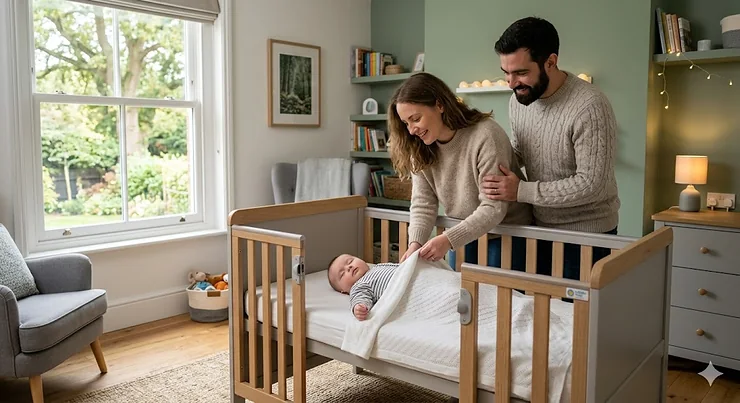
If you’ve spent any time Googling baby sleep gear, you’ve probably stumbled across some genuinely alarming headlines about drop side cots — and then, ten minutes later, found yourself standing in a nursery showroom, admiring one. That whiplash is completely understandable. The question of whether are drop side cots safe is one of the most Googled by expectant parents in Britain, and it deserves a proper, no-nonsense answer rather than a scaremongering click-bait summary.
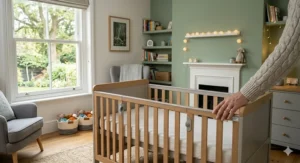
Here’s the short version: in the UK, drop side cots are perfectly legal and can be very safe, provided they meet the required safety standards — specifically BS EN 716-1:2017. That’s a meaningfully different situation from the United States, where drop-side cribs were banned outright by the Consumer Product Safety Commission (CPSC) in 2011 following a series of infant deaths linked to flimsy plastic mechanisms and poorly tested hardware. The UK and European standards are — and were before 2011 — considerably more rigorous. According to the UK’s Baby Products Association (BPA), there have been no reported deaths in this country involving drop-side cots made to British safety standards. That’s worth knowing.
This matters because a lot of the panic you’ll find online is imported directly from American sources, which don’t reflect British law, British cot design, or British safety testing at all. A drop-side cot built to BS EN 716-1 requirements is engineered to prevent precisely the kind of mechanism failures that caused the US ban — double-action unlocking, auto-locking at the top position, rigorous fatigue testing. The spec sheet differences are substantial.
So, are drop side cots safe for your family? They can be. But like most things in parenting, the answer lives in the detail. This guide walks you through the regulations, the real risks, and the seven best drop side cots available on Amazon.co.uk right now — so you can make a genuinely informed decision rather than one driven by fear or guesswork.
Quick Comparison: Best Drop Side Cots on Amazon.co.uk (2026)
| Product | Size | Material | Key Feature | Price Range | Best For |
|---|---|---|---|---|---|
| Babymore Stella Sleigh Cot Bed | 140×70 cm | Solid Pine | Single-hand drop side, 3 base heights | £200–£280 | Classic-style nurseries |
| Viculii Waffi Space Saver Cot | 100×50 cm | Solid Wood | Compact, award-winning | £80–£130 | Small flats & bedrooms |
| Babymore Aston Drop Side Cot Bed | 145×84×100 cm | Solid Wood | Mattress included | £150–£220 | Value-for-money buyers |
| Tutti Bambini Misha Cot Bed | 140×70 cm | Engineered Wood | 3-in-1 conversion | £220–£320 | Long-term use |
| Tutti Bambini Riley Mini Cot Bed | 120×60 cm | Engineered Wood | Compact + drawer | £180–£260 | Smaller nurseries |
| Babymore Eva Sleigh Cot Bed | 140×70 cm | Solid Pine | Mattress + teething rail | £200–£300 | First-time parents |
| Love For Sleep Jacob Cot Bed | 120×60 cm | Solid Wood | Free Aloe Vera mattress | £120–£180 | Budget-conscious buyers |
All prices in GBP; check current pricing on Amazon.co.uk as prices change frequently.
The table above highlights a clear pattern: the Babymore and Tutti Bambini ranges dominate this space for a reason — they’ve invested heavily in UK-compliant mechanisms and solid-wood construction that justifies a mid-range price. The Viculii Waffi is the standout choice if you live in a typical British flat or terraced house where a standard 140×70 cm cot simply won’t fit through the bedroom door without a minor incident involving a skirting board. If budget is the driving factor, the Love For Sleep Jacob delivers surprising value, though it lacks the conversion longevity of the pricier options.
💬 Just one click — help others make better buying decisions too! 😊
✨ Don’t Miss These Exclusive Deals!
🔍 Check current pricing and availability on Amazon.co.uk by clicking any highlighted product name in this guide. Stock and prices change regularly, so it’s worth checking before you buy!
Top 7 Drop Side Cots for UK Parents: Expert Analysis
1. Babymore Stella Sleigh Cot Bed — Best Overall Drop Side Cot
The Babymore Stella is one of the most recognisable names in UK nursery furniture, and the Stella Sleigh earns that reputation rather than simply resting on it. Built from solid pine with sweeping sleigh-style curves, it takes a standard 140×70 cm mattress (not included — a common gotcha to watch for) and is designed for use from birth up to approximately five years old, eventually converting to a toddler bed and sofa.
The single-hand drop side mechanism is genuinely useful at 3am, when the other hand is occupied by a baby who has finally, finally fallen asleep and you need to transfer them without a sound. Three adjustable base positions mean you can keep the mattress high when they’re a newborn and drop it lower as they start pulling themselves upright — which they will, sooner than you’d expect. Teething rails on both sides are a nice touch that protects both the baby’s gums and the cot’s paintwork.
Where the Babymore Stella particularly shines is build quality for the price range. Solid pine construction at this price point is unusual; most competitors use MDF or engineered wood. UK reviewers consistently praise its sturdiness and assembly clarity — important considerations when you’re building furniture at 11pm with a Braxton Hicks countdown.
✅ Solid pine construction — more durable than MDF alternatives
✅ Single-hand drop side mechanism; practical at night feeds
✅ Converts to toddler bed and sofa (use to age 5)
❌ Mattress not included — budget for an additional £40–£80
❌ Assembly can take 1–2 hours; tea essential
Price range: around £200–£280 on Amazon.co.uk. Excellent long-term value given the conversion versatility.
2. Viculii Waffi Space Saver Drop Side Cot — Best for Small Spaces
The Viculii Waffi won the Best Baby Cot/Cot Bed at the First Time Mums Choice UK Awards 2025, and it’s not hard to see why. At just 100×50 cm — roughly the footprint of a large suitcase — it’s the cot that actually fits in the average British bedroom without requiring a furniture rearrangement you’ll regret for months. Named a “space-saving marvel” by parents across the UK, and they’re not wrong.
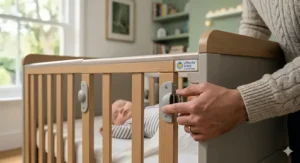
The drop side on the Waffi can either be lowered or removed entirely, giving you genuine flexibility depending on your sleeping arrangement. It meets BS EN 716-1:2017 certification, which means its mechanism has been tested to the current UK standard. UK reviewers call it “good quality, much better than expected” and praise the lovely rounded edges on the natural wood finish — relevant detail if your baby spends any time near the cot bars. The hypoallergenic ECO Fibre Core mattress (included in the bundle version) is a thoughtful addition for parents with concerns about allergens.
Where the Waffi has clear limitations: it’s designed for use up to 24 months, not five years. For a family in a two-bedroom flat in Sheffield or Bristol where a full-size cot bed simply won’t fit in the parents’ room, that limitation is a sensible trade-off. For a family with a dedicated nursery, you might grow out of it quicker than you’d like.
✅ Award-winning compact design — fits in small UK bedrooms
✅ BS EN 716-1:2017 certified; drop side removable
✅ Available with hypoallergenic mattress bundle
❌ Suitable only to 24 months (shorter lifespan than full-size cots)
❌ Instructions described as minimal by some reviewers
Price range: around £80–£130 (cot only) or £110–£160 with mattress. Superb value for urban flat dwellers.
3. Babymore Aston Drop Side Cot Bed — Best Value with Mattress Included
The Babymore Aston occupies a practical middle ground: it comes with a mattress as standard, which immediately removes one of the most confusing decisions new parents face (and saves a separate delivery). At 145L × 84W × 100H cm assembled, it’s a full-size cot bed that’ll see your child from birth to junior bed age.
Where the Aston earns its place on this list is the honest feedback from UK parents. One Amazon reviewer put it well: “I’d never buy a non-dropside again” — written after throwing out their back reaching into a non-drop side cot for a sleeping toddler. That anecdote captures the ergonomic reality of drop side cots better than any spec sheet: they matter enormously for parents with back problems, post-caesarean recovery, or simply a baby who wakes the moment they feel the air temperature change. Babymore’s customer service is consistently praised in UK reviews, which matters when you’re assembling nursery furniture on a deadline.
The Aston’s drop side mechanism does produce a “clunky” sound when operated — documented in multiple UK reviews. It’s not especially discreet, though most parents report their babies are unfazed. Worth factoring in if you have an extremely light sleeper.
✅ Mattress included — one less purchase to research
✅ Full-size cot bed with conversion capability
✅ Excellent UK customer service track record
❌ Mechanism is audible when operating the drop side
❌ Some users note quality feels slightly below Stella/Eva models
Price range: around £150–£220. Solid all-rounder for budget-conscious first-time parents.
4. Tutti Bambini Misha Baby Cot Bed — Best 3-in-1 Convertible
Tutti Bambini are one of the most respected names in UK nursery furniture, and the Misha represents their modern design direction: a 3-in-1 cot bed that transitions from newborn cot to toddler bed to toddler sofa, taking a 140×70 cm mattress and offering three height settings. The Mushroom & Golden Oak colourway is particularly popular with parents going for a Scandinavian-inflected nursery aesthetic — which, if Instagram nursery accounts are any guide, is about 40% of new parents in the UK right now.
The engineering here is notably thoughtful. Three mattress height levels mean you’re not stuck choosing between “too high to reach” and “already too low for a newborn.” UK buyers note the construction quality is exceptional — the 46 kg weight speaks to the density of materials used, which translates to a cot that doesn’t wobble, creak, or flex under the kind of abuse an enthusiastic two-year-old will inflict on it. For parents planning two children, the investment calculus makes real sense.
The drop side mechanism operates smoothly and quietly — a noticeable improvement over some noisier competitors. Availability on Amazon.co.uk is consistent, with Prime-eligible options available for quick delivery.
✅ Premium construction quality; 46 kg solid build
✅ Whisper-quiet drop side mechanism
✅ Stylish neutral colourways for contemporary nurseries
❌ Higher price point — the premium finish comes at a cost
❌ Heavy to move between rooms
Price range: around £220–£320. Justifies the spend for parents planning multiple children.
5. Tutti Bambini Riley Mini Cot Bed with Drawer — Best Compact Full-Featured Option
The Riley Mini answers a genuinely common British parent problem: you want the features of a full-size cot bed (three height positions, toddler conversion, storage drawer) but you live in a three-bedroom semi where the nursery is the former box room, and a 140×70 cm cot bed simply won’t leave enough floor space to navigate at 4am without a bruised shin. The Riley Mini takes a 120×60 cm mattress — the smaller standard UK size — and somehow packs in conversion capability, a built-in drawer, and that characteristic Tutti Bambini build quality.
The drawer deserves special mention for UK readers: in smaller British homes where under-cot storage is the only extra storage you’ve got, having a quality drawer built in rather than bolted on afterwards makes a genuine difference. UK reviewers use the word “sturdy” more than almost any other — telling praise from parents who’ve tested cheaper alternatives.
The drop side mechanism is well-reviewed and smooth. Available in White & Oak and several other finishes, it suits both traditional and modern nursery schemes without breaking a sweat.
✅ Compact 120×60 cm size — fits small UK nurseries
✅ Built-in drawer for practical storage
✅ 3-in-1 conversion extends useful life to 4 years
❌ Smaller mattress size (120×60 cm) limits replacement mattress options
❌ Slightly narrower sleeping surface than full-size models
Price range: around £180–£260. The sweet spot for parents with limited space who won’t compromise on quality.

6. Babymore Eva Sleigh Cot Bed — Best for New Parents Wanting Everything Included
The Babymore Eva is the Stella’s sibling — same sleigh curves, same solid pine DNA — but it ships with a mattress included, making it genuinely ready to assemble and use without a follow-up Amazon order. For first-time parents who are already drowning in decisions, removing even one variable is worth something. The Eva features the same single-hand drop side mechanism, three adjustable base positions, and teething rails, in a package that arrives without that slightly deflating “mattress sold separately” footnote.
UK parents note particularly positive experiences with Babymore’s customer service — several reviewers mention receiving swift responses and courtesy follow-up emails, which is rarer than it should be in the nursery furniture market. If you’re the type of buyer who worries about what happens when a slat cracks at month three, that service record matters more than any spec comparison.
The Eva is also Oeko-Tex certified — the product is manufactured meeting chemical safety standards for human health and the environment, a reassurance worth having given how much time a baby spends pressed against the cot’s surfaces.
✅ Mattress included; genuinely ready to use out of the box
✅ Oeko-Tex certified materials — chemical safety assured
✅ Exceptional customer service track record
❌ Similar mechanism noise to the Aston model
❌ Slightly higher price for the bundle vs buying separately
Price range: around £200–£300 with mattress. Best overall value for first-time buyers who want peace of mind from day one.
7. Love For Sleep Jacob Cot Bed — Best Budget Drop Side Option
The Love For Sleep Jacob is the honest budget recommendation on this list — not a compromise you’ll regret, but a realistic choice for parents working with tighter constraints. It takes a 120×60 cm mattress (the free Deluxe Aloe Vera mattress is included), features a wooden safety barrier, teething rails, and is built from solid wood. At this price point, solid wood construction is genuinely unusual and speaks well of the brand’s priorities.
The Aloe Vera mattress deserves a word: it’s a better-quality bundle item than you’d expect at this price tier, with a breathable, hypoallergenic fill that’s appropriate for sensitive skin. UK reviewers are largely positive about build quality for the price, though a handful note that the finish is slightly less refined than the Babymore or Tutti Bambini models — fair, given the price difference.
The Jacob suits a parent whose priority is a safe, functional, BS EN 716-1-compliant drop side cot without spending three hundred pounds. That’s a perfectly reasonable priority.
✅ Solid wood construction at budget-friendly price
✅ Free Aloe Vera mattress included
✅ Teething rails and safety barrier included
❌ Less refined finish than premium competitors
❌ Fewer colourway options
Price range: around £120–£180 with mattress. Straightforward value for straightforward budgets.
Drop Side Cots vs Fixed Side Cots: The Honest Comparison
| Feature | Drop Side Cot | Fixed Side Cot |
|---|---|---|
| Ease of lifting baby | ✅ Much easier | ❌ Can strain back |
| Legal status in UK | ✅ Legal (BS EN 716-1) | ✅ Legal |
| Safety record UK | ✅ No reported UK deaths (BPA) | ✅ Excellent |
| EYFS nursery setting use | ⚠️ Not recommended in childcare settings | ✅ Recommended |
| Price range | £80–£320 | £60–£400+ |
| Mechanism complexity | More moving parts | Simpler structure |
| Best for | Back pain, post-op recovery, night feeds | Childcare settings, simplicity preference |
What this table doesn’t tell you — but should — is that the “safety” comparison between fixed and drop-side cots in the UK is far less dramatic than the headlines suggest. The rigorous testing requirements under BS EN 716-1:2017 mean that a properly certified UK drop-side mechanism must auto-lock in the up position and require two consecutive actions to release — precisely the design safeguards that were absent in the US cribs that led to the 2011 ban. The risk profile between the two cot types, for home use in the UK, is genuinely small when both meet current standards.
The distinction that does matter: drop-side cots are not recommended for use in nurseries and childcare settings under EYFS guidance, as noted by the Lullaby Trust’s guidance on safer sleep. For home use with a parent or carer physically present, a certified drop-side cot is a different conversation entirely.
✨ Don’t Miss These Exclusive Deals!
🔍 Browse all drop-side cots currently available on Amazon.co.uk and compare options with Prime next-day delivery. Check current pricing — it changes more often than you’d think!
UK Regulations and Safety Standards for Drop Side Cots: What You Actually Need to Know
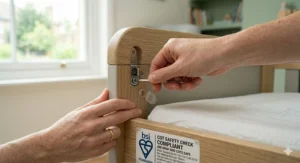
This is where things get specific, and specifics matter. The BS EN 716-1:2017 standard — the governing safety certification for baby cots sold in the UK — sets out requirements that are considerably stricter than the pre-ban US standards. Here’s what it actually mandates for drop-side cots:
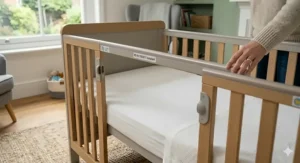
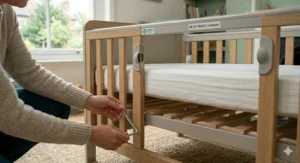
Mechanism design: The drop side must require two consecutive and deliberate actions to release — preventing accidental lowering by the baby or a casual bump. It must auto-lock when returned to the upright position. These were not requirements under the old US standards, and they are the reason the US incidents do not translate to UK-certified products.
Gap tolerances: The gap between the mattress edge and cot side must not exceed 30 mm. A mattress that is even 5 cm too small creates a “trap” where a baby’s face can become wedged. This is why buying a mattress specifically designed for your cot model matters — not a marketing upsell, but a genuine safety consideration.
Slat spacing: Between 25 mm and 60 mm — narrow enough to prevent head entrapment, wide enough to allow airflow. No negotiation on this dimension.
Rail height: When the mattress is at its lowest position, the side rail must be at least 60 cm above the mattress surface. At the highest sleeping position, a minimum of 30 cm is required.
Fatigue testing: Before approval, cots undergo what amounts to an industrial stress test — including dropping a 10 kg weight onto the base 1,000 times to simulate a jumping toddler. The mechanism is tested for repeated cycles of use across an extended period.
One additional note on the nursery and childcare context: since 2020, the new bedside crib standard BS EN 1130:2019 — which governs cribs designed to be used alongside an adult bed — specifies that these should not have a side that fully drops down. This has been taken on board in EYFS (Early Years Foundation Stage) guidance for childcare providers, where the recommendation is now that cots should have fixed sides. This does not apply to conventional cots used in domestic settings. The distinction is important and frequently confused in online discussions.
For UK parents buying second-hand, Trading Standards advises caution: older cots manufactured before the 2017 revision of BS EN 716 may not meet current requirements. If you can’t confirm the safety certification on a second-hand cot, the Lullaby Trust’s guidance on safer sleep is clear: “We strongly recommend that any second-hand product you choose meets the relevant British Standards.”
Who Should Consider a Drop Side Cot? A UK Buyer’s Decision Guide
Not every parent needs a drop-side mechanism. Not every parent can manage without one. Here’s how to think about which camp you’re in:
Choose a drop side cot if:
- You’ve had a caesarean section and bending deeply over a cot rail during recovery is a genuine medical concern
- You have a pre-existing back problem — several GPs and physiotherapists informally recommend drop-side cots to patients for exactly this reason
- You’re a shorter parent and a full-height fixed cot requires an awkward lean-and-deposit manoeuvre that would make a physiotherapist wince
- You’re placing the cot in your own bedroom and will be the primary person using it (you’re not operating a childcare setting)
- You do frequent night feeds and transfers, particularly in the early months when every sleep cycle matters
Choose a fixed side cot if:
- You’re a childcare provider or nursery operating under EYFS guidelines
- Simplicity is your priority and a fixed mechanism genuinely suits your needs
- You’re buying second-hand and can’t confirm the drop-side mechanism’s certification history
- You or your partner are tall enough that the fixed height is comfortable for both of you
The scenario most UK parents don’t anticipate: a full-size fixed cot bed at its lowest position is genuinely difficult to reach into once a baby is six months old, heavier, and the base has been lowered. That surprise back-strain is the most common reason parents mid-way through their first year quietly search for drop-side replacements. It’s worth thinking about before you buy rather than after.
How to Use a Drop Side Cot Safely: A Practical UK Guide
Safety standards give you a certified cot. Using it correctly is the other half of the equation. Here’s what the product manual won’t tell you with quite enough emphasis:
Check the mechanism weekly for the first three months. The mechanism that felt perfectly snug on assembly day can loosen slightly as pine settles and joints bed in. A quick check of all bolts and the drop-side hardware takes three minutes and matters. The instructions will say “check periodically” — treat that as weekly.
Never put the cot near a radiator. British homes are heated by radiators, and pine cots near direct heat can dry and warp over time, affecting the precision of mechanisms and joints. Keep the cot at least 60 cm from any heat source. In a compact UK bedroom — where the radiator may be closer than you’d like — this is a real consideration, not a theoretical one.
Use a correctly sized mattress, always. The 30 mm maximum gap rule under BS EN 716 applies in practice, not just in testing. If your 140×70 cm cot came with an off-brand mattress that measures 67×138 cm, those 2 cm gaps are no longer within the certified safety tolerance. Buy the mattress recommended by the manufacturer, or check measurements carefully before purchasing separately.
Don’t modify the mechanism. This sounds obvious. People still do it. One Amazon reviewer mentioned oiling a stiff mechanism with WD-40; this is not recommended — use a dry lubricant if needed, and contact the manufacturer first.
Retire the cot when your child can climb out. The drop-side mechanism has no bearing on this — it’s a universal cot rule. Once they can climb, the cot is a hazard regardless of design.
For the most current and comprehensive safe sleep guidance, the Lullaby Trust remains the UK’s leading authority and is worth bookmarking regardless of which cot you choose.
Are Drop Side Cots Banned in the UK? Clearing Up the Confusion
No. Drop side cots are not banned in the UK for home use. They are banned in the USA — the CPSC ban took effect in 2011 — and much of the misinformation circulating on UK parenting forums originates directly from that American context without acknowledging the regulatory difference.
The UK situation is nuanced rather than binary. BS EN 716-1:2017 was revised in 2011 and again in 2013 and 2017, each time tightening the mechanism requirements for drop-side cots in response to the US incidents. The standard was not simply carried over from the pre-ban era; it was actively improved. That’s a meaningful distinction that gets lost in the noise.
What is true: the 2020 update to BS EN 1130:2019 (bedside cribs specifically) specifies that those products should not have fully drop-down sides. This has influenced EYFS guidance for UK nurseries and childcare settings. Some people have conflated this specific guidance — aimed at bedside cribs in professional childcare — with a general UK ban on drop-side mechanisms in home cots. Those are not the same thing.
The short answer: buy a certified drop-side cot from a reputable UK brand, check it bears BS EN 716-1 compliance, and you are buying a legal, tested, and regulated product. The UK Baby Products Association’s position — that no deaths from drop-side cots meeting British standards have been reported — is the most directly relevant fact for British parents.
Long-Term Value & True Cost of Ownership in the UK
The sticker price of a cot is rarely the full story. Here’s how to think about total cost over the relevant period:
Entry-level budget cots (£80–£150): Fine for 12–18 months. After that, conversion to toddler bed may not be available, meaning a second purchase. Actual cost over three years: £150–£300 when you add a toddler bed.
Mid-range cot beds with conversion (£180–£280): Designed to last birth to age 4–5. Additional cost is primarily the mattress (£40–£80) and later the conversion kit (usually included). Actual cost over four years: around £220–£360. The better value per year.
Premium models (£280–£350+): Often better construction materials (solid pine vs engineered wood), superior mechanism longevity, and design that genuinely works as a toddler bed rather than a wobbly compromise. For families with two or more children planned, a solid pine cot that survives three children is a different calculation than a cheaper one that needs replacing after the first.
The hidden costs UK parents frequently miss: Separate mattress purchases (£40–£100), mattress protectors (£10–£25), and — if you go second-hand — the inability to verify BS EN 716 certification, which means the saving isn’t quite what it appears. UK consumer law under the Consumer Rights Act 2015 gives you strong protections on new goods; second-hand private sales carry no such guarantees.
Common Mistakes UK Parents Make When Buying a Drop Side Cot
These come up in customer reviews, parenting forums, and frankly in the experience of anyone who’s assembled nursery furniture at thirty-five weeks pregnant.
Buying the cot before measuring the room. A 140×70 cm cot bed assembled is around 160 cm long and 80 cm wide. In a small bedroom in a terraced house — extremely common in the UK — that plus a chest of drawers and a chair can make navigation genuinely hazardous. The Viculii Waffi exists for exactly this reason.
Ignoring the mechanism certification. “Drop side” as a product description doesn’t guarantee BS EN 716-1:2017 compliance. Some cheaper imports on marketplace platforms carry drop-side mechanisms that haven’t been tested to current UK standards. Always check the product description explicitly mentions the BS EN 716 standard before purchasing.
Buying a second-hand drop-side cot without documentation. If the seller can’t provide the original assembly instructions and certification markings, the Lullaby Trust advises against use. This applies doubly to older cots manufactured before the 2017 revision.
Assuming UK and US product names refer to the same product. Several popular US nursery brands sell differently-specified (and sometimes differently-named) products in the UK. Always verify you’re looking at the Amazon.co.uk listing, not a US-spec product description.
FAQ
❓ Are drop side cots banned in the UK in 2026?
❓ What safety standard should a UK drop side cot meet?
❓ Is a drop side cot suitable for use in a nursery or childcare setting?
❓ Can I buy a second-hand drop side cot in the UK?
❓ What is the maximum safe gap between a drop side cot mattress and the cot frame?
Conclusion: Are Drop Side Cots Safe? The Verdict for UK Parents
The honest answer, after all of this: yes, drop side cots are safe for UK parents when you choose a product that carries BS EN 716-1:2017 certification, buy it new (or second-hand with verified documentation), use a correctly sized mattress, and check the mechanism regularly. The US ban is real, the US incidents were real, but the product it bans is not the same product that British manufacturers have been building under stricter standards for decades. That distinction matters.
For parents with back conditions, post-caesarean recovery, or simply the very human challenge of lifting a sleeping baby over a fixed rail at 4am without disturbing them or yourself, the drop-side mechanism is not a frivolous feature. It’s an ergonomic consideration that genuinely affects the parenting experience.
The seven products reviewed in this guide all meet the relevant UK standards, are available on Amazon.co.uk, and cover the full range from compact flat-friendly options to premium convertible models. Start with your room measurements, your budget in GBP, and how many children you’re planning — then work backwards to the right cot.
✨ Don’t Miss These Exclusive Deals!
🔍 Click any highlighted product name above to check current pricing and Prime availability on Amazon.co.uk. Stock moves quickly on popular models, especially ahead of delivery dates!
Recommended for You
- Best Standard Cots UK 2026: 7 Expert Picks for Safe Sleep
- Best Mini Cot Beds UK 2026: 7 Top Picks for Small Rooms
- Best Sleigh Cot Beds UK 2026: 7 Stunning Picks for Your Nursery
Disclaimer: This article contains affiliate links. As an Amazon Associate, I earn from qualifying purchases. If you purchase products through these links, we may earn a small commission at no additional cost to you.
✨ Found this helpful? Share it with your mates! 💬🤗
