
In This Article
Sleep. It’s the thing every new parent craves for themselves — and the one thing they’d move mountains to give their baby. Yet choosing where your little one actually sleeps? That’s where the exhausted optimism of nursery planning collides headlong with a bewildering wall of product options, conflicting advice, and a price range that stretches from “remarkably sensible” to “did someone put a zero on by accident?”
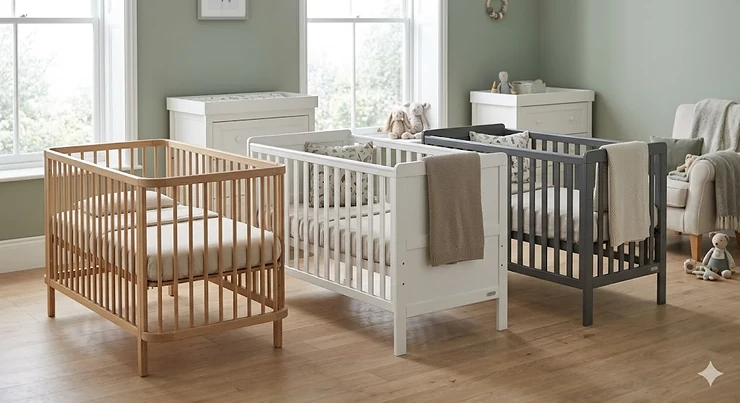
So let’s cut through the fog. The best standard cots are those measuring the classic 120x60cm — a size that fits universally available mattresses, suits the average British nursery (compact terraced house bedroom included), and sees most babies comfortably through the first two to three years. A standard baby cot 120×60 is not a compromise. It’s the sensible, time-tested choice that generations of UK families have relied on, and the one that most NHS guidance and The Lullaby Trust’s safer sleep advice implicitly assumes when recommending a firm, flat sleeping surface.
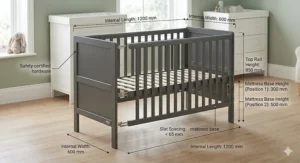
What should the best standard cots actually deliver? A sturdy, toxin-free frame. Adjustable mattress heights so you’re not wrenching your back at 3am during the newborn phase. Slats spaced no more than 6.5cm apart (a legal requirement under British Standard BS EN 716-1:2017). And, ideally, a design that doesn’t make your carefully considered nursery look like a furniture showroom reject.
In this guide, we’ve researched seven real products available on Amazon.co.uk — from budget-friendly finds under £100 to well-made mid-range options in solid beech or pine — and given you the honest commentary that the product listings simply won’t.
Quick Comparison Table: Best Standard Cots UK 2026
| Cot Model | Size | Material | Price Range | Mattress Included | Best For |
|---|---|---|---|---|---|
| Ickle Bubba Hartley Classic Cot | 120x60cm | MDF/Pine | £190–£220 | No | Stylish minimalists |
| Obaby Grace Mini Cot Bed | 120x60cm | MDF/Beech | £120–£160 | No | Space-conscious buyers |
| Love For Sleep JACOB Cot Bed | 120x60cm | Pine | £130–£170 | Yes ✅ | First-time parents on a budget |
| MEICI BABY Alex 3-in-1 Cot Bed | 120x60cm | Pine | £110–£150 | Yes ✅ | Value seekers |
| Tutti Bambini Riley Cot Bed | 120x60cm | Pine/Oak | £160–£220 | No | Design-conscious parents |
| Obaby Stamford Space Saver Sleigh | 120x60cm | MDF/Pine | £200–£260 | No | Traditional nursery lovers |
| Mamas & Papas Petite Cot | 120x60cm | MDF | £100–£140 | No | Compact nurseries & tight budgets |
Analysis: What the table above tells you is this — the sweet spot for a standard baby cot 120×60 without a mattress sits comfortably in the £120–£220 range, which for something your baby will spend roughly 14 hours a day in for two years is rather reasonable. Options that include a mattress (JACOB, MEICI BABY Alex) represent genuine value if you’re starting from zero, but do check the mattress specification carefully — the cot mattress size 120×60 matters enormously, and a mattress that doesn’t fit snugly (leaving more than 2cm around the edges) is a safety concern, not just an inconvenience. Premium options like the Stamford Sleigh cost more upfront but offer a longevity and aesthetic that mid-range models struggle to match.
💬 Just one click — help others make better buying decisions too! 😊
✨ Don’t Miss These Exclusive Deals!
🔍 Take your baby’s nursery to the next level with these carefully selected cots. Click on any highlighted product to check current pricing and availability on Amazon.co.uk. These picks will help you find exactly the right sleeping space for your little one!
Top 7 Best Standard Cots UK 2026: Expert Analysis
1. Ickle Bubba Hartley Classic Cot with Under Drawer
There’s a reason the Hartley keeps turning up on “best cots” lists across the UK parenting world. It’s the kind of piece that simply gets the brief right. A clean, Scandi-inspired slatted design in a 120x60cm standard footprint, this cot brings a full-length under-bed drawer to a price point where most rivals offer nothing but the bare frame.
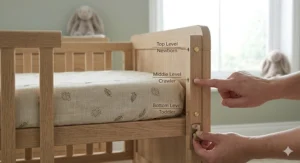
The three adjustable mattress heights are genuinely practical: start at the top position when your baby is a newborn and can’t yet haul themselves up, lower it as they gain mobility, and the transition feels natural rather than fiddly. The open slatted sides on all four panels mean you can see your baby from every angle — reassuring at 3am when you’d rather not have to move. Note that no mattress is included; you’ll need to budget for a separate cot mattress size 120×60 from a quality brand, which typically adds £40–£80 to the total.
UK buyers particularly appreciate this cot in smaller nurseries — the drawer maximises vertical storage in a room where floor space is precious, which is rather the story in most British homes. Assembly runs to about 30–45 minutes and is considered straightforward by most parents.
UK reviewers consistently praise the build quality relative to price, describing it as sturdy and well-finished. The odd comment about delivery packaging could be tighter, but the product itself rarely disappoints.
✅ Clean modern aesthetic suits most nursery styles
✅ Full-length drawer adds serious storage value
✅ Four-sided slat visibility is a genuine safety plus
❌ Mattress sold separately — factor this into your budget
❌ Not convertible to a toddler bed in this configuration
Price range: Around £190–£220 — strong value for what you get; one of the better-looking standard cots at this price bracket.
2. Obaby Grace Mini Cot Bed — Warm Grey
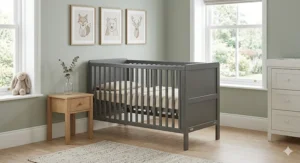
The Obaby Grace Mini occupies a clever little niche: it’s a 120x60cm cot bed with a visual softness (the warm grey finish, the gentle curves) that reads as modern nursery without screaming “trendy purchase you’ll regret in two years.” Obaby as a brand has been producing British nursery furniture for decades, and the Grace Mini reflects a brand that knows what UK parents actually need rather than what looks impressive in a catalogue.
Three adjustable base positions let you manage the mattress height as your baby grows, and when the time comes, the sides detach to convert to a toddler bed — extending usability up to roughly age three. For compact nurseries, the “mini” in the name isn’t just marketing: the overall frame dimensions are slightly trimmed compared to some rivals, making it a more sensible fit for the average British box room turned nursery.
What most buyers overlook about this model is the finish quality. Grey-painted MDF can look cheap on budget models, but Obaby’s execution here is noticeably better — smooth, consistent, and robust enough to survive teething (the teething rails are a bonus). The mattress is sold separately.
UK customers regularly describe assembly as manageable solo, and the cot as reassuringly solid once built.
✅ Compact dimensions suit smaller UK nurseries well
✅ Converts to toddler bed — genuinely extends the product’s life
✅ Teething rails protect both frame and gums
❌ Warm grey won’t suit every nursery colour scheme
❌ Mattress not included
Price range: Around £120–£160 — excellent value for a convertible option with a quality brand name behind it.
3. Love For Sleep JACOB Baby Cot Bed 120x60cm
The JACOB earns its place on this list for a single, quietly brilliant reason: it includes a mattress. And not a token effort, either — a quilted microfibre foam mattress that, while not a premium pocket-sprung number, is perfectly adequate as a starter and meets the cot mattress size 120×60 snug-fit requirement. For a first-time parent assembling a nursery on a realistic budget, this matters enormously.
Built from pine, the JACOB has the solid wood cot aesthetic that tends to age well in nurseries, even as tastes shift. The large under-cot drawer with an anti-dust cover is a thoughtful addition — it’s the kind of detail that makes you realise the designers actually spoke to parents. Guard rail and teething rails are included, and the three adjustable mattress heights follow the standard progression from newborn to active crawler.
Who is this for? First-time buyers who want a complete solution without the faff of sourcing a separate mattress, and who are rightly suspicious of suspiciously cheap cots that omit key safety documentation. The JACOB is BS EN 716-compliant and available on Amazon.co.uk with Prime delivery — a combination that makes it one of the most straightforward purchases in this category.
UK reviews are consistently positive, citing the value-for-money as the standout reason for purchase.
✅ Mattress included — genuine one-stop purchase
✅ Large drawer with anti-dust cover is a thoughtful practical touch
✅ Solid pine construction with good finish
❌ Included mattress is foam-only — upgrade when budget allows
❌ Style is fairly traditional; won’t suit ultra-modern nurseries
Price range: Around £130–£170 including mattress — exceptional complete-bundle value.
4. MEICI BABY Alex 3-in-1 Wooden Baby Cot Bed 120x60cm
The MEICI BABY Alex is the kind of product that should be on every budget-conscious parent’s shortlist, yet somehow flies slightly under the radar compared to the brand-name options. Three-in-one functionality — cot, toddler bed, junior bed — with five adjustable base positions and a mattress included in the box, all for a price that sits well under the £150 mark at time of research. That’s remarkable.
The pine construction feels solid for the price bracket, and the five mattress height positions (compared to the three offered by most rivals) give you genuinely finer adjustment — handy if you’re shorter and find reaching into a cot at 2am a recurring comedy of ergonomics. The short guardrail transitions the frame to toddler bed mode without requiring additional purchases, which represents a proper saving over the longer term.
The honest caveat: as with most cots in this price range, the finish won’t match the tactile quality of premium solid wood cot for baby options. But for a standard cot meeting BS EN 716 requirements, fulfilling its primary purpose — keeping your baby safely contained in a comfortable, appropriately firm sleeping environment — the MEICI Alex does the job thoroughly well.
Available on Amazon.co.uk with Prime delivery, making it a practical choice for parents who need a cot quickly.
✅ Five adjustable base positions — more flexibility than most rivals
✅ Mattress included; converts to toddler and junior bed
✅ Genuine best cot under £150 complete value
❌ Finish quality doesn’t match premium solid wood options
❌ Less brand recognition; check current Amazon reviews before purchasing
Price range: Around £110–£150 including mattress — the most complete budget package in this roundup.
5. Tutti Bambini Riley 3-in-1 Baby Cot Bed with Drawer, 120x60cm
Tutti Bambini has quietly built a strong reputation in UK nursery furniture, and the Riley is perhaps their most versatile standard-size offering. Available in a contemporary oak-and-white finish that photographs beautifully and ages gracefully in a nursery, the Riley converts across three configurations — cot, toddler bed, and toddler sofa — which means it genuinely earns its price point over the years rather than being replaced at the eighteen-month mark.
The drawer is a solid addition (the Riley’s under-bed storage is noticeably better-proportioned than some rivals), and the three mattress height positions cover the standard progression. What makes the Riley stand out in practical terms is the three-mode conversion: the sofa mode in particular is something parents consistently mention as a bonus they didn’t expect to use but end up appreciating as their toddler moves out of full-cot sleeping.
For parents in the Cotswolds, suburban Surrey, or anywhere with a “proper” nursery where aesthetics genuinely matter, the Tutti Bambini Riley is the white wooden cot option that looks like it cost considerably more than it did. It’s the kind of purchase you’ll still feel good about three years later.
UK Amazon reviews rate the assembly as manageable in 45–60 minutes and the finished product as impressively stable.
✅ Three-mode conversion including sofa mode extends usability significantly
✅ Oak/white finish is genuinely handsome — one of the best-looking in class
✅ Strong brand reputation with good UK customer support
❌ Mattress sold separately — budget accordingly
❌ At the higher end of the standard range; not for tight-budget buyers
Price range: Around £160–£220 — fair for a three-mode convertible with above-average aesthetics.
6. Obaby Stamford Space Saver Sleigh Cot Bed
Here’s the traditional nursery option for parents who want something that looks like it belongs in a proper nursery rather than a Scandinavian flat-pack catalogue. The Obaby Stamford Space Saver Sleigh is exactly what it sounds like: a classic sleigh silhouette — curved headboard and footboard, smooth painted finish, unmistakably nursery — in a 120x60cm standard footprint with an under-bed drawer that Obaby’s parent testers have praised effusively (77-litre capacity, which is meaningful when your nursery doubles as storage for everything you didn’t fit in the airing cupboard).
Three adjustable mattress heights, teething rails, and a conversion path to a toddler bed round out the spec. The pine wood cot construction gives you genuine material weight and solidity that MDF-heavy options can’t replicate — important when your eighteen-month-old has started rattling the bars at 5am like a tiny, pyjama-clad protest march.
This is a cot that suits parents who want the nursery to feel considered rather than functional, and who’ll use that drawer every single day. A solid choice for a family in a semi-detached in Birmingham or a Victorian terrace in Bristol where storage is scarce and aesthetic continuity matters.
UK reviews describe it as sturdy, well-packaged, and noticeably superior in terms of solidity to cheaper options at first impression.
✅ Classic sleigh design stands the test of nursery trends
✅ 77-litre drawer capacity is genuinely impressive for the size
✅ Pine construction adds real solidity and quality feel
❌ Higher price point — this is a mid-to-premium option
❌ Traditional aesthetic won’t suit minimalist or contemporary nurseries
Price range: Around £200–£260 — priced fairly for the quality of build and the design pedigree.
7. Mamas & Papas Petite Cot
Mamas & Papas need no introduction in UK parenting circles — they’ve been a fixture on the high street and online since before most current parents were born, and the Petite Cot represents their sensible, no-frills standard cot offering in the 120x60cm format. If what you want is a white wooden cot from a brand with a long UK service history, a recognisable name, and an established returns process, this is a compelling choice at around the £100–£140 mark.
Two adjustable mattress heights (rather than the three offered by most rivals) is a minor limitation, but for parents who won’t be obsessing over incremental height adjustments, it’s a non-issue. The clean, white finish is timeless, and the Petite’s compact overall dimensions make it genuinely suited to the smaller box-room nurseries that are the reality for many UK families in terraced or semi-detached homes.
What most buyers in this bracket overlook: the Mamas & Papas brand backing means warranty claims, replacement parts, and customer service interactions are markedly less fraught than with lesser-known brands. That’s worth something real when you’re sleep-deprived and a slat has inexplicably worked itself loose.
UK reviewers consistently cite “easy assembly” and “looks exactly as described” as their top observations — which, for this category of purchase, is quietly high praise.
✅ Trusted UK brand with solid customer service backing
✅ Clean white design suits virtually any nursery
✅ Competitive price with the brand name reassurance
❌ Only two mattress height positions — less flexibility than rivals
❌ No storage drawer at this price point
Price range: Around £100–£140 — the most accessible entry point from a recognisable UK brand.
Setting Up Your Standard Cot: A Practical UK Guide
Right. The cot’s arrived, it’s in approximately forty-seven pieces, and you’ve got a YouTube tutorial buffering on your phone. Here’s what actually matters beyond the assembly instructions.
Height setup: Start at the highest mattress position for a newborn — you’ll thank yourself when you’re lowering a sleeping baby at 3am and need to do so with one hand whilst trying not to breathe too loudly. Drop to the middle position when your baby can sit unaided (usually around six months), and to the lowest when they can pull themselves to standing. This progression is standard across virtually all adjustable-base cots.
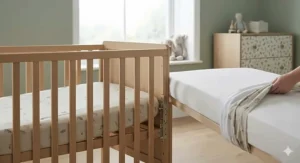
The mattress fit: Under British Standard BS EN 716-1:2017, the gap between the mattress and cot sides must not exceed 2cm. Measure it. A cot mattress size 120×60 from a reputable supplier should fit a standard 120x60cm cot perfectly, but always verify. The Lullaby Trust is clear: a firm, flat, waterproof mattress is non-negotiable. No pillows. No bumpers. No soft toys in the sleeping space. This isn’t overly cautious — it’s what the evidence says keeps babies safe.
UK damp climate consideration: British winters are less about extreme cold and more about persistent damp. If your nursery is on an external wall — common in Victorian terraces and Edwardian semis — a small amount of condensation is possible during the colder months. Keep the cot away from external walls and radiators alike, maintain a room temperature between 16–20°C as recommended, and ensure the room has adequate ventilation. A solid wood cot for baby (beech or pine) holds up well to temperature variation; avoid placing the cot directly against a cold wall regardless.
Storage drawer tip: If your cot includes an under-bed drawer, use it for non-essential items — bedding, spare muslins, sleep bags — not nappies and wipes that you’ll need at 3am. Sounds obvious. You’d be surprised how often this results in a full-drawer-unpack at the worst possible moment.
Which Standard Cot Is Right for Your Family? A UK Buyer’s Decision Framework
Let’s shortcut the agonising. The right cot depends less on brand loyalty and more on your actual situation.
If you’re in a compact flat or box room: The Obaby Grace Mini or Mamas & Papas Petite are your best options. Both are designed with the reality of smaller-than-average UK nurseries in mind. The Petite especially respects floor space in a way the larger sleigh-style options cannot.
If you’re starting with zero nursery kit and a tight budget: The Love For Sleep JACOB or MEICI BABY Alex are the most sensible choices — both include a mattress and you’ll spend under £170 for a complete sleeping solution. Buy a waterproof mattress protector alongside and you’re fully equipped.
If the nursery aesthetic genuinely matters to you (and there’s no shame in that): The Tutti Bambini Riley in oak/white is the best-looking option at its price point. The Obaby Stamford Sleigh is the traditional-nursery choice that photographs beautifully and holds its value well secondhand.
If longevity and material quality are your priority: Look for a solid wood cot for baby in beech or pine — genuinely denser and more durable than MDF-framed options. The Obaby Stamford and Love For Sleep JACOB offer pine construction at accessible prices. For premium solid beech, specialist brands beyond Amazon are worth exploring, but expect to pay considerably more.
If you’re somewhere rural with unreliable delivery windows: Amazon Prime’s next-day delivery is genuinely useful here — most options in this roundup are Prime-eligible, which is worth confirming before you order.
How to Choose the Best Standard Cots in the UK: 7 Expert Criteria
- Safety certification: Look for BS EN 716-1:2017 compliance on every cot you consider. This is not optional — it’s the British Standard that governs slat spacing, structural integrity, and mattress gap dimensions. UK Government guidance via the Department for Education explicitly references these standards as the benchmark for safe infant sleeping environments.
- Mattress height adjustability: Three or more positions is preferable. Two positions is workable but less forgiving as your baby’s mobility develops quickly — often faster than you expect.
- Standard 120x60cm footprint: Universally available mattresses. Lower replacement costs. Works in virtually every UK nursery. The standard baby cot 120×60 dimension exists for good reason.
- Drop-side or fixed sides: Drop-side cots are now prohibited in UK nurseries under BS EN 1130:2019 for bedside cribs, and fixed-side standard cots are the current safe standard. All products in this roundup use fixed sides. This is a drop side cot alternative — and it’s the right choice.
- Material and finish: Solid wood (beech or pine) outlasts MDF for structural durability. If you’re buying white-painted, check the paint specification — child-safe, water-based paints are the standard on reputable products. UK parents with smaller storage spaces also need to consider: does the flat-pack come apart for storage if needed? Some solid wood frames don’t.
- Under-bed storage: Not essential, but in a country where the average new-build bedroom is roughly the size of a generous wardrobe, a cot drawer can be genuinely transformative.
- Convertibility: Does it extend to a toddler bed? Not every parent wants or needs this, but if it’s likely to be your only child furniture purchase for several years, the extra usability is worth the modest price premium.
Pine vs Beech Cot: Which Wood Actually Matters?
It’s one of the most common questions — and oddly, one of the least clearly answered in most buying guides. So let’s settle it.
Pine is softer, lighter, and marginally more affordable. It takes paint well, which is why most white wooden cot options use pine as their base material. The grain is visible and warm under natural or painted finishes. The downside: pine dents and marks more readily than beech, which matters if you have a child who will one day discover that cot bars make a satisfying percussive instrument at 5am.
Beech is denser, harder, and more resistant to dinging and scratching. It’s the material of choice for specialist premium cot brands (Mokee, for example, build their solid beech cots to notably high standards with FSC-certified timber). It costs more, but for families who intend to pass a cot down to a second child or sell it secondhand, beech holds up better over time. The Obaby Grace Mini uses beech elements alongside MDF, striking a sensible balance.
For most UK families buying in the £120–£220 range, pine is entirely adequate — it meets the safety standards, it looks handsome in a nursery, and it’ll comfortably outlast the years of active use. The pine vs beech cot debate only meaningfully changes the answer when longevity and secondhand value are significant factors.
One note worth making: FSC-certified timber — whether pine or beech — is worth looking for if sustainability is a priority. Several UK brands now specify FSC certification, which at minimum tells you the wood was sourced responsibly.
UK Safety Standards & Legal Requirements for Baby Cots
This is the section most buying guides treat as a box-tick. It shouldn’t be.
Every standard cot sold legally in the UK must comply with BS EN 716-1+AC:2019 — the primary British Standard governing construction, structural integrity, and mechanical safety. This covers slat spacing (2.5–6.5cm, no exceptions), mattress gap dimensions (no more than 30mm between mattress and cot sides), and structural fatigue requirements that simulate years of active use. Compliance is enforced by Trading Standards and is not voluntary.
Additionally, under the Furniture and Furnishings (Fire) (Safety) Regulations 1988 — still active in UK law post-Brexit — any upholstered components (padding, foam) must meet fire safety requirements. For mattresses separately, BS EN 16890:2017+A1:2021 governs safety standards for cot mattresses.
Drop-side cots deserve a specific mention: as of 2020, all bedside cribs must meet BS EN 1130:2019, which prohibits fully-dropping sides. Standard cots should have fixed sides only — all products in this roundup comply.
The Lullaby Trust remains the UK’s leading safer sleep charity and their guidance — back sleeping, firm flat mattress, clear cot, room-sharing for the first six months — is based on decades of SIDS research and is endorsed by NHS guidance. It’s worth a thorough read before your baby arrives, not after.
Post-Brexit context: Most cots available on Amazon.co.uk now carry UKCA marking (replacing EU CE marking), confirming UK conformity assessment. When buying, check for UKCA or confirmed BS EN 716 compliance in the product description — don’t assume it from the listing alone.
Common Mistakes When Buying a Standard Baby Cot (And How to Avoid Them)
Buying the cot but forgetting to budget for the mattress. Happens constantly. Several popular cots — including some of the best-reviewed options in this guide — are sold frame-only. A quality cot mattress size 120×60 from a reputable UK brand adds £40–£120 to the total. Budget for it upfront.
Choosing size based on the room rather than the standard. Compact rooms tempt buyers towards non-standard cot sizes (100x60cm, for example), which means non-standard mattresses at higher replacement cost and less availability. The standard baby cot 120×60 fits most UK nurseries without difficulty and gives you a far wider choice of affordable mattresses and bedding.
Buying a secondhand cot without verifying the mattress. The Lullaby Trust and NHS guidance are unambiguous: buy a new mattress for each baby. A secondhand cot frame in good structural condition is a reasonable purchase; using the previous owner’s mattress is not recommended, regardless of apparent condition.
Ignoring assembly complexity. Some cots that look elegant in photos are considerably less pleasant to assemble. Read UK reviewer comments specifically about assembly — they’re generally more candid than the star rating alone suggests.
Focusing on aesthetics at the expense of safety documentation. A beautiful cot without visible BS EN 716-1 compliance documentation is a risk. Prioritise certification, then aesthetics. They’re not mutually exclusive — but in a category where the stakes are literally your baby’s safety, the certification comes first.
FAQ: Best Standard Cots UK 2026
❓ What is the standard cot size in the UK?
❓ Are drop-side cots still legal in the UK?
❓ Do I need to buy a mattress separately for a standard cot?
❓ What's the difference between a cot and a cot bed?
❓ Can I use a second-hand wooden cot from a car boot sale or Facebook Marketplace?
Conclusion: Finding Your Best Standard Cot Without the Stress
The best standard cots aren’t necessarily the most expensive, the most photographed on Instagram, or the ones your NCT group all bought. They’re the ones that meet the safety standard (BS EN 716-1:2017), fit your room, match your budget, and give your baby a firm, flat, clear sleeping surface for the first couple of years of their life.
For most UK families, that means a standard baby cot 120x60cm from one of the seven options above. If budget is the priority, the Love For Sleep JACOB or MEICI BABY Alex deliver a complete solution without financial pain. If longevity and aesthetics matter, the Tutti Bambini Riley or Obaby Stamford Sleigh represent the upgrade worth making. And if you just want something reliable from a brand that’ll answer the phone if something goes wrong, Mamas & Papas and Obaby have been doing this for decades.
Whatever you choose: buy a new mattress, keep the cot clear, and follow The Lullaby Trust’s safer sleep guidance. The cot is the stage. Safe sleep is the performance that matters.
✨ Don’t Miss These Exclusive Deals!
🔍 Check current pricing and availability on Amazon.co.uk for any cot in this guide. Prices change regularly — click through to see the latest deals and Prime delivery options for your postcode!
Recommended for You
- Best Mini Cot Beds UK 2026: 7 Top Picks for Small Rooms
- Best Sleigh Cot Beds UK 2026: 7 Stunning Picks for Your Nursery
- When to Convert Cot to Junior Bed: 7 Best UK Picks 2026
Disclaimer: This article contains affiliate links. As an Amazon Associate, I earn from qualifying purchases. If you purchase products through these links, we may earn a small commission at no additional cost to you.
✨ Found this helpful? Share it with your mates! 💬🤗
