
In This Article
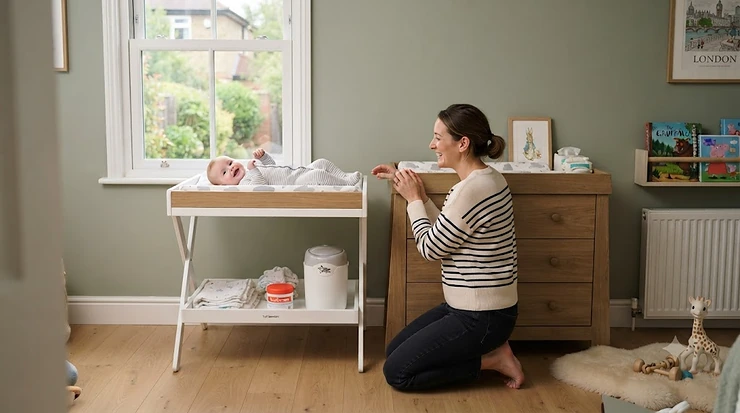
Somewhere around week thirty of pregnancy, most parents-to-be fall down the same rabbit hole: standing in a nursery aisle, phone in hand, trying to work out whether a foldable changing table or a fixed changing table is the smarter buy. It looks like a simple choice. It is not. One option folds flat and rolls under a bed; the other plants itself in the corner of the room like a piece of proper furniture and stays there for years. A changing table, broadly speaking, is any raised, waist-height surface designed to hold a nappy-changing mat safely off the floor, usually with some form of storage built in or attached underneath. Foldable versions collapse for storage or travel, while fixed versions are permanent nursery furniture, often doubling as a dresser.
The decision matters more than it looks like it should, because you’ll be using this thing five, six, sometimes eight times a day for the best part of two years. Get it wrong and you’re looking at a sore back, a cluttered nursery, or a wobbly unit that makes you nervous every time your squirming six-month-old decides changing time is wrestling time. Get it right and it quietly disappears into your routine, doing its job without you thinking about it twice.
This guide pulls together real, currently available UK products — a mix of budget, mid-range and premium options across both foldable and fixed designs — alongside genuine specification comparisons, safety standards such as BS EN 12221-1, which sets out safety requirements for changing units used in the home for children weighing up to 15kg, and honest analysis of where each style earns its keep. No fabricated reviews, no invented quotes — just the research, laid out so you can make the call that actually suits your home.
Foldable Changing Table vs Fixed Changing Table: Quick Comparison
Before diving into individual products, here’s the headline comparison most parents want first.
| Feature | Foldable Changing Table | Fixed Changing Table |
|---|---|---|
| Typical price range | Around £40–£100 | Around £70–£300 |
| Storage capacity | Small–moderate (baskets, hooks) | Moderate–large (drawers, shelves) |
| Portability | High — folds flat, often wheeled | None — stays put once assembled |
| Stability | Good, but lighter frames can flex | Excellent, especially anchored units |
| Longevity of use | Usually retired once nappies stop | Often converts to a dresser for years |
| Best for | Small flats, multi-room use, travel | Dedicated nurseries, long-term use |
The short version: foldable units win on flexibility and footprint, fixed units win on stability and staying power. Neither is objectively “better” — it depends entirely on your space, your budget, and how long you want the furniture to earn its place in the room. A young family in a two-bedroom flat with grandparents on regular babysitting duty has very different needs from a family who’s decorated a dedicated nursery and wants a piece that’ll still look smart as a chest of drawers in three years. Worth noting too: that price gap at the top end isn’t really about quality — it reflects the fact that fixed units are usually built from denser materials and designed for multi-year use, so the cost is spread over a much longer lifespan than a foldable unit typically sees.
💬 Just one click — help others make better buying decisions too!😊
Top 7 Changing Tables: Expert Analysis (Foldable & Fixed)
We’ve deliberately mixed foldable and fixed designs across budget, mid-range and premium price points so you can compare like-for-like within your own budget bracket, not just across the whole market. All seven are real products currently listed on amazon.co.uk. As always, check current pricing and availability at the time of purchase, since stock and pricing shift regularly.
1. WOLTU Baby Changing Unit with 3 Drawers — budget-friendly three-drawer storage
The standout here is straightforward: three full-width drawers for the price most retailers charge for a basic open shelf. That’s a genuinely useful ratio of storage to spend.
Built from MDF and particleboard in a white finish, this is a fixed dresser-style unit with a changing top built into the design rather than bolted on as an afterthought. The three drawers run the full width of the unit, which in practice means you can dedicate one to nappies, one to sleepsuits, and one to muslins and wipes without anything getting jumbled together — a small thing, but it saves real time at 3am. Reviewers consistently report that assembly takes an hour or so with the supplied Allen key, and that the drawers glide smoothly once the runners have bedded in, though a handful note the particleboard construction feels lighter-duty than solid wood alternatives, which tracks with the price point.
This suits first-time parents on a tight furniture budget who want a proper dresser rather than a mat balanced on a chest of drawers, and who are prepared to trade premium materials for genuine drawer storage. It is not the unit for anyone planning to move house twice in the next two years — flat-pack furniture like this is built for one careful assembly, not repeated dismantling.
Pros:
- ✅ Three full-width drawers for genuine everyday storage
- ✅ Compact footprint suits smaller nurseries
- ✅ Straightforward flat-pack assembly with basic tools
Cons:
- ❌ MDF/particleboard build feels less premium than solid wood
- ❌ Not designed to be moved or disassembled repeatedly
Expect to pay in the £70–£100 range at the time of research. For the drawer count alone, it represents strong value if your priority is storage over style.
2. Obaby Open Changing Unit — best open-shelf grab-and-go storage
What stands out immediately is the two large open shelves — no drawers to fumble with one-handed while you’re holding a squirming baby with the other.
The Obaby Open Changing Unit skips drawers entirely in favour of two deep open shelves, sized to take nappy boxes, wipe tubs, and stackable storage cubes with room to spare. The top surface is shaped to seat a standard-size changing mat securely, sitting at a height most adults find comfortable without excessive bending. Buyers frequently mention that the open-shelf design makes it genuinely easier to grab things one-handed mid-change, which — as anyone who’s tried to open a drawer with an elbow will tell you — is not a small point. On the flip side, open shelving means everything is visible and dust-exposed, so it suits parents happy to use baskets or boxes to keep things tidy rather than relying on the unit itself to hide the clutter.
This is a strong pick for parents who value speed and accessibility over concealment, and who don’t mind a slightly more “utilitarian” look in exchange for practicality. It’s less suited to anyone who wants everything hidden behind closed drawers for a tidier visual finish.
Pros:
- ✅ Open shelving allows fast, one-handed access
- ✅ Comfortable changing height for most adults
- ✅ Simple, sturdy construction with a 2-year manufacturer guarantee
Cons:
- ❌ No enclosed storage — contents stay on display
- ❌ Open shelves collect dust faster than drawers
Priced around £90–£130 at the time of research, it sits comfortably between the budget and mid-range brackets.
3. Obaby Maya Changing Unit — best Scandi-style mid-range dresser
The two-tone Scandinavian finish is the hook, but the real standout is the combination of multiple drawers and a full-height cupboard in one unit.
The Maya range pairs a light wood tone with contrasting drawer fronts, giving it a look that doesn’t scream “nursery furniture” the moment your child outgrows nappies — a genuine advantage if you’re planning to repurpose it as a bedroom dresser later. Inside, you get several drawers plus a tall cupboard with an adjustable shelf, which in practice means you can store bulkier items like a spare changing mat, folded towels or a nappy bin liner box without them eating into drawer space. What most buyers overlook when comparing dressers on spec sheets alone is how much that cupboard changes the day-to-day usability — it’s the difference between rummaging through a drawer for a single large item and just opening a door.
This suits parents who want furniture that will visually transition out of “baby mode” gracefully, and who value flexible storage over sheer volume. Budget-focused buyers may find better value in the WOLTU or Obaby Open unit if style is a lower priority than price.
Pros:
- ✅ Scandinavian two-tone finish blends into most décor
- ✅ Cupboard plus drawers gives flexible storage options
- ✅ Adjustable internal shelf adapts as storage needs change
Cons:
- ❌ Sits at a higher price point than basic dresser units
- ❌ Larger footprint needs a bit more floor space
At around £150–£200 at the time of research, it’s a mid-range investment that pulls double duty well beyond the nappy years.
4. Tutti Bambini Modena Solid Wood Baby Changing Table — best premium solid wood dresser
Solid wood construction is the headline feature, and it’s the detail that separates this from every MDF alternative on this list.
Built with a removable changing top sitting above three drawers, the Modena is designed from the outset to convert into a standalone chest of drawers once nappy changing is finished — you simply lift the top section away. Reviewers who’ve owned Tutti Bambini furniture through multiple nursery stages consistently note that the solid wood frame holds up to years of drawer use without the sagging or wobble that cheaper composite units can develop. On paper this means a higher upfront cost; in practice it means one purchase that outlasts the changing years entirely, rather than a piece you’re replacing once your toddler starts climbing on furniture.
This is the pick for parents furnishing a long-term nursery who want one considered purchase rather than a changing table now and a “proper” dresser later. It’s overkill for anyone who only needs changing facilities for a few months, such as grandparents’ houses or a temporary living situation.
Pros:
- ✅ Solid wood build feels noticeably sturdier than composite units
- ✅ Removable top converts it into a standalone dresser
- ✅ Established UK brand with a long nursery-furniture track record
Cons:
- ❌ Highest price point of the fixed options on this list
- ❌ Heavier and harder to move once assembled
Expect a price in the £220–£300 range at the time of research — a genuine investment piece rather than an impulse buy, but one that’s designed to earn that cost back in years of use.
5. Yosamy Foldable Baby Changing Table — best budget foldable for tight spaces
The lockable wheels and genuine fold-flat frame are what earn this a spot — most budget foldables compromise on one or the other.
Height-adjustable and mounted on wheels that lock in place once you’ve settled on a position, the Yosamy folds down to a slim profile that slides behind a door or under a bed when you don’t need it. The height adjustment is worth dwelling on: rather than committing to one fixed level, you can raise or lower the changing surface to suit whichever parent is on duty, which matters more than it sounds when partners have a meaningful height difference. Aggregated buyer feedback on similar mobile folding units generally points to the wheels and folding hinge being the components most likely to loosen with heavy daily use over time, so periodic tightening is worth building into your routine rather than treating it as a one-off assembly job.
This is the strongest option for parents in small flats, shared houses, or anyone who needs the changing station to move between rooms — or vanish entirely — several times a week. It is not the right choice if you want a piece of furniture that also stores a full stock of nappies and clothing, since the storage here is genuinely secondary to the folding mechanism.
Pros:
- ✅ Folds flat for easy storage in small spaces
- ✅ Height-adjustable to suit different parents’ comfort
- ✅ Lockable wheels for stable positioning and easy relocation
Cons:
- ❌ Storage is limited compared with drawer-based units
- ❌ Folding hinges need occasional tightening with regular use
At around £40–£60 at the time of research, it’s one of the most affordable genuine changing solutions on the market — ideal as a first purchase or a secondary unit for a second location.
6. Maxmass Baby Changing Table — best foldable with wheels for multi-room use
A dedicated shelf plus a separate storage basket is the standout combination — most folding units offer one or the other, not both.
The Maxmass sits on four wheels, folds for storage, and includes both an open shelf underneath and a hanging storage basket, giving you two distinct storage zones rather than one catch-all space. Height adjustment across several levels means it can be set for standing changes or for use alongside a lower cot, and the wheeled base makes it genuinely practical for parents who change nappies in more than one room — living room during the day, nursery at night, say. Based on the spec comparison with other foldable units in this bracket, the dual storage setup is what justifies the modest price premium over the Yosamy, rather than any dramatic difference in build quality.
This suits growing families who need a changing station that earns its keep in multiple rooms, and parents who want a bit more organised storage than the most basic foldable models offer without stepping up to fixed-furniture prices.
Pros:
- ✅ Combined shelf and hanging basket for organised storage
- ✅ Multiple height settings for different changing positions
- ✅ Four-wheel mobility for genuine multi-room use
Cons:
- ❌ Bulkier when folded than slimmer single-shelf models
- ❌ Wheeled frame can feel less rigid than a fixed unit
Priced around £55–£80 at the time of research, it sits neatly between the cheapest foldables and the pricier multi-function options.
7. COSTWAY 4 in 1 Baby Changing Table — most versatile foldable multi-function station
The four-in-one design — changing station, bath tub cradle, storage tray and mobile unit combined — is the clear standout, and it’s what separates this from every other foldable on the list.
Built around a PVC-covered pad and a fold-out frame on four wheels, the COSTWAY unit includes an integrated bath tub cradle that clips onto the frame, effectively combining two nursery essentials into a single footprint. The waterproof surface is a genuinely practical touch for a product that’s going to be near water regularly, and the storage tray beneath keeps towels, wash items and a spare outfit within arm’s reach during bath time. What the spec sheet won’t tell you, but the multi-function design implies, is that this is really aimed at parents tight on space who’d otherwise need to buy a separate baby bath and changing unit — combining them cuts both cost and floor space in one move.
This is the pick for space-conscious parents who want maximum function from one purchase, particularly in flats without room for two separate baby care pieces. Families with more space, or those who prefer a dedicated bath rather than a combined cradle, may find a standalone unit better suited to daily use.
Pros:
- ✅ Combines changing station and bath cradle in one unit
- ✅ Waterproof PVC pad suited to bath-time use
- ✅ Four wheels for mobility between rooms
Cons:
- ❌ Bulkier footprint than single-function foldables
- ❌ Bath cradle function adds bulk when folding for storage
Expect a price in the £70–£100 range at the time of research, which compares favourably against buying a separate bath and changing station individually.
Top 7 Products at a Glance
| Product | Type | Price Range | Storage | Best For |
|---|---|---|---|---|
| WOLTU 3-Drawer Unit | Fixed | £70–£100 | 3 full drawers | Budget dresser storage |
| Obaby Open Changing Unit | Fixed | £90–£130 | 2 open shelves | Fast one-handed access |
| Obaby Maya Changing Unit | Fixed | £150–£200 | Drawers + cupboard | Long-term flexible storage |
| Tutti Bambini Modena | Fixed | £220–£300 | 3 drawers | Premium, long-term nursery |
| Yosamy Foldable Table | Foldable | £40–£60 | Minimal | Small flats, portability |
| Maxmass Foldable Table | Foldable | £55–£80 | Shelf + basket | Multi-room families |
| COSTWAY 4-in-1 | Foldable | £70–£100 | Small tray | Combined bath + change |
Looking at the table, the clearest pattern is that fixed units scale in price with storage volume and material quality, while foldable units scale in price with added functionality rather than raw storage. If your priority is simply “somewhere safe and organised to change a nappy for two years,” the WOLTU 3-Drawer Unit or Yosamy Foldable Table cover the basics at the lowest cost in each category. If you want furniture that survives the nappy years and beyond, the Tutti Bambini Modena justifies its price through longevity rather than flashy features.
Practical Usage Guide: Setting Up and Maintaining Your Changing Table
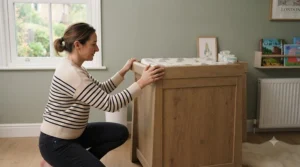
Whichever style you choose, the first thirty days set the tone for how well the unit serves you. Start by positioning it against a solid wall, away from windows, blind cords and radiators — a detail RoSPA repeatedly flags in its guidance on preventing childhood falls and furniture-related injuries. For fixed units, fit an anti-tip wall strap even if the manufacturer doesn’t supply one as standard; it takes ten minutes and removes a genuine tip-over risk once your baby starts pulling up on furniture around eight or nine months old. For foldable units, get into the habit of checking the locking mechanism engages fully before every single use — it’s the step most commonly skipped once the novelty wears off.
Maintenance differs by type. Fixed dressers need drawer runners checked every few months for grit or fluff build-up, and any exposed screws re-tightened as the wood settles. Foldable units need their folding hinges and wheel locks checked more frequently, roughly monthly, since these are the components under the most mechanical stress. A common first-month mistake is over-tightening flat-pack fixings during assembly, which can strip the threads in composite wood — snug is sufficient; forced is not. Whichever unit you choose, wipe the changing surface down with a mild antibacterial solution after every change rather than saving it for a weekly deep clean; nappy changes are one of the more hygiene-critical routines in a nursery, and daily wiping takes seconds.
Real-World Scenarios: Which Type Suits Your Home?
The flat-dwelling first-timer. If you’re in a one- or two-bedroom flat with a nursery corner rather than a dedicated room, a foldable unit like the Yosamy or Maxmass solves the space problem directly — fold it away for visitors, wheel it into the living room during the day, and you’ve avoided dedicating permanent floor space to something you’ll use for roughly two years.
The settled family with a proper nursery. If you’ve got a dedicated nursery and you’re furnishing it once, properly, a fixed dresser like the Obaby Maya or Tutti Bambini Modena makes more sense. You’re paying for furniture that transitions into a normal chest of drawers, so the cost amortises over five-plus years rather than two.
The budget-conscious second-time parent. If you already own most of the big-ticket nursery items and just need functional changing facilities without ceremony, the WOLTU 3-Drawer Unit or Obaby Open Changing Unit deliver the essentials — proper storage, a stable surface — without the premium price tag of a statement piece.
Problem → Solution Guide
Problem: Not enough floor space for permanent furniture. Solution — choose a foldable unit on wheels, like the Yosamy or Maxmass, and designate a specific “parked” spot for it rather than leaving it out permanently.
Problem: Changing table wobbles during use. Solution — for fixed units, check all flat-pack fixings are fully tightened and the unit is anchored to the wall; for foldable units, ensure the leg-locking mechanism is fully engaged, not just resting in position.
Problem: Storage overflowing within weeks. Solution — pair an open-shelf or drawer unit with stackable storage baskets sized to fit the shelves exactly, rather than buying generic bins that leave gaps.
Problem: Back pain from bending over a low unit. Solution — measure your own comfortable working height before buying; height-adjustable foldable units solve this directly, while fixed units should be checked against your height in-store or via listed dimensions before ordering.
Problem: Unit no longer needed once nappies stop. Solution — buy a convertible fixed dresser from the outset (Modena, Maya) so the furniture has a second life, rather than a single-purpose unit destined for resale or storage.
How to Choose Between a Foldable and Fixed Changing Table
- Measure your available space first, not last. A fixed unit needs a permanent footprint; a foldable one needs only temporary space plus a fold-away spot. Get this backwards and you’ll be returning furniture.
- Be honest about how long you’ll use it. If you’re planning more children soon, a fixed unit’s higher upfront cost spreads across more years of use. If this is likely your only child, or storage is genuinely tight, foldable wins on value.
- Think about who else uses the space. Shared living rooms, frequent visitors, or a home office nearby all favour a foldable table that can disappear when not needed.
- Weigh storage needs against footprint. Drawers hold more per square foot than open shelves or baskets, but cost more and can’t move with you.
- Factor in resale or repurposing value. Convertible fixed dressers hold more resale value than single-purpose foldable units once your child outgrows nappies.
- Check the weight rating against your baby’s growth curve. Most changing units, foldable or fixed, are only rated to hold a child up to around 11–15kg — plan your changing-table years accordingly.
- Test the assembly commitment you’re signing up for. Fixed furniture generally means one careful flat-pack build; foldable units need less initial assembly but more ongoing mechanical checks.
Foldable vs Fixed Changing Table: The Full Comparison
The core trade-off comes down to permanence versus flexibility, and it’s worth unpacking properly rather than reducing it to a single table.
Fixed changing tables — dressers with a changing top — win decisively on stability. A well-built fixed unit like the Tutti Bambini Modena simply doesn’t flex or rock the way a folding frame can, because the drawers and cupboard structure themselves brace the whole unit. They also win on storage density: three full-width drawers hold considerably more than a hanging basket or open shelf of similar footprint. Where they lose is flexibility — once assembled and positioned, moving a fixed dresser is a two-person job, and it occupies permanent floor space whether you’re using it or not.
Foldable changing tables flip that trade-off. A unit like the Maxmass or Yosamy can be relocated, folded flat, or wheeled between rooms in seconds, which suits households where the nursery doubles as something else, or where changing happens in multiple locations through the day. The compromise is storage — most foldable units offer a fraction of the capacity of even a modest fixed dresser — and, for lighter budget models, a slight reduction in rigidity compared with a bolted-together dresser. Reviewers of budget folding units frequently mention a small amount of flex or wobble under an actively wriggling toddler, which simply isn’t a factor with a well-anchored fixed unit.
There’s also a longevity argument worth weighing separately from either “type.” A convertible fixed dresser continues to earn its keep long after nappies are a distant memory, becoming a normal piece of bedroom furniture. A foldable changing table, by contrast, is almost always a single-purpose item — once your child is out of nappies, it’s typically sold on, stored in the loft, or passed to another family. That doesn’t make it a worse purchase; it simply means the true cost-per-year calculation looks different depending on how long each piece stays useful in your home.
Collapsible Changing Table Pros and Cons
Since “collapsible” and “foldable” are used interchangeably by most UK retailers, it’s worth a dedicated look at where these units genuinely shine and where they fall short, beyond the individual product reviews above.
On the plus side: collapsible units solve the space problem outright, they’re generally the most affordable route into a proper changing station, and their mobility means they adapt to whichever room the family actually spends time in — a real advantage during the newborn stage when parents rarely stray far from wherever the baby is settled. Height adjustability, present on most modern collapsible models, also means the unit can suit both parents even with a meaningful height difference between them, something fixed units rarely offer.
On the downside: collapsible units generally sacrifice storage volume for portability, moving parts (hinges, wheel locks, height adjusters) introduce components that can loosen or wear with heavy daily use, and budget models can feel noticeably less rigid than a solid fixed dresser once a baby is old enough to actively resist changing time. There’s also a practical ceiling on how long they remain useful — most families find themselves wanting more storage as their child grows, at which point a fixed dresser tends to take over regardless.
Permanent Changing Station vs Portable: Which Wins for Your Home?
“Permanent” and “portable” are really shorthand for a bigger question: are you optimising for the next six months, or the next five years? A permanent changing station — any fixed dresser-style unit — asks for a bigger upfront commitment of both money and floor space, but repays that with stability, storage, and a second life as ordinary furniture once nappies are behind you. It’s the better bet for families who’ve settled into their home and don’t anticipate needing to reconfigure the nursery layout regularly.
A portable station earns its keep differently. It’s the better bet for renters who may move before the nappy years are over, for families in smaller properties where every square foot is doing double duty, and for anyone who genuinely values the ability to reposition or hide the unit at will. Reviewers of portable units frequently cite exactly this flexibility as the reason they chose one over a dresser, even when they had space for the larger option — the ability to tidy the whole setup away for visitors matters more to some households than raw storage capacity.
Neither wins outright. What tends to happen in practice is that budget and living situation make the decision for most families before preference even comes into it — which is precisely why this guide leads with real prices and real space considerations rather than a blanket recommendation.
Changing Table Storage Space Comparison
Storage is where the two categories diverge most sharply, so it’s worth breaking down rather than leaving as a single line in the comparison table above.
Fixed dressers typically offer the most storage per square foot of floor space, because drawers stack vertically and use the full depth of the unit efficiently. The Tutti Bambini Modena and Obaby Maya, for instance, both combine drawer storage with either a cupboard or adjustable shelving, meaning bulky items (spare mats, towel stacks, nappy bin refills) and smaller items (creams, cotton wool, spare vests) each get an appropriate home rather than being crammed together. Open-shelf fixed units like the Obaby Open Changing Unit trade some of that organisation for speed of access — everything is visible and grabbable, at the cost of looking a little more cluttered day to day.
Foldable units, by contrast, generally offer a hanging basket, a single shelf, or both — enough for daily essentials (nappies, wipes, a change of clothes) but rarely enough to store a full stock of supplies. The practical solution most parents land on is pairing a foldable changing table with a separate, freestanding storage unit or set of drawers nearby, effectively splitting the “changing” and “storage” functions across two pieces rather than expecting one compact unit to do both jobs. If storage volume is your primary concern, that’s arguably the single biggest argument in favour of a fixed dresser over any foldable alternative, however well designed.
Furniture Flat-Pack Assembly: What New Parents Should Expect
Nearly every changing table sold in the UK today — foldable or fixed — arrives as flat-pack furniture, and it’s worth setting expectations before the box turns up, ideally before the third trimester leaves you unable to kneel on the floor for an hour with an Allen key. Fixed dressers like the WOLTU, Obaby and Tutti Bambini units typically take sixty to ninety minutes to assemble from scratch, following printed instructions and using the tools supplied — usually just an Allen key and occasionally a screwdriver. Reviewers of budget dresser units consistently mention that pre-drilled holes can be slightly misaligned on cheaper models, so a bit of patience (and possibly a helper to hold panels steady) goes a long way.
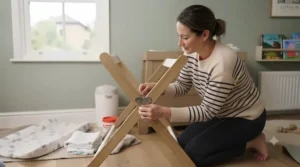
Foldable units require far less initial assembly — often just attaching legs or a basket to a pre-hinged frame — but they introduce a different kind of ongoing responsibility: checking that folding joints and height-adjustment clips are fully engaged every time the unit is unfolded, not just on day one. A sensible general rule, whichever type you buy: assemble it a week or two before your due date rather than the week of, since flat-pack furniture always seems to take longer than the box promises, and a wobbly unit assembled in a rush is far more likely to have a loose fixing somewhere. If in doubt about structural stability once built, most UK retailers — including Amazon — offer straightforward returns within the standard consumer rights window, so it’s worth testing the unit properly (gently rocking it, opening every drawer, checking every folding joint) within the first few days rather than assuming everything is fine because it looks fine.
Changing Table Weight Limits Explained
Every changing table, foldable or fixed, comes with a maximum weight limit, and it’s one of the most overlooked details on the entire spec sheet. Under BS EN 12221-1, changing units for domestic UK use are only required to meet safety requirements for children up to 15kg in body weight — in practical terms, that’s roughly the average weight of a child somewhere between twelve and eighteen months old, though every baby’s growth curve differs. Once your child approaches or exceeds that limit, or once they’re standing, rolling and actively resisting on the changing surface, it’s time to retire the changing table regardless of how sturdy it still looks.
Weight limits differ slightly by product and construction. Solid wood fixed units, like the Tutti Bambini Modena, tend to sit at the upper end of the typical range thanks to their sturdier frames, while lighter foldable units — particularly budget models with slimmer folding legs — can sit closer to the lower end. It’s always worth checking the specific listed weight limit for your chosen product rather than assuming every changing table covers the full newborn-to-toddler span; some parents are surprised to find their child outgrows the changing table’s weight rating well before they’re developmentally ready to stop using it, at which point switching to changing on a floor mat or bed is the sensible next step regardless of which type of table you originally bought.
Common Mistakes When Buying a Changing Table
The most frequent mistake is buying on aesthetics before measuring the space — a beautiful fixed dresser that’s two centimetres too wide for the intended corner is a genuinely common and entirely avoidable regret. A close second is underestimating storage needs; new parents consistently report needing more storage than they initially budgeted for, particularly once cloth nappies, spare outfits and bathing supplies all compete for the same shelf space. Another recurring error is skipping the anti-tip wall strap on fixed units, assuming it’s optional because the unit “feels” heavy enough — the UK government’s guidance on furniture and furnishings fire safety regulations is a useful reminder that nursery furniture rules exist precisely because furniture that seems stable in a showroom can behave differently once a mobile baby starts pulling up on it at home.
Buyers also frequently mismatch product to lifestyle — choosing a heavy fixed dresser despite living in a share house or rental where a move is likely within the year, or opting for a minimal foldable unit despite having the space and long-term plans that would suit a proper dresser. Finally, many parents forget to check the weight limit and stop-using-by guidance entirely, only realising well into the second year that the unit they bought was rated for a much younger child.
Long-Term Cost & Maintenance
Cost-per-use is a more useful metric than sticker price alone. A £250 fixed dresser used for eighteen months of changing and then a further four years as a bedroom chest of drawers works out at roughly £3–4 a month across its full useful life — considerably cheaper, in the long run, than it first appears. A £50 foldable table used for the same eighteen-month changing window, then sold on or retired, works out at a similar monthly rate purely for the changing period, but offers no second life to spread the cost further.
Maintenance costs are generally low for both types but differ in kind. Fixed dressers occasionally need a runner re-greased or a screw re-tightened as wood settles; the parts involved are simple and rarely need replacing. Foldable units, with their hinges, wheel locks and height-adjustment clips, are more likely to need a replacement part eventually — most manufacturers sell spare wheels or clips separately, which is worth checking before you buy if you want the unit to last the full changing period without a mid-use repair. Either way, total maintenance spend across the lifetime of a changing table is modest compared with the upfront purchase price, so it shouldn’t be a deciding factor on its own — but it’s worth knowing what you’re signing up for.
Safety, Regulations & Compliance Guide
UK changing tables sold for domestic use are expected to meet BS EN 12221-1, the British Standard covering safety requirements and test methods for changing units for children up to 15kg, whether the unit is foldable or fixed. It’s worth checking that any product you’re considering references compliance with this standard, either on the listing or the packaging, as a basic quality signal.
Beyond the standard itself, a few practical safety habits matter more than which type of table you choose. Never leave a baby unattended on any changing surface, even with a safety strap fastened — keep one hand on your baby at all times, as recommended across UK and international paediatric safety guidance. RoSPA’s guidance on preventing childhood falls reinforces a point that applies directly to nursery furniture: positioning matters as much as the product itself, so keep any changing table away from windows and, for fixed units, anchor them to the wall once your baby becomes mobile enough to pull up on furniture. Finally, note that baby furniture itself was recently exempted from certain flammability testing requirements under updated regulations, on the basis that the fire risk profile differs from upholstered adult furniture — worth knowing if you see it mentioned on product listings and wonder why it’s phrased differently to sofa or mattress labelling.
✨ Don’t Miss These Exclusive Deals!
🔍 Take your nursery shopping to the next level with these carefully selected changing tables. Click through to check current pricing and availability, and find the setup that gives your family a genuinely calmer changing routine.
Frequently Asked Questions
❓ Is a foldable changing table safe for daily use?
❓ Do fixed changing tables need to be anchored to the wall?
❓ What weight limit should I look for on a changing table?
❓ Can a foldable changing table replace a fixed dresser entirely?
❓ How long does a changing table typically last before it's outgrown?
Conclusion
There’s no universal winner in the foldable changing table vs fixed changing table debate, and any article that tells you otherwise is skipping the part where your flat size, budget and long-term plans actually matter more than any single spec sheet. What the research does make clear is this: fixed units like the Tutti Bambini Modena and Obaby Maya win on storage, stability and long-term value if you’ve got the space and the settled circumstances to use them, while foldable units like the Yosamy and Maxmass win decisively on flexibility, footprint and upfront cost for households that need the table to adapt around them rather than the other way round.
The honest answer, if you’re still torn, is to measure your space before you fall in love with either style, be realistic about how many years you’ll actually get from the piece, and check the weight rating and safety standard on whatever you shortlist. Both categories, done well, do the same core job safely and reliably — the difference is entirely in which trade-offs suit your household. Whichever way you land, buying from the real, currently available options covered here — rather than guessing from marketing photos alone — puts you in a considerably better position than most first-time buyers standing in that nursery aisle.
Recommended for You
- Changing Table Under £50: 7 Best Budget Picks for 2026
- 4 Piece Nursery Furniture Set: 7 Best Bundles Reviewed for 2026
- Traditional Nursery Furniture Set: 7 Best Picks for 2026 (UK Guide)
Disclaimer: This article contains affiliate links. As an Amazon Associate, I earn from qualifying purchases. If you purchase products through these links, we may earn a small commission at no additional cost to you.
✨ Found this helpful? Share it with your friends! 💬🤗
