
In This Article
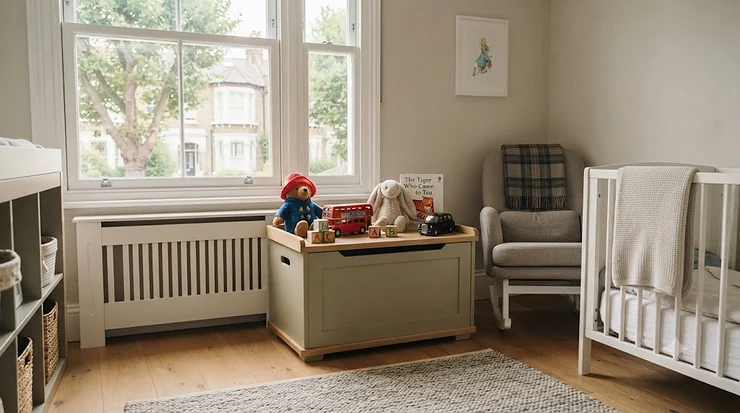
A toy storage box for nursery use is, at its simplest, a lidded or open container built to hold children’s toys in a baby or toddler’s room, keeping the floor clear and the space calm. But if you’ve ever stood in a room ankle-deep in plastic bricks at 9pm, you already know that “simple” doesn’t quite cover it. The right box changes the whole rhythm of a nursery — how easily you tidy up, how safely your toddler can play unsupervised for five minutes while you make a cup of tea, and honestly, how much your sanity survives the toddler years.
Here’s the thing nobody tells you before the baby shower gifts start piling up: toy storage isn’t really about storage. It’s about behaviour. A well-chosen nursery toy chest teaches a toddler where things live and, eventually, how to put them back. A badly chosen one becomes a graveyard of forgotten toys, a pinch hazard, or — worst case — a tip-over risk in a room where nobody’s watching every second.
Below, we’ve dug into seven real, currently available options sold through Amazon UK, from budget fabric foldables to a proper shelving unit built for toy rotation. We’ve compared them on capacity, safety design, and genuine practicality — not just how they photograph. Every price mentioned is a rough guide only, since Amazon prices shift daily; always check the current listing before buying.
Quick Comparison Table
| Product | Type | Capacity | Price Range | Best For |
|---|---|---|---|---|
| OLIVE&OSCAR 80L Large Toy Box | Fabric, foldable, lidded | 80L | Under £25 | Tightest budgets |
| GRANNY SAYS Extra Large Storage Box | Fabric, foldable, lidded | Extra-large | Under £25 | First-time buyers |
| Froppi XL Toy Box with Wheels | Stackable PP plastic | 70L | £25-£40 | Small, mobile boxes |
| GRANNY SAYS Wheeled Toy Storage Box | Fabric, wheeled | 135L | £30-£45 | Big toy hauls |
| AVC Designs Storage Chest Ottoman | Upholstered bench chest | Large | £30-£45 | Dual-purpose seating |
| HOMCOM Wooden Toy Box | Solid wood, safety hinge | Large | £45-£70 | Long-term durability |
| Amazon Basics 12-Bin Storage Unit | Wood-frame shelf with bins | 12 bins | £55-£75 range | Toy rotation systems |
Reading this table left to right tells its own little story: fabric boxes dominate the budget end because they’re cheap to manufacture and fold flat for storage, while the shelving unit at the premium end earns its price by making every toy visible and grabbable, which matters enormously once you start practising toy rotation systems. Notice too that capacity and safety design don’t always move together — a bigger box isn’t automatically the better nursery toy chest if the lid mechanism is clumsy. We’ll unpack exactly why in the product breakdowns below.
💬 Just one click — help others make better buying decisions too!😊
Top 7 Toy Storage Box for Nursery Options: Expert Analysis
1. OLIVE&OSCAR 80L Large Toy Box — best budget pick under £25
The OLIVE&OSCAR 80L Large Toy Box is the sort of thing you buy on a Tuesday and it arrives folded flat in a bag by Thursday, which is exactly the appeal. At roughly 60cm long, 33cm wide, and 40cm tall, it swallows an 80-litre haul of soft toys, blocks, and books without dominating a small nursery corner.
What the dimensions don’t tell you is how the fabric construction actually behaves day to day: because it’s soft-sided rather than rigid plastic or wood, there’s no hard edge for a wobbly toddler to catch a hip on, and the lid has real heft-free give — no spring-loaded snap, no pinch point. Reviewers consistently report that assembly takes under a minute and that the box holds its shape well once loaded, though a handful mention the base can sag slightly under really heavy stacks of books. For a first nursery box, or a second box tucked under a cot, this is a genuinely sensible starting point — parents who want zero fuss and zero tools should look here first, while anyone storing dense items like wooden blocks might want the sturdier wheeled option further down this list.
Pros:
- ✅ Folds flat for storage when not needed
- ✅ Soft sides mean no hard-edge injury risk
- ✅ Lightweight enough for a toddler to help tidy
Cons:
- ❌ Base can sag under very heavy loads
- ❌ Less structured shape than rigid boxes
Priced under £25 at the time of research, this sits firmly at the value end — check current price before ordering, since fabric storage pricing fluctuates with fabric costs more than most categories.
2. GRANNY SAYS Extra Large Storage Box — most reviewed budget staple
With well over a thousand customer ratings behind it, the GRANNY SAYS Extra Large Storage Box has quietly become one of the default answers to “what toy box should I get.” That volume of aggregated review sentiment is worth pausing on: reviewers consistently note that the fabric feels thicker than competing budget boxes, and a common thread in feedback is that it survives being climbed on and sat on far better than its price suggests.
Specs-wise, it’s another foldable, lidded fabric box in the extra-large category — the kind of neutral white design that works whether the nursery theme is dinosaurs this year or unicorns next year, which matters more than it sounds because nursery decor tends to get replaced faster than the storage does. Based on the spec comparison with the OLIVE&OSCAR box above, the main practical difference buyers report is stitching quality at the handle points, which is where cheap fabric boxes tend to fail first under toddler-strength tugging. This is the box for parents who want the safety of buying something already proven by thousands of other households rather than gambling on a newer, less-reviewed listing.
Pros:
- ✅ Large review volume gives confidence in durability
- ✅ Reinforced handle stitching reported by users
- ✅ Neutral colourway suits changing nursery themes
Cons:
- ❌ No wheels, so moving it full is awkward
- ❌ Lid doesn’t lock flat when overstuffed
At around £20-£25, it directly rivals the OLIVE&OSCAR box on price, so the choice between them often comes down to colour and review confidence rather than function.
3. Froppi XL Toy Box with Lid and Wheels (70L) — best for stacking and mobility
Move away from fabric and into rigid PP plastic, and the Froppi XL Toy Box with Lid and Wheels solves a problem soft boxes simply can’t: it stacks. Two or three of these lockable, wheeled 70-litre boxes can sit on top of each other in a corner, which turns a single nursery toy chest into a modular system as your toddler’s toy collection inevitably multiplies.
The lockable lid is worth explaining properly, because “lockable” here means a latch that keeps the lid shut during transport or stacking — not a child-proof lock that traps a toddler inside, which is an important distinction we’ll return to in the safety section below. What most buyers overlook about this model is the wheel placement: because the box rolls, it becomes genuinely useful for the “one box downstairs, one box upstairs” toy-splitting trick many parents use to avoid duplicate purchases. On paper, quality PP plastic also means it wipes clean in seconds after the inevitable yoghurt incident, something no fabric box can claim. It suits parents who move toys between rooms often, or who like the idea of stacking storage vertically in a nursery where floor space is tight.
Pros:
- ✅ Stackable design saves floor space
- ✅ Wheels make it easy to relocate when full
- ✅ Wipe-clean plastic handles spills well
Cons:
- ❌ Rigid plastic edges are harder than fabric
- ❌ Lock latch adds a part that can wear over time
Expect a mid-range price, roughly £25-£40, putting it a notch above the fabric boxes but below the wooden and shelving options later in this list.
4. GRANNY SAYS Kids Toy Storage Box with Wheels (135L) — best large-capacity rolling chest
When 80 litres genuinely isn’t enough — and with a toddler who has two sets of grandparents buying gifts, it often isn’t — the GRANNY SAYS Kids Toy Storage Box with Wheels steps up to 135 litres with 360° swivel casters underneath. Nearly 850 aggregated reviews and a strong average rating suggest this has become something of a sleeper hit among parents dealing with genuine toy overflow.
Here’s what the spec sheet won’t tell you outright: swivel casters on a box this size change the entire tidying routine, because instead of dragging a heavy chest across carpet (which damages both the carpet and your back), you glide it. Reviewers frequently mention buying a second one once the first fills up, which tells you something honest about capacity expectations for households with more than one child sharing a nursery-turned-playroom. Based on the review pattern, this is best suited to families consolidating toys from multiple rooms into one large toy storage box rather than a newborn’s first, minimal nursery — it’s simply more chest than a brand-new baby needs, but exactly right for the 18-months-to-four-years toy explosion.
Pros:
- ✅ 135L capacity handles serious toy overflow
- ✅ 360° casters make it easy to roll when full
- ✅ Strong, consistent review volume for reliability
Cons:
- ❌ Bulky footprint needs a dedicated corner
- ❌ Overkill for a newborn’s minimal toy count
Sitting in the £30-£45 price bracket at the time of research, it represents strong value per litre compared with smaller boxes at a similar price point.
5. AVC Designs Lounge Bedroom Playroom Nursery Storage Toy Box Chest — best dual-purpose bench seat
The AVC Designs Storage Chest does something the plastic and fabric boxes above simply can’t: it doubles as seating. Upholstered in a soft white finish, this ottoman-style chest fits as naturally at the end of a cot as it does under a window, giving parents somewhere to perch during story time while toys stay hidden beneath a padded lid.
That dual function is the whole commentary here — in a small nursery where every piece of furniture needs to earn its square footage twice over, a chest that’s also a bench is doing real work. Aggregated review sentiment sits in solidly positive territory, with hundreds of ratings, though some buyers note the upholstery shows marks more readily than a wipe-clean plastic surface would, which is a fair trade-off for the softer aesthetic. What most first-time nursery shoppers overlook is that a padded lid like this is inherently gentler if it falls shut on small fingers than a hard plastic or unsupported wooden one — softness at the point of contact matters more than most product listings ever mention. This suits parents styling a nursery that needs to look finished as well as function, rather than a purely utilitarian playroom corner.
Pros:
- ✅ Doubles as extra seating in the nursery
- ✅ Padded lid is gentler than hard lids if dropped
- ✅ Neutral upholstery suits most nursery colour schemes
Cons:
- ❌ Fabric upholstery marks more easily than plastic
- ❌ Heavier to reposition than wheeled alternatives
Priced in the mid-£30s to mid-£40s range, it sits comfortably between the budget fabric boxes and the premium wooden chest below.
6. HOMCOM Kids Wooden Toy Box with Safety Hinge — best wooden chest for long-term durability
Solid construction changes the conversation entirely, and the HOMCOM Wooden Toy Box is built for parents thinking five years ahead rather than five months. Wood simply outlasts fabric and most plastics under daily toddler abuse — no sagging seams, no cracking under a climbing three-year-old.
The detail that actually matters for safety, though, is the hinge. A slow-close or supported safety hinge is the single biggest differentiator between a wooden toy chest that’s a genuine hazard and one that isn’t; product safety bodies have repeatedly flagged unsupported wooden lids as a source of finger and head injuries when they slam shut unexpectedly. This model’s hinge is designed to resist sudden closure, which is precisely the feature you should refuse to compromise on if wood is your preferred material — we’ll return to this point in the dedicated safety section further down, because it’s genuinely the most important single spec on this entire list. Reviewers describe the finish as smooth with no obvious splinter risk, and the sturdier build means it tolerates being used as a step-stool substitute (which toddlers will attempt regardless of your wishes) far better than lighter materials. This is the pick for parents furnishing a “forever nursery” that will transition into a big-kid’s room rather than a starter setup they’ll replace within a year.
Pros:
- ✅ Solid wood construction resists years of wear
- ✅ Safety hinge prevents sudden lid slam
- ✅ Smooth, splinter-free finish reported by users
Cons:
- ❌ Heavier and harder to reposition than fabric boxes
- ❌ Higher price point than foldable alternatives
Expect to pay in the £45-£70 range for the added durability and the hinge engineering — a fair value trade if you’re not planning to replace it within a couple of years.
7. Amazon Basics Kids’ Toy Storage Organiser with 12 Plastic Bins — best for toy rotation systems
If your goal isn’t just storage but genuinely better play, the Amazon Basics 12-Bin Storage Organiser is the outlier on this list, and deliberately so. Rather than one lidded box, it’s a natural-wood-effect shelving frame holding twelve individual, brightly coloured plastic bins — a structure practically designed around toy rotation systems rather than dump-and-hide storage.
At roughly 85cm wide and 79cm tall, it needs proper floor space, but what you get in return is visibility: every bin is see-through-enough or clearly categorised that a toddler can find and return items without an adult digging through a single overstuffed chest. Reviewers with nearly 700 ratings and a strong average score frequently mention using it precisely this way — filling four or five bins with the week’s “active” toys and leaving the rest packed away out of sight, which lines up with the child-development research on toy rotation we cover later in this article. Based on the spec comparison, this unit sacrifices the closed-lid tidiness of the other six products for something arguably more valuable long-term: a system that actively teaches sorting, categorising, and independent tidying. It’s the right call for parents committed to playroom organisation as an ongoing practice rather than a one-off purchase.
Pros:
- ✅ Twelve bins support genuine toy rotation systems
- ✅ Open design encourages independent tidying
- ✅ Sturdy wood-effect frame suits a permanent playroom
Cons:
- ❌ Larger footprint than any lidded box here
- ❌ Higher price point around £55-£75
This sits at the premium end of the list, but per-bin organisation is genuinely hard to replicate with a single toy chest, however large.
Practical Usage Guide: Setting Up Your Nursery Toy Chest
Getting a box home is the easy part; making it actually work for the next three years takes a bit more thought. Start by measuring the corner you’ve mentally earmarked before you buy — it’s astonishing how many parents order a large toy storage box only to discover it blocks the cot drawer or the door swing by four centimetres. Once it’s in place, resist the urge to fill it to the brim on day one; overstuffed boxes are harder for a toddler to actually use, since digging to the bottom becomes a two-handed excavation project nobody enjoys.
In the first thirty days, the most common mistake is treating the box as a single catch-all rather than establishing a rough system — even a simple “big toys in the box, small toys in a separate tray” split saves enormous frustration later. Build in a five-minute weekly maintenance habit: wipe down plastic or wooden surfaces, check fabric seams for fraying, and — critically — reassess whether the current toy mix still suits your child’s age, since a six-month-old’s rattles and a two-year-old’s building blocks shouldn’t really share the same box indefinitely. If you’ve gone for a wheeled option like the Froppi XL Toy Box or the GRANNY SAYS Wheeled Toy Storage Box, get into the habit of rolling it to wherever play actually happens rather than expecting your toddler to migrate to the box’s fixed spot; toddlers, unsurprisingly, won’t.
Real-World Scenarios: Which Box Fits Which Family
Picture a first-time parent in a one-bedroom flat, nursery doubling as a guest room whenever family visits. Floor space is precious, toy volume is still modest, and everything needs to disappear fast before Grandma arrives. This household is the textbook case for the OLIVE&OSCAR 80L Large Toy Box or the GRANNY SAYS Extra Large Storage Box — both fold flat when genuinely empty, and both keep costs low while the baby’s toy collection is still manageable.
Now picture a family two years further along, with a toddler and a six-month-old sharing a room, toy volume roughly tripled, and grandparents on both sides who can’t resist buying “just one more thing.” That’s the GRANNY SAYS Wheeled Toy Storage Box or the wood-framed HOMCOM chest territory — capacity and durability now matter more than fold-flat convenience, because these boxes are staying put for years, not seasons.
Finally, picture a parent who’s read about toy rotation systems and wants to actually implement one rather than just aspire to it. Budget stretches a little further, floor space allows for a proper unit, and the goal has shifted from hiding toys to organising them meaningfully. That’s the Amazon Basics 12-Bin Storage Organiser, full stop — nothing else on this list does the job as well.
Problem → Solution Guide
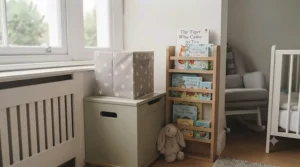
Problem: the box fills up within weeks of buying it. This is almost always a sorting issue, not a capacity issue — pair your chosen box with a rotation habit (see the dedicated section below) rather than simply buying a second, bigger box, which just delays the same problem.
Problem: toddler won’t put toys back. Open, visible storage like the Amazon Basics bins tends to solve this faster than closed lidded boxes, because a two-year-old can see exactly where something belongs without lifting anything heavy.
Problem: lid pinches fingers. Stop using it immediately and check for a proper hinge support or switch to a soft-lidded or open-top design — this genuinely isn’t a “toughen up” situation, it’s a design fault worth acting on.
Problem: fabric box looks tired within a year. Rotate laundering into your routine — most fabric boxes have removable or wipeable liners, and catching stains early extends their working life considerably.
Problem: box clashes with a nursery redecorate. Neutral colourways like white or grey age better across redecorations than heavily themed prints; it’s a small thing to plan for at purchase time that saves a future re-buy.
How to Choose a Toy Storage Box for Nursery Use
- Measure the space first. A box that looks modest online can dominate a small nursery corner — always check dimensions against your actual room before ordering.
- Match capacity to age, not aspiration. A newborn doesn’t need 135 litres of storage; buy for where your child is now, with room to grow over the next year.
- Prioritise lid safety over aesthetics. A soft-lidded or hinge-supported design beats a beautiful but unsupported hard lid every time — this is non-negotiable with a mobile toddler in the house.
- Consider mobility needs. If toys migrate between rooms, wheels earn their keep; if the box stays fixed, a lighter fold-flat design may serve better.
- Think about material longevity. Fabric is cheap and gentle but wears faster; wood and rigid plastic cost more upfront but last years longer under real toddler use.
- Plan for toy rotation from day one. Even a single box benefits from being paired with an “out of sight” storage spot elsewhere in the house for the toys not currently in rotation.
- Check stability, not just the box. An overloaded, top-heavy chest can become a tip hazard if a toddler climbs or leans on it — sturdier, lower-profile designs are safer around active climbers.
Common Mistakes When Buying Nursery Toy Storage
The single most common mistake is buying on aesthetics alone — a beautifully photographed rattan-look chest with a heavy, unsupported lid is a genuine hazard dressed up nicely, and it happens more often than it should. A close second is underestimating capacity growth: toy volume in the first two years of a child’s life tends to expand faster than any first-time parent expects, thanks largely to grandparents and birthday parties, so buying “just enough” storage today often means buying again within six months.
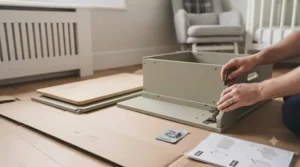
A third mistake worth flagging is ignoring maintenance realities before purchase — a gorgeous fabric box that can’t be spot-cleaned easily becomes a liability the first time a nappy leak happens nearby. And finally, buyers frequently skip checking whether the box needs assembly tools at all; several of the fabric options above genuinely require none, which matters enormously if you’re setting up a nursery solo at 34 weeks pregnant and don’t fancy wrestling an Allen key.
Toy Storage Box vs Open Shelving: Which Wins for a Nursery?
A closed toy storage box for nursery use and an open shelving system solve overlapping but genuinely different problems, and it’s worth being honest about the trade-off rather than pretending one universally wins. A lidded box like the HOMCOM Wooden Toy Box hides visual clutter completely — useful in a small room doing double duty as a guest space — but it also hides the toys themselves, meaning a toddler can’t self-select what to play with without an adult’s help digging through it.
Open shelving, exemplified here by the Amazon Basics 12-Bin Storage Organiser, flips that trade-off entirely: nothing is hidden, which supports independent play and rotation, but the room will always look a little busier, and the unit takes up considerably more floor footprint. In practice, many households end up with both — a lidded chest for the toys currently out of rotation, and an open shelf for what’s actively in play. If you can only choose one, base the decision on room size and your child’s age: toddlers under two generally benefit more from simplicity (one closed box), while children heading towards three and beyond get more developmental value from visible, sortable open storage.
What to Expect: Real-World Performance
Specs on a listing page rarely capture what daily use actually feels like, so here’s the honest version. Fabric boxes like the OLIVE&OSCAR and GRANNY SAYS Extra Large Storage Box genuinely do fold flat when empty, but in practice they’re rarely empty long enough for that to matter much — most households keep them permanently loaded. Wheeled options roll beautifully on hard flooring and laminate but drag noticeably on thick carpet, so factor your actual nursery flooring into the decision rather than assuming casters solve everything universally.
Wooden chests like the HOMCOM genuinely do feel more “furniture” than “storage bin,” which matters if the nursery needs to look finished for visitors, but that same solidity means repositioning them for a deep clean is a two-person job. And the Amazon Basics shelving unit performs best exactly as reviewers describe — brilliantly for active toy rotation, less brilliantly if you’re hoping for a single tidy-looking surface, since twelve individual bins inevitably show some wear-and-tear variation over time even when the frame itself holds up well.
Toy Storage for Baby Room: What Newborns Actually Need
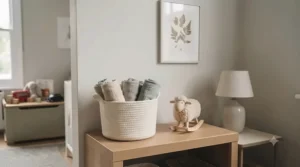
It’s worth pausing here because toy storage for baby room use in the first six months looks completely different from toddler-stage storage, and most guides skip this distinction entirely. A newborn owns remarkably few toys — a handful of rattles, a couple of soft books, maybe a play gym’s detachable toys — so a small nursery toy chest, not a 135-litre wheeled monster, is genuinely the right scale purchase. The OLIVE&OSCAR 80L Large Toy Box or even a smaller equivalent comfortably covers this phase with room to spare.
What matters more at this stage than capacity is where the box sits relative to the cot and changing area — keep it well clear of the cot’s reach zone as your baby approaches the rolling and reaching stage around four to six months, since anything climbable or grabbable near a cot becomes a safety consideration far sooner than most parents expect.
Toy Rotation Systems: Turning Storage Into a Development Tool
Toy rotation systems aren’t just a tidying trick — there’s genuine substance behind the idea that fewer visible toys lead to better play. Early-years researchers and educators have repeatedly observed that children presented with a smaller, curated selection of toys tend to engage more deeply and creatively than children faced with everything at once, where the sheer volume of choice becomes overwhelming rather than exciting. Practically, this means storing the majority of your child’s toys out of immediate sight — in a lidded chest like the GRANNY SAYS Wheeled Toy Storage Box kept in a cupboard or under a bed — while only four to six items sit accessible at any time in something like the Amazon Basics 12-Bin Storage Organiser.
Running a rotation is simpler than it sounds: swap out roughly a third of the accessible toys every one to two weeks, keeping favourites in steady rotation while introducing forgotten items back into the mix. The two-box system many parents land on — one “in rotation” open unit and one “in reserve” closed chest — maps almost perfectly onto pairing something like the bin organiser with a large sealed box, which is exactly why this article features both types rather than seven variations on the same idea.
Playroom Organisation Tips That Actually Work
Playroom organisation succeeds or fails on zones, not on the storage furniture itself — a fact that’s easy to forget when you’re deep in product comparisons. Before buying anything else, mentally divide the space into a quiet corner (books, soft toys), an active corner (blocks, ride-ons if space allows), and a storage wall where your chosen boxes live, ideally along a single edge of the room rather than scattered. This zoning approach, borrowed loosely from early-years classroom design, gives a toddler visual cues about what kind of play happens where, which genuinely does reduce chaos over time.
Labelling helps enormously once a child is old enough to recognise shapes or simple words — even picture labels on bin fronts, like those the Amazon Basics organiser lends itself to naturally, turn tidy-up time from a battle into something closer to a sorting game. And a small but often-missed tip: keep one bin or box permanently empty as a “catch-all” for the random single sock, stray crayon, or mystery Lego piece that doesn’t have an obvious home — it sounds trivial, but it removes a genuine daily friction point in almost every household we researched.
Toddler Play Area Setup: From Nursery Corner to Full Playroom
A toddler play area setup rarely stays static — what works for a fifteen-month-old crawling between soft toys looks nothing like what a three-and-a-half-year-old building elaborate block towers actually needs. Plan for this evolution rather than fighting it: start with a single flexible storage piece (a fold-flat fabric box scales down gracefully if the “playroom” is really just a corner of the lounge) and add a second, more specialised piece — shelving, a wheeled chest, whichever suits your space — once the toy collection and the child’s play style both mature.
Flooring matters more than most storage guides admit; a play mat or soft rug beneath the storage area cushions the inevitable tumbles and also defines the play zone visually, reinforcing the same zoning principle covered above. If space genuinely allows for a fuller playroom setup down the line, the HOMCOM Wooden Toy Box or Amazon Basics shelving both transition well from a nursery corner into a dedicated playroom, since neither is aesthetically tied to “baby” styling the way some brightly themed fabric boxes are.
Long-Term Cost & Maintenance
Judged purely on upfront price, the fabric boxes win easily — OLIVE&OSCAR and GRANNY SAYS Extra Large Storage Box both sit under £25. But total cost of ownership tells a slightly different story once you factor in replacement cycles: fabric boxes under heavy daily toddler use commonly need replacing within eighteen months to three years, while the HOMCOM Wooden Toy Box is built to outlast the nursery phase entirely, often transitioning into general bedroom storage well into primary-school years.
Maintenance costs are effectively zero across the board — none of these require anything beyond an occasional wipe-down or, for fabric, a machine wash of a removable liner where available — so the real long-term variable is simply replacement frequency. If you’re budgeting for a single purchase that lasts the full nursery-to-playroom journey, the wooden chest or the bin-based shelving unit both represent better pound-per-year value than the appeal of a sub-£25 price tag initially suggests.
Safety, Regulations & Compliance Guide
Every toy storage box sold legitimately in the UK should carry either a UKCA or CE marking confirming compliance with the relevant product safety framework, and under the Toys (Safety) Regulations 2011, manufacturers must complete a documented safety assessment before a toy-related product reaches UK shelves. It’s genuinely worth glancing for these markings on the packaging or listing before buying, particularly for anything a child might climb into or lean heavily against.
Lid mechanism safety deserves special attention. NHS guidance on toy safety marks highlights the value of recognised safety marks as a quick way to check a product meets recommended standards before it reaches your child’s room, and the same logic extends sensibly to nursery furniture generally. A supported hinge — like the one on the HOMCOM Wooden Toy Box — prevents a lid from slamming shut suddenly onto small fingers, while soft-sided or padded-lid options like the AVC Designs chest reduce impact risk even without a mechanical hinge at all. Avoid any chest with an automatic-locking lid entirely; a toddler climbing inside during play and finding themselves unable to push the lid open from inside is a genuine, documented hazard, not a hypothetical one.
Stability is the other half of the safety picture. RoSPA’s guidance on furniture tip-over risk underlines how climbable, top-heavy furniture poses a real injury risk to young children, and while a floor-level toy chest is inherently lower-risk than a tall bookcase, an overloaded box against a wall can still tempt a climbing toddler. Keep boxes low, keep them stable, and avoid stacking loose items — like a favourite toy — on top of a closed lid, since that’s precisely the kind of “attractive nuisance” that encourages climbing in the first place.
FAQ
❓ What is the best toy storage box for a small nursery?
❓ Is a lidded or open toy box safer for toddlers?
❓ How often should I do toy rotation with a nursery toy chest?
❓ What size toy storage box do I need for a baby room?
❓ Are wooden toy boxes safe for nurseries?
Conclusion
There’s no single “best” toy storage box for nursery use — there’s only the best one for your space, your child’s age, and how seriously you’re planning to take toy rotation systems down the line. If you’re furnishing a first nursery on a tight budget, the fold-flat fabric boxes from OLIVE&OSCAR and GRANNY SAYS genuinely do the job without fuss. If your toddler’s toy collection has outgrown polite containment, the wheeled GRANNY SAYS 135L chest or the sturdy HOMCOM wooden box carry real long-term value. And if playroom organisation is a project you’re actually committed to rather than just hoping happens by magic, the Amazon Basics bin system is worth the extra outlay.
Whichever you choose, prioritise the lid mechanism and overall stability above aesthetics — a beautiful box that pinches fingers or tips under a climbing toddler isn’t a bargain at any price. Measure your space, be honest about how fast your child’s toy collection is growing, and buy with the next year in mind, not just the next month.
✨ Don’t Miss These Exclusive Deals!
🔍 Take your nursery organisation to the next level with these carefully selected picks. Click on any highlighted item to check current pricing and availability. These sturdy, toddler-safe boxes will help you create a genuinely calmer playroom your family will love!
Recommended for You
- Nursery Storage Under £30: 7 Brilliant Budget Picks (2026)
- Sturdiest Baby Wardrobe: 7 Safest Picks For UK Nurseries (2026)
- Top Rated Baby Wardrobe Reviews: 7 Best UK Picks (2026)
Disclaimer: This article contains affiliate links. As an Amazon Associate, I earn from qualifying purchases. If you purchase products through these links, we may earn a small commission at no additional cost to you.
✨ Found this helpful? Share it with your friends! 💬🤗
