
In This Article
You’ve assembled the pram. You’ve washed every tiny sock three times. You’ve argued affectionately about paint colours for the nursery. And then — just when you thought you’d sorted the basics — someone asks, “So are you getting a cot or a cot bed?”
Blank stare. Mild panic.
It’s one of those deceptively simple questions that opens into a rabbit hole of mattress heights, room dimensions, and surprisingly strong opinions on Reddit. If you’re trying to figure out cot bed vs cot which is better for your specific situation, here’s the honest answer: it genuinely depends. Not a cop-out — an actual truth. Both have real advantages, and choosing the wrong one for your home and lifestyle is surprisingly easy to do.
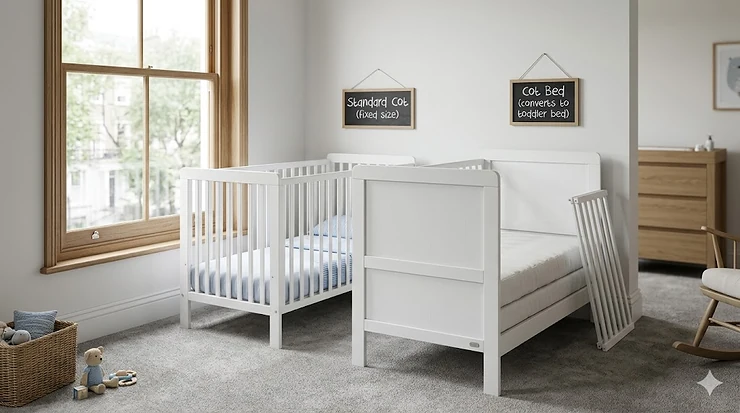
To cut through the noise: a cot is a compact, fixed-side sleeping enclosure designed for babies roughly from birth to around two years old. A cot bed is a larger, convertible version — the sides come off, an end panel drops away, and you end up with a toddler-sized bed that takes your child from birth to roughly four years old. The core difference between a cot and a cot bed is longevity and size, and both of those things matter enormously in a typical British semi-detached with a nursery the size of a generous cupboard.
We’ve done the legwork on Amazon.co.uk, consulted guidance from the Lullaby Trust and the team at Which?, and distilled seven of the best buys available in the UK right now — whether you’re leaning toward a compact cot for a box-room nursery or a full cot bed that’ll see your little one through to school age.
Quick Comparison: Cot vs Cot Bed at a Glance
| Feature | Standard Cot | Cot Bed |
|---|---|---|
| Typical Size | 120 x 60 cm | 140 x 70 cm |
| Age Range | Birth–~2 years | Birth–~4 years |
| Converts to Toddler Bed? | ❌ No | ✅ Yes |
| Nursery Footprint | Smaller | Larger |
| Average Price Range | £80–£200 | £150–£450+ |
| Best For | Compact rooms, second babies | Long-term value, growing families |
| Mattress Cost | Lower | Slightly higher |
The table above reveals the crux of the decision rather neatly. If you’re in a compact flat or terrace and plan to move your baby into a shared room with a sibling within eighteen months, a standard cot makes sound financial and spatial sense. But if you have a dedicated nursery that can comfortably absorb a 140 x 70 cm frame, the cot bed’s superior longevity — and the fact that you won’t need to buy separate toddler furniture in two years — makes it the more sensible investment for most families.
💬 Just one click — help others make better buying decisions too! 😊
✨ Don’t Miss These Exclusive Deals!
🔍 Take your nursery setup to the next level with these carefully selected products. Click on any highlighted item to check current pricing and availability on Amazon.co.uk. These picks will help you find exactly what you need!
Top 7 Cots and Cot Beds on Amazon.co.uk: Expert Analysis
1. Tutti Bambini Rio Cot Bed (140 x 70 cm)
The Rio is arguably the sweet spot in the UK cot bed market right now — and the reason it keeps appearing at the top of “best of” lists from Mumsnet to MadeForMums isn’t just brand loyalty. It’s genuine quality at a genuinely reasonable price.
The Rio measures 140 x 70 cm, features three adjustable mattress heights (essential for managing a newborn at accessible height and then lowering as your baby starts pulling to stand), and converts into a toddler bed by removing the front rail. The pine construction is solid without feeling chunky, and the clean, simple lines work well in both traditional nurseries and the kind of Scandi-minimalist aesthetic that’s dominated UK baby rooms for the past few years.
In practical terms: the three mattress heights matter more than you might think. Reach in repeatedly at a fixed low height with a newborn at 3am and your back will be making its feelings known by week two. What most UK parents overlook is that the conversion kit for the toddler bed mode is included in the box — a detail that sounds minor until you discover that some rival brands charge separately for it.
UK parents who’ve reviewed the Rio on Amazon.co.uk consistently praise the assembly process and the solid feel. A few note that the mattress is sold separately, so budget accordingly.
✅ Clean, timeless design that works in most nurseries
✅ Three-height adjustment built in
✅ Toddler bed conversion included — no extras to buy
❌ Mattress not included
❌ 140 x 70 cm means it won’t suit the smallest rooms
Price range: around £150–£190 | A strong mid-range performer with excellent long-term value.

2. Obaby Bantam Space Saver Cot (100 x 56 cm)
Here’s where the standard cot proves its worth. The Obaby Bantam is a compact, no-frills cot designed for the very real British problem of having a nursery that doubles as a home office, or a master bedroom with approximately 40 cm of spare floor space.
At 100 x 56 cm — notably smaller than a standard cot — the Bantam fits into the kind of spaces where a cot bed would be an act of wishful thinking. The slatted pine design is simple and honest, with two adjustable mattress heights. It’s not glamorous. But it does exactly what it needs to do: keeps a baby safe, fits in small rooms, and doesn’t cost a fortune.
The key practical insight: because the Bantam uses a non-standard mattress size (100 x 56 cm), you’ll want to source your mattress at the same time to avoid any awkward gaps. The British Standard BS EN 716 specifies that mattresses should fit with no more than a 2 cm gap around the edges — worth checking before you order a mattress separately.
UK parents in flats and terraced houses with compact bedrooms rate this one highly. It’s the sensible choice when space is genuinely limited and budget matters.
✅ Ideal for compact rooms and box-room nurseries
✅ Solid Obaby build quality at a lower price point
✅ Straightforward assembly — most parents report under 30 minutes
❌ Non-standard mattress size — shop carefully
❌ No conversion to toddler bed
Price range: around £100–£130 | Exceptional value for space-constrained homes.
3. SnuzKot Skandi Cot Bed (132 x 70 cm)
The SnuzKot Skandi is for parents who want their nursery to look like it belongs in a lifestyle magazine — and who are prepared to pay accordingly. This is a genuinely beautiful piece of furniture, offered in a range of finishes from sage green to natural oak that the competition simply can’t match.
Beyond aesthetics, though, the Skandi earns its price tag through thoughtful design. The 132 x 70 cm frame sits between a standard cot and a full-size cot bed, which makes it more manageable for medium-sized rooms while still offering a generous sleeping space. The five adjustable mattress heights (rather than the usual two or three) mean it adapts unusually well as your baby grows. And the conversion to toddler bed is clean and robust — the end panel removes without leaving the frame looking cobbled together.
What most buyers overlook: the Skandi’s narrower-than-standard 132 cm length means it uses slightly smaller cot bed sheets than the 140 cm standard. Check bedding compatibility before you commit. That said, SnuzKot sells a full range of matching bedding directly, and the range is widely available on Amazon.co.uk.
UK parents with modern interiors consistently rate this as worth the investment — particularly those who’ve noted that the style holds up when the cot converts to a toddler bed and moves into a bigger child’s room.
✅ Outstanding range of contemporary colour options
✅ Five mattress heights — more flexibility than most rivals
✅ Genuinely beautiful toddler bed conversion
❌ Premium price point
❌ Non-standard sheet sizes — factor this in
Price range: around £300–£380 | A premium investment justified by design quality and longevity.
4. Obaby Stamford Space Saver Sleigh Cot (120 x 65 cm)
Obaby’s Stamford range has been a fixture in UK nurseries for good reason — it manages to look considerably more expensive than it actually is. The sleigh-style curved ends give it a traditional, substantial look that suits the kind of Victorian terraced houses and 1930s semis that make up a significant chunk of British housing stock.
The Space Saver variant is cleverly designed: the 120 x 65 cm dimensions are compact enough for most nurseries, but the integrated drawer underneath adds valuable storage for blankets, spare sheets, and the seemingly endless parade of sleeping bags in different tog ratings that UK parents accumulate. The drawer alone — at 77 litres capacity — is worth noting if you’re in a house where under-bed storage is doing serious heavy lifting.
Three adjustable mattress heights, teething rails, and a conversion kit for toddler bed mode round out a package that represents genuinely good value in the mid-range. One practical note: the storage drawer slides from the end of the cot, not the side — worth checking this works with your room layout before you position the cot in a corner.
Amazon.co.uk reviews are largely positive, with particular praise for the assembly instructions and the quality of the finish.
✅ Integrated 77L drawer — a meaningful bonus in smaller homes
✅ Traditional sleigh design with wide appeal
✅ Good mid-range value with solid construction
❌ Drawer opens from the end — layout-dependent practicality
❌ Bulkier than modern minimalist alternatives
Price range: around £200–£260 | Excellent value when storage matters.
5. Mamas & Papas Petite Cot (90 x 64 cm)
The Mamas & Papas Petite Cot is the smallest standard cot on this list — and that’s entirely the point. With a footprint of just 0.61 m², it’s designed for parents who want to follow Lullaby Trust guidance on room-sharing for the first six months but genuinely cannot fit a larger cot beside their bed without blocking the door.
The Petite uses a 90 x 60 cm mattress, which is slightly unusual — so again, source your mattress simultaneously. Two adjustable mattress heights offer basic but adequate adjustment. The pine and engineered board construction is honest rather than luxurious, but for a cot that’s likely to spend most of its life in a bedroom before moving to a small nursery, that’s a reasonable trade-off.
The key caveat with the Petite: at this size, babies can outgrow it faster than a standard cot. Mamas & Papas suggest it’s suitable to around 18 months, which is somewhat shorter than the ~2 years you’d expect from a full-size cot. If you’re planning a second baby who might need the cot before the first has fully transitioned, the compressed timeline is worth thinking about.
That said, for families in London flats, city-centre apartments, or simply anyone in a house where the spare bedroom is also a study and a storage room, the Petite is a genuinely practical solution.
✅ Smallest footprint of any quality cot on Amazon.co.uk
✅ Perfect for room-sharing in compact master bedrooms
✅ Trusted UK brand with good after-sales support
❌ Non-standard mattress size
❌ Shorter usage period than full-size cots
Price range: around £100–£140 | The right answer for very constrained spaces.

6. Ickle Bubba Snowdon Classic Cot Bed (140 x 70 cm)
The Snowdon is Ickle Bubba’s flagship cot bed, and it looks the part. The sleigh-style frame in white or grey ash is well-proportioned, the build feels substantial, and the three mattress heights are set at sensible intervals. Like the Obaby Stamford, it converts to a toddler bed — but the Snowdon’s conversion leaves a tidier-looking result, with the remaining three sides forming a proper low bed rather than something that looks like a cot with a piece missing.
The teething rails deserve mention: they’re a practical addition that other brands sometimes skip. If you’ve seen what a teething baby can do to an unprotected wooden rail — and once you have, you can never unsee it — you’ll appreciate that Ickle Bubba has factored this in.
At 140 x 70 cm, this takes a standard cot bed mattress, which makes bedding shopping significantly easier. The range of compatible accessories (changing units, wardrobes, dressers) in the Snowdon collection also means you can build out a coordinated nursery if aesthetics are important to you.
Amazon.co.uk UK customers rate it particularly well for assembly clarity and the overall finish-to-price ratio.
✅ Teething rails included as standard
✅ Standard 140 x 70 cm — easy mattress and bedding sourcing
✅ Clean toddler conversion
❌ On the larger side — needs a proper nursery
❌ Mattress sold separately
Price range: around £280–£360 | A handsome, practical choice for families who want style and longevity.
7. Babymore Caro Mini Cot Bed (120 x 60 cm)
The Babymore Caro is the answer for parents who want cot bed conversion but can’t accommodate the full 140 x 70 cm footprint. At 120 x 60 cm — the same dimensions as a standard cot — it’s the most space-efficient convertible option currently available on Amazon.co.uk.
Three adjustable mattress positions, teething rails, and a clean grey-wash finish give it a contemporary look. The conversion to toddler bed works by removing the front rail and adding a smaller guardrail — simple and tool-free. The 120 x 60 cm mattress it takes is entirely standard, which keeps bedding costs manageable.
The trade-off is straightforward: because the sleeping surface doesn’t expand when you convert it, the toddler bed mode is slightly smaller than what you’d get from a 140 x 70 cm cot bed. For most toddlers up to age three or so, this is fine. For longer children, or parents who want maximum longevity, the full-size 140 x 70 cm options above are worth the extra room.
What this model does uniquely well is resolve the space-versus-longevity tension that most of this list forces you to choose between. For a terraced house nursery or a flat where 20 cm genuinely matters, this is a clever solution.
✅ Cot bed conversion in a standard cot footprint — unique advantage
✅ Standard 120 x 60 cm mattress sizing
✅ Clean, contemporary grey wash finish
❌ Toddler bed mode is smaller than full-size alternatives
❌ Limited to 4 years rather than the 5–6 some full-size cot beds offer
Price range: around £130–£175 | The space-saving cot bed solution — ideal for compact UK nurseries.
How to Choose: A Practical Decision Framework for UK Parents
Here’s the framework that cuts through the options quickly. Work through these questions and the right choice tends to emerge without much agonising.
If your nursery or bedroom is under 9 m² — and in Britain, that describes a depressingly high percentage of box rooms — a compact cot or the Babymore Caro Mini is almost certainly your starting point. Trying to squeeze a 140 x 70 cm cot bed into a room where you also need to stand upright and actually access the cot is an exercise in frustration.
If you’re planning only one child, the cot bed’s longevity advantage is strongest. You buy it once, it grows with your child, and you sidestep the cost of a separate toddler bed at the 18–24 month mark. Most children transition somewhere between 18 months and three-and-a-half years, so a quality cot bed bought now could comfortably see you through to 2029 or 2030 without another furniture purchase.
If you’re expecting or planning a second child within two to three years, the calculation shifts. You may well want the cot bed back in cot mode for the new baby before your toddler has fully moved on — which either means buying a second cot or converting the cot bed early and sourcing a toddler bed sooner than planned. In this scenario, two standard cots can actually be more practical (and less expensive) than one cot bed.
If you’re prioritising the first six months of room-sharing — as the Lullaby Trust recommends — a compact cot or even a bedside crib followed by a standard cot is often the most practical approach for smaller master bedrooms.
If budget is the primary consideration: a mid-range standard cot (£100–£150) plus a separate toddler bed later (£80–£150) typically costs roughly the same as a quality cot bed. The cot bed wins on convenience and continuity; the two-stage approach gives you more flexibility.
The Real-World Setup Guide: Getting It Right from Day One
Once you’ve made your choice, the practical detail matters more than most product listings acknowledge.
Mattress selection is non-negotiable. The Lullaby Trust is unambiguous: use a firm, flat, waterproof mattress that fits snugly with no more than 2 cm of gap around the edges. Buy new — not secondhand, not passed down from a sibling. Mattresses change shape over time in ways you can’t necessarily see, and the safety implications are serious. Budget at least £50–£80 for a decent foam mattress, and consider a pocket sprung option (£80–£150) if you want the cot to last comfortably to the toddler stage.
Mattress height management. Start on the highest setting when your baby is a newborn — your back will thank you. Lower it before they can sit unaided (around five to six months for most babies), and again before they can stand. Don’t wait until they’re pulling themselves upright and you’re frantically reaching for the Allen key.
The clear cot rule. The Lullaby Trust’s mantra — a clear cot is a safe cot — means no bumpers, no pillows, no soft toys, no positioners. Just mattress and a lightweight, tucked-in blanket or a correctly-sized sleeping bag. It sounds obvious until you’re gifted a beautifully padded cot bumper set by a well-meaning relative and have to explain why it’s going straight into a cupboard.
Assembly in a British home. Most cots and cot beds come flat-packed. Budget an hour for assembly, not the twenty minutes the optimistic instruction sheets suggest. Check that all bolts are fully tightened — then check them again after six weeks, because vibration from daily use can loosen fixings gradually.
Damp and ventilation. This being Britain, the nursery will likely spend October to March in conditions that hover between slightly cool and properly cold. A room thermometer is useful — the Lullaby Trust recommends 16–20°C for baby sleep. Adequate ventilation in a small nursery matters; a tightly sealed, well-heated room with poor air circulation can contribute to excessive warmth, which is a risk factor for SIDS.

Cot Bed vs Cot: Who Actually Benefits from Each?
Let’s be direct about specific UK scenarios, because generic advice only goes so far.
The London flat first-time parent. Living in a one-bed or two-bed flat where the “second bedroom” is 7–8 m² and houses a wardrobe, a chest of drawers, and now a cot? The Obaby Bantam or Mamas & Papas Petite. Full stop. Fighting a full-size cot bed into that space isn’t wisdom — it’s stubbornness.
The family in a three-bed semi in Manchester, Leeds, or Birmingham. Standard UK nursery in a semi gives you around 9–12 m² to work with. A full-size cot bed is entirely feasible. The Tutti Bambini Rio or Obaby Stamford Space Saver are both well-suited — you get longevity without paying premium prices, and the storage drawer on the Stamford does real work in a typical semi where airing cupboard space is already doing overtime.
The family planning a second child within 18 months. Consider two standard cots — or the Babymore Caro Mini for child one and a standard compact cot for child two. Alternatively, factor in that you’ll likely want the cot bed converted to toddler bed mode before the new baby arrives, and plan accordingly.
The rural family with space to spare. If you’re in a detached house in the Cotswolds, Yorkshire Dales, or similar, space constraints probably aren’t your primary concern. In which case: invest in the best cot bed you can afford, because you’ll use it longer and likely pass it to siblings. The SnuzKot Skandi or Ickle Bubba Snowdon are both excellent choices at the upper-mid range.
✨ Don’t Miss These Exclusive Deals!
🔍 Ready to make your choice? Click any highlighted product above to check current pricing and availability on Amazon.co.uk. Prime members enjoy free next-day delivery — ideal when the nursery needs to be sorted before your due date.
Common Mistakes When Buying a Cot or Cot Bed in the UK
Buying the wrong mattress size. It bears repeating: non-standard cots (the Obaby Bantam, Mamas & Papas Petite, Babymore Caro Mini in the 120 x 60 cm format) use non-standard mattress dimensions. Order the wrong size and you’re either returning it or using an ill-fitting mattress, neither of which is a good outcome. Always confirm dimensions before adding to basket.
Assuming the toddler bed conversion kit is included. Some brands include it. Many charge extra — typically £20–£40 for a conversion rail kit that you’ll need in eighteen months’ time. The Tutti Bambini Rio includes it; others don’t. Check before you buy, not when you’re trying to sort a climbing toddler at 7pm on a Sunday.
Ignoring drop-side cots. If you come across an older drop-side cot — the kind where one side could be lowered — be aware that these are no longer considered safe and haven’t been manufactured for the UK market since regulations changed. As Which? notes, Mandy Gurney of Millpond Sleep Clinic advises parents specifically to avoid them.
Buying based on aesthetics alone. That stunning all-white cot with the ornate spindles looks extraordinary in the showroom. At 3am, when you’re attempting a silent transfer, the number of spindles becomes irrelevant. What matters: mattress height adjustment, how easily you can reach in, and whether the mechanism for lowering/raising the mattress is intuitive enough to operate one-handed while holding a sleeping baby.
Underestimating the mattress budget. The cot is a fixed cost. The mattress, however, is replaced more frequently and the quality directly affects both safety and longevity. The BS EN 16890:2017+A1:2021 standard is the benchmark for cot bed mattresses in the UK — look for it on the mattress labelling.
UK Safety Standards and What to Look For
All cots and cot beds sold in the UK should meet BS EN 716, the British Standard for children’s cots. This covers slat spacing (no more than 6.5 cm apart, to prevent head entrapment), structural stability, and finish requirements. Post-Brexit, UK products carry UKCA marking rather than CE marking, though products with CE marking remain acceptable for products placed on the UK market before the transition deadlines.
For mattresses, the relevant standard is BS EN 16890:2017, which covers firmness, fit, and materials. Always look for these standards on product listings — and if a listing doesn’t mention them at all, that’s worth treating as a yellow flag.
The NHS and Lullaby Trust both recommend placing your baby on their back to sleep, in their own clear cot, in the same room as you for the first six months. These guidelines apply regardless of whether you choose a cot or a cot bed — the sleeping environment and positioning are more significant safety factors than the type of furniture itself.
Long-Term Cost and Value: The GBP Reality Check
Here’s the maths most buying guides avoid doing explicitly.
Standard cot route: Quality cot (£100–£200) + toddler bed in 18 months (£80–£150) + two mattresses = roughly £280–£450 over four years.
Cot bed route: Quality cot bed (£150–£380) + one mattress + conversion kit (if not included, £20–£40) = roughly £220–£460 over four years.
The total costs are genuinely comparable. The cot bed wins on simplicity — one furniture purchase, one transition, one mattress — and on environmental footprint if that matters to you. The two-stage approach wins on flexibility, particularly if your housing situation might change or a second child is in the picture.
Where the cot bed pays most clearly for itself is in the middle-range spending bracket. A £200–£280 cot bed that converts cleanly to a toddler bed and lasts four years is almost always better value than a £150 cot followed by a separate £130 toddler bed plus the logistics of buying, assembling, and storing two separate pieces of furniture.

FAQ: Cot Bed vs Cot Which Is Better — Your Questions Answered
❓ What is the main difference between a cot and a cot bed?
❓ How long does a cot bed last compared to a standard cot?
❓ When should I move my baby from a cot to a cot bed (or toddler bed)?
❓ Are cot beds safe for newborns in the UK?
❓ Do I need to buy a special mattress for a cot bed in the UK?
Conclusion: Which Is Actually Better?
Straight answer: for most UK parents with a dedicated nursery of reasonable size, the cot bed is the better long-term choice. The value equation holds up, the single transition is genuinely easier for toddlers than moving to an entirely new piece of furniture, and the best models — the Tutti Bambini Rio, the Ickle Bubba Snowdon, the SnuzKot Skandi — are genuinely well-made and worth the investment.
For parents in compact flats, houses where the nursery doubles as something else, or those who are certain about having a second child in quick succession: the standard cot is the smarter play. Buy well, expect to use it for 18–24 months, and plan the toddler transition when the time comes.
What nobody tells you is that the furniture itself, ultimately, matters less than the environment inside it. A clear cot with a good mattress in a well-ventilated room is what keeps babies safe — whether that cot converts in two years or not.
✨ Don’t Miss These Exclusive Deals!
🔍 Found your perfect match? Check current pricing and Amazon Prime availability for every product featured in this guide. Click any highlighted item above to view on Amazon.co.uk — and remember, Prime members get free next-day delivery on most nursery furniture.
Recommended for You
- Best Cot Beds for Newborns UK 2026: 7 Safest Picks Reviewed
- Essential Car Seat Accessories UK: 7 Must-Haves in 2026
- Best Car Seat Organiser UK 2026: 7 Expert Picks for Tidy Family Journeys
Disclaimer: This article contains affiliate links. As an Amazon Associate, I earn from qualifying purchases. If you purchase products through these links, we may earn a small commission at no additional cost to you.
✨ Found this helpful? Share it with your mates! 💬🤗
