
In This Article
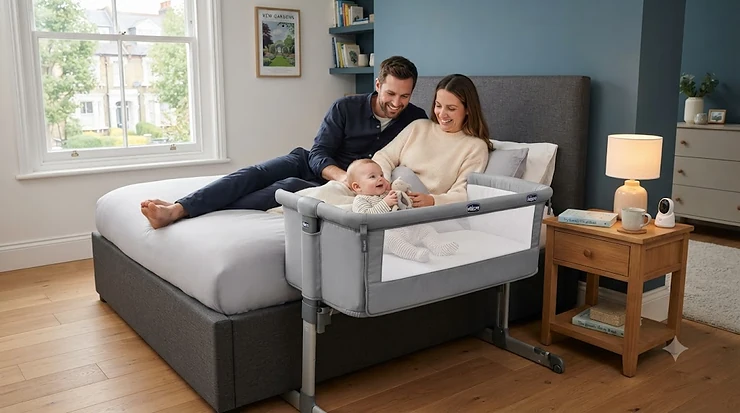
Somewhere around 2am, with a screaming newborn and a partner who’s somehow still asleep, every parent eventually asks the same question: is there a way to have the baby close enough to touch without actually sharing a bed? That’s the entire premise behind this Chicco Next2Me Magic review — a bedside crib is, in simple terms, a cot that straps securely to the side of an adult bed with one wall lowered, letting your baby sleep in their own safe space while staying within arm’s reach for those middle-of-the-night feeds.
Chicco has been making the Next2Me range for the better part of a decade now, and the Magic sits near the top of that family as the most feature-loaded version — height adjustment, a rocking mode, tilt settings, and a side panel that drops with one hand while you’re holding a baby in the other. None of that automatically makes it the right crib for your household, though, and that’s really what this review sets out to establish honestly: what the Magic actually does well, where it falls short, how it stacks up against rivals like the SnuzPod4 and Shnuggle Air, and the practical details — dimensions, mattress sizing, accessories — that most product pages gloss over.
As the NHS notes in its guidance on reducing the risk of SIDS, the safest place for a baby to sleep is in their own separate sleep space in the same room as their parents for at least the first six months, and that single piece of guidance is essentially the whole reason bedside cribs like this exist as a product category.
Quick Comparison Table
For anyone who wants the headline view before the deep dive:
| Crib | Rocking | Height Settings | Mesh Sides | Best For |
|---|---|---|---|---|
| Chicco Next2Me Magic | Yes (standalone mode) | 11 | 2 mesh windows | Feature-rich all-rounder |
| Chicco Next2Me Magic Evo | Yes (standalone mode) | 11 | 2 mesh windows + 3D mattress | Latest tech, best breathability |
| Chicco Next2Me Air | No | 6 | Mesh on all 4 sides | Hot sleepers, maximum airflow |
| Chicco Next2Me Dream | Yes (older models) | 11 | 1 extra mesh window | Mid-range Chicco alternative |
| SnuzPod4 | No | 7 | Mesh liner panels | Stylish wooden-frame option |
| Shnuggle Air | No | 7 | Dual-view mesh | Converts to full cot later |
| Joie Roomie Glide | Gliding motion | Adjustable | Double mesh windows | Budget-conscious parents |
Reading across that table, the pattern is clear: the Chicco Magic and Magic Evo are the only two in this line-up offering genuine rocking motion, which on paper makes them the strongest pick for parents whose babies need soothing back to sleep rather than just a safe place to lie down. The trade-off is price and bulk — the SnuzPod4 and Joie Roomie Glide are both lighter, more portable options if a sleek bedroom footprint matters more to you than the extra functions.
💬 Just one click — help others make better buying decisions too!😊
✨ Don’t Miss These Exclusive Deals!
🔍 Check current pricing on the Chicco Next2Me Magic and its closest rivals before you decide — availability and bundle deals shift regularly.
Top 7 Bedside Cribs: Chicco Next2Me Magic & Rival Models Compared
This section gives the Chicco Next2Me Magic the full review treatment, then places it honestly alongside its closest Chicco siblings and three genuine market competitors, so you can see exactly where it sits in the wider field.
1. Chicco Next2Me Magic — the feature-rich original with rocking mode
The standout feature is the combination no other crib on this list fully matches: genuine side-to-side rocking motion alongside 11 height settings and a one-handed sliding side panel.
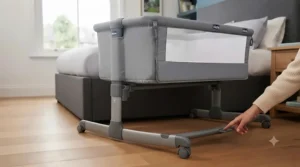
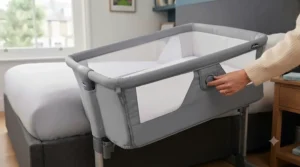
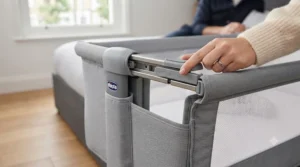
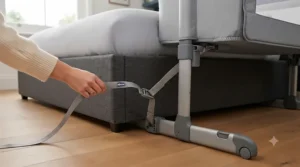
In side-sleeping mode, the crib straps to your bed using the included harness and clips, and once secured, the front panel slides up and down with a single button press, which matters enormously at 3am when you’re juggling a baby in one arm. Dimensions sit at roughly 82.5 × 73 × 99cm assembled, folding down to about 94 × 59 × 16cm for storage or travel, with a mattress measuring 51.5 × 82.5cm and a total crib weight of around 13kg. Based on the spec comparison with the rest of this list, the Magic’s 11-level height adjustment is genuinely best-in-class, fitting bed mattress heights between roughly 51cm and 66cm, including divan bases thanks to retractable feet.
Aggregated review sentiment from independent UK parenting sites is consistently positive on adjustability and night-time ease of use, with testers across multiple write-ups praising how simple it is to drop the side and access the baby one-handed, though several reviewers note the fabric covers are hand-wash only and the crib itself is bulky to move between rooms.
✅ Eleven height settings cover almost any UK bed type, including divans
✅ One-handed sliding side panel genuinely speeds up night feeds
✅ Rocking and four-position tilt add real soothing functionality
❌ Covers are hand-wash only, which is inconvenient after spills
❌ Sizeable footprint makes it awkward to move between rooms regularly
Typically priced in the £180-£240 range depending on retailer and bundle, it’s a strong value pick for parents who want the full Next2Me feature set in one purchase rather than buying functions piecemeal.
2. Chicco Next2Me Magic Evo — the newest, most breathable version
The headline upgrade over the standard Magic is the 3D mesh mattress paired with two mesh side windows, specifically aimed at improving airflow and temperature regulation through the night.
Functionally it carries over the Magic’s strongest features — 11 height settings, one-handed sliding panel, rocking mode in standalone configuration, and a four-position tilt of up to 10 degrees for reflux or congestion — while adding retractable feet that Chicco markets as easier to fit to a wider range of bed types, including divans. What most buyers overlook about the “Evo” naming is that it isn’t a totally different crib so much as a refined version with better materials; the core mechanism and dimensions are very close to the original Magic, so choosing between them often comes down to whether the extra breathability is worth a modest price premium.
Reviewers who’ve tested both the original 2019-era Magic and the more recent Evo consistently describe the core adjustability and night-time usability as unchanged and still excellent, with the main improvements being airflow and a slightly updated fabric finish.
✅ 3D mesh mattress noticeably improves airflow versus the standard Magic
✅ Retains all the Magic’s height, tilt and rocking functionality
✅ Solo assembly typically takes around 30-35 minutes, no tools required
❌ Price premium over the standard Magic isn’t always justified for cooler bedrooms
❌ Still hand-wash only for the outer covers
Sitting around £200-£250, it’s the better long-term pick for warmer bedrooms or parents whose babies tend to overheat at night.
3. Chicco Next2Me Air — best for maximum ventilation
The defining advantage here is mesh panelling on all four sides of the crib, rather than the one or two mesh windows found on the Magic models, making it the most breathable Chicco option by a clear margin.
This comes at the cost of the rocking function, which the Air doesn’t have at all — once attached and adjusted, it’s a static crib, with six height settings rather than the Magic’s eleven. Here’s what to weigh: if your priority is keeping a baby cool and visible from any angle of the room, the Air’s all-round mesh wins outright, but if soothing motion matters more to your particular baby, you’ll want to look at the Magic or Magic Evo instead. Reviewers consistently note that the see-through mesh sides are popular specifically because they let parents check on their baby without fully opening the crib, which is a genuinely different practical benefit from the Magic’s drop-side design.
✅ Mesh on all four sides gives the best ventilation in the Chicco range
✅ Simpler mechanism with fewer moving parts to maintain
✅ Shares the same core dimensions and weight as other Next2Me models
❌ No rocking function at all
❌ Only six height settings versus the Magic’s eleven
Priced around £170-£200, it’s the sensible choice for parents prioritising breathability over soothing features.
4. Chicco Next2Me Dream — the mid-range Chicco alternative
The standout feature is an additional mesh window beyond the standard single panel, giving better visibility and airflow than the entry-level Next2Me while sitting below the Magic on price.
Older Dream models include a rocking function similar to the Magic, though this has varied across production runs, so it’s worth checking the specific listing before assuming parity with the Magic’s soothing features. On paper this means the Dream occupies a genuine middle ground in the Chicco line-up: more ventilation than the base model, a comparable 11-level height range, but without quite matching the Magic Evo’s 3D mesh mattress or guaranteed rocking mode. What the spec sheet won’t tell you, but owner reports suggest, is that the practical difference between the Dream and the Magic in day-to-day use is smaller than the price gap implies, making the Dream a reasonable way to access most of the Magic’s usability at a slightly lower cost.
✅ Extra mesh window improves airflow over the entry-level Next2Me
✅ 11 height levels match the Magic’s adjustability range
✅ Generally lower price point than the Magic or Magic Evo
❌ Rocking function isn’t guaranteed across all production runs
❌ Lacks the Magic Evo’s upgraded 3D mesh mattress
Typically found in the £170-£220 range, it’s worth comparing directly against current Magic pricing before deciding, since the gap between them fluctuates.
5. SnuzPod4 — best for a stylish wooden-frame alternative
The standout feature is build material: a birch wood frame paired with heavy-duty bassinet fabric, giving it a noticeably different aesthetic from the predominantly metal-and-fabric Chicco range.
Functionally, the SnuzPod4 offers seven height settings accommodating beds roughly 53-73cm in height, along with a “ComfortAir” system combining airflow vents and a mesh liner for temperature regulation, though it lacks the Magic’s rocking mode entirely. Based on the spec comparison, this is a toy-free trade: you’re giving up motion-based soothing in exchange for a genuinely 3-in-1 design that works attached to the bed, as a free-standing bassinet, or lifted off its stand entirely for portable naps around the house. Reviewers consistently praise the build quality and craftsmanship, specifically calling out the birch frame components as feeling more premium than typical plastic-and-metal bedside cribs.
✅ Genuine 3-in-1 flexibility — attached, standalone, or portable bassinet
✅ Premium birch wood build feels noticeably higher quality
✅ ComfortAir ventilation system aids temperature regulation
❌ No rocking or motion-based soothing function
❌ Incorrect height setting at assembly requires partial disassembly to fix
Priced around £190-£210, it suits parents who value design and craftsmanship as highly as core function.

6. Shnuggle Air — best for long-term value through conversion
The headline advantage is longevity: unlike every other crib on this list, the Shnuggle Air can convert into a full-sized cot once your baby outgrows bedside use, extending its working life well beyond six months.
The crib itself uses dual-view mesh sides for visibility and airflow, seven height adjustments, and a hypoallergenic airflow mattress that independent testers have specifically praised for firmness and breathability. Here’s what to weigh: the conversion kit and matching cot mattress are sold separately, typically adding a meaningful amount to the total cost, so the “value” argument only holds up if you’re confident you’ll actually use the cot conversion rather than buying a separate cot anyway. A common theme in aggregated reviews is that parents who do convert it feel the total spend was justified, since they avoid buying an entirely separate full-sized cot later.
✅ Converts into a full cot, extending useful life well past six months
✅ Hypoallergenic airflow mattress rated highly for firmness and breathability
✅ Dual-view mesh improves both ventilation and visibility
❌ Conversion kit and cot mattress are additional, separate purchases
❌ No rocking function, similar to the SnuzPod4
Initial crib pricing sits around £180-£250, with the conversion kit and mattress adding a further cost if you go that route later.
7. Joie Roomie Glide — best budget-friendly option
The standout feature is a smooth, single-hand gliding motion rather than full rocking, designed specifically to help soothe a baby back to sleep after a night feed without lifting them out of the crib.
It includes double mesh windows on both sides for ventilation, a soothing tilt function for digestion, and a cushioned, mesh-covered mattress as standard, all while sitting at a noticeably lower price point than most of the Chicco range. On paper, the gliding motion is a genuinely different soothing mechanism from the Magic’s side-to-side rock, and several independent reviewers have specifically called out how smooth and quiet it feels in practice. This is squarely the pick for budget-conscious parents who still want some motion-based soothing without paying Magic-level prices, accepting a slightly less feature-dense crib in return.
✅ Smooth gliding motion offers genuine soothing without lifting baby
✅ Noticeably lower price than the Chicco Magic or Magic Evo
✅ Double mesh windows provide solid ventilation for the price point
❌ Fewer premium touches than the pricier Chicco options
❌ Suitable only to six months, requiring a second cot afterward
At around £150-£180, it’s the strongest value pick for parents working to a tighter nursery budget.
Chicco Next2Me Magic How to Use: Setup and Night-Time Guide
Getting full value from the crib starts with correct setup, and most frustration with bedside cribs traces back to a handful of avoidable steps. Assembly itself is genuinely straightforward — independent testers consistently report completing it solo in around 30-35 minutes with no tools required, and Chicco’s own video guides are a reliable backup if a step feels unclear. The part that catches people out is attachment: in side-sleeping mode, the crib must be securely strapped to your bed frame using the included harness and clips before it’s used overnight, with the straps tightened until there’s no gap between the crib and mattress edge.
Once attached, measure your bed’s mattress height before adjusting the crib’s legs — the Magic accommodates bed heights from roughly 51cm to 66cm, and each leg adjusts independently, so it’s possible (and sometimes necessary) to fine-tune one side at a time on an uneven bed frame or divan base. A genuinely useful first-month habit is checking the strap tension every few nights, since mattresses can shift slightly and a loosened harness undermines the entire safety case for side-sleeping mode. For the rocking function specifically, remember it only operates in standalone mode, away from the bed, and only once the side panel is fully raised and secured — a sensible safety restriction, but one that catches first-time users off guard if they expect to rock the crib while it’s still attached.
Next2Me Crib Height Settings Explained
Getting the height setting right is arguably the single most important set-up step, and it works the same logical way across the range:
- Measure your bed’s mattress height first, from the floor to the top of your mattress, before touching the crib’s legs.
- Check the compatible range for your specific model — the Magic and Magic Evo fit roughly 51-66cm, while the Air and Dream fit roughly 49-64cm.
- Adjust each leg independently, using the numbered markings visible on the outside of each leg to confirm a matching setting on both sides.
- Re-check the height after attaching the straps, since tightening the harness can subtly shift the crib’s final position relative to your mattress.
- For divan or drawer-base beds, use the retractable feet designed specifically to handle bases without a conventional bed frame underneath.
- Re-measure if you change beds or rooms, rather than assuming the previous setting will still be correct.
- Use the tilt function separately from height, since the four incline positions adjust the sleeping angle, not the crib’s overall height relative to your bed.
Skipping step four is the most common error reported by reviewers — getting the height “approximately right” before strapping the crib down, rather than confirming it afterwards, is what leads to the small gaps between crib and mattress that the whole side-sleeping design is meant to avoid.
Real-World Scenarios: Which Next2Me Suits Your Family?
Picture a first-time parent with a divan bed and a baby who startles awake easily — for this household, the Chicco Next2Me Magic or Magic Evo earns its higher price tag through the combination of wide height-range compatibility with divan bases and genuine rocking motion to resettle a startled baby without a full pick-up. Compare that with a parent in a smaller flat who’s watching the budget closely and values portability above soothing extras — the Joie Roomie Glide or SnuzPod4 (used in standalone bassinet mode) make more practical sense, trading the rocking function for a lighter, more move-friendly footprint.
Now consider a parent planning for more than one child, or simply wanting maximum value from a single purchase that lasts well past six months — the Shnuggle Air’s cot conversion option is the standout here, provided the extra conversion-kit spend is factored into the original budget rather than treated as an afterthought. Across all three scenarios, the common thread is that bed type, soothing needs and long-term budget should genuinely drive the choice, rather than defaulting to whichever crib has the most marketing buzz.
Chicco Next2Me Magic Dimensions: What You Need to Know
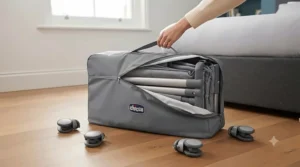
Getting the dimensions right before buying avoids the single most common bedside crib regret: ordering a crib that doesn’t actually fit the available bedroom space or bed type. The Chicco Next2Me Magic measures approximately 82.5cm long by 73cm wide by 99cm tall when fully assembled, with a mattress area of roughly 51.5 × 82.5cm — genuinely larger than many rival cribs, which is part of why owners consistently describe it as roomy enough to comfortably last the full newborn-to-six-month window. Folded down for storage or travel, it reduces to around 94 × 59 × 16cm, fitting into the included travel bag, though the assembled crib’s overall weight of roughly 13kg means it’s not something you’ll want to move between rooms on a daily basis.
What most buyers overlook about the dimensions is the bed-height compatibility range specifically: at roughly 51-66cm from floor to mattress top, the Magic suits a wider span of UK bed types — including many divan bases via the retractable feet — than the Air or Dream models, which cover a slightly lower 49-64cm range. If your bed sits unusually high or low, checking this figure against your own mattress height before ordering matters more than almost any other spec on the page.
Chicco Next2Me Mattress Replacement: When and How
Mattress hygiene matters more for newborn sleep products than almost any other nursery item, and most safer-sleep guidance is unambiguous that a baby’s mattress should be clean, firm, flat and in good condition for every sleep. Independent testing by MadeForMums has consistently rated the original mattress as comfortable and well-fitting. The original Chicco Next2Me Magic mattress measures around 82.5 × 51.5cm, and over time — particularly after spills, regular use, or if you’re using the crib for a second child — many parents look at replacement rather than just a fresh cover.
Two realistic replacement routes exist. The first is buying directly through Chicco’s official spares range, which guarantees an exact dimensional match and includes options like the hygienical terry mattress cover or the Night Breeze mattress topper, both designed to fit the standard Next2Me mattress precisely. The second is a third-party compatible replacement, such as the Callowesse Next2Me-compatible mattress, which fits the standard Next2Me and the Magic but measures slightly smaller at 80 × 50cm and 4cm thick — in this case, the original mattress baseboard should stay in the crib base, with the new mattress placed on top, rather than being discarded. Either way, replacing rather than simply re-covering an aged mattress is the safer call if the foam itself has softened or lost its shape, since a sagging mattress works against the firm, flat sleep surface that safer-sleep guidance consistently recommends.
Chicco Next2Me Accessories Worth Buying
Beyond the crib itself, a handful of genuinely useful accessories show up repeatedly in owner recommendations rather than feeling like upsell padding. The Chicco Set of Fitted Sheets, made from 100% cotton and machine washable, is close to essential since you’ll want at least two in rotation for the inevitable night-time changes. A mattress protector — either Chicco’s own hygienical terry cover or a compatible third-party waterproof option sized around 83 × 50cm — sits underneath the fitted sheet and meaningfully extends the working life of the mattress itself by catching spills and accidents before they reach the foam.
The included travel bag covers portability without an extra purchase, but if you’re using the crib regularly as a travel cot away from home, double-checking the bag’s condition before a trip is worth the two minutes it takes. Beyond direct crib accessories, Chicco’s First Dreams range of nightlights and soothing plush toys is marketed as a companion product line for the Next2Me range, though these sit more in the “nice to have” category than anything that affects the crib’s core safety or function.
Bedside Crib Breathable Mesh: Why It Matters
Mesh panelling has become close to a standard feature across modern bedside cribs, and it solves a genuinely important problem rather than being a cosmetic add-on. Babies can’t regulate their own body temperature well, and overheating is a recognised risk factor connected to sleep safety, with both the Lullaby Trust and NHS guidance recommending a bedroom temperature between 16°C and 20°C specifically to manage this risk. Mesh side panels and mesh-covered mattresses, like those on the Next2Me Magic Evo and Next2Me Air, work by allowing continuous airflow around the baby rather than trapping warm air against a solid fabric or padded surface.
The practical difference between crib models comes down to how much mesh is used and where. The Next2Me Air’s all-round mesh sides offer the most airflow in the Chicco range, while the Magic and Magic Evo use targeted mesh windows alongside a breathable mattress cover — a middle-ground approach that still improves on a fully solid-sided crib without sacrificing the padded, cocoon-like feel some parents prefer for visual calmness at night. For parents in warmer bedrooms, or babies who run hot, prioritising mesh coverage over other features is a genuinely sensible way to narrow the shortlist.
Building a Complete Chicco Nursery Furniture Set
Buying into the wider Chicco nursery furniture range has a practical advantage beyond simple brand loyalty: fitted sheets, mattress covers and travel accessories are generally designed to be cross-compatible across several Next2Me models and the Chicco Lullago travel crib, which makes restocking bedding considerably simpler than juggling differently sized products from multiple brands. If you’re setting up a full nursery rather than just a bedside sleep space, Chicco’s broader range extends to highchairs, travel systems and the First Dreams sleep-aid line, all loosely coordinated in terms of styling and colourways.
That said, cross-brand mixing is perfectly sensible too — there’s no functional requirement to buy every nursery item from one manufacturer, and several of the rival cribs covered in this guide pair just as well with generic, correctly-sized bedding. The Chicco-specific advantage is really about convenience and matching aesthetics rather than any meaningful safety or performance difference.
Common Mistakes When Buying a Bedside Crib
The most frequent and costly error is buying based on price or brand recognition alone without checking bed-height compatibility first — a beautifully reviewed crib is useless if it simply doesn’t fit your particular bed frame or divan base. A second common mistake is underestimating footprint: bedside cribs, particularly the more feature-rich Chicco models, are larger than many parents expect, and a cramped bedroom can make even a well-loved crib feel like a daily obstacle.
Skipping the mattress and bedding extras at checkout is another frequent regret — most parents end up buying a spare fitted sheet and mattress protector within the first few weeks anyway, so factoring that into the initial budget avoids a frustrating second order during an already exhausting newborn period. Finally, some parents assume every bedside crib includes rocking or soothing motion as standard; as this comparison shows, that’s genuinely not the case, so checking the specific model’s feature list rather than the general “bedside crib” category matters.
💬 Found the Right Crib for Your Family?
Compare current prices on the Chicco Next2Me Magic and its closest rivals, and factor in mattress protectors and spare sheets while you’re at it.
Bedside Crib vs Moses Basket vs Standard Cot
A frequent early-pregnancy question is whether a bedside crib is even necessary compared with cheaper, more traditional options. The table below sets out the practical trade-offs.
| Factor | Moses Basket | Bedside Crib (e.g. Next2Me Magic) | Standard Cot |
|---|---|---|---|
| Typical lifespan | Birth to ~4 months | Birth to ~6 months | 6 months to toddler |
| Attaches to parent’s bed | No | Yes | No |
| Portability | High | Low to moderate | Very low |
| Typical price | £40-£100 | £150-£250 | £100-£300 |
| Room-sharing ease | Good | Best | Moderate |
The clearest takeaway from this comparison is that a bedside crib occupies a genuine middle ground: more expensive and far less portable than a Moses basket, but purpose-built for the close-proximity room-sharing that safer-sleep guidance recommends for the first six months, in a way a standard cot simply isn’t designed for. Parents who already own or are gifted a Moses basket sometimes use it for the first six to eight weeks before transitioning to a bedside crib as the baby grows, which is a perfectly reasonable way to spread the cost rather than buying everything at once.
Long-Term Cost & Value Analysis
Thinking about a bedside crib purchase purely on sticker price misses the bigger financial picture, since usable lifespan varies considerably across this category. A Moses basket might cost less upfront but typically needs replacing by four months, while a bedside crib like the Magic genuinely lasts through the full newborn window recommended for room-sharing.
| Crib Type | Typical Price | Typical Usable Life | Extras Often Needed |
|---|---|---|---|
| Moses basket | £40-£100 | 8-16 weeks | Stand, replacement liner |
| Standard bedside crib (e.g. Magic, SnuzPod4) | £150-£250 | 5-6 months | Fitted sheets, mattress protector |
| Convertible bedside crib (e.g. Shnuggle Air) | £180-£250 + £150-£170 conversion | 5-6 months, then 2+ years as a cot | Conversion kit, cot mattress |
Looking at the table, the convertible option only becomes the better long-term value if you’re confident you’ll actually complete the conversion rather than buying a separate cot anyway — for many families, a standard bedside crib paired with a modestly priced cot purchased separately later works out similarly, with more flexibility to choose styles independently for each stage.
Safety, Regulations & Safer Sleep Compliance Guide
Bedside cribs sold in the UK since November 2020 must meet the revised BS EN 1130:2019 safety standard, covering structural stability, attachment mechanisms and gap tolerances between the crib and the parent bed — a detail worth checking if you’re considering a second-hand or older model rather than buying new. Beyond the product standard itself, safer-sleep practice around the crib matters just as much as the crib’s own certification.
Both NHS guidance on reducing the risk of SIDS and Lullaby Trust guidance are consistent on the core principles: babies should sleep on their back, in a clear sleep space free of loose bedding, toys or cot bumpers, in the same room as a parent for at least the first six months, with a room temperature kept between 16°C and 20°C. A correctly fitted bedside crib supports this guidance directly, but only if it’s properly attached and the height is correctly matched to your bed — a loosely strapped crib, regardless of how well-reviewed the model is, undermines the safety case the entire product category is built on.
Frequently Asked Questions
❓ What are the dimensions of the Chicco Next2Me Magic?
❓ How do I attach the Chicco Next2Me Magic to my bed?
❓ Can the Chicco Next2Me Magic rock while attached to the bed?
❓ How often should I replace the Next2Me crib mattress?
❓ Is the Chicco Next2Me Magic worth the price compared to cheaper bedside cribs?
Conclusion
This Chicco Next2Me Magic review comes down to a fairly simple verdict: it’s a genuinely well-adjustable, feature-rich bedside crib that earns its higher price through real functional advantages — eleven height settings, a one-handed sliding side panel, and rocking motion that several rivals simply don’t offer. It isn’t the lightest or most portable option on the market, and the hand-wash-only covers are a recurring minor frustration in independent reviews, but for parents prioritising adjustability and soothing features over a slim footprint, it remains one of the strongest bedside cribs available in 2026.
Whether the Magic, the breathability-focused Air, or a rival like the SnuzPod4 or Shnuggle Air suits your household best really comes down to your specific bed type, budget, and whether motion-based soothing matters for your baby. Measure your bed height before you buy, budget for a spare mattress protector and fitted sheets from day one, and you’ll avoid the two most common regrets reported by other parents in this category.
✨ Ready to Choose Your Bedside Crib?
🍼 Compare current prices across the Chicco Next2Me Magic and its rivals today, and check your bed’s mattress height before you order.
Recommended for You
- SnuzPod vs Chicco Next2Me: 7 Best Bedside Cribs UK 2026
- Best Bedside Cribs UK 2026: 7 Safest Picks for Newborns
- Best Rocking Stand for Moses Basket UK 2026: 7 Top Picks Reviewed
Disclaimer: This article contains affiliate links. As an Amazon Associate, I earn from qualifying purchases. If you purchase products through these links, we may earn a small commission at no additional cost to you.
✨ Found this helpful? Share it with your friends! 💬🤗
