
In This Article
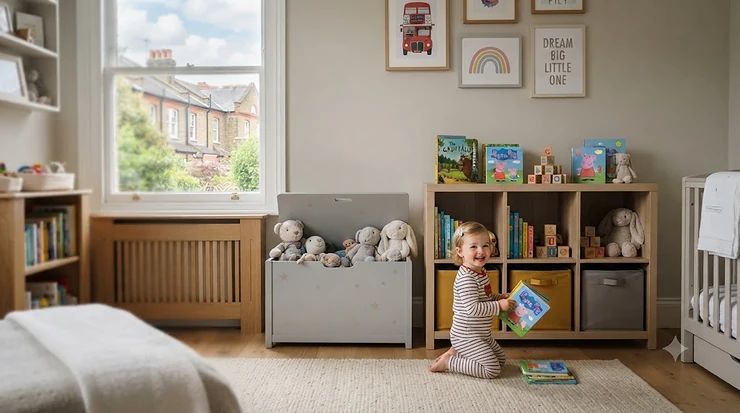
Open storage unit vs toy box for nursery is a choice between two philosophies. One is low, see-everything shelving that lets a toddler spot, grab and return toys alone. The other is a lidded chest that swallows the lot in one deep well. Shelving rewards choice and order. A toy box rewards speed and a calm-looking room.
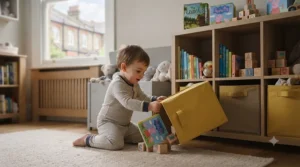
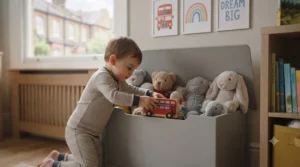
Picture a quarter to seven on a Saturday morning. A small person shuffles in, surveys the kingdom and wants the wooden train, not the rattle. With an open shelf, they point, reach and choose. With a chest, they lean, rummage and launch half the contents onto the carpet before the train surfaces. Neither scene is wrong. They’re just different bargains.
Here’s what most buying guides skip: how many toys you own matters almost as much as the container. A University of Toledo experiment with 36 toddlers, summarised by the British Psychological Society’s Research Digest, found that children offered four toys played with each one in more varied ways than children offered sixteen. Storage that limits what’s on show at once is quietly doing developmental work.
So this guide weighs the open storage unit vs toy box for nursery question using seven real products from Amazon UK: four open or part-open units and three closed boxes. You’ll get specs translated into everyday reality, honest safety context and a decision framework. Prices are ranges only, checked in September 2026, so always confirm the current listing.
Quick Comparison: Open Storage Unit vs Toy Box for Nursery
Think of it as choosing between a shop window and a treasure chest: one displays, the other hides. Here is the head-to-head at category level.
| Factor | Open storage unit | Toy box |
|---|---|---|
| Toy visibility | Everything on show, so choice is instant | Nothing visible until the lid is lifted |
| Toddler access | Point, reach, grab | Lift lid, then dig |
| Tidy-up style | Every item has a “home” | One-step dump |
| Main safety watch-point | Wall anchoring | Lid support and ventilation |
| Best for | GYMAX 5-Cubby, Amazon Basics organiser | HOMCOM toy box, Froppi |
Read down the columns and a pattern appears. Open units win on choice and visibility, while toy boxes win on speed and visual calm. If you want a child who can start playing without summoning a parent, low shelving like the GYMAX 5-Cubby is the stronger starting point. If your priority is a ninety-second sweep before bath time, the Froppi wheeled box or the HOMCOM toy box suits better. Plenty of nurseries sensibly run both.
💬 Just one click — help others make better buying decisions too!😊
Top 7 Open Storage Units and Toy Boxes for Nursery: Expert Analysis
We’ll take the four open units first, then the three closed options. Every rating and price below is a snapshot from September 2026.
1. Amazon Basics 4 Shelf Organiser (12 Bins) — best budget open unit with bins
The trick here is the tilt. Twelve removable plastic bins slot into four tiers at a slight downward slant, so a toddler sees what’s inside without hauling anything out.
The frame is roughly 85 × 28 × 79 cm and weighs about 8.7 kg. That’s light enough to shift for hoovering, and it’s designed to be anchored to the wall. The catch is a stated total load limit of around 11.3 kg, so the wooden blocks belong in a bin on the bottom row, not the top. At 79 cm tall, the upper tier will sit above most under-twos’ reach. Think of it as “toddler gets the bottom two rows, adult manages the top two.”
Based on the spec comparison, this is the tidy-minded parent’s pick. It turns sorting into a daily game of “which bin does this live in?”, which is the habit-building this guide keeps returning to. It’s less convincing as a Montessori-style piece, since bright plastic reads playroom rather than calm nursery.
Amazon’s own summary of customer reviews says buyers find it easy to assemble and sturdy. The listing family sits around 4.7 out of 5 across thousands of ratings.
Pros:
- ✅ Twelve bins make sorting by type easy
- ✅ Wall-anchoring hardware supplied in the box
- ✅ Big review pool at a low price
Cons:
- ❌ Low overall load limit of about 11.3 kg
- ❌ Top tier sits above most toddlers’ reach
Expect roughly the high-£30s to mid-£40s. Check the current price, but it’s the lowest-cost open unit in this round-up.
2. Humble Crew Cambridge Large Wooden Toy Shelf (9 Bins) — two bin sizes plus stabilising braces
Two bin sizes are the clever bit. Six standard bins (about 30 × 22 × 15 cm) and three large ones (about 40 × 30 × 15 cm) mean chunky diggers and tiny figures needn’t share a home.
The white engineered-wood frame, reinforced with steel dowels, measures about 86 × 28 × 79 cm. Stabilising braces stretch the depth to roughly 40 cm. That extra reach is the price of stability: a determined toddler tug is less likely to topple the unit. But it eats floor space in a compact nursery and creates a low bar for new walkers to stumble over. The bins are described as BPA- and phthalate-free, which matters for mouthy under-twos.
Compared with the Amazon Basics organiser, this reads as the “buy once” option: fewer, roomier bins, a top shelf for the day’s rotation and a sturdier stance. If your child is between one and three and you plan to keep it for years, that logic is hard to argue with.
The wider Humble Crew listing family carries roughly 4.3 out of 5 from more than 37,000 ratings. That’s a slightly lower average than the Amazon Basics organiser, but from a very large pool. I couldn’t verify specific recurring complaints, so skim the latest three-star reviews before buying.
Pros:
- ✅ Two bin sizes suit mixed toy collections
- ✅ Stabilising braces add tip resistance
- ✅ Large review pool for buying confidence
Cons:
- ❌ Braces extend depth to roughly 40 cm
- ❌ Costs noticeably more than the budget rival
Expect the low-£60s to about £70. It’s worth it if you value the braces and bin flexibility.
3. GYMAX 5-Cubby Kids Storage Shelf Unit — low, wide and fully open
This is the closest of the seven to a genuine Montessori-style shelf: five open cubbies, no doors, no lids, nothing between child and toy.
It measures roughly 111 × 30 × 62 cm and weighs about 21 kg, with cubes of around 53 × 28 × 30 cm and 35 × 28 × 18 cm, plus rounded corners. That 62 cm height puts every compartment within a toddler’s reach, which is the whole logic of low shelving. The weight lends stability. I couldn’t confirm that anti-tip hardware ships with this listing, so budget a few pounds for wall straps anyway.
The lack of bins is both a limitation and a feature. Small parts will need baskets. But a shelf showing one activity per cubby naturally nudges you towards the four-to-six-toy rule from the Toledo research. At 111 cm wide, it also wants a clear stretch of wall, so measure twice.
I couldn’t verify a robust review count for this exact listing. That makes it less proven than the Amazon Basics organiser or Humble Crew Cambridge, so treat it as a spec-led choice rather than a crowd-tested one.
Pros:
- ✅ 62 cm height keeps every cubby within toddler reach
- ✅ Fully open, so choice is instant
- ✅ Rounded corners and a stable, weighty frame
Cons:
- ❌ No bins, so loose small toys need baskets
- ❌ Wide 111 cm footprint needs a clear wall
Expect roughly £55–£65, which is good value if independence is your main goal.
4. Liberty House Toys Kids Storage Shelf and Fabric Bins — open shelves with a hide-the-clutter option
Half display, half disguise. Open shelves keep favourites and books on show, while three fabric bins swallow the visual noise of loose cars and figures.
Model LHT13043 measures about 90 × 28 × 60 cm. It sits on solid beechwood legs and is quoted with a 30 kg maximum load, far more generous than the 11.3 kg on the Amazon Basics organiser. Lifting the base off the floor also helps when you’re sweeping underneath. The body is MDF, so wipe spills promptly rather than letting them soak in.
Retailers label it for ages 3–12. For a nursery with a younger toddler that isn’t a ban, but it’s a prompt to supervise and keep small-part toys inside the bins. As a compromise in the open storage unit vs toy box for nursery debate, it’s persuasive: your child sees the good stuff and you hide the chaos.
I found very little verifiable review data for this exact model, so I can’t report a sentiment trend. Check the current ratings on the listing.
Pros:
- ✅ Generous 30 kg maximum load
- ✅ Open shelves plus three fabric bins
- ✅ Raised legs simplify floor cleaning
Cons:
- ❌ Only three bins included
- ❌ Labelled 3+, so supervise with under-threes
Across retailers it has ranged from the upper-£50s to the low-£70s, so check the current price.
5. HOMCOM Kids Wooden Toy Box — compact chest with a hold-open lid
The safety hinge is the headline. The lid opens to about 110 degrees and stays put, rather than dropping onto small fingers.
The white MDF box measures 62 × 40 × 46.5 cm outside and roughly 59.5 × 36 × 25 cm inside. It has two side handles and a raised base with about 6 cm of clearance, and the listing quotes a 20 kg maximum load. That 25 cm interior depth is a quiet advantage. It’s shallow enough that toys don’t vanish into an abyss, which softens the classic “dig to the bottom” complaint about toy boxes.
It’s the sensible entry point if a nursery corner needs to look calm at bedtime. Where it disappoints is autonomy: with the lid down, nothing is visible, so choice depends on the child remembering what’s inside. Ventilation isn’t mentioned on this listing, so consider keeping the lid propped open while your child plays nearby.
I couldn’t verify a rating for this exact variant. A sibling HOMCOM 2-in-1 bench toy box sat at about 3.7 out of 5 from 125 ratings, which is a modest signal rather than a verdict.
Pros:
- ✅ Hold-open safety hinge protects fingers
- ✅ Shallow interior limits digging
- ✅ Side handles and raised base
Cons:
- ❌ Nothing visible with the lid down
- ❌ MDF flat-pack needs careful assembly
Expect around the mid-£30s, which is solid entry-level value.
6. COSTWAY Wooden Toy Box with Cushion Bench — chest and reading seat in one
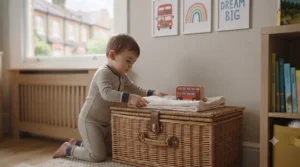
Two jobs, one footprint: a slow-closing storage chest topped with a cushion, so it doubles as a reading perch.
The lid uses a slow-closing safety hinge with a groove at the front edge to reduce finger-pinch risk, and the corners are rounded. Costway quotes a 20 kg limit on the top panel but only around 10 kg inside, so a crate of wooden train track is the wrong cargo. The surface is described as smooth and easy to wipe.
That tight interior limit is the detail most buyers overlook. It’s fine for soft toys, dress-up and books, but less fine for dense wooden sets. Its real value is in shared living spaces, where a bench that hides toys by day and seats a story-time parent is worth more than a second cupboard.
Buyer feedback on the brand’s own site for this design praises the non-slamming hinge but flags a thin cushion. I couldn’t verify a rating for the Amazon UK listing itself.
Pros:
- ✅ Slow-closing hinge with finger-pinch groove
- ✅ Doubles as a story-time bench
- ✅ Rounded corners throughout
Cons:
- ❌ Only about 10 kg allowed inside
- ❌ Priciest closed option; thin cushion reported
Expect around the mid-£60s, and note that you’re paying for the bench function.
7. Froppi 45L Toy Box on Wheels — cheapest, lightest and mobile
Wheels turn tidy-up into a game. A toddler can push or pull the box between rooms and “drive it home” at bedtime.
The hard-plastic box measures about 50 × 35 × 30 cm, holds 45 litres, has rounded corners and a lid, and stacks. Four wheels make it mobile, though the flip side is that it can wander on smooth floors. The listing also describes a lockable lid, so keep the lid unlatched in a toddler’s room.
It’s the pragmatic choice for soft toys, which are bulky, light and love to sprawl. It’s not Montessori-style and won’t win interior-design prizes. But as a second, portable store beside an open shelf, it’s hard to beat on price.
The listing shows around 4.5 out of 5 from a few hundred ratings on one size variant, with buyers describing it as spacious.
Pros:
- ✅ Wheels make tidy-up feel like play
- ✅ Wipe-clean plastic and stackable
- ✅ Lowest price in this round-up
Cons:
- ❌ Plastic look suits playrooms more than calm nurseries
- ❌ Lid hides contents; can roll on hard floors
Expect roughly the mid-£20s to about £30.
Top 7 at a Glance
| Product | Type | Approx. size (cm) | Standout spec | Approx. price | Rating snapshot | Best for |
|---|---|---|---|---|---|---|
| Amazon Basics organiser | Open unit + bins | 85 × 28 × 79 | 12 removable bins | High-£30s to mid-£40s | ~4.7/5, thousands of ratings | Budget sorting |
| Humble Crew Cambridge | Open unit + bins | 86 × 28 × 79 (40 deep with braces) | 9 bins, stabilising braces | Low-£60s to ~£70 | ~4.3/5, 37,000+ ratings | Buy-once bin shelf |
| GYMAX 5-Cubby | Low open cubbies | 111 × 30 × 62 | 5 cubes, no bins | ~£55–£65 | Not verified | Montessori-style setups |
| Liberty House shelf | Shelf + fabric bins | 90 × 28 × 60 | 30 kg max load | Upper-£50s to low-£70s | Not verified | Hiding clutter, displaying favourites |
| HOMCOM toy box | Lidded chest | 62 × 40 × 46.5 | Hold-open hinge, 20 kg | Mid-£30s | Not verified (sibling ~3.7/5) | Tight budgets, calm corners |
| COSTWAY bench toy box | Chest + bench | See listing | Slow-close hinge, ~10 kg inside | Mid-£60s | Not verified | Living-room corners |
| Froppi 45L | Wheeled plastic box | 50 × 35 × 30 | 4 wheels, 45 L | Mid-£20s to ~£30 | ~4.5/5, a few hundred ratings | Soft toys, portability |
The table shows a clear split between proven and promising. The Amazon Basics organiser and Humble Crew Cambridge have the strongest review evidence. The GYMAX 5-Cubby offers the best height logic on paper. For closed storage, the Froppi is the value leader and the COSTWAY bench toy box is the versatility play. If you can only buy one thing, match it to your child’s height and your floor plan first, and the price second.
✨ Don’t Miss These Nursery Storage Picks!
🔍 Take your nursery storage to the next level with these carefully selected products. Click on any highlighted item to check current pricing and availability. These picks will help you create a calm, tidy corner your toddler can actually run themselves!
How to Choose Between an Open Storage Unit vs Toy Box for Nursery
To choose, measure your child’s reach, count their toys, then match the format to whoever will do the tidying. Seven steps make it concrete:
- Measure reach, not the room. Kneel down and look. Anything your child should use unaided must sit at eye-and-elbow level, which favours units around 60 cm high for under-twos, such as the GYMAX 5-Cubby.
- Count the toys. Aim to display roughly four to six at once and keep the rest in a rotation box, echoing the Toledo finding.
- Check floor and wall. Open units need a stretch of wall and anchoring, while a toy box needs only floor.
- Read the age label and safety features. Several wooden units here are labelled 3+, so look for lid supports, air gaps and anti-tip hardware.
- Decide who tidies. If the child does, choose open shelving. If you do, a chest is fine.
- Check load limits. The Amazon Basics organiser allows about 11.3 kg in total, the Liberty House shelf 30 kg, and the COSTWAY bench toy box roughly 10 kg inside.
- Consider a hybrid. One open shelf for the everyday few, one closed box for overflow.
Notice that step one is really the storage type for toddler toys question in disguise. Height and reach decide more than colour ever will.
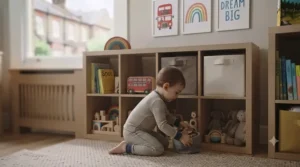
Open Shelving vs Closed Storage Nursery: Where Each Wins
The open shelving vs closed storage nursery debate is really about what you want the room to teach. Open shelving teaches choosing and returning. Closed storage protects visual calm and tames overflow.
| Benefit | Open shelving | Traditional toy box |
|---|---|---|
| Independence | High: child sees and selects | Lower: child rummages |
| Visual calm | Depends on what you display | High: lid hides everything |
| Toy rotation | Easy: swap items on and off | Awkward: rotation means unpacking |
| Cost and space | Often pricier, needs wall | Cheaper, floor only |
| Best for | Humble Crew Cambridge, Liberty House shelf | COSTWAY bench toy box, Froppi |
Open shelving earns its premium through independence and easy rotation, while the toy box wins on cost and camouflage. The interesting territory is the middle, where the Liberty House shelf and its fabric bins deliver a bit of both. If you’re on the fence, buy the open unit first. A plain box is easy to add later, and it’s much harder to justify a wall unit once the floor is full of chests.
Easy Access Toy Storage Comparison: Reach, Grab, Return
An easy access toy storage comparison comes down to counting the steps between wanting a toy and holding it. An open cubby like the GYMAX 5-Cubby takes one step. A bin on a tier of the Amazon Basics organiser takes two: pull the bin, tip it out. A lidded chest like the HOMCOM toy box takes three or four: approach, lift the lid, search, and often wait for a grown-up.
Height matters too. The GYMAX 5-Cubby tops out at 62 cm, while the Amazon Basics organiser and Humble Crew Cambridge stand near 79 cm. Their upper rows will likely be adult-only for very small children. Put daily favourites on the bottom rows and reserve the top for special-occasion items.
On the return leg, the picture flips. A big open bin or a wheeled Froppi is the most forgiving target because it needs no accuracy. So the best easy-access arrangement is often open shelves for choosing and a generous box for returning.
Storage Type for Toddler Toys: Matching Format to What You Own
Choosing the right storage type for toddler toys starts with sorting what you actually own. Soft toys are bulky and squishy, so a wheeled box like the Froppi or a fabric bin handles them well. Wooden blocks and vehicles are heavy, which calls for sturdy, low cubbies or a bottom-row bin. Books like to face forward, which favours open shelving. Loose small parts belong in a lidded or fabric bin such as those on the Liberty House shelf.
Then filter out marketing. Features that actually matter are load limit, height, interior depth and how the lid behaves. Features that don’t are bin colour, printed animals and cute product names. A pretty unit that tips or slams is worse than a plain one that doesn’t. When two options tie on the essentials, choose the one whose bins are easiest for your child to carry, because carrying is half of tidying.
Montessori-Style Toy Storage: What It Means in a UK Nursery
Montessori-style toy storage borrows one big classroom idea: furniture and materials scaled to the child, kept visible and reachable. The University of Connecticut’s archive explainer on the Montessori prepared environment describes low, accessible shelves and child-sized furnishings as central to the approach.
Translate that to a nursery and you get three rules: low, open and edited. Nothing here carries a formal Montessori certificate, and I found no certification scheme behind the term on these listings. Judge by shelf height, openness and how few items sit on it. By that yardstick the GYMAX 5-Cubby is the closest fit, the Liberty House shelf is a partial fit, and the Amazon Basics organiser is functional but visually busy.
A simple upgrade is to swap bright bins for shallow baskets or trays, one activity per tray. You get the calm look without buying premium furniture, and it makes the four-to-six-toy rule almost automatic.
Toddler Independence Play: How Storage Shapes What Children Do
Toddler independence play means self-directed play with minimal adult steering, and it depends on a child being able to choose. That’s where open shelving earns its keep. A child who can see, reach and return a toy needs no parent as gatekeeper.
Honesty check: the Toledo research tested toy quantity, not furniture, so it would be a stretch to claim shelves cause deeper play. But it suggests a mechanism. When only a handful of toys are visible, toddlers settle. An open unit makes that curation natural, because the shelf’s capacity is the limit. A toy box invites “everything, all the time.”
Practically, stage a small invitation each morning: two open-ended toys on the bottom shelf, everything else out of sight. Expect short stretches of solo play at first, and remember that independence is a skill that builds gradually. Under-twos still need company, and a shelf can’t replace it.
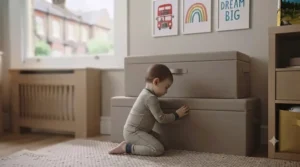
Tidy-Up Habits for Children: Making the Reset Routine Stick
Tidy-up habits for children form when returning a toy is easy, obvious and quick, and storage design influences all three. Easy means a big, forgiving target like the wheeled Froppi or an open bin. Obvious means a clear “home” for each category, ideally with a photo label on the bin front. Quick means fewer items in circulation.
A five-minute pre-bath reset beats a Sunday marathon, and a parent joining in beats instructions from the doorway. Which format builds the habit best? Bin-based units like the Amazon Basics organiser encourage sorting. A toy box encourages dumping, which is still a habit, just a coarser one.
Set expectations honestly. Very young toddlers imitate more than they sort, so a one-year-old dropping a block into a bin counts as a win. The routine matters more than the result at this age, so keep it short, cheerful and consistent.
Nursery Safety Guide: Tip-Overs, Lids and Age Labels
Three hazards deserve your attention. First, tip-overs: any open unit should be anchored to the wall, however short. The Amazon Basics organiser is designed for wall anchoring and Humble Crew Cambridge adds stabilising braces. Check the GYMAX 5-Cubby listing for hardware and buy straps if none is included. Keep heavy toys on the lowest shelves.
Second, lids. The US Consumer Product Safety Commission has warned about toy chest lids falling on children, recommending lidless designs or lid supports that hold the lid open in any position. It’s a US regulator, but the physics travels well. Slow-closing hinges like those on the HOMCOM toy box and COSTWAY bench toy box address exactly this.
Third, ventilation and latching. Avoid anything a child could shut themselves inside, and leave the Froppi‘s lockable lid unlatched.
Finally, read age labels. The Liberty House shelf is labelled 3–12 and several wooden boxes carry 3+ markings, so supervise babies and under-threes, and keep small-part toys inside bins.
Long-Term Cost and Maintenance: What Each Option Really Costs
Buying price is only half the story. Spread over about four years of use from nursery to preschool, the cost per year looks like this. All figures are ranges, not exact prices.
| Product | Price range | Approx. cost per year (4 years) | Best for |
|---|---|---|---|
| Amazon Basics organiser | High-£30s to mid-£40s | ~£9–£12 | Budget sorting |
| Humble Crew Cambridge | Low-£60s to ~£70 | ~£15–£18 | Buy-once bin shelf |
| GYMAX 5-Cubby | ~£55–£65 | ~£14–£16 | Montessori-style setups |
| Liberty House shelf | Upper-£50s to low-£70s | ~£14–£18 | Hidden clutter plus display |
| HOMCOM toy box | Mid-£30s | ~£8–£10 | Tight budgets |
| COSTWAY bench toy box | Mid-£60s | ~£15–£17 | Living-room corners |
| Froppi 45L | Mid-£20s to ~£30 | ~£6–£8 | Soft toys, portability |
The spread is smaller than it looks: the priciest option costs roughly £10 more per year than the cheapest. That reframes the decision from “what’s cheapest?” to “what will my child actually use?” A £25 box that sits ignored is dearer than a £60 shelf used daily. The Froppi and HOMCOM toy box are the value picks. The Humble Crew Cambridge justifies its premium if you’d otherwise replace a wobbly budget unit.
Maintenance is light. Wipe MDF with a barely damp cloth, tighten fasteners every few months, and wash fabric bins on a gentle cycle if the manufacturer allows it.
Practical Setup Guide: Your First 30 Days With Open Storage
Day 0: Position and anchor
Choose a wall away from radiators and doors. Anchor the unit before loading it, put the heaviest items on the bottom row, and check that the top surface isn’t a launchpad for anything tempting.
Days 1–3: Start small
Load just four to six toys. Everything else goes into a closed box or wardrobe, out of sight. It will look almost empty, which is the point.
Week 1: Label and demonstrate
Stick a photo or drawing on each bin front. Show your child how to return a toy, then let them copy you.
Week 2: Rotate
Swap two or three toys each week. Watch what gets ignored and retire it. Watch what gets carried around and keep it.
Day 30: Audit
Check fixings, wipe surfaces and note what your child reaches for. Common first-month mistakes are overfilling the top shelf, forgetting to anchor, and expecting a one-year-old to sort by category. If the shelf is chaos by week three, remove half the toys before buying anything new.
Real-World Scenarios: Three Nurseries, Three Different Answers
Scenario 1: The rented flat, a 14-month-old and £40
Budget is about £40, space is tiny and use is daily. The Amazon Basics organiser, anchored, gives the bottom two rows to the child and the top two to you. If your tenancy bans drilling, skip wall fixings and choose the HOMCOM toy box instead. Rotate four to six toys either way.
Scenario 2: The shared bedroom, a two-year-old and a newborn
Budget is roughly £80–£95 for two pieces. The GYMAX 5-Cubby gives the toddler a Montessori-style shelf, while the Froppi takes soft toys and rolls out of the way. Keep small-part toys well away from the baby, ideally up high or behind a closed door.
Scenario 3: The living-room corner that must vanish by 7 p.m.
Budget is £60–£70 and toys must disappear every evening. The COSTWAY bench toy box hides the lot and doubles as a story-time seat. Keep dense wooden toys in a separate basket because of its roughly 10 kg interior limit.
Problem-and-Solution Guide: Fixing the Usual Storage Headaches
Problem: the shelf is emptied onto the floor daily
Too many toys is the usual culprit. Cut to four to six visible items and use shallow trays so contents stay contained. This is also the fastest fix for tidy-up habits for children that keep collapsing.
Problem: my toddler climbs the shelf
Anchor it, keep it low and clear the top of tempting objects. A 62 cm unit like the GYMAX 5-Cubby is less of a climbing frame than a 79 cm tower.
Problem: the toy box has become a black hole
Choose a shallow interior like the HOMCOM toy box‘s roughly 25 cm depth, and use a lift-out tray or bag for small pieces.
Problem: is it properly labelled and safe?
The gov.uk guidance on the Toys (Safety) Regulations 2011 explains how toys are regulated in Great Britain, including CE and UKCA marking. Storage furniture may sit outside that definition, so a listing that cites standards such as EN 71 is offering extra reassurance rather than a legal guarantee. Read the age label, check the hinge or anchoring hardware, and keep the paperwork.
FAQ
❓ Is an open storage unit vs toy box for nursery use better in a small room?
❓ How many toys should I put on an open nursery shelf?
❓ What height should a shelf be for a one-year-old?
❓ Are fabric bins or plastic bins better for toddler toys?
❓ Can I use a toy box and an open shelf together?
Conclusion
So, who wins the open storage unit vs toy box for nursery contest? It depends on what you value. If independence and Montessori-style toy storage matter most, low open shelving such as the GYMAX 5-Cubby, or a bin unit like the Amazon Basics organiser or Humble Crew Cambridge, is the stronger foundation. If visual calm and quick evening resets matter more, the HOMCOM toy box, COSTWAY bench toy box or Froppi deliver. The Liberty House shelf sits diplomatically between the two.
Across the open shelving vs closed storage nursery debate, the pattern holds. Open units win on choice and rotation, boxes win on speed and camouflage. In any easy access toy storage comparison, remember that height and reach beat looks, and that the right storage type for toddler toys follows the toys you actually own. Whichever you choose, anchor open units, check lids, limit the toys on show and treat tidying as a routine rather than a chore.
Most families end up with a hybrid, and that’s perfectly sensible: a small open shelf for the everyday few, and one forgiving box for the rest.
✨ Don’t Miss These Nursery Storage Picks!
🔍 Take your nursery storage to the next level with these carefully selected products. Click on any highlighted item to check current pricing and availability. These picks will help you create a calm, tidy corner your toddler can actually run themselves!
Recommended for You
- Toy Storage Box For Nursery: 7 Best UK Picks; Buying Guide (2026)
- Nursery Storage Under £30: 7 Brilliant Budget Picks (2026)
- Sturdiest Baby Wardrobe: 7 Safest Picks For UK Nurseries (2026)
Disclaimer: This article contains affiliate links. As an Amazon Associate, I earn from qualifying purchases. If you purchase products through these links, we may earn a small commission at no additional cost to you.
✨ Found this helpful? Share it with your friends! 💬🤗
