
In This Article
There’s a particular kind of exhaustion that arrives around week two: you’re half-awake, half-hanging off the mattress, trying to lift a squirming newborn out of a Moses basket on the floor without dropping either of you. Somewhere in that fog, most parents start Googling next to me cribs, usually at about 3am, usually while balancing a phone on one knee.

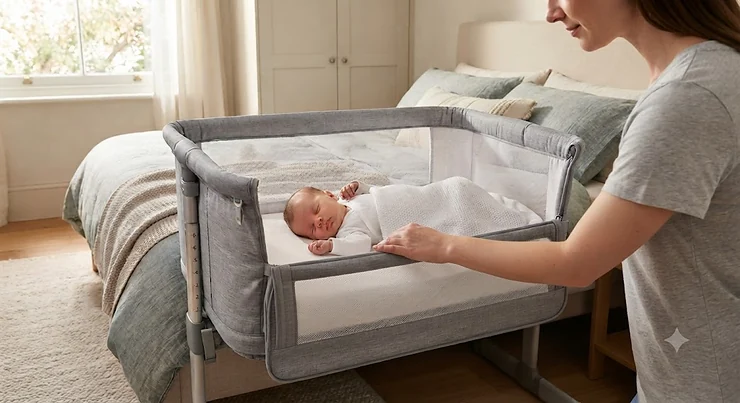
So what actually is a next to me crib? It’s a small cot that straps securely to the side of your own bed, with one lowered or removable panel, so your baby sleeps at roughly the same height as you — close enough to reach, but in their own separate, safe sleeping space rather than in your bed.
That distinction matters more than the marketing photos let on. The Lullaby Trust’s safer sleep guidance is built around reducing the risk of SIDS while still supporting closeness between parent and baby, and a next to me crib is essentially the physical embodiment of that compromise: proximity without the risks that come from an actual shared sleep surface. It’s also, frankly, a back-saver — nobody wants to be doing a 3am forward-fold over the side of a Moses basket with stitches still healing.
This guide walks through seven real, currently available bedside cribs, from budget-friendly British brands to premium beechwood pieces that convert into furniture your child will use for years. Every price mentioned below is a range rather than a fixed figure, because Amazon pricing moves around constantly — always check the current listing before you buy.
Quick Comparison Table: Best Next to Me Cribs at a Glance
| Product | Height Settings | Converts To | Best For |
|---|---|---|---|
| Chicco Next2Me Forever | 11 positions | Standalone cot + toddler floor bed | Long-term all-in-one use |
| SnuzPod5 | Multiple, up to 73cm | Standalone/lift-off bassinet | Portability around the house |
| Shnuggle Air | Multiple with incline | Full-size cot (kit sold separately) | Reflux and breathability |
| babybay Original/Maxi | Infinitely adjustable | Bassinet, cot, or toddler bed | Tall beds and heirloom quality |
| Tutti Bambini CoZee Air | 6 positions (49–64+cm) | Standalone crib | Budget-conscious first-timers |
| Ickle Bubba Bubba&Me | 7 positions | Freestanding crib | British-brand value |
| Maxi-Cosi Iora | Adjustable, extensive storage | 2-in-1 standalone | Airflow-focused sleepers |
The pattern worth noticing here is that “adjustable height” isn’t a premium-only feature — even the budget-leaning CoZee and Bubba&Me offer six or seven positions, which tells you the industry has largely standardised on this as table stakes. What actually separates the tiers is convertibility: whether the crib dies a natural death at six months or quietly becomes a toddler bed, a play area, or even a desk years down the line.
💬 Just one click — help others make better buying decisions too!😊
1. Chicco Next2Me Forever — the closest thing to a lifetime crib
Chicco built its reputation on the original Next2Me, and the Forever version pushes that concept further than any rival on this list: it converts from a bedside co-sleeper, to a standalone cot, to a toddler floor bed as your child grows.
Eleven height settings mean it’s genuinely one of the most flexible fits for different bed heights on the market, and a tilt function lets you angle the mattress up to 10cm on one side — useful for babies with reflux or a stuffy nose during a cold. The zip-down side gives quick, one-handed access during night feeds, and assembly is reportedly quick enough to manage solo.
Based on the spec comparison, what most buyers overlook is that “Forever” isn’t just marketing fluff — the floor-bed conversion genuinely extends this crib’s useful life well past the six-month mark most bedside cribs are limited to, which changes the cost-per-month maths considerably in its favour if you’re planning to keep it around. Here’s what the listing photos won’t tell you: several reviewers mention that reaching in for comfort, rather than a full feed, becomes noticeably easier than with a Moses basket, since you’re not leaning over a rigid rim.
Reviewer sentiment consistently praises the ease of getting the baby out compared with older-style bedside cribs, with one parent specifically noting how much less back strain they experienced after switching from a Moses basket following a caesarean. A smaller theme in aggregated feedback flags that the crib runs on the larger side once assembled, so it’s worth measuring your available floor space before committing.
Pros:
- ✅ Genuinely converts through three life stages, not just two
- ✅ Eleven height settings fit an unusually wide range of beds
- ✅ Zip-down side allows quick, low-strain access at night
Cons:
- ❌ Larger footprint than most rivals once fully assembled
- ❌ Premium pricing compared with budget-tier options
Typically priced in the £180-£280 range, this sits firmly mid-to-premium, and it earns that price through longevity rather than luxury materials — a fair trade if you’d rather buy one crib and be done with it.

2. SnuzPod5 — best for parents who want the crib to travel with them
Snuz built its name on a genuinely clever design quirk: the bassinet section lifts clean off the rocking stand, meaning you can carry your baby’s sleeping space from bedroom to living room without waking them mid-nap.
The crib also rocks gently on its stand, comes with breathable mesh side panels, and offers a tilt function for reflux-prone babies, alongside rails at each end that double as handy storage for muslins and spare dummies. Nine colour options give more choice than any other product on this list, which matters more than it sounds if the crib is going to live in your bedroom for six months straight.
What most buyers overlook about the SnuzPod5 is how much the lift-off bassinet genuinely changes your daytime routine, not just your nights — several reviewers specifically mention using it as a portable daytime sleeping space around the house, effectively getting a bassinet and a bedside crib in one purchase. On paper this means better value than it first appears, since you’re not separately buying a Moses basket for daytime naps downstairs.
Aggregated feedback is strongly positive on build quality and sturdiness, with one parent-tester noting the crib felt reassuringly solid despite being relatively compact, though another mentioned it’s quite bulky once packed into its travel bag, meaning a partner may need to carry it if you’re visiting family.
Pros:
- ✅ Lift-off bassinet doubles as a portable daytime sleeper
- ✅ Nine colour options, more than any rival here
- ✅ Gentle rocking function that many babies settle well in
Cons:
- ❌ Bulky travel bag makes it a two-person job to transport
- ❌ Compact size may suit smaller or shorter babies best
Generally found in the £170-£230 range, the SnuzPod5 rewards families who genuinely intend to move the crib between rooms rather than leaving it fixed to the bed for six straight months.
3. Shnuggle Air — best for babies who run hot or struggle with reflux
Where most bedside cribs treat breathability as an afterthought, the Shnuggle Air makes it the entire point. Dual-view mesh sides run along both long edges rather than just one, so you get genuine airflow whichever way the crib is positioned against your bed.
The bundled mattress is hypoallergenic and specifically engineered for airflow, with Shnuggle citing 50% more breathability than standard foam mattresses — a detail that matters considerably more than it might seem if you’re a parent who lies awake worrying about overheating. An incline setting helps babies with colic or reflux sleep at a gentler angle, and the drop-down sides release via a simple safety catch and zip combination for fast night access.
Here’s what the spec sheet won’t fully convey: this is one of only two cribs on this list, alongside the Chicco, that genuinely extends beyond the newborn stage — buy the separate conversion kit and cot mattress, and the Shnuggle Air becomes a full-sized cot usable up to around age two. Based on the spec comparison, that’s a smart long-term investment if you’re willing to pay for the conversion kit later rather than balking at the bundled price now.
Reviewer sentiment is consistently glowing on the mesh sides and mattress firmness specifically, with parents repeatedly describing sound, settled sleep even for babies who’d previously struggled elsewhere, though the standalone crib feels smaller than some full-size rivals until the conversion kit is added.
Pros:
- ✅ Genuine dual-side mesh for maximum airflow
- ✅ Incline setting specifically helps reflux and colic
- ✅ Converts to a full cot lasting until around age two
Cons:
- ❌ Conversion kit and cot mattress are sold separately
- ❌ Standalone crib size feels compact before converting
Usually priced in the £150-£220 range before any conversion extras, this is the pick for parents whose main worry is temperature regulation or a baby who doesn’t sleep well flat on their back.
4. babybay Original/Maxi — the heirloom-quality choice for tall or unusual beds
If wood over steel-and-fabric is your instinct, babybay is the name that keeps coming up, and for good reason: it’s been making beechwood bedside sleepers for over two decades, and the Original model is infinitely height-adjustable rather than locked to a handful of preset positions.
That “infinite” adjustment is the genuinely useful bit — rather than hoping your bed height lands neatly on position 4 or 5, you can dial the babybay to match almost any mattress height, up to around 28 inches on the Original and taller still on the Maxi Tall variant, which is specifically built for beds with a boxspring base. The wood is solid European beechwood, wipeable, and free from the kind of upholstered fabric that traps allergens and needs frequent washing.
What most buyers overlook here is the sheer longevity built into the design: babybay sells conversion kits that turn the same frame into a standalone bassinet, a playpen, a desk, or a full toddler bed, meaning the wood you buy for a six-week-old could plausibly still be in use when they start school. On paper this means a genuinely different cost-per-year calculation than any fabric crib on this list — expensive upfront, but built to be handed down rather than binned.
Aggregated reviews consistently praise the build quality and finish, describing the wood as smooth, sturdy, and free of rough edges, though several buyers note assembly takes closer to 40 minutes than the “quick setup” marketing suggests, and the lack of wheels as standard makes it a poor fit for parents who want to shift the crib between rooms regularly.
Pros:
- ✅ Infinitely adjustable height, not locked to preset positions
- ✅ Solid beechwood built to be handed down for years
- ✅ Genuinely converts into furniture well past the crib stage
Cons:
- ❌ No wheels as standard, so it’s not easily portable
- ❌ Assembly takes longer than most fabric rivals
Typically priced from around £220 up to £400 depending on size and accessories, this is the considered choice for parents who see the crib as a long-term furniture investment rather than a six-month rental in disguise.
5. Tutti Bambini CoZee Air — best value for budget-conscious first-timers
Not every family needs — or wants — to spend two hundred-odd pounds on something a newborn will use for a matter of months. The Tutti Bambini CoZee Air is proof that budget doesn’t have to mean flimsy.
Six height positions cover mattress heights from roughly 49cm up to 64cm and beyond, with oak-effect legs that look considerably more expensive than the price tag suggests. Two ventilated mesh sides aid airflow, and a storage shelf underneath keeps muslins and nappies within arm’s reach for night feeds — a small detail that saves a genuine number of steps across a sleep-deprived week.
Based on the spec comparison, the trade-off for the lower price is a simpler accessory bundle and a shorter lifespan than the Chicco or Shnuggle — this is a crib built to do one job well for around six months, not to convert into anything afterward. What most buyers overlook is that attaching it to a divan or platform bed genuinely does require threading the safety straps underneath the adult mattress, which some reviewers found fiddlier than expected without a video tutorial for reference.
Reviewer sentiment consistently praises the value for money and the ease of the six-height system once set up correctly, with several parents specifically flagging the storage shelf as more useful in practice than they’d anticipated, though a handful mention the included written instructions could be clearer for first-time assembly.
Pros:
- ✅ Genuinely competitive pricing against premium rivals
- ✅ Oak-effect legs that look pricier than they are
- ✅ Underneath storage shelf saves steps during night feeds
Cons:
- ❌ No conversion option once baby outgrows it
- ❌ Strap attachment can be fiddly on divan beds
Sitting in the £90-£150 range, this is the sensible pick for parents who want a genuinely safe, well-reviewed bedside crib without premium-brand pricing attached.

6. Ickle Bubba Bubba&Me — best British-brand value bundle
Ickle Bubba built its reputation on making baby gear that doesn’t cost the earth, and the Bubba&Me bedside crib is a strong example of that positioning done well. Seven height positions accommodate a wide range of bed heights, and the whole thing arrives with a mattress, a storage basket, and a carry bag included as standard — no separate purchases needed to get started.
Mesh windows run along the sides for visibility and airflow, and the freestanding frame means it doesn’t have to live permanently strapped to your bed; you can move it around the house on days when your baby naps downstairs. The zip-down side, according to several reviewers, is left permanently open by some parents for the quickest possible access during night feeds.
What most buyers overlook about this crib is how much value is baked into that single bundled price — a mattress and a travel bag alone would add £30-£40 to most rivals if bought separately, so the effective saving is larger than the headline price suggests. Here’s what most reviews don’t emphasise clearly enough: the storage basket underneath genuinely reduces 3am fumbling for a spare muslin, which matters more than it sounds when you’re operating on two hours of broken sleep.
Aggregated sentiment is consistently strong on ease of assembly and sturdiness for the price point, with reviewers specifically praising how quickly the crib went up and how comfortable their baby seemed from the first night, while a smaller number note the crib runs on the compact side, which may suit smaller babies better than larger ones by the four-month mark.
Pros:
- ✅ Mattress, storage basket, and travel bag all included
- ✅ Seven height positions for wide bed compatibility
- ✅ Freestanding frame moves easily around the house
Cons:
- ❌ Compact size may be outgrown sooner by larger babies
- ❌ Fewer premium extras than the Chicco or Shnuggle
Typically priced around £100-£160, this is the pick for budget-conscious parents who still want a well-reviewed, British-designed crib rather than an unbranded alternative.
7. Maxi-Cosi Iora — best for airflow-focused, storage-hungry parents
Rounding out the list, the Maxi-Cosi Iora takes a genuinely 2-in-1 approach: usable as a bedside co-sleeper for the early months, then as a standalone crib once your baby no longer needs to be strapped to your bed.
Adjustable height settings accommodate a wide range of bed heights, and the design leans heavily into breathability, with mesh panelling positioned to maximise airflow around the sleeping area. Extensive underneath storage — more generous than several rivals on this list — keeps essentials within reach without cluttering the bedroom floor.
Based on the spec comparison, what most buyers overlook is that the standalone-crib mode genuinely extends this product’s useful life beyond the typical six-month bedside window, without requiring a separately purchased conversion kit the way the Shnuggle does. On paper this means a simpler, single-purchase route to a longer-lasting crib, even if the upfront price sits toward the premium end.
Reviewer sentiment specifically highlights the breathability and the storage capacity as standout features, with parents noting they appreciated not having to buy a separate storage unit for muslins and spare sheets, while a smaller number mention the price point sits noticeably above budget rivals for what is, at its core, a similar core function.
Pros:
- ✅ Genuine 2-in-1 design without a separate conversion kit
- ✅ Strong airflow focus throughout the mesh panelling
- ✅ More underneath storage than most rivals on this list
Cons:
- ❌ Premium pricing relative to core feature set
- ❌ Less height-adjustment flexibility than the babybay
Generally priced in the £180-£260 range, this suits parents who specifically prioritise breathability and built-in storage over convertibility into a toddler bed.
Practical Usage Guide: Setting Up Your Next to Me Crib for the First Month
Getting the crib delivered is the easy part. Getting it correctly and safely attached is where most of the genuine first-week stress actually happens, so it’s worth doing properly rather than rushing it at 11pm the night before you’re due home from hospital.
Start by measuring your own mattress height from floor to top, not the bed frame height — this single measurement determines which position setting you’ll need, and getting it wrong by even a couple of centimetres can leave a gap that defeats the entire point of a bedside crib. Most bedside cribs, including several on this list, specify that the maximum safe gap between the two mattresses should not exceed around 20mm, so measure twice before you commit to a setting.
During the first 30 days, resist the urge to over-fill the crib with soft toys, cot bumpers, or extra blankets, however tempting a cosy-looking setup appears in product photography. Core safer sleep guidance consistently emphasises keeping a baby’s sleep space clear of anything beyond a firm, flat, waterproof mattress, since loose items increase suffocation risk regardless of how safety-certified the crib itself is. For maintenance, check the safety straps weekly for the first month, since new mattresses can compress slightly and subtly change the fit, and wipe mesh panels with a damp cloth rather than machine-washing them unless the manufacturer specifically says otherwise.
Real-World Scenarios: Which Next to Me Crib Suits Your Family?
Picture a family in a small terraced house, bedroom barely bigger than the bed itself, wanting something that won’t dominate the room. The Tutti Bambini CoZee Air or the Ickle Bubba Bubba&Me solve the actual problem here — both are genuinely compact and don’t demand extra floor space once attached.
Now picture parents expecting a baby who runs warm, or with a family history of reflux discomfort. The Shnuggle Air’s dual-mesh, high-airflow mattress and built-in incline setting are the more defensible choice, addressing a specific, named problem rather than a generic wishlist feature.
Finally, picture grandparents who want to buy one beautiful piece that lasts from newborn right through toddlerhood, viewing it as a long-term investment rather than a disposable first-months purchase. The babybay’s infinite height adjustment and multi-stage conversion options, or the Chicco Next2Me Forever’s three-stage transformation, are the more genuinely long-term-minded picks on this list.
Problem → Solution: Common Next to Me Crib Headaches Solved
Problem: there’s a visible gap between the two mattresses. This is almost always a height-setting issue rather than a faulty product. Re-measure your bed’s mattress height precisely and adjust to the nearest available position; if you’re between settings, the lower one is generally the safer choice.
Problem: the crib feels wobbly when attached. Check the safety straps haven’t loosened — this happens naturally within the first fortnight as fabric and webbing settle. Most manufacturers recommend a weekly strap check for exactly this reason.
Problem: your baby seems too warm at night. Mesh-sided cribs like the Shnuggle Air and SnuzPod5 exist specifically to address this. In the meantime, a lighter sleeping bag and a room thermometer solve most overheating concerns without buying anything new.
Problem: you’re struggling to reach your baby one-handed after a caesarean. Prioritise cribs with a genuine zip-down or drop-side panel, like the Chicco Next2Me Forever or Ickle Bubba Bubba&Me, both specifically praised in aggregated reviews for reducing the need to lean or twist.
How to Choose a Next to Me Crib
- Measure your bed’s mattress height before browsing brands. This single number rules out or confirms most products faster than comparing feature lists.
- Decide how long you genuinely want to use it for. A crib limited to six months, like the CoZee Air, is a different financial decision than one that converts through toddlerhood, like the Chicco or babybay.
- Check the maximum gap tolerance specified by the manufacturer. Most sit around 20mm — anything wider isn’t a safe fit for your particular bed.
- Prioritise mesh sides if overheating worries you. Not every “breathable” claim means the same level of airflow; dual-side mesh, as on the Shnuggle Air, genuinely outperforms single-side designs.
- Weigh portability against permanence honestly. A lift-off bassinet, like the SnuzPod5’s, suits parents who want a daytime sleeper too; a fixed frame suits parents who won’t move it regardless.
- Read reviews specifically for strap and attachment complaints, since these, rather than the crib itself, are the most common source of genuine safety concerns.
- Factor in your bed type. Divan and ottoman beds sometimes need extra straps sold separately, so check compatibility before assuming any crib will fit.
Next to Me Crib vs Moses Basket: How Do They Compare?
Moses baskets have been the traditional first sleep space for generations, and there’s genuine sentimental pull there — but the comparison against a next to me crib isn’t really about tradition versus modernity, it’s about function.
| Factor | Moses Basket | Next to Me Crib |
|---|---|---|
| Attaches to parent’s bed | No | Yes |
| Typical lifespan | Around 3–4 months | 6 months to several years |
| Portability | Very high, lightweight | Moderate, some lift off |
| Night access | Requires lifting baby fully out | Reach-in access, no full lift needed |
What this comparison actually reveals is that a Moses basket wins decisively on portability and initial cost, while a next to me crib wins on longevity and, for most parents recovering from birth, on physical ease of use. Moses baskets are typically outgrown within three to four months as babies grow in length, whereas several cribs on this list, particularly the Chicco and babybay, are engineered to stretch considerably further. If budget and portability matter most, a Moses basket remains a perfectly reasonable choice for the earliest weeks; if physical strain and longevity matter more, a next to me crib tends to earn its higher price back over time.
Next to Me Crib Reviews: What Aggregated Parent Feedback Really Says
Trawling through genuine reviews across these seven cribs reveals a few patterns that individual product pages rarely surface. First, complaints about strap attachment cluster overwhelmingly around divan and ottoman beds rather than standard bed frames — if you have one of these bed types, budget extra time for setup and check whether additional straps are needed.
Second, “ease of getting baby in and out” is mentioned far more often in five-star reviews than any single feature like colour or storage, suggesting this is genuinely the deciding factor for most exhausted parents rather than aesthetics. Third, longevity complaints — babies outgrowing the crib faster than expected — appear disproportionately in reviews of babies who measured large or long at birth, a pattern worth bearing in mind if you know you’re expecting a bigger baby.
Reading a spread of three-star reviews, rather than exclusively five-star ones, tends to surface the most balanced picture before you buy — a theme that held true across every product researched for this guide.
Next to Me Crib with Adjustable Height: Why the Numbers Matter
It’s tempting to skim past height-adjustment specs as boring technical detail, but this is genuinely the single most important number on the entire listing page. A next to me crib with adjustable height that doesn’t actually match your bed defeats the entire purpose of buying one — you’ll either have a dangerous gap or a mismatched, uncomfortable reach.
Most products on this list offer somewhere between six and eleven discrete height positions, while the babybay stands apart by offering infinite adjustment rather than fixed steps. On paper this means the babybay is more forgiving of unusual bed heights, tall divans, or beds with a boxspring base — situations where a fixed-position crib might land awkwardly between two settings, neither of which is quite right.
The trade-off worth flagging honestly: more height positions generally means a more complex adjustment mechanism, which is occasionally where minor stability complaints in aggregated reviews originate. A crib with fewer, sturdier fixed positions can, in some cases, feel more solid than one with many finer adjustments — so more isn’t automatically better if your bed height happens to land neatly on one of the standard settings anyway.

Next to Me Crib Mattress Size: Getting the Fit Right
Mattress dimensions vary more between brands than you’d expect, and this is where a lot of parents get caught out buying a “universal” replacement mattress that doesn’t actually fit. Chicco Next2Me-style cribs typically use an 83 x 50cm mattress, while the Tutti Bambini CoZee uses a very slightly larger 83 x 52cm, and the SnuzPod range uses its own dimensions that aren’t interchangeable with either.
The genuinely critical number, more than length and width, is the gap tolerance: most manufacturer guidance specifies that the maximum gap between the mattress and the sides or ends of the crib should not exceed roughly 20mm, since anything wider creates an entrapment risk. This is precisely why third-party “universal” mattresses need checking carefully against your specific crib model before purchase, rather than assumed to be a safe fit because the label says “next to me crib.”
If you’re buying a replacement or spare mattress rather than the one bundled with your crib, always cross-reference the exact model name against the mattress manufacturer’s compatibility list — a mattress that’s even a centimetre too narrow on paper can translate into a genuinely unsafe gap once the crib is assembled.
Next to Me Crib for a Plus Size Bed: Height, Width and Strap Fit
“Plus size bed” here really means two related things: a taller bed frame or thicker mattress than average, and a wider adult bed like a king or super king where the strap system needs to reach further and hold securely under more weight.
For taller beds — think a deep divan base topped with a thick pocket-sprung mattress, or a boxspring setup — height range is the deciding factor, and this is where the babybay Maxi Tall genuinely earns its name, purpose-built for exactly this scenario with extra height-adjustable inches beyond the standard Original. The Chicco Next2Me Forever’s eleven-position range also copes unusually well with taller-than-average beds compared with six or seven-position rivals.
For wider beds, the practical concern shifts to strap length and anchor security rather than height. Divan and ottoman bases sometimes require additional straps, sold separately by most manufacturers, to reach fully underneath a wider mattress without pulling at an angle. Based on the spec comparison, it’s genuinely worth measuring your bed’s full width and the distance from floor to mattress top before ordering, and checking the manufacturer’s own compatibility guidance rather than assuming any crib marketed as “universal fit” will work with an unusually large or heavy bed setup.
Breastfeeding at Night Made Easier: The Real Reason Parents Buy These
Ask most parents why they actually bought a next to me crib, once you get past the safety talking points, and the honest answer usually comes down to feeding. NHS guidance on helping your baby sleep notes that for at least the first six months, your baby should be in the same room as you for every sleep, both day and night, partly because this reduces SIDS risk — and a bedside crib is simply the most physically practical way to achieve that closeness night after night.
The practical difference a next to me crib makes to breastfeeding specifically is less about milk supply and more about sheer physical logistics: reaching a baby who’s an arm’s length away, rather than in another room or across a hallway, means feeds happen faster, with less time spent fully waking up in between. Several reviewers across the products in this guide specifically mention this as the deciding factor over a standard cot, describing feeds that once required getting up entirely now happening while barely leaving the pillow.
What’s worth being realistic about, though, is that a next to me crib doesn’t replace safe positioning during the feed itself — side-lying breastfeeding technique still matters, and it’s worth asking a midwife or health visitor to check your position is comfortable and safe before you rely on it as your default overnight routine.
Common Mistakes When Buying a Next to Me Crib
The single most common mistake is buying before measuring your own bed, leaving parents discovering on delivery day that no height setting quite closes the gap safely. A close second is underestimating how quickly a genuinely large or long baby can outgrow a compact crib — several products on this list are visibly smaller than others, which matters if you already know you’re expecting a big baby.
Parents also frequently overlook strap compatibility with divan or ottoman beds specifically, assuming a crib marketed as “universal” will fit any bed type without extra parts. It’s worth checking this explicitly before ordering rather than discovering it needs an additional purchase once the box has already arrived.
Finally, a subtler mistake is choosing based on aesthetics alone — colour and finish matter for a bedroom you’ll be spending a lot of time in, admittedly, but a beautiful crib that doesn’t match your bed height or doesn’t support your baby’s growth trajectory becomes an expensive ornament rather than a useful piece of kit within weeks.
Bedside Crib Open Side and Safety: What NHS and Lullaby Trust Guidance Says
Older-style bedside cribs used to feature a side that dropped down completely flat, effectively merging the two sleep surfaces into one. That’s no longer considered safe, and it’s worth understanding why before you buy anything secondhand or from an older stock listing.
Since a regulatory update in 2020, all new bedside cribs sold in the UK must meet the crib safety standard BS EN 1130:2019, and the Lullaby Trust’s guidance on keeping a clear cot is explicit that this means cots should no longer have a side that fully drops down, since a completely flat, open connection between the two mattresses removes the protective barrier that stops a baby rolling onto the adult bed. Every crib featured in this guide instead uses a half-height wall or a securely locked, partially-lowered panel — close enough to reach in easily, but never fully flush with your own mattress.
This is precisely why buying secondhand needs extra caution: an older bedside crib bought before 2020 may not meet current standards, even if it looks structurally sound. If you’re considering a secondhand option, check the model name against the manufacturer’s current compliance information, replace the mattress regardless of its apparent condition, and treat “the side fully drops down” as a red flag rather than a nostalgic feature from an earlier design era.
Long-Term Cost & Value: Is a Premium Bedside Crib Worth It?
| Consideration | Budget Pick (e.g. Ickle Bubba Bubba&Me) | Premium Pick (e.g. babybay) |
|---|---|---|
| Upfront cost | Lower | Higher |
| Typical lifespan | 6 months, standalone use | Several years, multi-stage conversion |
| Resale value | Modest, if condition is good | Reasonable, wood ages well |
| Ongoing accessory costs | Minimal, bundle included | Conversion kits add up over time |
Cost-per-month tells a more interesting story than the sticker price alone. A £120 budget crib used for six months works out to roughly £20 a month — genuinely solid value for something used every single night during the hardest sleep-deprived stretch of early parenthood. A £350 babybay that converts through several stages and lasts three to four years, potentially passed to a second child, can work out to under £8 a month across that full lifespan, despite the much higher upfront number. The honest deciding factor isn’t which price tag looks scarier at checkout — it’s whether you realistically plan to keep and convert the crib, or whether a single six-month stretch is genuinely all you need.
Frequently Asked Questions
❓ How long can a baby use a next to me crib?
❓ Can a next to me crib fit any bed?
❓ Is a next to me crib safer than bed-sharing?
❓ What's the standard next to me crib mattress size?
❓ Do next to me cribs help with breastfeeding at night?
Conclusion
Choosing the right next to me crib really comes down to three honest questions: how tall and wide your own bed actually is, how long you realistically want the crib to last, and how much you’re willing to pay upfront for that longer lifespan. None of the seven options here wins outright — the Chicco Next2Me Forever suits families wanting a genuine three-stage investment, the Ickle Bubba Bubba&Me suits budget-conscious first-timers who want a bundled, no-fuss setup, and the babybay earns its premium price through wood that’s built to be handed down.
What matters more than any single spec is getting the height and mattress fit exactly right before that first night home, and being realistic about how long you’ll actually use the crib before assuming a premium, convertible option is automatically the smarter buy. A well-matched next to me crib genuinely does earn its keep — not in grand, obvious ways, but in the quiet 3am reach that doesn’t require fully waking up, night after exhausting night.
Whichever of these seven you’re drawn to, check the current listing on Amazon.co.uk for up-to-date pricing and availability before buying, since stock on popular bedside cribs can shift quickly.
✨ Don’t Miss These Exclusive Deals!
🔍 Give those exhausting early months a little more ease with one of the seven next to me cribs above. Click through to check current pricing and availability on Amazon.co.uk, and get your little one settled just an arm’s reach away tonight!
Recommended for You
- Safest Co Sleeping Crib 2026: 7 Bedside Cribs Parents Trust
- Chicco Next2Me Magic Review 2026: Worth the Money?
- SnuzPod vs Chicco Next2Me: 7 Best Bedside Cribs UK 2026
Disclaimer: This article contains affiliate links. As an Amazon Associate, I earn from qualifying purchases. If you purchase products through these links, we may earn a small commission at no additional cost to you.
✨ Found this helpful? Share it with your friends! 💬🤗
