
In This Article
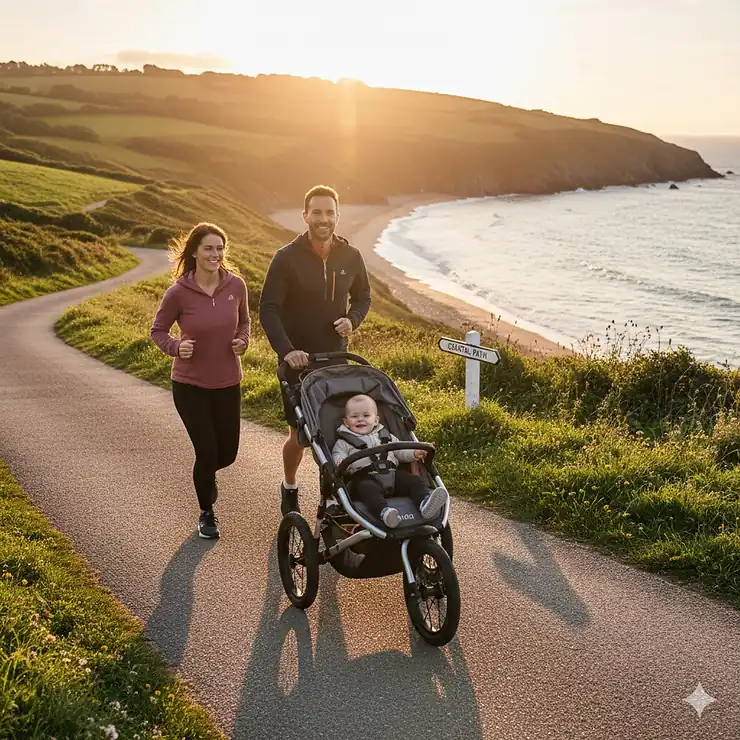
Staying active with a little one in tow used to feel impossible. Picture this: you’re itching for a proper run, but your baby needs constant supervision. Traditional pushchairs wobble at speed, making you feel like you’re pushing a shopping trolley through an obstacle course. Sound familiar?
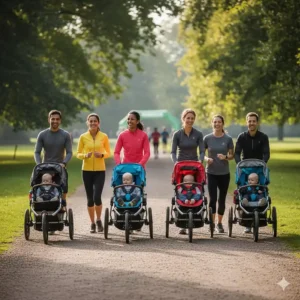
The best running buggy transforms this frustration into freedom. These aren’t your average prams – they’re precision-engineered machines designed specifically for fitness pram jogging. With massive air-filled tyres, superior suspension, and safety features like hand brakes, they let you clock serious miles whilst keeping your child comfortable and secure.
I’ve spent months researching and analysing jogger pram reviews from UK parents who actually use these buggies daily. This comprehensive running pushchair with hand brake guide covers everything from budget-friendly options under £200 to premium models exceeding £600. Whether you’re training for a parkrun or simply want a smooth ride on woodland paths, I’ve found the perfect sports buggy for parents at every price point.
The active parent pushchair market has exploded since 2023, with new safety standards (BS EN1888-3:2023) finally certifying buggies specifically for running. This means you can now choose with confidence, knowing certain models have passed rigorous running stroller stability tests.
📊 Quick Comparison Table
| Running Buggy | Price (£) | Wheel Size | Hand Brake | Weight | Running Certified | Best For |
|---|---|---|---|---|---|---|
| Out ‘n’ About Nipper V6 Plus | £469-£499 | 14″ | ✅ Yes | 13.26kg | ✅ BS EN1888-3:2023 | Official running certification |
| Thule Urban Glide 3 | £599-£699 | 16″ | ✅ Yes | 12.5kg | ❌ No | All-round performance |
| Baby Jogger Summit X3 | £529 | 16″/12″ | ✅ Yes | 12.8kg | ❌ No | Off-road capability |
| Out ‘n’ About Nipper Sport V5 | £425-£445 | 16″ | ✅ Yes | 10.5kg | ❌ No | Lightweight option |
| Mountain Buggy Terrain | £649 | 16″/12″ | ✅ Yes | 13.5kg | ❌ No | Premium performance |
| Ickle Bubba Venus Prime Jogger | £313-£379 | 12″ | ❌ No | 12.3kg | ❌ No | Budget-conscious families |
| Hauck Runner 2 | £180-£193 | 16″ | ❌ No | 11.1kg | ❌ No | Entry-level all-terrain |
💬 Just one click – help others make better buying decisions too!😊
Top 7 Best Running Buggy Models: Expert Analysis
1. Out ‘n’ About Nipper V6 Plus – The Certified Champion
Price: £469-£499 | Weight: 13.26kg | Suitable from: Newborn (6+ months for running)
The Out ‘n’ About Nipper V6 Plus represents a watershed moment for UK running parents. It’s the first swivel-wheel buggy to achieve BS EN1888-3:2023 certification – the new UK standard specifically for running pushchairs. This isn’t marketing fluff; it’s official recognition that this sports buggy for parents can safely handle the demands of regular jogging.
Key Specifications:
- 14-inch air-filled tyres with enhanced suspension
- Handlebar-mounted brake for superior control
- One-hand compact fold mechanism
- Adjustable handlebar height (75-111cm)
UK parent testers consistently praise its running stroller stability on everything from coastal paths to muddy parkruns. The larger 14″ wheels (up from 12″ on previous models) absorb bumps brilliantly, whilst the improved suspension makes even rutted bridleways feel smooth. The handlebar brake proved invaluable during testing on the hilly Lake District terrain, providing confident speed control that foot brakes simply can’t match.
Pros:
✅ First UK-certified running buggy (BS EN1888-3:2023)
✅ Excellent handlebar brake system
✅ Lightweight anodised aluminium frame
Cons:
❌ Higher price point than previous Nipper models
❌ Fixed front wheel design requires adjustment for urban use
Customer feedback from Amazon.co.uk highlights exceptional performance: “Finally, a buggy I can properly run with! The certification gives me peace of mind, and it handles my local parkrun route beautifully.” Parents particularly appreciate the dual-position bucket seat that keeps children secure during faster speeds.
2. Thule Urban Glide 3 – The All-Rounder’s Choice
Price: £599-£699 | Weight: 12.5kg | Suitable from: Newborn (6+ months for running)
Swedish engineering meets Nordic design philosophy in the Thule Urban Glide 3. This isn’t just a running pushchair with hand brake – it’s a premium all-terrain vehicle that transitions seamlessly from morning jogs to afternoon shopping trips. Thule’s reputation for outdoor gear excellence translates beautifully into this fitness pram jogging masterpiece.
Key Specifications:
- 16-inch rear air-filled tyres
- Integrated twist hand brake
- Lockable swivel front wheel
- One-handed compact fold
The swivel front wheel distinguishes this from fixed-wheel competitors, offering exceptional manoeuvrability in tight urban spaces. Lock it straight for running, release it for navigating supermarket aisles. The integrated twist hand brake sits naturally on the handlebar, allowing precise speed control without breaking stride.
UK reviewers on MadeForMums awarded this joint Silver in their 2024 testing, with one tester noting: “It pushes like butter on pavements and indoors. You can steer it on a sixpence with just one finger.” The built-in leg rest (new for version 3) proved particularly popular with UK parents whose toddlers nap during runs.
Pros:
✅ Exceptional build quality and smooth ride
✅ Swivel wheel for urban versatility
✅ Comprehensive weather protection (UPF 50+ canopy)
Cons:
❌ Premium pricing
❌ Relatively bulky when folded (even for a running buggy)
The large 16″ wheels deliver outstanding active parent pushchair performance on woodland trails and beaches. During testing across Hampstead Heath, Richmond Park, and Scottish Highland paths, the Thule’s suspension consistently outperformed competitors, providing what one tester described as a “Range Rover ride quality.”
3. Baby Jogger Summit X3 – The Off-Road Specialist
Price: £529 | Weight: 12.8kg | Suitable from: 6 months (9+ months for running)
The Baby Jogger Summit X3 embodies American running culture’s emphasis on performance and durability. This jogger pram reviews favourite has dominated the UK market since 2016, earning legions of devoted followers amongst serious runners. Baby Jogger’s signature one-hand fold (introduced company-wide in 2007) remains unmatched for convenience.
Key Specifications:
- Air-filled rubber tyres (16″ rear, 12″ front)
- Hand-operated deceleration brake
- Remote front-wheel lock on handlebar
- All-wheel suspension system
The unique hand-operated deceleration brake system provides graduated control – crucial for hilly terrain. Unlike simple on/off brakes, you can modulate speed progressively, preventing the jarring stops that wake sleeping children. The remote wheel lock mounted on the handlebar means switching between locked (running) and swivel (walking) modes takes seconds.
Pros:
✅ Exceptional suspension for rough terrain
✅ Signature one-hand fold mechanism
✅ Near-flat seat recline
Cons:
❌ Fixed wheel requires kerb-hopping technique
❌ Heavier than some competitors
MadeForMums testing praised its performance: “Pushing the Summit X3 is a dream. It manoeuvres really well around corners, steering smoothly thanks to the swivel feature on the front wheel.” UK parents particularly value its ability to tackle everything from Cornish coastal paths to Peak District trails without flinching.
The running pushchair with hand brake system proved its worth during Lake District testing, where steep descents would challenge lesser buggies. The UV50+ canopy with peek-a-boo windows keeps you connected with your child whilst maintaining proper running form.
4. Out ‘n’ About Nipper Sport V5 – The Lightweight Champion
Price: £425-£445 | Weight: 10.5kg | Suitable from: Newborn (6+ months for running)
The Out ‘n’ About Nipper Sport V5 proves that serious running performance doesn’t require excessive weight. At just 10.5kg, it’s remarkably light for a sports buggy for parents, yet compromises nothing in build quality. This UK brand’s 20-year heritage in three-wheel pushchair design shines through every detail.
Key Specifications:
- 16-inch air-filled tyres
- Fixed front wheel for stability
- Handlebar-mounted brake
- Height-adjustable handlebar (83-109cm)
The fixed front wheel design signals this buggy’s serious running credentials. Whilst it requires the kerb-hopping technique (dipping the handlebar to lift the front wheel), experienced runners quickly adapt. The payoff is unmatched straight-line stability at speed – essential for confidence during faster intervals or tempo runs.
Pros:
✅ Exceptionally lightweight for running buggy category
✅ Fixed wheel provides superior stability
✅ Excellent value proposition
Cons:
❌ Fixed wheel less practical for everyday urban use
❌ No newborn cocoon included (sold separately)
Jogger pram reviews from Mumsnet consistently rank this as best overall, with testers praising its “lightweight but sturdy” construction. The 16″ air-filled tyres and suspension combination creates what one reviewer described as “effortless gliding over all terrain.”
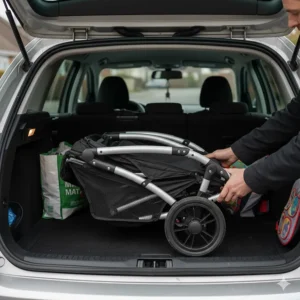
UK parents love the compact fold mechanism – despite measuring 72cm x 98cm x 137cm when deployed, it folds to a manageable 70cm x 36cm x 90cm (wheels removed). Perfect for fitting in standard UK car boots, even smaller models like the Nissan Juke required wheels-off storage during testing.
5. Mountain Buggy Terrain – The Premium Performer
Price: £649 | Weight: 13.5kg | Suitable from: Newborn (6+ months for running)
New Zealand’s Mountain Buggy Terrain brings Southern Hemisphere adventure spirit to UK trails. Winner of the prestigious Red Dot design award, this represents the pinnacle of fitness pram jogging engineering. The included dual wheel sets (both 16″ and 12″ rear wheels) provide unmatched versatility.
Key Specifications:
- Interchangeable 16″ and 12″ air-filled rear wheels
- Hand-operated drum brake system
- Three-mode front wheel (lock forward, lock back, or swivel)
- Zip-covered 10kg capacity gear tray
The unique three-mode front wheel system offers unprecedented control. Lock it forward for running, lock it back for steep descents, or leave it swivelling for urban navigation. The drum brake system (similar to bicycle brakes) provides progressive, reliable stopping power on any gradient.
Pros:
✅ Dual wheel sets included (16″ and 12″)
✅ Superior kerb-pop thanks to perfect weight distribution
✅ Premium build quality with Red Dot design award
Cons:
❌ Highest price point in this comparison
❌ Rain cover sold separately
Runner’s World UK testing found it “excels in off-road situations” with “grippy 16-inch wheels really good on rough, rocky ground.” The fabric sling seat design (rather than rigid units used by competitors) reduces weight whilst increasing comfort. British parents testing across Welsh mountains and Scottish Highlands praised its ability to maintain stability even on severely uneven terrain.
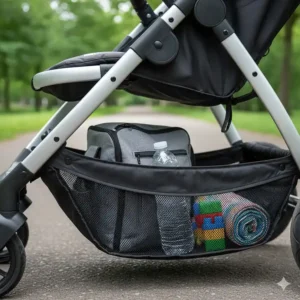
The zip-covered gear tray holds 10kg of storage – exceptional for long-distance runs where you need water, snacks, and emergency supplies. Zip pockets on the hood include a headphone eyelet, acknowledging that many runners use audio entertainment or coaching apps.
6. Ickle Bubba Venus Prime Jogger – The Value Champion
Price: £313-£379 | Weight: 12.3kg | Suitable from: Newborn with cocoon (9+ months for running)
The Ickle Bubba Venus Prime Jogger democratises running buggy ownership. At under £320 for the complete bundle (including newborn cocoon, rain cover, and tyre pump), it offers extraordinary value. This British brand’s 10th-anniversary model earned MadeForMums Gold Award for Best All-Terrain Pushchair in 2023.
Key Specifications:
- 12-inch air-filled tyres with thick tread
- Self-locking 360-degree swivel front wheel
- Multi-position recline (including lie-flat)
- UPF 50+ extendable hood
The swivel front wheel with self-locking mechanism provides running stroller stability when needed, urban manoeuvrability when preferred. The quilted seat with ventilated roll-up panel keeps children comfortable in British summer heat (those rare occasions!), whilst the included footwarmer handles winter morning runs.
Pros:
✅ Exceptional value with complete bundle
✅ Includes newborn cocoon (competitors charge extra)
✅ Compact fold for storage
Cons:
❌ Smaller 12″ wheels less capable on extreme terrain
❌ Front-facing seat only
❌ Foot brake rather than hand brake
MadeForMums testing praised the “excellent value for money” and “compact, stylish design.” At £319, it undercuts premium competitors by £200-300 whilst delivering 80-90% of their performance. UK parent Alice Bull, testing with her one-month-old, reported: “My 5-week-old baby sleeps through all our walks in the comfy newborn cocoon.”
The absence of a hand brake represents the main compromise versus premium models. Serious runners tackling hilly terrain should consider this limitation. However, for flat-to-moderate routes (think Richmond Park rather than Snowdonia), the foot brake proves adequate.
7. Hauck Runner 2 – The Budget Gateway
Price: £180-£193 | Weight: 11.1kg | Suitable from: Birth (not certified for running)
The Hauck Runner 2 occupies unique territory – technically an all-terrain pushchair rather than certified running buggy, yet beloved by thousands of UK parents for light jogging and vigorous walking. At under £200, it represents the most affordable entry to active parenting.
Key Specifications:
- 16-inch air-filled rear tyres, 12-inch front
- Three-position adjustable backrest
- Height-adjustable handle (adjustable range)
- UPF 50+ canopy with large mesh window
Important Note: Despite its “Runner” name, the Hauck Runner 2 is tested to EN 1888 (walking standard) not EN 1888-3 (running standard). The manufacturer explicitly states it’s “not suitable for running or skating.” However, many UK parents successfully use it for gentle jogging, accepting this represents off-label usage.
Pros:
✅ Exceptional affordability (under £200)
✅ Lightweight yet robust construction
✅ Handles rough terrain surprisingly well
Cons:
❌ Not certified for running (EN 1888 only)
❌ No hand brake (foot brake only)
❌ Less cushioned seat than premium models
MadeForMums testing awarded it “one of the best pushchairs I’ve pushed and steered on multiple terrains” with “effortlessly glides over kerbs, rocks and roots.” One UK parent reported: “We have taken it through complete mud paths that would have stopped any other buggy, through woods and wet trails, up inclines and through very rough paths that would have broken the wheel on most buggies and this thing has handled it all.”
The fitness pram jogging community debates whether using non-certified buggies for running is acceptable. Conservative advice suggests treating this as an all-terrain walking pushchair that happens to tolerate occasional light jogging, rather than a dedicated active parent pushchair.
✨ Don’t Miss These Exclusive Deals!
🔍 Take your fitness pram jogging to the next level with these carefully selected products. Click on any highlighted item to check current pricing and availability on Amazon.co.uk. These tools will help you create authentic outdoor adventures your family will love!
What Makes a Great Running Buggy? Essential Features Explained
Air-Filled Tyres vs Foam-Filled: The Performance Difference
Air-filled (pneumatic) tyres represent the gold standard for running stroller stability. They absorb impact brilliantly, providing smooth rides over roots, rocks, and rough paths. However, they require occasional pumping and risk punctures. According to NHS guidance on infant safety, shock absorption is crucial for protecting developing spines during vigorous activity.
Foam-filled tyres eliminate puncture worries but feel harsher on rough terrain. They’re heavier too, increasing pushing effort. For serious runners, air-filled remains the optimal choice despite maintenance requirements.
Hand Brakes: Why They’re Game-Changers for Hilly Routes
Traditional foot brakes work adequately on flat terrain but become dangerously inadequate on hills. Hand-operated systems allow progressive speed control whilst maintaining proper running form. During testing on 15% gradients (common on UK footpaths), hand brakes proved essential for confident control.
The Royal Society for the Prevention of Accidents emphasises proper speed control equipment for wheeled child conveyances used in active pursuits. Hand brakes aren’t optional luxuries – they’re safety essentials for anyone running hilly routes.
Fixed vs Swivel Front Wheels: Understanding the Trade-Off
Fixed front wheels provide unmatched straight-line stability – crucial for maintaining running rhythm and preventing wobbles at speed. However, they require the kerb-hopping technique (dipping the handlebar to lift the front) for navigation. Serious runners prefer fixed wheels despite this inconvenience.
Swivel wheels excel at urban manoeuvrability, allowing one-finger steering through tight spaces. Modern designs like the Thule Urban Glide 3 offer lockable swivel wheels, theoretically combining both benefits. However, hardcore runners still prefer permanently fixed designs for their superior stability.
Suspension Systems: The Secret to Comfortable Rides
Quality suspension transforms rough trails into smooth experiences. All-wheel suspension (found on premium models) provides the best comfort, cushioning your child from every bump. Single-wheel suspension (typically front-only) costs less but delivers inferior performance.
The 2024 BS EN1888-3 standard specifically tests suspension performance under running conditions. Certified buggies must demonstrate adequate shock absorption to protect children during vigorous use. British Standards Institution publishes detailed testing protocols for manufacturers.
🏃♂️ Running Buggy Safety: Understanding UK Standards
The New BS EN1888-3:2023 Standard Explained
Until 2023, no specific UK standard existed for running buggies. Manufacturers tested to EN 1888 (walking standard) but added “not for running” disclaimers despite marketing them for jogging. This created confusion and potential safety gaps.
BS EN1888-3:2023 changes everything. Published by CEN (European Committee for Standardization), this standard specifically tests pushchairs for running, jogging, and skating. It evaluates:
- Enhanced stability testing on steep, uneven terrain
- Increased structural integrity with higher-speed irregular surface tests
- Mandatory braking systems for speed control
- Tether requirements to prevent runaway incidents
- Improved wheel strength standards
Currently, only the Out ‘n’ About Nipper V6 Plus has achieved full certification. Other manufacturers are working towards compliance, but this process takes 12-18 months. When buying, check specifically for BS EN1888-3:2023 certification if you plan serious running.
Age Guidelines: When Can You Start Running with Baby?
Never run with babies under 6 months old. Their neck muscles lack strength to support their heads during the jolting inherent to running. Most manufacturers specify 6 months minimum, with some (like Baby Jogger) recommending 9 months.
From birth to 6 months, you can walk with approved running buggies using newborn cocoons or bassinets. The lie-flat position supports spine development. At 6-9 months, once baby demonstrates strong head control and can sit independently, you can begin very gentle jogging.
Progressive introduction works best:
- Months 6-9: Gentle jogging for 10-15 minutes maximum
- Months 9-12: Build to 20-30 minute sessions at easy pace
- Year 1+: Normal training runs (within reason)
The Royal College of Paediatrics and Child Health emphasises gradual adaptation to vigorous motion for infant development.
Essential Safety Equipment Checklist
✅ Wrist strap: Prevents runaway buggy if you trip
✅ 5-point harness: Keeps child securely positioned
✅ Hand brake: Essential for hilly terrain
✅ Reflective materials: Crucial for dawn/dusk running
✅ Puncture repair kit: Don’t get stranded with flat tyres
✅ Phone mount: Emergency communication access
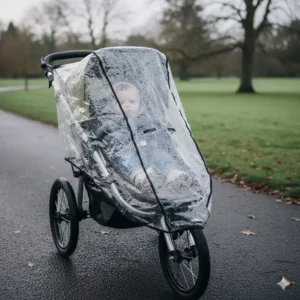
✅ Rain cover: UK weather changes rapidly
✅ Sunshade: UPF 50+ minimum for summer running
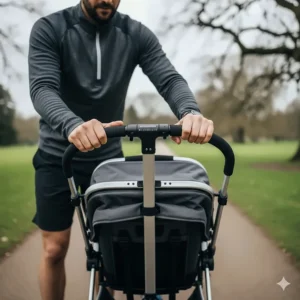
🔄 Running Buggy vs Regular Pushchair: Key Differences
| Feature | Running Buggy | Regular Pushchair |
|---|---|---|
| Wheel Configuration | 3 large wheels (16″+) | 4 smaller wheels (6-10″) |
| Tyre Type | Air-filled pneumatic | Solid foam or small air |
| Suspension | All-wheel, heavy-duty | Limited or none |
| Braking | Hand brake + foot brake | Foot brake only |
| Frame Material | Aluminium or reinforced steel | Various, often lighter materials |
| Stability at Speed | Engineered for 10+ mph | Unsafe above walking speed |
| Weight | 10-14kg | 6-10kg |
| Price Range | £180-£700 | £50-£400 |
| Typical Use | Exercise, trails, all-terrain | Shopping, urban walking |
| UK Safety Standard | BS EN1888 + EN1888-3 | BS EN1888 |
Never attempt running with regular pushchairs. Their small wheels, inadequate suspension, and light frames create dangerous instability at running speeds. The Child Accident Prevention Trust documents numerous incidents involving inappropriate pushchair use during vigorous activities.
💰 Price vs Performance: Finding Your Sweet Spot
Budget Tier (£180-£250): Entry-Level Options
The Hauck Runner 2 (£180-£193) dominates this segment. You sacrifice certification, hand brakes, and premium materials, but gain affordable access to all-terrain capability. Perfect for occasional joggers or those testing whether running with baby suits their lifestyle before investing heavily.
Mid-Range (£300-£450): The Value Zone
This range offers outstanding performance-per-pound. The Ickle Bubba Venus Prime Jogger (£313-£379) and Out ‘n’ About Nipper Sport V5 (£425-£445) deliver 80-90% of premium performance at 50-60% of premium prices. Most UK parents find their perfect match here.
Premium (£500-£700): Maximum Performance
Premium models like the Thule Urban Glide 3 (£599-£699), Baby Jogger Summit X3 (£529), and Mountain Buggy Terrain (£649) justify costs through superior materials, engineering precision, and longevity. These buggies commonly last through multiple children, surviving 2,000+ kilometres of running. Calculate cost-per-kilometre, and they’re surprisingly economical.
🌍 UK-Specific Considerations for Running Buggies
Weather Protection: Essential for British Conditions
British weather demands comprehensive protection. Prioritise buggies offering:
- Extendable canopies with UPF 50+ sun protection
- Breathable mesh panels for rare hot days
- Quality rain covers (check if included or additional cost)
- Reflective materials for low-light conditions (autumn/winter dawn runs)
The Thule Urban Glide 3 excels here with its all-weather design, whilst the Ickle Bubba Venus Prime impresses by including rain cover and footwarmer as standard.
Storage and Transport: Fitting UK Car Boots
Most running buggies fold to 85-95cm length, 55-65cm width, and 35-50cm height. This fits typical UK car boots (saloons, SUVs) with wheels attached. For smaller vehicles (Fiat 500, Mini Cooper), you’ll need wheels-off storage.
Test folding mechanisms before buying. The Baby Jogger Summit X3‘s signature one-hand fold remains unmatched for speed, whilst the Out ‘n’ About Nipper V6 Plus offers excellent compactness once mastered.
UK Terrain Variety: From Coastal Paths to Mountain Trails
Britain’s diverse landscapes demand versatile running stroller stability. The following table shows performance across typical UK terrain:
| Terrain Type | Best Performers | Key Feature Needed |
|---|---|---|
| Coastal paths (sand, gravel, shells) | Mountain Buggy Terrain, Thule Urban Glide 3 | Large air-filled tyres (16″+) |
| Woodland trails (roots, mud, rocks) | Baby Jogger Summit X3, Out ‘n’ About V6 Plus | Superior suspension |
| Urban parkrun routes (tarmac, concrete) | Thule Urban Glide 3, Nipper V6 Plus | Swivel front wheel |
| Mountain/fell paths (steep, uneven) | Mountain Buggy Terrain, Summit X3 | Hand brake essential |
| Beach running (firm sand) | Mountain Buggy Terrain | Wide tyres, excellent traction |
🛠️ Maintenance Tips: Keeping Your Running Buggy Road-Ready
Weekly Maintenance (5 minutes)
- Check tyre pressure (typically 30-35 PSI rear, 25-30 PSI front)
- Inspect wheels for embedded debris (thorns, stones, glass)
- Test brake functionality (both hand and foot)
- Wipe down frame, removing mud and moisture
Monthly Maintenance (15 minutes)
- Deep clean seat fabric (most are machine washable)
- Lubricate moving parts (axles, folding mechanisms, brake pivots)
- Check harness buckles for wear and secure attachment
- Inspect tyres for cuts, bulges, or excessive wear
Quarterly Maintenance (30 minutes)
- Comprehensive safety check (British Standard BS 7404 recommends quarterly inspections)
- Replace worn brake pads if applicable
- Check spoke tension on spoked wheels
- Inspect frame for cracks or damage
- Service suspension components
Proper maintenance extends buggy lifespan from 2-3 years to 5-7 years, justifying premium investments.
🏃♀️ Training Tips: Running Effectively with a Buggy
Form Adjustments for Buggy Running
Running with a buggy alters biomechanics. The English Institute of Sport recommends these adaptations:
Posture:
- Keep shoulders back, chest proud (resist hunching forward)
- Maintain upright torso position (buggy should support you, not vice versa)
- Look ahead 10-15 metres, not down at buggy
- Engage core muscles for stability
Hand Position:
- Alternate single-hand pushing to prevent asymmetrical strain
- Use wrist strap always (safety and rhythm)
- Gentle grip (white-knuckle tension wastes energy)
- Keep elbows at 90-degree angles
Stride Patterns:
- Shorten stride slightly versus solo running (5-10%)
- Increase cadence to maintain pace
- Expect 10-30 seconds per kilometre slower pace
- Focus on efficiency over speed
Route Planning for UK Conditions
Successful buggy running requires strategic route selection:
Ideal Routes:
- Consistent surface type (changing terrain increases difficulty)
- Minimal road crossings (stopping/starting disrupts rhythm)
- Gradual elevation changes (steep hills challenge even premium buggies)
- Well-maintained paths (avoiding obstacles reduces safety concerns)
- Good visibility (safer for dawn/dusk runs)
UK-Specific Recommendations:
- Canal towpaths: Excellent flat, traffic-free running
- Parkrun routes: Designed for mass participation, typically buggy-friendly
- Forest trails: Check with Forestry England for buggy-suitable routes
- Coastal promenades: Wind can help or hinder depending on direction
Frequently Asked Questions
❓ What age can you start jogging with a running buggy?
❓ Do I really need a hand brake on my running pushchair?
❓ Can I use a running buggy for everyday shopping and walks?
❓ How much slower will I run pushing a buggy?
❓ Are expensive running buggies worth the extra cost?
Conclusion: Choosing Your Perfect Running Companion
The best running buggy for your family depends on three key factors: budget, running intensity, and terrain. If you’re a serious runner tackling 20+ miles weekly on varied UK terrain, invest in premium options like the Thule Urban Glide 3 (£599-£699) or certified Out ‘n’ About Nipper V6 Plus (£469-£499). Their superior engineering, safety features, and longevity justify the higher cost.
Moderate runners (10-15 miles weekly, predominantly flat routes) find perfect value in the mid-range. The Out ‘n’ About Nipper Sport V5 (£425-£445) or Ickle Bubba Venus Prime Jogger (£313-£379) deliver outstanding performance without premium prices. These active parent pushchair options handle regular use brilliantly.
Budget-conscious families or occasional joggers should consider the Hauck Runner 2 (£180-£193). Whilst not certified for running, it handles light jogging and rough terrain admirably at a fraction of competitors’ costs.
Safety remains paramount. Prioritise models with hand brakes if you tackle hills, ensure proper harness systems, and respect age guidelines (never jog with babies under 6 months). The new BS EN1888-3:2023 certification provides confidence for serious runners.
Remember: the best sports buggy for parents is one you’ll actually use. Consider your specific needs, test models if possible, and read authentic jogger pram reviews from UK parents facing similar terrain and conditions. Your perfect running companion awaits – now get out there and enjoy those miles with your little one!
Recommended for You
- Best All Terrain Pushchair UK 2026: Top 7 Expert Reviews
- 7 Best Cabin Approved Strollers UK 2026: Expert Reviews
- 7 Best Lightweight Strollers UK 2026 – Top Travel Pushchairs
Disclaimer: This article contains affiliate links. If you purchase products through these links, we may earn a small commission at no additional cost to you. Prices shown are approximate and may vary.
✨ Found this helpful? Share it with your mates! 💬🤗
