
In This Article
Nobody warns you about the sheer volume of stuff. A newborn weighs about as much as a bag of sugar, yet arrives with the logistical footprint of a small touring band: vests, muslins, nappies by the crate, creams, a baffling number of hats. By week three, the changing area looks like a chemist’s after a burglary.
That’s where top rated nursery storage reviews earn their keep. Done well, they cut through the listing-speak and tell you what actually fits, what lasts and what quietly wobbles. This guide to top rated nursery storage reviews compares seven real, UK-available products using their published specs, comparison-site rankings and recognised safety guidance. It then turns all of that into a plan for your own box room.
A quick word on method, because trust matters more than hype. This article is research, not a testing diary. No product here has been used hands-on by the author, and where individual customer reviews couldn’t be verified, we say so plainly. Safety gets equal billing with style. Tall units fall under storage furniture safety standards such as EN 14749, which includes stability testing, and we’ll unpack what that means later.
What Does “Top Rated Nursery Storage Reviews” Actually Mean?
Top rated nursery storage reviews are independent, comparative assessments of the furniture, baskets, bins and organisers used to store a baby’s clothes, nappies and toys. They rank products on safety, capacity, durability and value for money. The best ones explain how a product performs in a real, cramped British nursery rather than repeating the listing.
Fair warning: “top rated” is a slippery phrase. A score tells you what the crowd thinks, not whether the product suits your 2 × 2.4 metre box room. In nursery storage 2026, the sensible direction is low, modular, flexible pieces that survive the leap from newborn to toddler. That’s the lens used throughout.
Top Rated Nursery Storage Reviews at a Glance: Quick Comparison
| Product | Storage type | Standout spec | Best for |
|---|---|---|---|
| Fortella Nappy Caddy Organiser | Rolling 3-tier trolley with bag | Wheels, three tiers | Changing-time essentials in several rooms |
| Lestarain 3-Tier Storage Unit | Low shelving + 6 boxes | 63 × 30 × 60 cm frame | Toys and clothes in small rooms |
| ULG 5-Tier Over Door Organiser | Hanging pockets | 5 large + 10 mesh pockets | Zero-footprint storage |
| Vtopmart 12 Pack Drawer Organiser | Foldable fabric dividers | 3 sizes, 4.5 in deep | Tiny clothes in drawers |
| LIVIVO 4 Tier Kids Bookshelf | Sling bookcase | Front-facing sling shelves | Books on display for toddlers |
| TidyTrove 23L Storage Boxes | Lidded, wheeled 4-tier boxes | 23L per box, visible contents | Bulk nappies and spare sizes |
| mirolam Teddy Hammock | Hanging macramé net | About 104 × 104 × 140 cm | Soft toys off the floor |
Looking at the comparison above, the Fortella Nappy Caddy Organiser and Lestarain 3-Tier Storage Unit cover the broadest ground for first-time parents. The ULG 5-Tier Over Door Organiser wins when floor space is the scarce resource. Budget buyers should note that the mirolam Teddy Hammock and Vtopmart 12 Pack Drawer Organiser solve narrower problems brilliantly, but neither replaces proper shelving. The TidyTrove 23L Storage Boxes are the quiet workhorse for bulk-buy nappies.
💬 Just one click — help others make better buying decisions too!😊
Top Rated Nursery Storage Reviews: The 7 Picks, Analysed
Here’s how these seven were chosen: real, currently listed UK products covering clothes, changing-time kit, books, toys and bulk storage. Feedback summaries draw on the comparison site bestproductsreviews.co.uk, whose rankings are generated algorithmically from customer reviews. Treat them as a starting point, not gospel. Prices are indicative bands only, so check current price before buying. The picks cluster in the budget-to-mid range because accessories dominate this category. If you’re spending premium money, put it into a solid chest or changer, covered later in this guide.
1. Fortella Nappy Caddy Organiser — rolling trolley that follows you around
The headline feature is mobility. A three-tier trolley with its own bag means the 3am essentials travel with you instead of living in one stubborn corner.
The listing describes a 3-tier rolling storage trolley and bag, offered in brown and beige. Three tiers let you zone by urgency: nappies and wipes on top, creams and muslins in the middle, spare outfits below. Wheels matter more than they sound when changing happens upstairs by night and in the lounge by day. We couldn’t confirm exact dimensions or weight limits from the sources available, so check the product page against your space.
Based on the spec, this suits parents without a dedicated changing unit, or anyone juggling two floors. What most buyers overlook is that open tiers show their contents. The trolley organises; it doesn’t hide. Once your baby is crawling, park it out of reach.
On bestproductsreviews.co.uk, this was the top-ranked nursery storage item, with a 9.7 “Exceptional” score. That’s an aggregator score, not an Amazon star rating, and individual review text couldn’t be verified, so skim recent reviews yourself.
Pros:
- ✅ Moves easily between nursery and living room
- ✅ Three tiers allow sensible zoning
- ✅ Bag adds flexibility for outings
Cons:
- ❌ Open tiers show clutter at a glance
- ❌ Wheels need care around crawling babies
Price range: indicatively £25–£45 (check current price). Value verdict: strong if you change in more than one room.
2. Lestarain 3-Tier Storage Unit — compact shelves with six removable boxes
The standout is the box system. Six removable boxes mean tidy-up becomes “lift, tip, replace” rather than a shelf-by-shelf wrestling match.
The listing gives 63 × 30 × 60 cm, a white MDF frame and non-woven boxes across three tiers. That 30 cm depth is the real story. It slides beside a changing unit or under a window without eating the room. At 60 cm tall it sits low, which reduces (but doesn’t remove) tip-over risk. Because it’s MDF, look for low-formaldehyde emission claims in the product details.
Analytically, this is the sensible mid-range choice for toys, books and spare bedding in rooms where every centimetre is contested. It won’t suit a hoarder of hardbacks. Non-woven boxes are lightweight, so the heavy stuff (stacked board books, wooden blocks) belongs on the bottom tier.
On bestproductsreviews.co.uk it ranked second, scoring 9.4 “Excellent”. Again, that’s an algorithmic aggregator score and individual reviews weren’t verified, so read recent buyer feedback on assembly and box sturdiness before committing.
Pros:
- ✅ Shallow depth suits tight nurseries
- ✅ Removable boxes make tidying quick
- ✅ White finish blends with most schemes
Cons:
- ❌ MDF frame is less robust than solid wood
- ❌ Fabric-style boxes can sag when overloaded
Price range: indicatively £30–£50 (check current price). Value verdict: excellent mid-range value for compact rooms.
3. ULG 5-Tier Over Door Organiser — turns the back of a door into storage
The standout is vertical thinking. Five large pockets plus ten mesh side pockets steal storage from space you were never using.
The listing quotes a 44 lb (roughly 20 kg) capacity and a clear window for visibility. That’s generous for muslins, vests and wipes, though a lightweight door is still the weak link. Mesh pockets suit small items you’d otherwise lose: dummies, nail files, hair ties. The sensible approach is heavy items low, light items high, and a gentle hand when closing the door.
This is the pick for renters, shared rooms and the dreaded box room, where floor space is gold dust. What the spec sheet won’t tell you is door compatibility. Check thickness and clearance before you buy, because a door that won’t shut properly defeats the point. Keep anything sharp or small (scissors, nail clippers) in pockets your toddler can’t reach.
The aggregator’s summary highlights maximised vertical space, an easy-to-view window and a stable structure that resists sagging. It scored 9.3 “Excellent” and ranked third. Individual review text wasn’t verified.
Pros:
- ✅ Uses zero floor space
- ✅ Mix of large and mesh pockets
- ✅ Generous stated weight capacity
Cons:
- ❌ Door-thickness compatibility needs checking
- ❌ Small pockets invite forgotten, expired items
Price range: indicatively £10–£20 (check current price). Value verdict: arguably the best value per centimetre of any pick here.
4. Vtopmart 12 Pack Drawer Organiser — twelve foldable dividers for tiny clothes
The standout is variety. Three sizes in one pack suit everything from socks to sleepsuits.
Per the listing, you get four large squares (11 × 11 × 4.5 in, about 28 × 28 × 11 cm), four rectangles (11 × 5.5 × 4.5 in) and four small squares (5.5 × 5.5 × 4.5 in). Baby clothes are small and numerous, so dividing by type and size beats stacking. An 11 cm depth fits most standard drawers, but it won’t help if your clothes live on a wardrobe rail.
Here’s a practical angle: label each box by size (0–3 months, 3–6 months) and decluttering becomes an eyes-only job when babies outgrow things overnight. That’s a genuine time-saver and the core of decluttering a baby room without tears.
The aggregator tagged this “Value for Money” at 9.2 “Excellent”. Its summary points to neat clothing organisation, multiple sizes and easy folding. We couldn’t verify individual reviews, so check how the fabric holds shape.
Pros:
- ✅ Three sizes suit every garment type
- ✅ Folds flat when not needed
- ✅ Makes size-based sorting effortless
Cons:
- ❌ Fabric walls lose shape if overstuffed
- ❌ Needs drawers deeper than about 11 cm
Price range: indicatively £12–£22 (check current price). Value verdict: the cheapest way to make a chest of drawers feel twice the size.
5. LIVIVO 4 Tier Kids Bookshelf — front-facing sling shelves toddlers can reach
The standout is display. Sling pockets show covers rather than spines, which is how toddlers actually choose books.
The listing describes a 4-tier wooden sling book organiser in a natural finish. Front-facing storage turns reading into a self-service habit, and slings suit lightweight board books far better than a rigid shelf swallowing them. It’s also light enough to move when the room layout changes.
Here’s the catch. Any freestanding bookcase is a climbing frame in a toddler’s eyes. Fix it to the wall with straps or L-brackets, and keep heavy hardbacks out of the slings. Sagging is the sling-shelf failure mode, so don’t treat it as a general toy store.
The aggregator ranked it fifth, with a 9.1 “Excellent” score. As always, individual review text wasn’t verified, so look at reviews that mention assembly, stability and sling sag.
Pros:
- ✅ Covers on display encourage independent reading
- ✅ Lightweight and easy to reposition
- ✅ Open design keeps books visible
Cons:
- ❌ Needs wall anchoring for safety
- ❌ Heavy hardbacks may strain the slings
Price range: indicatively £30–£50 (check current price). Value verdict: good mid-range value, provided you budget for wall fixings.
6. TidyTrove 23L Storage Boxes — wheeled, lidded boxes for bulk buys
The standout is the lids. Closed boxes keep dust off spare nappies and out-of-season clothes, and clear visibility saves rummaging.
The listing describes a 4-tier set of 23L plastic boxes with lids and wheels. That suits stockpiling: multipacks of nappies, wipes and spare bedding. The wheels mean you can slide the lot out of a wardrobe or from under a bed for a restock. Check the product page for stack stability and any wheel locks, since stacked, wheeled boxes should never be a toddler’s climbing project.
This is the practical-not-pretty option. The aggregator’s summary highlights smooth wheels, visible contents and maximised storage in limited spaces. It scored 8.2 “Good”, the lowest of the ranked picks. That doesn’t mean “avoid”; it suggests a narrower sweet spot. Individual reviews weren’t verified.
Pros:
- ✅ Lids keep dust off stored items
- ✅ Wheels simplify moving and restocking
- ✅ Visible contents save rummaging
Cons:
- ❌ Utilitarian look suits cupboards, not display
- ❌ Lowest aggregator score of the ranked seven
Price range: indicatively £20–£40 (check current price). Value verdict: sensible for bulk storage, less so as nursery decor.
7. mirolam Teddy Hammock — soft toys off the floor
The standout is the corner net, which lets a menagerie live above floor level instead of underfoot.
The listing quotes 41 × 41 × 55 inches (roughly 104 × 104 × 140 cm) in cotton macramé. That’s big, so a corner of a larger room suits it better than a box room. Fix it securely, and keep it well away from the cot. Official safer sleep guidance co-written by the Department for Education and The Lullaby Trust notes that unnecessary items such as toys increase accident risk in a baby’s sleep space. A hammock of plush toys looming above the cot is exactly what to avoid.
It’s a charming extra for toddler-age rooms, less a newborn necessity. It didn’t appear in the aggregator’s ranked list, so there’s no verified review summary. Check buyer comments on fixing strength before you hang anything.
Pros:
- ✅ Frees floor space instantly
- ✅ Soft cotton look suits calm schemes
- ✅ Big capacity for a plush collection
Cons:
- ❌ Must be fixed securely, away from the cot
- ❌ Sized for larger corners, not tiny rooms
Price range: indicatively £10–£25 (check current price). Value verdict: a pleasant bonus rather than an essential.
Side-by-Side: Specs, Value and Ratings
| Product | Key spec | Indicative price | Aggregator score | Best for |
|---|---|---|---|---|
| Fortella Nappy Caddy Organiser | 3 tiers, rolling, bag | £25–£45 | 9.7 | Multi-room changing |
| Lestarain 3-Tier Storage Unit | 63 × 30 × 60 cm, 6 boxes | £30–£50 | 9.4 | Small-room toys and clothes |
| ULG 5-Tier Over Door Organiser | ~20 kg, 15 pockets | £10–£20 | 9.3 | Renters, box rooms |
| Vtopmart 12 Pack Drawer Organiser | 12 dividers, 3 sizes | £12–£22 | 9.2 | Drawer order |
| LIVIVO 4 Tier Kids Bookshelf | 4 sling tiers | £30–£50 | 9.1 | Toddler reading nook |
| TidyTrove 23L Storage Boxes | 4 lidded 23L boxes, wheels | £20–£40 | 8.2 | Bulk nappies |
| mirolam Teddy Hammock | ~104 × 104 × 140 cm | £10–£25 | Not ranked | Soft toys off the floor |
On pure value, the ULG 5-Tier Over Door Organiser and Vtopmart 12 Pack Drawer Organiser punch well above their price. Spend more only where the job demands it, such as the Lestarain 3-Tier Storage Unit for room-anchoring shelves. Remember that scores come from an algorithm and prices are indicative bands, so use this table to shortlist rather than to decide.
✨ Ready to Start Sorting?
🔍 Tap any bold product name above to check current pricing and availability. Pick one problem to solve first, whether that’s the nappy station, the drawers or the toy pile, and build the rest of your nursery storage around it. Your future 3am self will thank you! 🍼
Nursery Organisation Checklist: Your Pre-Birth Setup Plan
A good nursery organisation checklist beats impulse buying every time. Work through it in this order:
- 8–6 weeks before: Measure the room, then note door widths and drawer depths. Sketch three zones: sleep, changing and play.
- 6–4 weeks before: Buy storage for the changing zone first (the Fortella Nappy Caddy Organiser or a hanging option). It’s used most.
- 4 weeks before: Assemble and anchor anything freestanding. Fix shelving to the wall before it fills with stuff.
- 2 weeks before: Wash and sort clothes into size boxes, using something like the Vtopmart 12 Pack Drawer Organiser.
- Week of the birth: Check room temperature. The Lullaby Trust’s early years safer sleep booklet and NHS-backed guidance both point to 16–20°C as ideal. Keep the cot clear of bumpers and toys.
The common first-30-days mistakes? Buying “just in case” storage before knowing what you own, and stashing wipes where you can’t reach them one-handed. Keep this nursery organisation checklist taped inside a wardrobe door and revisit it monthly.

Decluttering a Baby Room: A Problem-and-Solution Guide
Decluttering a baby room is less about discipline and more about systems. These are the five problems that come up again and again.
Problem 1: Outgrown clothes pile up. Babies change size faster than parents change habits. Solution: use size-labelled dividers, and bag anything outgrown on the first Sunday of each month.
Problem 2: Floor toys everywhere. Solution: low shelves with removable boxes (the Lestarain 3-Tier Storage Unit) and corner storage like the mirolam Teddy Hammock for plush.
Problem 3: The nappy station gets chaotic. Solution: a zoned trolley (the Fortella Nappy Caddy Organiser) with the most-used item at hand height.
Problem 4: Gifts multiply. Solution: the “one in, one out” rule. Rotate toys in the TidyTrove 23L Storage Boxes to keep the room calm and playtime fresh.
Problem 5: Books vanish into drawers. Solution: face-out display in the LIVIVO 4 Tier Kids Bookshelf, anchored to the wall.
A ten-minute weekly reset beats an exhausting monthly marathon. Treat decluttering a baby room as maintenance, not a project.
Real-World Scenarios: Three Nurseries, Three Budgets
Scenario 1: The rented flat with a box room. Budget: about £50. Frequency: daily. Skip freestanding furniture altogether. Pair the ULG 5-Tier Over Door Organiser with the Vtopmart 12 Pack Drawer Organiser, both easy to remove and no drilling required.
Scenario 2: The family with a newborn and a toddler. Budget: about £120. Frequency: constant, chaotic. The Fortella Nappy Caddy Organiser handles baby kit. Meanwhile, the Lestarain 3-Tier Storage Unit and LIVIVO 4 Tier Kids Bookshelf (both anchored) give the toddler a self-serve zone, so big-sibling tidying becomes plausible.
Scenario 3: The grandparents’ spare room. Budget: about £60. Frequency: weekend visits. The TidyTrove 23L Storage Boxes keep spare nappies and bedding dust-free between stays, and they roll away easily. A nappy caddy lives on the changing surface for the visit.
Notice the pattern: match the storage to how often you use it, not how it looks in a styled photograph. Top rated nursery storage reviews are a shortcut to that thinking, not a substitute for it.
Nursery Storage Buying Guide: How to Choose in 6 Steps
This nursery storage buying guide boils the decision down to six steps.
- Measure first. Width, depth, height and door swing. A 30 cm-deep unit can beat a “bigger” one that blocks the cot.
- Zone the room. Changing, clothes, play. Buy for the busiest zone first.
- Prioritise safety. Freestanding tall units must be anchorable. Check for stability testing information (see our safety section).
- Think five years ahead. Pieces that become toddler or playroom storage are better value than newborn-only kit.
- Check materials. For MDF or chipboard, look for low-emission claims. For fabric, check it’s washable.
- Read recent reviews, not just scores. Look for comments on assembly, wall fixings and long-term wear.
A good nursery storage buying guide also says what not to do: don’t buy the full matching set before the baby arrives. You’ll learn what you need in the first fortnight, and nursery storage 2026 offers plenty of flexible, mix-and-match pieces. Premium-minded buyers can invest in a solid-wood chest or combination changing unit, then use the accessories above to organise inside it.
Storage Furniture Safety Standards: What the Labels Actually Mean
Storage furniture safety standards sound dry until you picture a wardrobe leaning on a toddler. The key reference is EN 14749, adopted in the UK as BS EN 14749:2016+A1:2022. It covers safety requirements and test methods for domestic storage units, free-standing and wall-hung, including stability testing.
Know its limits. It excludes non-domestic storage and units covered by toy-safety standards. It also doesn’t cover the building itself, so the strength of your wall and fixings is on you. Most soft goods (hanging organisers, fabric bins) aren’t “furniture” in this sense, so there’s no equivalent stability test. For those, general product safety law applies, and the safe approach is to check the seller’s safety information.
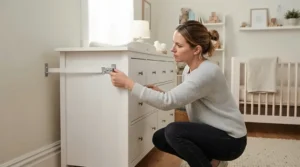
Practical steps? Ask suppliers whether a unit is tested to EN 14749. Secure large furniture with straps or L-brackets, as RoSPA-backed guidance on securing furniture recommends. Fit drawer stops, and keep heavy items low. Following storage furniture safety standards is the baseline; anchoring is the finishing touch.
Highest Rated Baby Room Organisers: How to Read the Ratings
“Highest rated baby room organisers” is a promise, not a guarantee. Ratings come from different places: star averages on retail pages, editorial rankings and algorithmic scores like those used above. Each answers a slightly different question.
A few reading habits help. A 4.5-star average from thousands of reviews tells you more than 5.0 from twelve. Look for recurring themes (sagging, wobble, missing screws) rather than single rants. Be wary of sellers who bundle reviews across product variants. And remember that review scores rarely test safety. They tell you about satisfaction, not about stability.
That’s why this guide pairs scores with specs and safety context. The highest rated baby room organisers are typically soft, simple and cheap, which is fine, but top-scoring doesn’t automatically mean top-suited. Use the highest rated baby room organisers as a shortlist, then test them against your room, your budget and your habits.

Nursery Storage vs Standard Furniture: Benefits Compared
| Option | Main benefit | Main drawback | Best for |
|---|---|---|---|
| Soft organisers | Cheap, flexible, removable | No stability certification as furniture | Vtopmart 12 Pack Drawer Organiser, ULG 5-Tier Over Door Organiser |
| Low shelving units | Toddler-friendly, grows with child | Needs anchoring | Lestarain 3-Tier Storage Unit, LIVIVO 4 Tier Kids Bookshelf |
| Solid chest or changer | Durable, long-lasting | Higher cost, heavy | Families wanting a 10-year piece |
| Wheeled caddies/boxes | Mobile, quick restocking | Need supervision around crawlers | Fortella Nappy Caddy Organiser, TidyTrove 23L Storage Boxes |
Reading this table, soft and wheeled options give the best flexibility per pound, while a solid chest wins on longevity. The sweet spot for many families is one sturdy anchored piece plus two or three flexible organisers. That combination handles the newborn phase, the toddler explosion and everything in between.
Long-Term Cost & Maintenance: Nursery Storage 2026 Value
Cost-per-use is the honest metric. A £15 organiser used daily for three years costs pennies per day, while a £150 unit used for ten years is cheaper still. Nursery storage 2026 trends favour pieces that convert: a changing-time trolley becomes a craft caddy, and a bookcase becomes a toddler’s shelf.
Maintenance is mostly wiping and washing. Wipe plastics and boxes with a damp cloth. Machine-wash fabric items where the label allows. Re-check wall fixings every few months, since walls and screws loosen over time. Re-tighten anything that wobbles. Rotate boxes so nothing gets left to rot at the bottom.
Resale is a bonus. Sturdy shelving often sells on locally, and soft goods can be donated. In total cost terms, nursery storage 2026 is best bought in stages: essentials first, extras once you know what clutter really looks like.
Features That Actually Matter (And Those That Don’t)
Matter: shallow depth for small rooms, wipe-clean surfaces, stable bases, removable boxes, wall-fixing options and clear labelling space. These solve daily friction.
Don’t matter (much): themed prints that will date within a year, “set of 12” bragging rights you won’t use, and decorative extras that collect dust. Colour palettes are cheap to change; shelving depth isn’t.
One more filter: does it help at 3am? If a feature doesn’t make a one-handed, half-asleep task easier, it’s decoration. Spend your attention accordingly.
Common Mistakes When Buying Nursery Storage
- Buying everything pre-birth. You’ll learn what you need in two weeks. Keep receipts and stay flexible.
- Ignoring depth. A shelf that’s too deep steals walkable floor.
- Skipping the anchor. The most common and most avoidable safety slip.
- Overloading fabric. Soft boxes and slings sag; heavy items belong low.
- Forgetting the cot rule. Nothing soft hanging over or inside the sleep space.
- Trusting scores blindly. Check reviews for the faults that matter to you.
Avoid these, and most of the regret evaporates.
FAQ
❓ What are the highest rated baby room organisers for a tiny nursery?
❓ How much nursery storage do I need before the baby arrives?
❓ Does a low nursery shelf still need anchoring to the wall?
❓ How often is decluttering a baby room necessary?
❓ Is a nursery organisation checklist worth following in a box room?
Conclusion
Good nursery storage isn’t about matching baskets. It’s about giving a sleep-deprived adult one-handed access to everything, at 3am, without a avalanche. Across these top rated nursery storage reviews, the pattern is clear. The Fortella Nappy Caddy Organiser tops the aggregator’s list for changing-time practicality. The Lestarain 3-Tier Storage Unit and LIVIVO 4 Tier Kids Bookshelf give toddlers a tidy-up habit. The ULG 5-Tier Over Door Organiser and Vtopmart 12 Pack Drawer Organiser offer outstanding value in small spaces. The TidyTrove 23L Storage Boxes and mirolam Teddy Hammock fill specialist roles.
Safety is the thread running through all of it: anchor what stands, keep the cot clear and know what storage furniture safety standards do and don’t cover. Pair that with a simple nursery organisation checklist, and the clutter stays manageable.
Recommended for You
- Toy Storage With Lid For Safety: 7 Best Picks For UK Homes (2026)
- Fabric Cube Storage Bins For Nursery: 7 Best Picks (2026)
- Stackable Nursery Storage Boxes: 7 Best Picks For UK Homes (2026)
Disclaimer: This article contains affiliate links. As an Amazon Associate, I earn from qualifying purchases. If you purchase products through these links, we may earn a small commission at no additional cost to you.
✨ Found this helpful? Share it with your friends! 💬🤗
