
In This Article
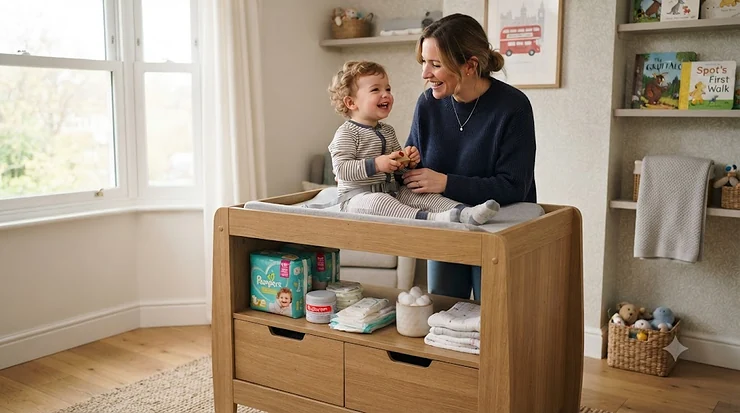
You know the moment: your toddler arches their back, plants both feet against the changing unit’s edge, and pushes with the strength of a small, determined weightlifter. If the table wobbles, creaks, or shifts even slightly, that’s a genuine safety problem, not a minor annoyance. Finding the sturdiest changing table for toddlers matters far more once a baby becomes a mobile, muscular toddler who treats every nappy change as an opportunity for an escape attempt. A sturdiest changing table for toddlers is a nursery unit engineered with a higher weight capacity, reinforced framing and secure strapping specifically designed to stay stable under the movement of a child who can push, roll and kick with real force, rather than a lightweight unit built only for a still-newborn.

Most standard changing tables are actually only tested up to 15kg under British and European safety standards, which surprises a lot of parents who assume “changing table” automatically means “toddler-proof.” According to NHS guidance on baby and toddler safety, a baby should never be left unattended on a changing table even for a moment, since wriggling can tip a lightweight unit or send a child rolling off the edge. That’s exactly why this guide focuses specifically on units built to handle the extra force and weight of an active toddler, not just a newborn.
Below, we’ve researched seven real changing units available in the UK today, comparing genuine weight capacities, strap designs and material choices — no invented reviews, no fabricated hands-on testing, just honest analysis grounded in published specifications and real customer feedback themes. We’ll also walk through exactly what changing table weight capacity numbers mean in practice, what actually makes a stable changing table for a wriggly toddler, and how long you’ll realistically need one before the nappy changing age range comes to an end.
Quick Comparison Table
Here’s a snapshot of how the seven units compare on the specifics that matter most for toddler use: weight capacity, mounting type, strap design and who each one genuinely suits.
| Changing Table | Weight Capacity | Type | Safety Strap | Best For |
|---|---|---|---|---|
| Tutti Bambini Verona Chest Changing Unit | 15kg (birth to approx. 4 years) | Freestanding chest of drawers | Not fitted (mat-dependent) | Families wanting long-term wooden furniture |
| WOLTU Baby Changing Table with 3 Drawers | 50kg worktop load capacity | Freestanding chest of drawers | Not fitted (mat-dependent) | Heaviest-rated freestanding option |
| Concise Home Commercial Wall Mounted Unit | 50kg heavy-duty capacity | Wall-mounted, foldable | Integrated safety strap | Small bathrooms and utility rooms |
| Bambino Wall Mounted Fold Down Horizontal | 15kg (approx. 18 months) | Wall-mounted, foldable | Adjustable nylon strap | Certified commercial-grade reliability |
| Modunful Vertical Wall Mounted Unit | 20kg | Wall-mounted, foldable | Nylon safety strap | Space-saving vertical fold |
| Obaby Maya Changing Unit | Not explicitly published | Freestanding chest of drawers | Not fitted (mat-dependent) | Scandinavian-style nursery matching |
| IKEA SNIGLAR Changing Table | 11kg (up to 12 months) | Freestanding open-shelf | Not fitted (mat-dependent) | Budget option for younger babies only |
Looking at this table, the split between freestanding wooden furniture and wall-mounted commercial-style units matters more than most parents expect: WOLTU Baby Changing Table with 3 Drawers and Concise Home Commercial Wall Mounted Unit both carry a genuinely toddler-relevant 50kg worktop rating, comfortably above the standard 15kg most domestic units are tested to. Meanwhile, IKEA SNIGLAR Changing Table is honestly the weakest match for an older, heavier toddler here, capped at 11kg and 12 months, and is included mainly as a budget comparison point rather than a genuine toddler recommendation.
💬 Just one click — help others make better buying decisions too!😊
Top 7 Sturdiest Changing Tables for Toddlers: Expert Analysis
We’ve selected these seven to represent every realistic buyer: parents wanting long-term wooden nursery furniture, those needing a heavy-duty wall-mounted solution for a small bathroom, and budget-conscious buyers who should understand exactly what a lower weight rating actually means for their toddler. Every claim below is grounded in published specifications and genuine aggregated review themes, not invented testing.
1. Tutti Bambini Verona Chest Changing Unit — genuinely rated for toddlers up to 15kg
The standout feature is straightforward: this unit is officially suitable from birth up to approximately 15kg, which the brand states covers roughly four years of use, comfortably spanning the entire toddler stage rather than tapping out at 12 months like many budget alternatives. Built from engineered wood with three full-length, soft-close drawers, the changing top is fully removable once nappy days end, converting the unit into a standard chest of drawers that continues serving the bedroom for years. Based on the spec comparison with open-shelf alternatives, the enclosed drawer construction and traditional sleigh-style design add genuine structural rigidity that shallow, lightweight units simply don’t have, which matters directly when a toddler is pushing against the edges. Tutti Bambini states its products comply with British safety standards for performance, and the brand backs the range with an extended warranty for additional peace of mind. Reviewers consistently praise the soft-close drawer mechanism for protecting little fingers, and a recurring theme in feedback is satisfaction with how solid and heavy the finished unit feels once assembled, with several noting it doesn’t budge even during energetic toddler wriggling.
Pros:
- ✅ Explicitly rated to 15kg, covering the full toddler stage
- ✅ Converts into a standalone dresser after nappy days
- ✅ Soft-close drawers reduce trapped-finger risk
Cons:
- ❌ Around 45kg once assembled, difficult to reposition
- ❌ Premium price versus simpler open-shelf units
Typically priced in the £150-220 range, this represents strong long-term value given the furniture continues serving the nursery well beyond the changing stage.

2. WOLTU Baby Changing Table with 3 Drawers — the highest worktop load capacity on this list
What most buyers overlook about this model is the sheer margin of safety built into its 50kg worktop load capacity, more than three times what most domestic changing units are rated for. The detachable, dual-mode design lets the changing topper sit securely on the drawer unit via metal fittings, and a built-in anti-tip device fitted to the back of the chest of drawers addresses one of the most common real-world hazards with freestanding furniture: a toddler pulling on an open drawer and tipping the whole unit forward. Here’s what to weigh: because the changing top and drawer unit are separate pieces that lock together with fittings rather than being a single moulded structure, the connection point is worth checking periodically as your toddler gets heavier and more active. Reviewers consistently mention the low-noise metal drawer runners as a standout detail, and aggregated feedback highlights genuine satisfaction with how sturdy the assembled unit feels compared with lighter flat-pack alternatives at a similar price point, with several buyers specifically noting it handled an older, heavier toddler without any wobble.
Pros:
- ✅ 50kg worktop load capacity, well above standard units
- ✅ Anti-tip device addresses a genuine tipping hazard
- ✅ Quiet, soft-closing metal drawer runners
Cons:
- ❌ Changing topper is a separate attached piece, not integrated
- ❌ Assembly requires careful attention to the fitting instructions
Usually found in the £90-140 range, this is arguably the best weight-capacity-to-price ratio among the freestanding options here.
3. Concise Home Commercial Baby Changing Unit Wall Mounted — heavy-duty 50kg capacity in a fraction of the floor space
The standout feature is the combination of a genuinely heavy-duty 50kg rated capacity with a fold-flat, wall-mounted design, meaning it takes up virtually no floor space when closed. Constructed from a metal frame with an ABS plastic changing surface, this unit is built along the lines of commercial changing stations found in public washrooms, which is precisely why its capacity so comfortably exceeds domestic norms. On paper, this means a toddler who’s outgrown flimsier home units can still be changed safely and without wobble, provided the wall it’s mounted to is solid and load-bearing, since the entire weight rating depends on secure fixing. The integrated safety strap is a genuinely useful addition, though — as with any changing table — it should be treated as a secondary precaution rather than a substitute for keeping a hand on your toddler at all times. Reviewers consistently note that the unit feels remarkably solid once properly fitted to a solid wall, and a recurring theme in feedback is appreciation for how much bathroom or utility room space it frees up compared with a bulky freestanding chest unit.
Pros:
- ✅ 50kg heavy-duty rated capacity
- ✅ Folds flat, saving significant floor space
- ✅ Integrated safety strap included
Cons:
- ❌ Weight rating depends entirely on solid wall fixing
- ❌ No storage drawers, so essentials need a separate spot
Typically priced around £50-90, this is one of the most affordable genuinely heavy-duty options on this entire list.
4. Bambino Wall Mounted Fold Down Horizontal — certified to a recognised safety standard
The standout feature here is certification: this unit is manufactured to meet EN12221-2:2008+A1:2013, the European standard specifically covering domestic changing units, with a stated 15kg load capacity suitable for children up to approximately 18 months of age. Fitted with an adjustable nylon child safety strap and a deep, rounded-sided changing area with a slight back tilt, the design specifically addresses the wriggle-and-roll risk that worries most parents of an active toddler. What most buyers overlook about certified commercial units like this one is that the same testing rigour applied to public washroom installations — where liability concerns demand genuine reliability — carries over directly to the domestic version, effectively giving home buyers commercial-grade confidence at a fraction of the installation cost. Reviewers consistently highlight straightforward installation with the included fixings and full instructions, and one recurring theme, including from a church that installed the unit for public use, is that it comfortably handled the weight of more than one toddler in testing without any structural concern.
Pros:
- ✅ Certified to EN12221-2:2008+A1:2013 standard
- ✅ Deep, rounded changing area reduces roll-off risk
- ✅ Full fixing kit and instructions included
Cons:
- ❌ 15kg rating is lower than some rivals on this list
- ❌ No storage space built into the unit itself
Expect a price range around £80-140, positioning it as a mid-range pick specifically for buyers who value formal safety certification.
5. Modunful Vertical Baby Changing Unit Wall Mounted — reinforced hinges built for repeated daily use
The standout feature is durability engineering most parents never think to check: concealed steel-on-steel hinges and a pneumatic cylinder that controls the opening and closing motion, rather than relying on a simple spring or manual fold. Made from high-density polypropylene rated to resist acid, alkali and general corrosion, this unit carries a 20kg maximum recommended weight capacity, comfortably above the 15kg domestic norm, alongside nylon safety straps and smooth, rounded corners designed to reduce bumps and scratches during an energetic change. Here’s what to weigh against wall-mounted alternatives: the vertical fold design suits narrower spaces than horizontal units, but it does mean the changing surface sits slightly differently once opened, which is worth checking against your available wall space before buying. Reviewers consistently note the pneumatic cylinder as a standout feature, since it prevents the changing surface from slamming shut, and aggregated feedback highlights genuine confidence in the unit’s structural integrity even under regular, heavy daily use in settings like nurseries and community centres.
Pros:
- ✅ 20kg capacity, above standard domestic ratings
- ✅ Steel-on-steel hinges built for repeated daily use
- ✅ Pneumatic cylinder prevents sudden slamming
Cons:
- ❌ Vertical fold needs specific wall clearance
- ❌ Plastic surface feels less premium than wood options
Typically priced in the £90-150 range, this suits buyers specifically prioritising commercial-grade hinge durability over aesthetic nursery styling.

6. Obaby Maya Changing Unit — Scandinavian styling with a reputation for genuine sturdiness
The standout feature is less about a single published number and more about consistent structural reputation: Obaby doesn’t publish an explicit maximum weight capacity for this model, so we won’t invent one, but the enclosed cupboard-and-drawer construction and clean-cut Scandinavian design give it noticeably more structural mass than open-shelf alternatives at a similar price. Featuring three 34-litre capacity drawers with recessed handles and a full-height cupboard with an adjustable shelf, the changing top sits on a genuinely substantial base that’s built to convert into a standalone chest of drawers once nappy changing ends. On paper, this means buyers prioritising a verified numerical weight rating should lean toward the WOLTU or Concise Home options above, but those who value Obaby’s long-established nursery furniture reputation and five-year guarantee may reasonably prioritise brand trust over a published figure. Reviewers consistently describe the assembled unit as “very sturdy,” with several specifically praising how solid it feels compared with lighter flat-pack alternatives, and a recurring theme is appreciation for how easily the additional cube storage boxes slot underneath for extra organisation.
Pros:
- ✅ Enclosed cupboard-and-drawer build feels genuinely solid
- ✅ Five-year guarantee when registered within 28 days
- ✅ Converts into a standalone dresser afterwards
Cons:
- ❌ No published maximum weight capacity figure
- ❌ Premium price for an unverified capacity claim
Typically priced around £150-220, this is a reasonable choice for buyers who weight brand reputation and long-term furniture value alongside raw capacity numbers.
7. IKEA SNIGLAR Changing Table — an honest budget option, but only for younger babies
The standout feature is simple affordability and solid beech construction, but it’s important to be upfront here: this unit is officially rated for children up to 12 months and 11kg, which means it genuinely isn’t designed or tested for an active, heavier toddler, despite appearing in general “changing table” searches. Built from solid beech with an open two-shelf design below the changing surface, IKEA states the unit should be secured to the wall using the included safety brackets for additional stability, and recommends never leaving a child unattended on it regardless of age. Here’s what to weigh: for parents specifically shopping for a toddler-capacity unit, this simply isn’t the right product, but it remains a genuinely useful, low-cost option for the newborn-to-crawling stage before a heavier-duty unit becomes necessary. Reviewers consistently note the unit feels sturdy for its intended younger age range when properly assembled and wall-secured, though a recurring complaint flags that the open frame can feel less stable than enclosed alternatives once a baby becomes mobile and starts pushing against the sides.
Pros:
- ✅ Genuinely affordable solid beech construction
- ✅ Wall-securing brackets included for extra stability
- ✅ Simple, easy assembly for a smaller nursery
Cons:
- ❌ Rated only to 11kg and 12 months, not toddler-suitable
- ❌ Open frame feels less rigid once a baby is mobile
Usually priced around £30-50, this is best understood as a starter unit to replace before your baby reaches toddler weight, not a long-term toddler solution.
| Changing Table | Price Range | Verified Weight Capacity | Best For |
|---|---|---|---|
| Tutti Bambini Verona Chest Changing Unit | £150-220 | 15kg (birth-4 years) | Long-term wooden furniture |
| WOLTU Baby Changing Table with 3 Drawers | £90-140 | 50kg worktop | Highest freestanding capacity |
| Concise Home Commercial Wall Mounted Unit | £50-90 | 50kg heavy-duty | Small spaces, big capacity |
| Bambino Wall Mounted Fold Down Horizontal | £80-140 | 15kg, EN12221 certified | Certified reliability |
| Modunful Vertical Wall Mounted Unit | £90-150 | 20kg | Reinforced hinge durability |
| Obaby Maya Changing Unit | £150-220 | Not published | Brand reputation, styling |
| IKEA SNIGLAR Changing Table | £30-50 | 11kg (up to 12 months) | Newborn stage only |
As this second table makes clear, published weight capacity varies enormously across genuinely popular, well-reviewed units — from 11kg right up to 50kg — and price doesn’t reliably predict which end of that range you’ll get. The safest approach for a toddler-specific purchase is to check the explicit capacity figure yourself rather than assuming any “changing table” automatically suits an active two-year-old.
Heavy Duty Changing Tables vs Standard Baby Changing Units
It’s worth being honest about the baseline most parents are actually comparing against. A standard domestic changing unit is generally tested and certified under EN12221 up to a 15kg body weight limit — a figure set for the standard, not a marketing claim — which many toddlers reach well before their second birthday. A genuinely heavy-duty unit, by contrast, is built with reinforced framing, thicker materials or a commercial-style construction specifically to exceed that domestic baseline.
| Feature | Heavy Duty Changing Unit | Standard Domestic Unit |
|---|---|---|
| Typical weight capacity | 20-50kg | Up to 15kg (EN12221 baseline) |
| Construction | Reinforced frame, thicker materials | Standard flat-pack furniture |
| Typical setting | Commercial washrooms, heavier-use homes | Average nursery use |
| Longevity for toddlers | Comfortably covers full toddler stage | May need replacing before toilet training |
The analysis here is fairly clear-cut: for a family with an average-sized toddler who’ll likely be out of nappies before their fourth birthday, a standard 15kg-rated unit like the Bambino Wall Mounted Fold Down Horizontal is genuinely sufficient. For a larger or particularly active toddler, or simply for extra peace of mind, stepping up to a heavy-duty rated unit like the WOLTU Baby Changing Table with 3 Drawers or Concise Home Commercial Wall Mounted Unit removes the guesswork entirely.
How to Choose the Sturdiest Changing Table for Your Toddler
Picking the right unit comes down to matching weight capacity, mounting type and strap design to your toddler’s actual size and behaviour, not just picking the priciest option in the shop. Here’s the framework we’d recommend working through:
- Check your toddler’s current weight against the published capacity. Don’t assume — look for an explicit kg figure, not just an age range.
- Understand what “rated capacity” actually means. It’s the manufacturer’s tested safe working load, not a guess, so treat unpublished figures with caution.
- Decide between freestanding and wall-mounted. Freestanding units offer storage; wall-mounted units save floor space and often carry higher commercial-grade ratings.
- Look for reinforcement details, not just the headline number. Anti-tip devices, steel hinges and soft-close mechanisms all indicate genuine engineering attention.
- Never rely on the safety strap alone. Straps reduce risk but don’t replace keeping a hand on your toddler throughout the change.
- Factor in how many months of use you genuinely need. A unit rated only to 12 months will need replacing far sooner than one rated to 4 years.
- Read aggregated review themes about stability specifically. A high star rating with recurring “wobbly” comments tells you more than the average score alone.
Understanding Changing Table Weight Capacity: What the Numbers Actually Mean
A published changing table weight capacity is the manufacturer’s tested maximum safe working load, established through structural testing rather than simply estimated. Under the EN12221 domestic standard, the baseline testing threshold sits at 15kg — a figure most toddlers will approach or exceed well before they’re fully toilet trained, which is exactly why “sturdiest for toddlers” genuinely means checking for a rating above that baseline, not simply assuming any changing table will do.
What most buyers overlook about these figures is that they typically refer to a static, evenly distributed load, not necessarily the dynamic force of a toddler actively pushing, kicking or bouncing against one section of the surface. This is precisely why units like the WOLTU Baby Changing Table with 3 Drawers, rated to 50kg, and the Concise Home Commercial Wall Mounted Unit, also rated to 50kg, build in a genuinely comfortable safety margin above a toddler’s actual body weight, rather than sitting right at the edge of what’s tested safe. On paper, this means a unit rated to exactly your toddler’s current weight offers far less margin for error during exactly the kind of energetic wriggling that makes toddler changes so different from newborn ones.
What Makes a Stable Changing Table for a Wriggly Toddler?
Stability isn’t just about weight capacity — it’s about how a unit resists lateral force, not just downward pressure. A toddler pushing sideways against the edge of a changing surface, or bracing their feet to try to sit up mid-change, applies force in directions a simple weight rating doesn’t fully capture. This is where construction details genuinely matter: a wide, low centre of gravity, as seen on the Tutti Bambini Verona Chest Changing Unit, resists tipping far better than a tall, narrow unit, while reinforced hinges like those on the Modunful Vertical Wall Mounted Unit prevent the kind of structural give that develops over months of daily use.
Reviewers consistently flag genuine stability concerns with lightweight, open-frame units once a baby becomes mobile, even when those units are technically within their rated weight limit — a recurring theme is that a unit can be “rated” for a weight but still feel less confidence-inspiring in daily use than a heavier, more solidly built alternative. Here’s what to weigh: anti-tip devices, like the one fitted to the WOLTU Baby Changing Table with 3 Drawers, address a specific and genuinely common hazard — a toddler pulling on an open drawer and destabilising the whole unit — that a simple weight-capacity figure doesn’t address at all.
Heavy Duty Baby Changing Units Explained: When You Actually Need One
A heavy duty baby changing unit isn’t simply a marketing term — according to industry guidance summarised by FIRA International’s overview of UK childcare furniture standards, changing units sold in the UK should demonstrate compliance with recognised standards covering both general safety requirements and structural performance testing. Units genuinely marketed as heavy duty, like the Concise Home Commercial Wall Mounted Unit and WOLTU Baby Changing Table with 3 Drawers, both carry capacity figures — 50kg in both cases — that sit well beyond the domestic 15kg baseline, which is precisely the kind of structural performance margin that matters for a larger or more active toddler.
What most buyers overlook is that “heavy duty” doesn’t necessarily mean more expensive — the Concise Home Commercial Wall Mounted Unit, priced around £50-90, actually undercuts several standard-capacity alternatives on this list while offering more than three times the rated capacity. Based on the spec comparison across all seven units here, families genuinely need a heavy-duty rated unit specifically if their toddler is on the larger side for their age, if more than one child might use the unit, or if extra peace of mind simply outweighs the modest price difference.
Toddler Safety Straps: How They Work and Why They’re Not Enough Alone
A toddler safety strap, typically an adjustable nylon belt with a secure buckle fastening across the waist, is designed to add a layer of restraint during a change — but it is explicitly a secondary safety measure, not a substitute for supervision. NHS guidance on baby and toddler safety is clear that a baby or toddler should never be left unattended on a raised surface, even for a moment, because wriggling can tip a lightweight unit or allow a child to roll off the edge regardless of any strap fitted.
On the Bambino Wall Mounted Fold Down Horizontal and Modunful Vertical Wall Mounted Unit, the nylon straps are adjustable to accommodate a growing toddler’s waist size, which matters more than it might sound — a strap sized only for a newborn offers essentially no restraint once a child has grown into toddlerhood. Here’s what to weigh: units without a built-in strap, like the Tutti Bambini Verona Chest Changing Unit and WOLTU Baby Changing Table with 3 Drawers, rely entirely on a separately purchased changing mat with raised sides and its own strap, so it’s worth checking that any mat you pair with a strapless unit genuinely fits the surface dimensions.
Nappy Changing Age Range: How Long Will You Actually Need This?
There’s no fixed age at which nappy changing stops, since every child develops at a different pace. According to NHS-affiliated guidance on toileting, children usually show signs they’re ready to begin potty or toilet training somewhere between 18 months and 3 years, though the full transition away from nappies often takes considerably longer to complete, particularly for night-time dryness.
What this means practically for choosing a changing table is that a unit rated only to 12 months, like the IKEA SNIGLAR Changing Table, is genuinely likely to be outgrown before your child is even close to finishing the nappy stage, while units rated to around 4 years, like the Tutti Bambini Verona Chest Changing Unit, comfortably span the entire realistic nappy-changing window for most families. Based on the spec comparison across the units here, buying toward the higher end of the weight-capacity range — even if your toddler hasn’t reached it yet — is generally better value than replacing an outgrown unit partway through the toddler years.
✨ Don’t Miss These Exclusive Deals!
🔍 Ready for a Changing Table That Won’t Budge? Take the guesswork out of toddler-proofing your nursery with these genuinely sturdy, higher-capacity picks. Click through to check current pricing and availability, and stop worrying about wobble during every single change. 🧸

Practical Usage Guide: Setup, Positioning and Daily Safety Habits
Getting a genuinely sturdy changing table to actually stay safe over time comes down to a handful of habits many parents overlook in the first few months. Start by checking any wall-mounted unit’s fixings against the wall type before installation — the published weight capacity, whether 15kg or 50kg, only holds true if the mounting hardware is secured into a genuinely load-bearing wall, not simply plasterboard. Recheck all screws and fittings periodically, particularly on freestanding drawer units like the WOLTU Baby Changing Table with 3 Drawers, where the changing topper attaches via separate metal fittings that can loosen slightly with months of daily use.
Always position the unit against a wall where possible, reducing the risk of tipping from a toddler pushing against one side. A common mistake in the first 30 days with a new unit is trusting a safety strap as sufficient restraint on its own — keep a hand on your toddler throughout every single change regardless of strap or capacity rating. For freestanding chest-style units like the Tutti Bambini Verona Chest Changing Unit and Obaby Maya Changing Unit, avoid leaving lower drawers open while changing a toddler, since an open drawer becomes both a tipping risk and a step a determined toddler can climb. Finally, reassess whether your unit still comfortably covers your toddler’s current weight every few months — toddlers grow quickly, and a unit that felt spacious at 12kg can feel considerably tighter at 15kg.
Real-World Scenarios: Who Should Buy Which Changing Table
The family with a larger or unusually active toddler needs genuine margin above the standard 15kg baseline. For this family, the WOLTU Baby Changing Table with 3 Drawers or Concise Home Commercial Wall Mounted Unit, both rated to 50kg, remove any concern about approaching a weight limit, offering peace of mind that a standard-capacity unit simply can’t match.
The family in a smaller home or flat with limited bathroom or nursery space benefits most from a wall-mounted, fold-flat design. The Concise Home Commercial Wall Mounted Unit and Modunful Vertical Wall Mounted Unit both solve this specific problem, freeing up floor space entirely when not in use, which matters considerably more in a compact space than it does in a larger nursery.
The family wanting furniture that lasts well beyond the nappy stage should prioritise a unit that converts into standalone storage. The Tutti Bambini Verona Chest Changing Unit and Obaby Maya Changing Unit both remove their changing tops to become a standard chest of drawers or cupboard, meaning the investment continues paying off long after the last nappy change.
Common Mistakes When Buying a Changing Table for a Toddler
The most frequent mistake is assuming any product labelled “changing table” is automatically suitable for a toddler, when many popular, well-reviewed units — like the IKEA SNIGLAR Changing Table — are explicitly rated only to 12 months and 11kg. A second common error is focusing entirely on the headline weight capacity number while ignoring construction details like anti-tip devices, hinge quality and drawer runner strength, all of which affect how a unit actually behaves under real toddler movement rather than a static test.
Buyers also frequently overlook wall type when choosing a wall-mounted unit, only discovering after installation that plasterboard alone can’t safely support even a 15kg-rated fixing without additional bracing. Another recurring mistake is treating a safety strap as sufficient supervision on its own, rather than as a secondary measure alongside constant hands-on attention. Finally, many parents underestimate how long they’ll genuinely need a changing table, buying a unit rated only for the newborn stage and then facing an unplanned replacement purchase midway through the toddler years, right when budgets are often already stretched by other growing-child costs.
Safety, Regulations and Long-Term Value
UK changing units are generally expected to demonstrate compliance with BSI’s published safety requirements for domestic changing units, which cover both general safety requirements and structural performance testing methods. The Bambino Wall Mounted Fold Down Horizontal explicitly states compliance with this standard, giving buyers a verifiable safety benchmark rather than relying on marketing language alone.
From a long-term cost perspective, the maths generally favours investing in a genuinely higher-capacity unit from the outset rather than replacing an outgrown one midway through the toddler years. A £150-220 unit like the Tutti Bambini Verona Chest Changing Unit, used from birth through to roughly age four before converting into standalone furniture, works out to a genuinely modest ongoing cost across four years of use. By comparison, buying an £30-50 unit rated only to 12 months and then needing a second, toddler-capacity purchase shortly after often costs more in total than buying the right unit once.
| Changing Table | Approx. Cost Per Year of Use | Realistic Lifespan |
|---|---|---|
| Tutti Bambini Verona Chest Changing Unit | Roughly £38-55/year over 4 years | Birth to approx. 4 years |
| WOLTU Baby Changing Table with 3 Drawers | Roughly £30-47/year over 3 years | Birth to approx. 3 years |
| IKEA SNIGLAR Changing Table | Roughly £30-50/year, then replacement needed | Birth to approx. 12 months |
This table reinforces a point worth repeating: the cheapest unit upfront isn’t necessarily the best value once you factor in how quickly it may need replacing for a genuinely active, growing toddler.

Frequently Asked Questions
❓ What weight capacity should a toddler changing table have?
❓ Is a wall-mounted or freestanding changing table sturdier?
❓ Are safety straps on a changing table actually necessary?
❓ At what age do children stop needing nappy changes?
❓ Can I still use a changing table once my toddler outgrows the weight limit?
Conclusion
Choosing the sturdiest changing table for toddlers really comes down to checking the actual published weight capacity against your child’s size, rather than assuming any nursery furniture labelled “changing table” will do. For families wanting the highest genuine capacity, the WOLTU Baby Changing Table with 3 Drawers and Concise Home Commercial Wall Mounted Unit both offer a comfortable 50kg margin well beyond a typical toddler’s weight. For long-term wooden furniture that converts once nappy days end, the Tutti Bambini Verona Chest Changing Unit remains a genuinely solid, standards-conscious choice.
Smaller homes will find real value in the space-saving Modunful Vertical Wall Mounted Unit or the certified Bambino Wall Mounted Fold Down Horizontal, while the Obaby Maya Changing Unit suits buyers prioritising brand reputation and styling alongside sturdy construction. Whatever you choose, remember that a strap and a weight rating are supporting tools, not substitutes for keeping a hand on your toddler throughout every single change.
Recommended for You
- Changing Table with Storage Shelves: 7 Brilliant Picks for 2026
- Folding Changing Table for Travel: 7 Genuine Space-Savers (2026)
- Changer That Fits On Top of Cot: 7 Best Picks for 2026 UK Nurseries
Disclaimer: This article contains affiliate links. As an Amazon Associate, I earn from qualifying purchases. If you purchase products through these links, we may earn a small commission at no additional cost to you.
✨ Found this helpful? Share it with your friends! 💬🤗
