
In This Article
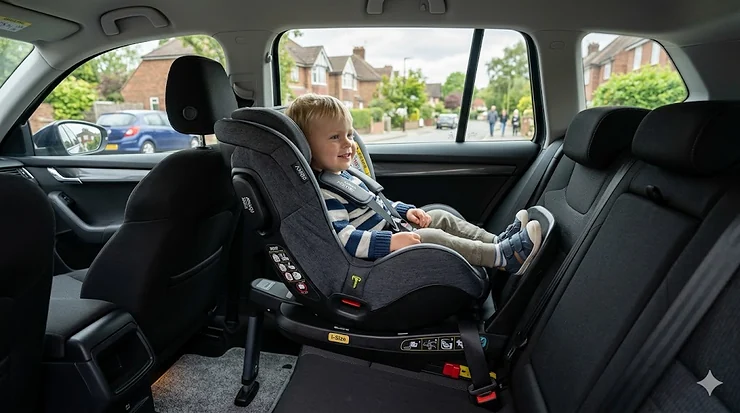
Every parent wants their child to travel as safely as possible, yet many don’t realise that an extended rear facing car seat could reduce their child’s risk of serious injury by up to five times compared to forward-facing alternatives. The numbers speak for themselves—research consistently shows that keeping children rear-facing for longer provides superior protection for their developing neck and spine.
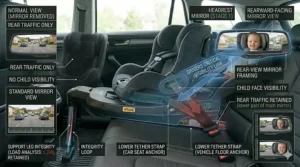
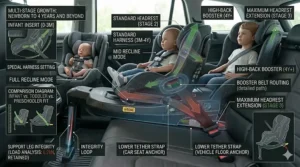
Since the introduction of the R129 (i-Size) regulation in the UK, the law now requires children to remain rear-facing until at least 15 months old. However, many safety experts and organisations recommend extending this period to 4 years or beyond. An extended rear facing car seat allows you to do precisely that, accommodating children up to 125 centimetres or even 36 kilograms in some premium models.
In this comprehensive guide, we’ll explore the 7 best options available on Amazon.co.uk in 2026, covering everything from budget-friendly choices to premium Swedish-engineered seats. Whether you’re a first-time parent or looking to upgrade your current seat, you’ll find detailed specifications, honest pros and cons, and real customer feedback from UK buyers to help you make an informed decision.
Quick Comparison Table
| Product | Price Range (£) | Max Height | Weight Limit | Swedish Plus Test | Rating |
|---|---|---|---|---|---|
| Axkid Minikid 4 Max | £380-£450 | 125cm | 36kg | ✅ Yes | ⭐⭐⭐⭐⭐ |
| BeSafe iZi Kid X3 i-Size | £350-£425 | 105cm | 18kg | ✅ Yes | ⭐⭐⭐⭐⭐ |
| Joie i-Spin 360 | £200-£260 | 105cm | 19.5kg | ❌ No | ⭐⭐⭐⭐ |
| Cybex Sirona G i-Size | £280-£340 | 105cm | 19kg | ❌ No | ⭐⭐⭐⭐½ |
| Graco Turn2Me i-Size | £140-£180 | 105cm | 18kg | ❌ No | ⭐⭐⭐⭐ |
| BeSafe iZi Twist i-Size | £380-£420 | 105cm | 18kg | ✅ Yes | ⭐⭐⭐⭐⭐ |
| Axkid Minikid 4 Pro | £320-£380 | 125cm | 36kg | ✅ Yes | ⭐⭐⭐⭐⭐ |
💬 Just one click – help others make better buying decisions too! 😊
✨ Don’t Miss These Exclusive Deals!
🔍 Take your child’s safety to the next level with these carefully selected products. Click on any highlighted item to check current pricing and availability on Amazon.co.uk. These seats will help you create authentic peace of mind your family will love!
Top 7 Extended Rear Facing Car Seats: Expert Analysis
1. Axkid Minikid 4 Max – The Premium Swedish Champion
The Axkid Minikid 4 Max represents the pinnacle of extended rear facing technology from Sweden, where keeping children rear-facing until school age has been the norm for decades. This seat earned the prestigious Swedish Plus Test certification—the world’s toughest crash test—and offers genuine extended rear facing up to approximately 7 years of age.
Key Specifications:
- Suitable: 61cm to 125cm (6 months to approx. 7 years)
- Maximum weight: 36kg
- Swedish Plus Test certified
The Axkid Minikid 4 Max features CompactFit™ design, allowing installation even in compact cars whilst providing up to 30 centimetres of legroom for your child. Installation takes under 60 seconds thanks to auto-retracting tethers and a simple 6-step process. The dynamic headrest technology automatically adjusts to your child’s height, whilst magnetic harness holders keep straps out of the way during boarding.
UK parents report that whilst the seat feels substantial (it’s built to withstand crash forces up to 1,500 kilograms), the quality is immediately apparent. “Worth every penny for the extended rear-facing capability,” shared one London parent. “My 4-year-old still fits comfortably, and I have complete peace of mind knowing she’s in the safest position.”
Price Range: £380-£450
✅ Pros:
- Swedish Plus Test certified for maximum safety
- Extended use up to 125cm/36kg
- Installation in under 60 seconds
❌ Cons:
- Premium price point
- Requires more boot space than some alternatives
2. BeSafe iZi Kid X3 i-Size – Norwegian Engineering Excellence
The BeSafe iZi Kid X3 i-Size brings over 50 years of Norwegian car seat expertise to UK families. As a purely rear-facing seat, it’s passed both UN R129 (i-Size) standards and the Swedish Plus Test, achieving what BeSafe describes as a “historic” ADAC safety score that set new benchmarks in the industry.
Key Specifications:
- Suitable: 61cm to 105cm (approx. 6 months to 4 years)
- Maximum weight: 18kg
- SIP+ side impact protection
This seat introduces SIP+ (Side Impact Protection Plus), the newest generation of lateral protection that absorbs up to 20% more impact forces than previous versions. The magnetic belt assistants hold harness straps to the side, making it remarkably easy to get your child seated. UK buyers particularly appreciate the 8 individual height levels that adjust automatically when you change the headrest position.
“The iZi Kid X3 was the easiest rear-facing seat I’ve ever installed,” noted a Manchester parent. “The ISOFIX connectors click in reassuringly, and the clear installation indicators leave no doubt that it’s fitted correctly.” Another Birmingham buyer mentioned the seat’s excellent recline options help their child nap comfortably on longer motorway journeys.
Price Range: £350-£425
✅ Pros:
- Excellent ADAC safety ratings
- SIP+ technology for enhanced side protection
- Magnetic belt assistants for easy boarding
❌ Cons:
- 105cm height limit (shorter than Axkid models)
- Premium price category
3. Joie i-Spin 360 – Best Value 360° Rotation
For families seeking 360-degree rotation functionality without the premium price tag, the Joie i-Spin 360 delivers exceptional value. This R129-certified seat allows extended rear facing up to approximately 4 years whilst offering the convenience of rotating toward the door for easy access.
Key Specifications:
- Suitable: 40cm to 105cm (birth to approx. 4 years)
- Maximum weight: 19.5kg
- 360° rotation with ISOFIX base
The seat features Guard Surround Safety panels that automatically extend when your child is placed in the seat, providing enhanced protection for head, body, and hips. With 6 recline positions usable in both rear and forward-facing modes, plus Tri-Protect™ headrest with patented Intelli-Fit™ memory foam, comfort is genuinely prioritised alongside safety.
UK customer feedback highlights the seat’s versatility. “The rotation feature is brilliant for getting my toddler in and out, especially with my dodgy back,” shared a Glasgow parent. “It’s substantially cheaper than the Cybex equivalent but feels just as solid.” The misuse-proof mechanism ensures children stay rear-facing until at least 15 months (80-105cm height), aligning with UK legal requirements.
Price Range: £200-£260
✅ Pros:
- Excellent value for 360° rotation
- Suitable from birth (with newborn insert)
- Tri-Protect™ memory foam headrest
❌ Cons:
- Heavier than some alternatives (13kg)
- Standard R129 certification (not Plus Tested)
4. Cybex Sirona G i-Size – Contemporary German Design
The Cybex Sirona G i-Size combines German engineering precision with contemporary aesthetics, offering what Cybex claims is 50% higher safety levels in the rear-facing position compared to forward-facing. Part of the Modular G Family, this seat installs on the Base G with a satisfying one-click connection.
Key Specifications:
- Suitable: 61cm to 105cm (approx. 3 months to 4 years, from birth with newborn inlay)
- Maximum weight: 19kg
- Linear Side-Impact Protection (L.S.P.) System
What sets the Sirona G apart is its all-round ventilation system with specially designed 3D mesh structure that increases breathability up to six times. The 360° rotation mechanism operates smoothly with one hand, even when the seat is reclined—a feature parents consistently praise. UK buyers report the integrated L.S.P. System, which extends from the side nearest the door, provides streamlined reinforcement without compromising interior space.
“The Sirona G feels incredibly premium,” commented a Bristol parent. “The ventilation system is genuinely effective—my daughter doesn’t get sweaty even on warm days.” Another Edinburgh reviewer mentioned the magnetic harness holders make boarding significantly quicker than their previous seat.
Price Range: £280-£340 (requires separate Base G: £180-£220)
✅ Pros:
- Advanced ventilation for year-round comfort
- One-hand rotation mechanism
- Sleek, contemporary design
❌ Cons:
- Requires separate ISOFIX base purchase
- Limited legroom for taller children
5. Graco Turn2Me i-Size – Budget-Friendly Rotation Option
The Graco Turn2Me i-Size proves that 360° rotation doesn’t require premium spending. At under £180, this American brand brings R129 safety standards and rotating functionality to budget-conscious UK families without compromising on essential safety features.
Key Specifications:
- Suitable: 40cm to 105cm (birth to approx. 4 years)
- Maximum weight: 18kg
- 10 recline positions (5 rear, 5 forward)
This seat features luxury padding from headrest to buckle covers, plus built-in side ventilation to manage temperature through changing seasons. The no-rethread harness system adjusts simultaneously with the headrest as your child grows. UK parents particularly appreciate the load leg’s 12 positions with clear green/red indicators confirming correct installation.
Customer feedback reveals both strengths and limitations. “For the price, the Turn2Me offers incredible value,” shared a Cardiff parent. “The rotation works perfectly, and my baby seems comfortable.” However, some taller children found the space more limited than premium alternatives. A Leeds reviewer noted, “My 2-year-old looked quite cramped already—I don’t think we’ll get the full 4 years from it.”
Price Range: £140-£180
✅ Pros:
- Most affordable 360° rotation option
- R129 certified safety
- Luxury padding throughout
❌ Cons:
- More limited space for taller/larger children
- Minimal recline difference between positions
6. BeSafe iZi Twist i-Size – Premium Rotating Innovation
The BeSafe iZi Twist i-Size represents rotating car seat technology at its finest. Not only did it achieve the Swedish Plus Test certification and ADAC’s highest “Very Good” safety rating, but it introduces side-to-side 180° rotation that many parents find more intuitive than traditional circular rotation.
Key Specifications:
- Suitable: 61cm to 105cm (approx. 6 months to 4 years)
- Maximum weight: 18kg
- Swedish Plus Test certified
This seat features double-layer safety with built-in SIP in the shell plus additional SIP+ protection. The protective headrest incorporates BeSafe’s innovative Dynamic Force Absorber™ technology. Magnetic Belt Assistants™ make boarding effortless, whilst adjustable recline positions work even after installation—unusual flexibility in this category.
“The iZi Twist is engineering art,” enthused a Newcastle parent. “The side-to-side rotation feels more natural than spinning seats, and the safety credentials are impeccable.” UK buyers consistently mention the optical and audio installation feedback that confirms correct fitting. Fresh Black Cab and Anthracite Mesh remain the most popular colour choices among British families.
Price Range: £380-£420
✅ Pros:
- Swedish Plus Test and ADAC “Very Good” ratings
- Innovative side-to-side rotation
- Dynamic Force Absorber™ technology
❌ Cons:
- Premium pricing
- Rotation only works with ISOFIX installation
7. Axkid Minikid 4 Pro – Smart Extended Rear Facing Value
The Axkid Minikid 4 Pro delivers Swedish Plus Test certification and extended rear facing up to 125cm at a more accessible price point than the Max variant. Developed from over 15 years of Scandinavian innovation, it’s designed for parents wanting maximum safety in a seat compatible with both small and large cars.
Key Specifications:
- Suitable: 61cm to 125cm (approx. 6 months to 7 years)
- Maximum weight: 36kg
- CompactFit™ space-saving design
The Axkid Minikid 4 Pro includes ASIP (Axkid Side Impact Protection), a dedicated system mounted on the door-side that absorbs and redistributes lateral collision forces. Despite offering 125cm accommodation, the slim profile allows three seats to install side-by-side in most vehicles—impressive versatility. The 13-position headrest and 2-step recline ensure children remain comfortable throughout the extended rear-facing period.
UK customer feedback emphasises value. “We wanted Swedish Plus Test safety without the Max’s price,” explained a Southampton parent. “The Pro delivers exactly that—our 5-year-old still fits perfectly rear-facing.” The soft, breathable fabric receives consistent praise, with parents noting it remains pleasant even on longer journeys. The sturdy shell construction, tested to demanding safety standards, provides confidence that lasts years.
Price Range: £320-£380
✅ Pros:
- Swedish Plus Test certified
- Extended use to 125cm/36kg
- CompactFit™ allows three-across installation
❌ Cons:
- No rotation feature
- Slightly fewer premium features than the Max
Understanding UK Extended Rear Facing Regulations
The landscape of child car seat safety in the United Kingdom has evolved significantly with the R129 (i-Size) regulation. Unlike the older R44/04 standard that categorised seats by weight groups, R129 uses height as the primary determinant, making it considerably easier for parents to select appropriately sized seats.
The 15-Month Rear-Facing Law
Under R129 regulations, children must remain in a rear-facing position until they are at least 15 months old and 76 centimetres in height. This represents a substantial improvement over R44/04, which permitted forward-facing from just 9 kilograms (approximately 9 months old). The extended minimum reflects decades of crash data analysis showing that rear-facing travel provides superior protection for young children’s developing neck and spine.
However, 15 months is truly the bare minimum. Safety organisations across Europe, including the Royal Society for the Prevention of Accidents (RoSPA), recommend keeping children rear-facing until at least 4 years old when possible. The reasoning is straightforward: a toddler’s vertebrae are connected via cartilage rather than fully ossified bone, making their neck significantly more vulnerable to the forces experienced during collisions.
Why R129 Matters for UK Families
R129 seats must undergo rigorous side-impact testing using advanced Q-series crash test dummies with up to 32 sensors measuring forces on different body parts. This contrasts sharply with the older P-series dummies used for R44 testing, which featured just 4-6 sensors. For parents, this means greater confidence that the seat has been thoroughly evaluated for the types of collisions most likely to occur.
All R129-approved seats display a label showing a capital ‘E’ in a circle alongside ‘R129’. When shopping, verify this marking to ensure you’re getting a seat meeting current standards. Both R44/04 and R129 seats remain legal in the UK, though R44/04 is being gradually phased out across Europe.
The Science Behind Extended Rear Facing Safety
Understanding why extended rear facing car seats provide superior protection requires examining both crash dynamics and child development. The statistics are compelling: rear-facing travel reduces serious injury risk by up to 92% compared to forward-facing alternatives, according to Swedish National Road and Transport Research Institute data.
How Rear-Facing Protects Your Child
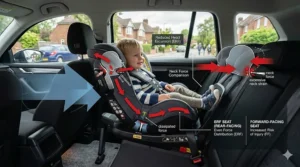
During a frontal collision—which represents approximately 60% of all crashes according to NHTSA data—a forward-facing child is thrown forward against the harness straps. This places enormous strain on the neck, which must support the head’s rapid deceleration. For a toddler whose head comprises roughly 25% of total body weight (compared to 6% in adults), these forces can be catastrophic.
In contrast, a rear-facing child is pushed back into the seat shell during frontal impact. The crash forces distribute across the entire back, cradling the head and spine rather than placing concentrated stress on the neck. This fundamental physics difference explains why rear-facing is described as “five times safer” in research literature.
Developmental Vulnerabilities
A child’s spine doesn’t fully ossify until approximately age 8. Before then, vertebrae connect via cartilage synchondroses that are slowly closing over time. Research published in the Association for the Advancement of Automotive Medicine shows:
- 50% probability that C3 vertebra closure completes at age 2-3
- 50% probability that axis closure completes at age 5-6
- 50% probability that atlas closure completes at age 7-8
Without a CT scan, there’s no way to know your specific child’s ossification progress. Extended rear facing accommodates this developmental reality, protecting children throughout the vulnerable period regardless of their individual timeline.
Key Features Comparison: What Really Matters
| Feature | Budget Options | Mid-Range | Premium |
|---|---|---|---|
| Swedish Plus Test | ❌ No | Sometimes | ✅ Yes |
| Maximum Height | 105cm | 105-125cm | 125cm |
| 360° Rotation | Sometimes | ✅ Usually | ✅ Usually |
| Side Impact Protection | Basic | Enhanced (SIP) | Advanced (SIP+) |
| Ventilation System | Standard | Good | Exceptional |
| Installation Time | 3-5 mins | 1-3 mins | <60 seconds |
| Price Range (£) | £140-£200 | £200-£350 | £350-£450 |
How to Choose the Right Extended Rear Facing Car Seat
Selecting the perfect extended rear facing car seat involves balancing safety credentials, practical features, and budget considerations. Here’s a strategic approach to making your decision:
1. Determine Your Budget and Longevity Goals
Premium Swedish Plus Tested seats like the Axkid Minikid 4 Max command £380-£450 but accommodate children to 125cm—potentially 7 years of use. Budget options like the Graco Turn2Me cost £140-£180 but typically serve until age 4. Calculate cost-per-year to understand true value: a £400 seat used for 6 years costs £67 annually, whilst a £150 seat used for 3 years costs £50 annually. The difference narrows considerably when viewed long-term.
2. Measure Your Vehicle’s Available Space
Extended rear facing seats require adequate space behind the front passenger seat. Compact cars may struggle with larger seats, though CompactFit™ technology in models like the Axkid range specifically addresses this. Before purchasing, check your vehicle’s compatibility using the manufacturer’s car list, typically available on their website. Many UK retailers offer fitting services to verify compatibility before commitment.
3. Consider Your Child’s Size and Growth Trajectory
Taller children benefit from seats with 125cm maximum height rather than 105cm variants. If your child consistently tracks above 75th percentile for height, prioritising extended capacity makes sense. Conversely, average-height children comfortably fit most seats to age 4, making premium height capacity less critical.
4. Evaluate Practical Features for Your Lifestyle
Rotation capability significantly eases getting children in and out, particularly beneficial if you have back problems or park in tight spaces. However, rotating seats typically cost £100-£200 more than non-rotating equivalents.
Installation method matters enormously. ISOFIX provides quicker, more secure fitting than seat belt installation, though some vehicles lack ISOFIX anchor points. Belt-installed seats like the Axkid range offer flexibility across multiple vehicles.
Fabric and ventilation become increasingly important for longer journeys. Premium seats incorporate breathable mesh and advanced ventilation systems that maintain comfort year-round.
5. Prioritise Safety Credentials
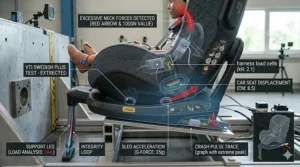
At minimum, ensure your chosen seat meets R129 standards. For maximum protection, consider Swedish Plus Test certification—the world’s most stringent car seat evaluation. Plus Tested seats undergo additional crash scenarios at higher speeds than legally required, providing enhanced confidence in real-world protection.
6. Factor in Sibling Considerations
Families planning multiple children should consider seats that accommodate three-across installation or invest in models that can transfer between vehicles easily. The Axkid Minikid 4 Pro specifically markets its slim profile for three-seat installation, whilst the lighter Joie i-Spin 360 transfers more readily between cars.
7. Research Real Customer Experiences
Amazon UK customer reviews provide invaluable insights into long-term satisfaction, installation challenges, and how seats perform with actual children rather than crash test dummies. Look particularly for reviews from UK buyers discussing British vehicles, as continental cars sometimes have different ISOFIX positioning.
Installation Tips for Extended Rear Facing Success
Proper installation dramatically affects safety effectiveness. Studies suggest 46-90% of car seats show some misuse, reducing their protective capability. Follow these strategies for optimal installation:
ISOFIX Installation Best Practices
- Locate anchor points precisely – Run your hand between seat base and backrest to find the metal anchor points. Some vehicles include small indicator markers; others require more searching.
- Push firmly until you hear clicks – ISOFIX connectors should click audibly into place. Many seats include visual indicators (green = correct, red = incorrect) to confirm proper engagement.
- Tension the seat – After connecting ISOFIX, push the seat firmly into the vehicle seat whilst tightening any tension straps or pressing the load leg into position.
- Check movement – Grasp the seat at the belt path and attempt to move it side-to-side and forward. Proper installation allows less than 2.5 centimetres of movement in any direction.
Belt Installation Guidance
Belt-installed seats like certain Axkid models require different technique:
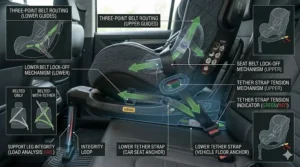
- Route the belt correctly – Follow manufacturer diagrams precisely. Belt routing varies between models, and incorrect routing compromises safety dramatically.
- Remove all slack – Pull the lap portion of the belt firmly whilst simultaneously pushing the seat into the vehicle seat. Weight from your body helps achieve tightness.
- Utilise anti-rebound features – Top tethers and anti-rebound bars prevent seat rotation during impact. Always deploy these when manufacturer instructions specify them.
- Lock the belt – Some vehicles require specific locking techniques. Consult your vehicle handbook to understand your seatbelt’s locking mechanism.
Common Installation Mistakes to Avoid
❌ Loose installation – The most frequent error. A properly installed seat shouldn’t move more than 2.5cm at the belt path.
❌ Wrong recline angle – Too upright causes head to fall forward; too reclined reduces crash protection. Use angle indicators provided.
❌ Twisted straps – Tether straps and harness straps must lie completely flat. Twists concentrate forces in narrow areas, reducing effectiveness.
❌ Incorrect harness height – Harness should route from slots at or slightly above shoulder level in rear-facing mode.
Making the Switch: From Infant Carrier to Extended Rear Facing
Transitioning from your infant carrier to an extended rear facing car seat typically occurs around 6-12 months when your baby outgrows the infant seat’s height or weight limit. Here’s how to ensure a smooth transition:
Timing the Changeover
Don’t wait until your infant carrier becomes dangerously small. Signs it’s time to switch include:
- Baby’s head reaching within 2.5cm of the carrier’s top
- Exceeding the carrier’s weight limit (typically 13kg)
- Shoulders surpassing the highest harness slots
Most convertible extended rear facing seats accommodate from 61cm height, perfect for babies around 6 months old. Seats like the Joie i-Spin 360 and Graco Turn2Me include newborn inserts allowing use from 40cm (birth), eliminating the need for a separate infant carrier entirely.
First Installation Tips
Schedule your first installation when you have adequate time and patience—rushing increases mistakes. Many UK retailers offer professional fitting services for £20-£40, money well spent for peace of mind. Alternatively, locate your nearest Child Seat Fitting Station through local council websites.
Helping Your Baby Adjust
Some babies initially protest the new seat after growing accustomed to their infant carrier. Strategies that help:
- Install the new seat several days before you plan to use it, allowing your baby to explore whilst stationary
- Transfer favourite toys from the old carrier to the new seat
- Make early journeys short and positive
- Maintain the same journey routines (songs, talking) they enjoyed in the infant carrier
Maintaining Your Extended Rear Facing Car Seat
Proper maintenance extends seat lifespan and ensures ongoing protection. Follow these guidelines:
Regular Cleaning Protocols
Most seat covers are machine washable, though always verify manufacturer instructions before washing. Remove covers monthly for washing, using gentle cycle and air drying to prevent shrinkage. Harness straps should never be submerged or machine washed—surface clean only with mild soap and damp cloth.
Hard plastic components wipe clean with baby-safe disinfectant wipes. Avoid harsh chemicals that might degrade plastic integrity. Check crevices regularly for dropped food, which attracts bacteria and creates unpleasant odours.
Safety Inspections
Every six months, conduct thorough safety checks:
- ✅ Verify all harness straps are free from fraying, cuts, or signs of wear
- ✅ Ensure ISOFIX connectors click firmly without looseness
- ✅ Check metal components for rust or corrosion
- ✅ Confirm the seat hasn’t exceeded its expiration date (typically 6-10 years from manufacture)
Post-Accident Protocols
Even minor collisions can compromise seat integrity. Most manufacturers recommend replacing seats involved in any accident, though some specify only moderate-to-severe crashes require replacement. When in doubt, contact the manufacturer directly—many offer crash replacement programmes.
Budget vs Premium: What’s the Real Difference?
The £300 price gulf between budget options like the Graco Turn2Me (£140-£180) and premium Swedish models like the Axkid Minikid 4 Max (£380-£450) begs the question: what exactly are you paying for?
Safety Testing Levels
Budget seats meet R129 legal minimums—rigorous testing ensuring adequate protection. Premium seats often add Swedish Plus Test certification, indicating they’ve passed additional crash scenarios at higher speeds than legally required. Whilst both provide substantial safety, Plus Testing offers enhanced confidence for families prioritising absolute maximum protection.
Materials and Longevity
Premium seats typically employ higher-grade materials: thicker padding, more breathable fabrics, more robust plastic compounds. These differences affect comfort and durability rather than baseline safety. A budget seat meeting R129 standards protects your child; a premium seat does so whilst potentially lasting through multiple children with less wear.
Extended Usage
The most significant practical difference often lies in maximum accommodation. Budget seats typically serve until 105cm height (approximately 4 years), whilst premium models extend to 125cm (approximately 7 years). For taller children or families wanting extended value, this capacity difference justifies premium pricing.
Installation Convenience
Premium models frequently incorporate features like auto-retracting tethers, magnetic harness holders, and one-handed recline adjustment. These conveniences don’t necessarily improve safety but substantially improve daily usability—valuable for parents installing/removing seats frequently or managing multiple children.
Honest Value Assessment
For families confident their child will outgrow a seat by age 4, budget options represent excellent value. For families with taller children, planning multiple children who’ll use the same seat, or simply wanting premium peace of mind, investment in Swedish Plus Tested premium models makes financial and safety sense long-term.
Common Myths About Extended Rear Facing Debunked
Misconceptions about extended rear facing persist despite decades of safety research. Let’s address the most common myths with evidence-based facts:
Myth 1: “My child’s legs look uncomfortable bent up”
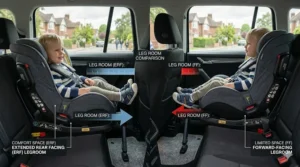
Reality: Children under 4 are remarkably flexible and comfortable sitting cross-legged, in positions adults find uncomfortable. Studies show zero increase in leg injuries for rear-facing children. In fact, forward-facing children experience more leg injuries when thrown forward in crashes and their legs strike the seat ahead.
Myth 2: “Bigger babies are strong enough for forward-facing earlier”
Reality: Physical size doesn’t correlate with spinal development. A large baby’s vertebrae ossify at the same rate as a smaller baby’s. Actually, larger babies have proportionally heavier heads, creating greater forward force during crashes—making rear-facing even more critical for protecting their developing spine.
Myth 3: “I can’t see my child rear-facing”
Reality: Whilst you can’t make direct eye contact, inexpensive rear-view baby mirrors (£10-£20 on Amazon UK) allow you to monitor your child. More importantly, the temptation to turn around and look at a forward-facing child creates dangerous driving distraction. Singing, talking, and interaction work perfectly without visual contact.
Myth 4: “Once forward-facing, they can’t go back to rear-facing”
Reality: You absolutely can reinstall a seat in rear-facing position even after using it forward-facing. Some initial protest is normal, but with distraction and consistency, children quickly adjust. If you’ve learned about extended rear facing benefits after transitioning to forward-facing, don’t hesitate to switch back.
Myth 5: “Rear-facing is only important until they meet the legal minimum”
Reality: The 15-month legal requirement represents bare minimum regulation, not optimal safety recommendation. Research consistently shows rear-facing benefits extend well beyond 15 months—ideally until 4 years or the seat’s maximum rear-facing limit. Regulations lag behind safety science.
Extended Rear Facing FAQs
❓ Will my child's legs be injured with them bent up in a rear-facing seat?
❓ When can I legally turn my child forward-facing in the UK?
❓ Are extended rear facing car seats worth the extra cost in the UK?
❓ What's the difference between Swedish Plus Test and R129 certification?
❓ Can I fit three extended rear facing car seats across the back seat?
Conclusion: Investing in Your Child’s Safety Journey
Choosing an extended rear facing car seat represents one of the most important safety decisions you’ll make as a parent. The evidence overwhelmingly demonstrates that keeping children rear-facing substantially reduces serious injury and fatality risk during the critical developmental years when their spine and neck remain vulnerable.
Whether you opt for the Swedish-engineered excellence of the Axkid Minikid 4 Max, the Norwegian innovation of the BeSafe iZi Kid X3 i-Size, or the budget-friendly practicality of the Graco Turn2Me i-Size, you’re making a conscious choice to prioritise your child’s safety beyond legal minimums.
Remember that the “best” extended rear facing car seat isn’t necessarily the most expensive—it’s the one that fits your child, fits your vehicle, fits your budget, and most importantly, that you install correctly and use consistently every single journey. A properly installed mid-range seat provides infinitely better protection than an incorrectly installed premium model.
As you make your decision, consider not just immediate price but long-term value, not just legal compliance but optimal protection, and not just convenience but comprehensive safety. Your child’s developing spine, growing year by year, deserves the protection that extended rear facing uniquely provides.
The investment you make today in an extended rear facing car seat could be the single most important safety decision of your child’s early years. Choose wisely, install correctly, and keep them rear-facing for as long as possible. Their future self—and their fully ossified, healthy spine—will thank you.
Recommended for You
- 7 Best Car Seat Base for Two Cars UK – 2026
- 7 Best 360 Rotating Car Seat Bases UK 2026 + Safety Guide
- 7 Best Isofix Base for Car Seat UK 2026
Disclaimer: This article contains affiliate links. If you purchase products through these links, we may earn a small commission at no additional cost to you. Prices shown are approximate and may vary. All extended rear facing car seats recommended have been researched for UK market availability and comply with current UK safety regulations (R129/i-Size or R44/04). Always verify current prices, specifications, and vehicle compatibility before purchasing.
✨ Found this helpful? Share it with your mates! 💬🤗
