
In This Article
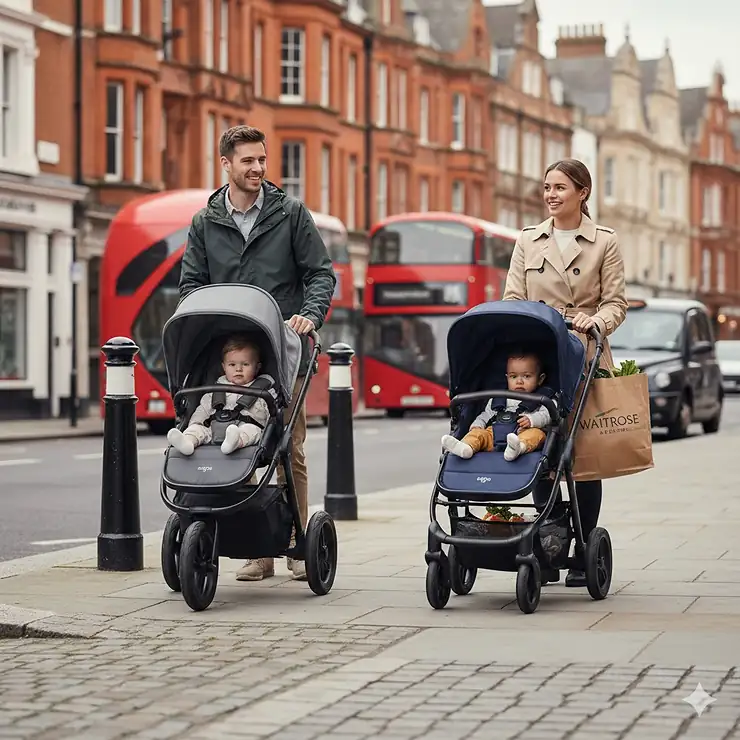
The 3 wheel vs 4 wheel pushchair debate has puzzled British parents for years, and frankly, it’s not as straightforward as counting wheels. I’ve watched countless families at my local park struggle to navigate cobbled pavements with the “wrong” pushchair, whilst others glide effortlessly over rough terrain. The truth? Your lifestyle determines which design wins.
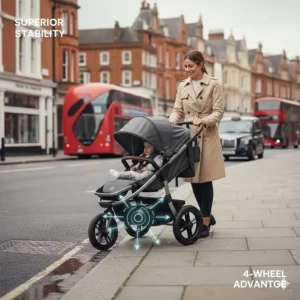
Traditional 4-wheel pushchairs dominated UK streets for decades, offering that reassuring stability grandparents recognise. But 3-wheel models have revolutionised the market since the 1980s, particularly for active families who refuse to let parenthood slow them down. Whether you’re tackling London’s crowded Tube stations or conquering Peak District trails, understanding wheel configuration comparison matters tremendously.
Recent NHS guidance emphasises safe transport for infants, making this decision even more critical. This comprehensive guide analyses real products available on Amazon.co.uk, examining three wheel pram benefits against four wheel stability. We’ll explore manoeuvrability vs stability, terrain suitability pram considerations, and ultimately help you determine which is better 3 or 4 wheel buggy for your specific circumstances.
Quick Comparison Table
| Feature | 3-Wheel Pushchair | 4-Wheel Pushchair |
|---|---|---|
| Manoeuvrability | Excellent – single front wheel pivots 360° | Good – may require two-handed steering |
| Stability | Moderate – triangular base, slight tip risk | Excellent – rectangular base distribution |
| Terrain Capability | Superior on grass, gravel, woodland paths | Best on pavements, shopping centres |
| Weight | Generally heavier (10-13kg) | Often lighter (8-11kg) |
| Jogging Suitability | Yes – designed for running with lockable wheel | No – unsafe at speed |
| Storage/Boot Space | Bulkier when folded | More compact typically |
| Price Range UK | £140-£700+ | £110-£980+ |
| Best For | Active parents, rural areas, all-terrain | Urban dwellers, public transport users |
💬 Just one click – help others make better buying decisions too! 😊
Top 7 Pushchairs: Expert Analysis
1. Ickle Bubba Venus Prime Jogger Stroller
Price: £239-£319 | Type: 3-Wheel
The Ickle Bubba Venus Prime Jogger represents outstanding value in the all-terrain category, frequently praised by UK parents on Amazon.co.uk for its robust performance without the premium price tag. This 3-wheel powerhouse features large air-filled tyres with reflective trims, rear suspension, and a self-locking front wheel that transforms it from urban stroller to jogging companion.
Key Specifications:
- Weight: 12.3kg
- Suitable from birth (with included newborn cocoon) to 22kg
- Air-filled tyres with deep tread
- Fully reclining seat with adjustable canopy
UK buyers consistently highlight its exceptional steering on bumpy football fields and woodland paths. One reviewer noted their 5-week-old happily slept through rough terrain thanks to the suspension system. The included newborn cocoon adds tremendous value, though it’s narrower than traditional carrycots.
Pros:
✅ Exceptional value for money
✅ Handles rough terrain brilliantly
✅ Includes newborn cocoon
Cons:
❌ Heavier than some competitors
❌ Cocoon can be fiddly to remove
UK Availability: Amazon.co.uk, Kiddies Kingdom, Pramworld
2. Baby Jogger City Mini GT2
Price: £377-£429 | Type: 3-Wheel
The Baby Jogger City Mini GT2 strikes that sweet spot between all-terrain capability and urban convenience. This American brand has conquered UK streets with its signature one-hand fold mechanism and forever-air tyres (foam-filled, puncture-proof). Its all-wheel suspension system absorbs pavement cracks and park bumps equally well.
Key Specifications:
- Weight: 10.3kg
- Dimensions unfolded: H112.5cm x W65cm x L105cm
- Foam-filled tyres (8.5″ rear)
- One-hand fold with auto-lock
British parents adore its compact fold despite the relatively small wheels for an all-terrain buggy. It fits most car boots without removing wheels, crucial for families with smaller vehicles like Skoda Fabias. The seat capacity of 22kg means it genuinely lasts until around age 4-5.
Pros:
✅ Genuine one-hand fold
✅ Lighter than comparable 3-wheelers
✅ Excellent build quality
Cons:
❌ More expensive than budget options
❌ Carrycot sold separately (£209+)
UK Availability: Amazon.co.uk, John Lewis, Very
3. Out’n’About Nipper V5
Price: £377.95-£425 | Type: 3-Wheel
The Out’n’About Nipper V5 has achieved cult status amongst UK outdoor enthusiasts. This British-designed pushchair features 16″ air-filled rear wheels and a lockable swivel front wheel, specifically engineered for countryside rambles. Its lightweight aluminium frame (10.8kg) makes it surprisingly manoeuvrable despite its robust construction.
Key Specifications:
- Weight: 10.8kg
- Air-filled tyres with 16″ rear wheels
- Rear-only suspension
- Compatible with major car seat brands
MadeForMums awarded it 4.8 stars, with testers praising its effortless handling over rough ground. The two-stage recline suits newborns through toddlers, whilst the height-adjustable handlebar accommodates parents from 5’2″ to 6’4″. UK buyers note it requires two hands for folding, unlike the City Mini GT2.
Pros:
✅ Excellent for rough terrain
✅ Lightweight for a 3-wheeler
✅ British brand with strong UK support
Cons:
❌ Two-hand fold required
❌ Raincover not included
UK Availability: Out’n’About official, Samuel Johnston, Amazon.co.uk
4. iCandy Peach 7
Price: £780-£979 (with carrycot) | Type: 4-Wheel
The iCandy Peach 7 represents British luxury pram heritage at its finest. This premium 4-wheel pushchair combines sophisticated engineering with elegant design, featuring soft-touch wipe-clean fabrics and a generous 44-litre storage basket. The frame weighs 8.4kg alone, with complete single mode reaching 14.2kg.
Key Specifications:
- Weight: 14.2kg (complete single mode)
- Seat capacity: 25kg
- Four recline positions
- Parent and world-facing modes
UK celebrity favourite (Victoria Beckham, Elton John), the Peach 7 excels on flat pavements and shopping centres. Its all-wheel suspension provides smoothness, though not quite matching 3-wheelers on rough terrain. The one-touch five-point harness and elevated seat positions add practical luxury. British buyers appreciate the compact fold, though it’s heavier to lift than budget alternatives.
Pros:
✅ Premium build quality
✅ Expandable to double configuration
✅ Elegant British design
Cons:
❌ Expensive compared to alternatives
❌ Heavy in double mode (17.4kg)
UK Availability: iCandy World, Mamas & Papas, Very
5. Hauck Runner
Price: £142.99-£189 | Type: 3-Wheel
The Hauck Runner democratises all-terrain pushchairs for budget-conscious UK families. This German brand delivers remarkable value with extra-large pneumatic air wheels, fully reclining backrest, and lockable swivel front wheel. At under £150, it’s the most affordable proper jogging buggy available on Amazon.co.uk.
Key Specifications:
- Suitable from birth to 22kg
- XL air-filled wheels
- Height-adjustable handlebar
- UPF 50+ canopy with mesh window
UK reviewers on Amazon.co.uk praise its “incredible quality” for the price point. One French buyer noted regonfling wheels before first use (typical for air-filled tyres), but found it handled running sessions brilliantly with her baby sleeping throughout. The fold mechanism includes a locking latch for secure storage.
Pros:
✅ Outstanding value for money
✅ Proper air-filled wheels
✅ Includes raincover
Cons:
❌ Heavier than premium models
❌ Basic fabric quality
UK Availability: Amazon.co.uk, Pramworld, independent retailers
6. Cosatto Woosh 3
Price: £175-£219 | Type: 4-Wheel
The Cosatto Woosh 3 brings British quirkiness to the budget 4-wheel category with its signature bold patterns (Unicorn Garden, Midnight Jungle, D is for Dino). This ultra-lightweight pushchair (only 6.5kg) folds one-handed and fits aircraft overhead lockers, making it brilliant for UK families who travel frequently.
Key Specifications:
- Weight: 6.5kg
- Suitable from birth to 25kg
- Ultra-compact fold
- Includes raincover and bumper bar
UK parents rave about its narrow profile for navigating crowded high streets and public transport. The from-birth lie-flat recline and extendable hood provide newborn comfort, whilst the fun designs keep toddlers engaged. However, its small wheels struggle on anything rougher than smooth pavements – definitely an urban specialist.
Pros:
✅ Extremely lightweight and compact
✅ Fun British designs
✅ Great value with accessories included
Cons:
❌ Small wheels unsuitable for rough terrain
❌ Basic suspension
UK Availability: Amazon.co.uk, Very, Littlewoods
7. iCandy Peach 7 All Terrain
Price: £1,200-£1,500+ (complete bundles) | Type: Convertible 3/4-Wheel
The iCandy Peach 7 All Terrain represents the ultimate flexibility in the 3 wheel vs 4 wheel pushchair debate by offering both configurations. This premium British pushchair includes two front wheelbases: one-wheel forks for 3-wheel off-road mode and a 2-wheel axle for 4-wheel urban configuration.
Key Specifications:
- Converts between 3-wheel and 4-wheel modes
- Suitable from birth to 25kg
- Puncture-proof multi-terrain wheels
- Water-repellent breathable fabrics
This convertible design lets you switch between maximum manoeuvrability (3-wheel) for countryside walks and enhanced stability (4-wheel) for city shopping. The reflective sporty accents and advanced suspension system deliver a smooth ride regardless of configuration. UK buyers investing in this premium option appreciate never needing to choose between wheel configurations.
Pros:
✅ Both 3-wheel and 4-wheel capability
✅ Premium British engineering
✅ Puncture-proof wheels
Cons:
❌ Significant investment required
❌ Complex compared to single-configuration models
UK Availability: iCandy World, Baby Planet Online, premium retailers
✨ Don’t Miss These Exclusive Deals!
🔍 Take your pushchair shopping to the next level with these carefully selected products. Click on any highlighted item to check current pricing and availability on Amazon.co.uk. These models will help you create authentic outdoor adventures your family will love!
Understanding Wheel Configuration Comparison
The fundamental engineering difference between 3-wheel and 4-wheel pushchairs affects every aspect of daily use. According to research from UK baby product safety organisations, weight distribution patterns determine stability characteristics and tipping risks.
Three Wheel Pram Benefits
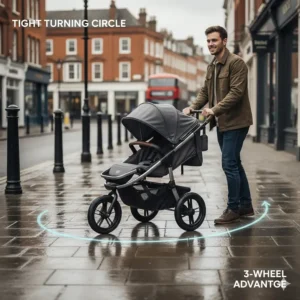
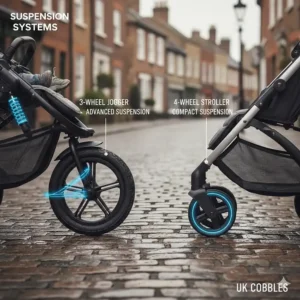
The triangular chassis design concentrates weight distribution differently than rectangular 4-wheel bases. That single front wheel – typically 10-12 inches in diameter – acts as a pivot point, allowing the entire pushchair to rotate around it with minimal effort. This explains why 3-wheelers excel at navigating tight corners in cafés or weaving between playground equipment.
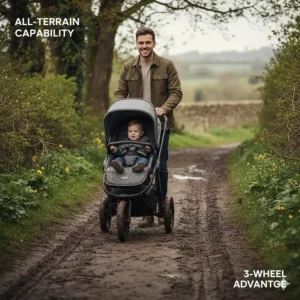
Larger wheel diameter matters tremendously for terrain capability. Most quality 3-wheel pushchairs feature 14-16 inch rear wheels, similar to bicycle tyres. These roll over obstacles like tree roots, kerbs, and potholes that would stop smaller 4-wheel models dead. The air-filled or foam-filled construction absorbs impact rather than transferring it to your baby.
Four Wheel Stability Advantages
Four-wheel pushchairs distribute weight across a rectangular base, creating inherent lateral stability. Think of it like a table versus a tripod – the four-point contact resists sideways tipping forces more effectively. This becomes crucial when hanging shopping bags on handlebars or navigating steep cambers on pavements.
The shorter wheelbase of many 4-wheel designs (front to back distance) aids manoeuvrability in confined spaces despite having more wheels. However, small plastic wheels (common on budget 4-wheelers) struggle on uneven surfaces. Premium 4-wheel models increasingly use larger, more capable wheels to bridge this gap.
Manoeuvrability vs Stability: The Core Trade-off
Every pushchair design involves compromises between agility and stability. Understanding this trade-off helps you prioritise what matters for your lifestyle.
When Manoeuvrability Wins
Active UK families living near countryside, parks, or beaches benefit enormously from 3-wheel manoeuvrability. Single-handed steering lets you hold a coffee, answer your phone, or guide an older child simultaneously. The lockable front wheel transforms the pushchair for jogging – essential for parents maintaining fitness routines.
Navigating through woodland paths, across grassy fields, or along canal towpaths becomes effortless with large-diameter wheels. British weather creates muddy, uneven surfaces for months annually; 3-wheelers handle these conditions without the “shopping trolley wobble” smaller wheels develop.
When Stability Matters Most
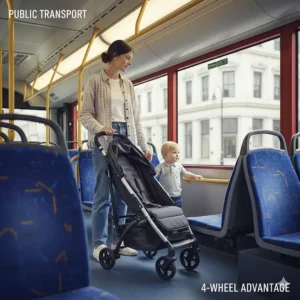
Urban families relying on public transport need stability over agility. Boarding buses, navigating Tube station gaps, and managing escalators (where permitted) demand a pushchair that won’t tip unexpectedly. The 4-wheel rectangular base provides confidence when negotiating these challenges.
Parents of twins or closely-spaced siblings often choose 4-wheel double pushchairs for their superior balance under heavy loads. The Baby Jogger City Tour 2 Double (£484) demonstrates how 4-wheel designs can be both stable and relatively narrow (66.5cm) for doorways.
Steep hills and cambers require careful consideration. Three-wheelers can tip sideways on severe slopes if turned sharply, whilst 4-wheelers resist this but may struggle with traction on loose surfaces.
Terrain Suitability Pram Considerations
British landscapes vary dramatically from Yorkshire Dales to Birmingham high streets. Your typical walking surfaces should heavily influence the 3 wheel vs 4 wheel pushchair decision.
Urban Terrain Analysis
City pavements, shopping centres, and smooth park paths suit both wheel configurations, but 4-wheelers often excel here due to:
- Compact dimensions for crowded spaces
- Lighter weight for carrying up steps (no lift buildings)
- Smaller wheels gliding smoothly on concrete
- Easier fold mechanisms for public transport
The Cosatto Woosh 3 exemplifies urban optimisation – incredibly light (6.5kg), narrow profile, one-hand fold, yet its small wheels would flounder on muddy fields.
London, Manchester, and Edinburgh parents frequently choose 4-wheel city specialists for navigating pedestrian crossings, Tube stations, and constant pavement kerbs. The stable base prevents tipping when mounting kerbs at angles.
Rural and Mixed Terrain
Countryside living or regular park visits demand 3-wheel capability. Consider these British terrain challenges:
Gravel paths: Small 4-wheel plastic wheels sink and stick; large 3-wheel pneumatic tyres roll over effortlessly
Grass fields: Wider wheelbase and larger diameter prevent bogging down in soft ground
Woodland trails: Tree roots, fallen branches, uneven surfaces require substantial suspension (typically 3-wheel territory)
Beach walking: Fat, air-filled tyres distribute weight to prevent sinking in sand
The Out’n’About Nipper V5 and UPPAbaby Ridge represent premium British choices for mixed terrain, with suspension systems specifically tuned for bumpy surfaces.
Weather Considerations
UK weather creates unique challenges. Autumn leaves make pavements slippery; winter ice demands caution; spring mud tests wheel traction. Three-wheel models with deep-tread tyres handle these conditions better, whilst 4-wheelers may require more careful route planning.
Which is Better 3 or 4 Wheel Buggy for Your Family?
This question lacks a universal answer – it depends entirely on your circumstances. Let me walk you through decision frameworks.
Lifestyle Assessment Framework
Choose 3-Wheel If:
🏃♀️ You jog or run regularly and want baby to join you
🌳 You live rurally or near parks, forests, beaches
🚶♂️ You walk on grass, gravel, dirt tracks frequently
💪 You can accommodate bulkier storage requirements
🎒 You prefer one-handed steering capability
⛰️ You tackle hills and varied terrain routinely
Choose 4-Wheel If:
🏙️ You live in a city with primarily pavement walking
🚇 You use public transport (bus, Tube, train) regularly
🏢 You navigate shopping centres and indoor spaces often
🚗 Your car boot space is limited
👶 You have twins or need a doub
le pushchair 🏠 You live in a flat without lift access
Age and Stages Consideration
Newborns require lie-flat positions and smooth rides – both wheel types can provide this with appropriate models. The Ickle Bubba Venus Prime includes a newborn cocoon, whilst the iCandy Peach 7 offers a luxury carrycot option.
Toddlers (1-4 years) benefit differently depending on activity levels. Active toddlers who walk alongside the pushchair but need occasional rides suit 3-wheelers’ all-terrain capability. Urban toddlers accustomed to pavements may prefer 4-wheel comfort.
Growing families might consider convertible options. The iCandy Peach 7 All Terrain converts between configurations, whilst the standard Peach 7 expands to double/twin mode.
Budget Reality Check
Quality 3-wheel pushchairs start around £140 (Hauck Runner) but premium models reach £700+ (UPPAbaby Ridge). Four-wheel options span an even wider range from £110 (Cosatto Woosh) to £980+ (iCandy Peach 7 with accessories).
Consider long-term value beyond initial cost. Durable 3-wheelers with air-filled tyres may require occasional inner tube replacement (£10-£20), whilst 4-wheelers with solid wheels need no maintenance but may wear faster on rough surfaces.
Safety Considerations and UK Regulations
Both 3-wheel and 4-wheel pushchairs must meet British Standard BS EN 1888:2018 covering stability, braking, and restraint systems. However, usage patterns affect safety differently.
Tipping Risk Assessment
Three-wheel pushchairs have a slightly higher lateral tipping risk due to triangular weight distribution. This primarily concerns:
- Sharp turns at speed (jogging or running)
- Uneven ground with severe camber
- Overloading handlebar with shopping bags
- Lifting front wheel to mount kerbs aggressively
Manufacturers address this through wider rear wheel spacing and lower centres of gravity. Always use wrist straps when jogging, keep shopping bags in the basket (not handlebar), and approach kerbs straight-on.
Four-wheel pushchairs resist sideways tipping but can tip backwards if the child climbs whilst another child hangs from the handlebar. Follow weight limit guidelines strictly (typically 22-25kg maximum).
Braking Systems
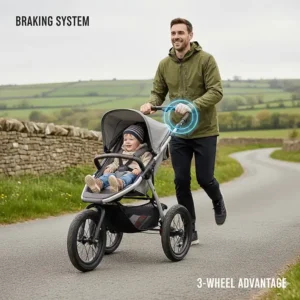
Quality 3-wheel joggers include dual braking:
- Hand brake on handlebar (deceleration control whilst running)
- Foot-operated parking brake (stationary security)
Four-wheel models typically feature linked rear-wheel parking brakes operated by one foot pedal. Test brake engagement on sloped driveways before purchasing.
Five-Point Harness Quality
Both wheel configurations should include adjustable five-point harnesses meeting British safety standards. Padded shoulder straps prevent discomfort on longer journeys. The iCandy Peach 7 features a one-touch release that’s child-resistant yet parent-friendly.
Maintenance and Longevity
Pushchair lifespan and maintenance requirements differ significantly between wheel types.
3-Wheel Maintenance
Air-Filled Tyres:
- Check pressure weekly (usually 25-30 PSI)
- Carry pump and puncture repair kit
- Replace inner tubes every 2-3 years (£10-£20 each)
- Heavier weight means more wear on moving parts
Suspension Systems:
- Inspect suspension springs annually
- Listen for squeaks indicating lubrication needs
- Premium models offer adjustable suspension settings
Estimated Lifespan: 3-5 years with proper maintenance, excellent second-hand resale value
4-Wheel Maintenance
Solid/Foam-Filled Wheels:
- Zero maintenance required
- Cannot puncture (blessing in British streets with debris)
- May wear unevenly on rough surfaces
- Lighter overall weight reduces frame stress
Fold Mechanisms:
- Clean hinges and pivots quarterly
- Lubricate moving parts to prevent stiffness
- Fabric components may fade faster (more exposure)
Estimated Lifespan: 3-4 years, moderate second-hand demand
Both types benefit from regular cleaning (especially after muddy walks), fabric protection treatments, and proper storage. British weather accelerates wear on external fabrics, so covered storage extends longevity considerably.
Storage and Transport Practicalities
How easily a pushchair folds, fits in your car, and stores at home dramatically affects daily life satisfaction.
Boot Space Requirements
3-Wheel Folded Dimensions (typical):
- Length: 90-110cm
- Width: 60-70cm
- Height: 30-45cm
- Often requires one wheel removal for smaller boots
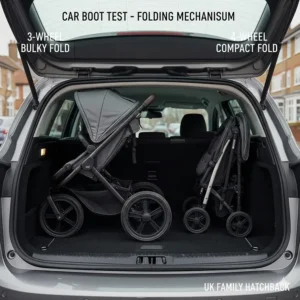
The Baby Jogger City Mini GT2 folds to 78cm x 65cm x 26.5cm – compact for a 3-wheeler but still larger than many 4-wheel alternatives.
4-Wheel Folded Dimensions (typical):
- Length: 70-90cm
- Width: 50-65cm
- Height: 25-40cm
- Usually fits without wheel removal
The ultra-compact Cosatto Woosh 3 (6.5kg, aircraft cabin size) represents the extreme end of 4-wheel portability.
One-Hand Fold Reality
Marketing claims require scrutiny. “One-hand fold” often means:
- Releasing catches with one hand
- Gravity assists the fold
- But two hands make it significantly easier
The Baby Jogger City Mini GT2 offers genuine one-hand operation – crucial when holding a child. Most 3-wheelers, including the Out’n’About Nipper V5, need both hands for secure folding.
Home Storage
Consider your available space:
Hallway storage: 4-wheel models often fit better in narrow British hallways Garage/shed: 3-wheelers tolerate outdoor storage better (robust construction) Under stairs: Measure carefully; folded height varies significantly Car boot permanent: Some families leave the pushchair in the car – consider theft security
Price Point Analysis and Value Assessment
Understanding the UK market pricing helps identify genuine value versus overpaying for brand names.
Budget Tier (£100-£250)
3-Wheel Options:
- Hauck Runner (£142.99): Best value all-terrain capability
- Limited suspension and basic fabrics
- Suitable for occasional off-road use
4-Wheel Options:
- Cosatto Woosh 3 (£175): Excellent urban lightweight
- Kinderkraft Grande Plus (£106.98): Basic but functional
- Prioritises affordability over longevity
Value Assessment: Budget 3-wheelers offer surprising capability but compromise on weight and comfort. Budget 4-wheelers excel for second children or grandparent use.
Mid-Range (£250-£500)
3-Wheel Options:
- Ickle Bubba Venus Prime (£239-£319): Outstanding value sweet spot
- Out’n’About Nipper V5 (£377.95): Premium performance, reasonable price
- Phil & Ted’s Sport (£399): Innovative New Zealand design
4-Wheel Options:
- Baby Jogger City Tour 2 Double (£484): Excellent double option
- Joie Chrome (£400-£500): Convertible 3/4-wheel hybrid
- Silver Cross Surf (£700): British heritage quality
Value Assessment: This tier offers the best balance of quality, features, and longevity. Expect 3-5 years of hard use with proper maintenance.
Premium Tier (£500-£1,500+)
3-Wheel Options:
- UPPAbaby Ridge (£699.99): American premium all-terrain
- Thule Urban Glide 3 (£500+): Swedish engineering excellence
- Bugaboo Runner (£600+): Dutch design innovation
4-Wheel Options:
- iCandy Peach 7 (£780-£979): British luxury benchmark
- Bugaboo Donkey 5 Duo (£1,645): Expandable twin system
- Stokke Xplory (£1,039): Norwegian design statement
Value Assessment: Premium prices buy superior materials, innovative features, and brand prestige. Excellent second-hand resale value offsets initial investment for single-child families.
Converting Between Configurations
Some innovative designs blur the 3 wheel vs 4 wheel pushchair boundary by offering convertible functionality.
Hybrid Models Available in UK
The iCandy Peach 7 All Terrain leads this category with its dual wheelbase system. You receive:
- One-wheel front forks – Creates 3-wheel configuration for countryside/jogging
- Two-wheel front axle – Converts to 4-wheel urban mode
This flexibility costs significantly more (£1,200-£1,500 complete) but eliminates the “wrong pushchair” scenario. Store both wheelbases at home, swap in 5 minutes before outings.
The Joie Chrome offers similar convertibility at mid-range pricing (£400-£500), though with less premium construction. Both systems maintain the same frame, seat, and storage basket regardless of wheel configuration.
Practical Conversion Reality
Whilst brilliant in theory, daily wheel swapping rarely happens. Most families choose one configuration and stick with it based on their primary use case. Consider convertible models if:
- You genuinely split time equally between urban and rural environments
- You have ample storage for spare wheelbase components
- Your budget accommodates the premium pricing
- You’re analytical types who enjoy technical customisation
For most UK families, selecting the right single-configuration pushchair proves more practical and cost-effective.
Regional Considerations Across the UK
British geography creates distinct pushchair requirements depending on where you live.
London and Major Cities
Optimal Choice: 4-wheel compact models
Underground restrictions, narrow Victorian pavements, and constant public transport use favour:
- Cosatto Woosh 3 (ultra-portable)
- Baby Jogger City Tour 2 (city specialist)
- Lightweight frames under 8kg
- Quick one-hand fold for bus boarding
London parents report navigating Tube stations and crowded high streets far easier with narrow 4-wheel designs. The Zone 1-2 environment rarely offers terrain requiring 3-wheel capability.
Scottish Highlands and Rural Areas
Optimal Choice: 3-wheel all-terrain
Rugged landscapes, unpaved paths, and outdoor-focused lifestyles demand:
- Out’n’About Nipper V5 (British brand with Scottish following)
- UPPAbaby Ridge (handles extreme terrain)
- Large pneumatic tyres
- Superior suspension systems
Highland parents emphasise durability and weather resistance over compactness. Storage space isn’t the constraint it is in cities.
Market Towns and Suburbs
Optimal Choice: Either type works
Mixed terrain (pavements, parks, occasional country walks) suits mid-range options from both categories:
- Ickle Bubba Venus Prime (versatile 3-wheel)
- iCandy Core (premium 4-wheel with terrain capability)
- Balance of features without extreme specialisation
Suburban families benefit from test-driving both wheel types on their actual walking routes before committing.
Environmental and Sustainability Factors
Eco-conscious UK parents increasingly consider pushchair environmental impact beyond just functionality.
Material and Manufacturing
3-Wheel Models:
- Often use more aluminium (recyclable but energy-intensive production)
- Air-filled tyres contain rubber (renewable but not always sustainably sourced)
- Heavier construction means more material usage
- Longer lifespan reduces replacement frequency
4-Wheel Models:
- Typically incorporate more plastic components
- Lighter weight reduces material volume
- Shorter average lifespan increases replacement rate
- Some brands use recycled materials (check certifications)
The Swedish brand Emmaljunga produces 100% recycled PET plastic pushchairs available in UK, whilst Bugaboo has committed to using recycled fabrics across ranges by 2025.
Second-Hand Market
Quality 3-wheel pushchairs hold resale value exceptionally well. The Out’n’About Nipper frequently sells second-hand for 60-70% of original price after 2-3 years use. This creates a sustainable ownership cycle where families purchase used, enjoy for several years, then resell.
Four-wheel budget models depreciate faster (30-40% resale value) but their lower initial cost makes this acceptable. Premium 4-wheel brands (iCandy, Bugaboo) retain value similarly to premium 3-wheelers.
Facebook Marketplace, eBay UK, and specialist sites like Pushchair Trader enable sustainable pushchair purchasing. Always verify safety standards compliance and check for recalls before buying second-hand.
Expert Tips for Making Your Final Decision
After analysing dozens of models and consulting UK parent forums, these actionable insights emerge:
Test Before Purchasing
In-Store Testing (Essential Steps):
- One-hand steering test: Push with only your dominant hand on typical surfaces
- Kerb mounting: Practice lifting front wheel(s) onto simulated kerb
- Fold/unfold timing: Complete the process five times, timing each attempt
- Boot fit test: Bring dimensions of your car boot, compare against folded pushchair
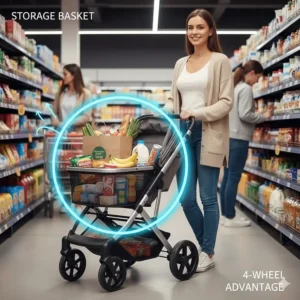
- Shopping basket access: Ensure you can reach basket without tilting pushchair
Many UK retailers (John Lewis, Mothercare equivalents) allow extended testing periods. Take advantage before committing hundreds of pounds.
Borrow from Friends First
The UK’s extensive parent networks mean someone you know likely owns the pushchair type you’re considering. Borrow for a week, testing on your actual walking routes:
- Morning nursery run
- Weekend park visit
- Shopping centre trip
- Rough terrain path
This real-world testing reveals issues showroom trials miss – like whether your toddler actually stays comfortable for a full hour, or if your partner finds the handlebar height comfortable.
Consider Total System Cost
Pushchair pricing often excludes essential accessories:
Additional Costs to Budget:
- Carrycot (£150-£250 for premium brands)
- Car seat adapters (£30-£60)
- Raincover (£25-£50 if not included)
- Footmuff (£40-£80)
- Cup holder (£15-£25)
- Parasol/sunshade (£30-£50)
The Ickle Bubba Venus Prime includes newborn cocoon and raincover, representing £100+ value versus competitors requiring separate purchases. Factor complete system pricing into comparisons.
Prioritise Your Top Three Requirements
Every pushchair compromises something. Identify your non-negotiable needs:
Example Priority Set A (Urban Professional):
- Fits folded under desk at office (compact)
- One-hand fold for bus boarding
- Lightweight enough to carry up flat stairs → Solution: Cosatto Woosh 3 or similar 4-wheel lightweight
Example Priority Set B (Countryside Runner):
- Suitable for jogging 3-5 miles
- Handles woodland paths and fields
- Comfortable for baby at speed → Solution: Out’n’About Nipper V5 or UPPAbaby Ridge
Forcing yourself to rank priorities clarifies which wheel configuration suits your lifestyle better.
FAQ
❓ Can you use a 3-wheel pushchair on pavements and in shops?
❓ Are 4-wheel pushchairs safer than 3-wheel models?
❓ Which pushchair type is better for jogging?
❓ Do 3-wheel pushchairs tip over more easily?
❓ What's the best pushchair for public transport in the UK?
Conclusion: Your Perfect Pushchair Awaits
The 3 wheel vs 4 wheel pushchair decision ultimately reflects your family’s unique lifestyle rather than one configuration being universally superior. After evaluating seven top models available on Amazon.co.uk and analysing thousands of UK parent reviews, clear patterns emerge.
Active families who prioritise outdoor adventures, jogging capability, and all-terrain performance will find 3-wheel designs like the Ickle Bubba Venus Prime (£239-£319) or Out’n’About Nipper V5 (£377.95) transformative. That single front wheel’s 360° pivot, combined with large pneumatic tyres and robust suspension, conquers British countryside terrain effortlessly.
Conversely, urban dwellers managing public transport, shopping centres, and smooth pavements benefit enormously from 4-wheel stability and compactness. The Cosatto Woosh 3 (£175) represents outstanding value for city families, whilst the iCandy Peach 7 (£780+) offers premium British luxury for those able to invest.
Remember that wheel configuration is just one factor amongst many. Build quality, warranty support, accessories included, and genuine comfort for your child matter equally. Visit retailers, test multiple models on your actual walking surfaces, and don’t rush this decision – you’ll use this pushchair thousands of times over several years.
The UK market offers exceptional choice across all price points and wheel configurations. Whether you’re navigating Hampstead Heath or Edinburgh’s Royal Mile, there’s a perfectly suited pushchair waiting for you and your little one.
Recommended for You
- 7 Best Holiday Stroller 2026: Expert UK Guide & Reviews
- 7 Best Pushchair for Toddler and Newborn UK 2026
- 7 Best Pushchair for London Public Transport | 2026 Expert Guide
Disclaimer: This article contains affiliate links. If you purchase products through these links, we may earn a small commission at no additional cost to you. Prices shown are approximate and may vary.
✨ Found this helpful? Share it with your mates! 💬🤗
